The Body That Wears Our Identity

Prepared by the ArchUp Research Team.
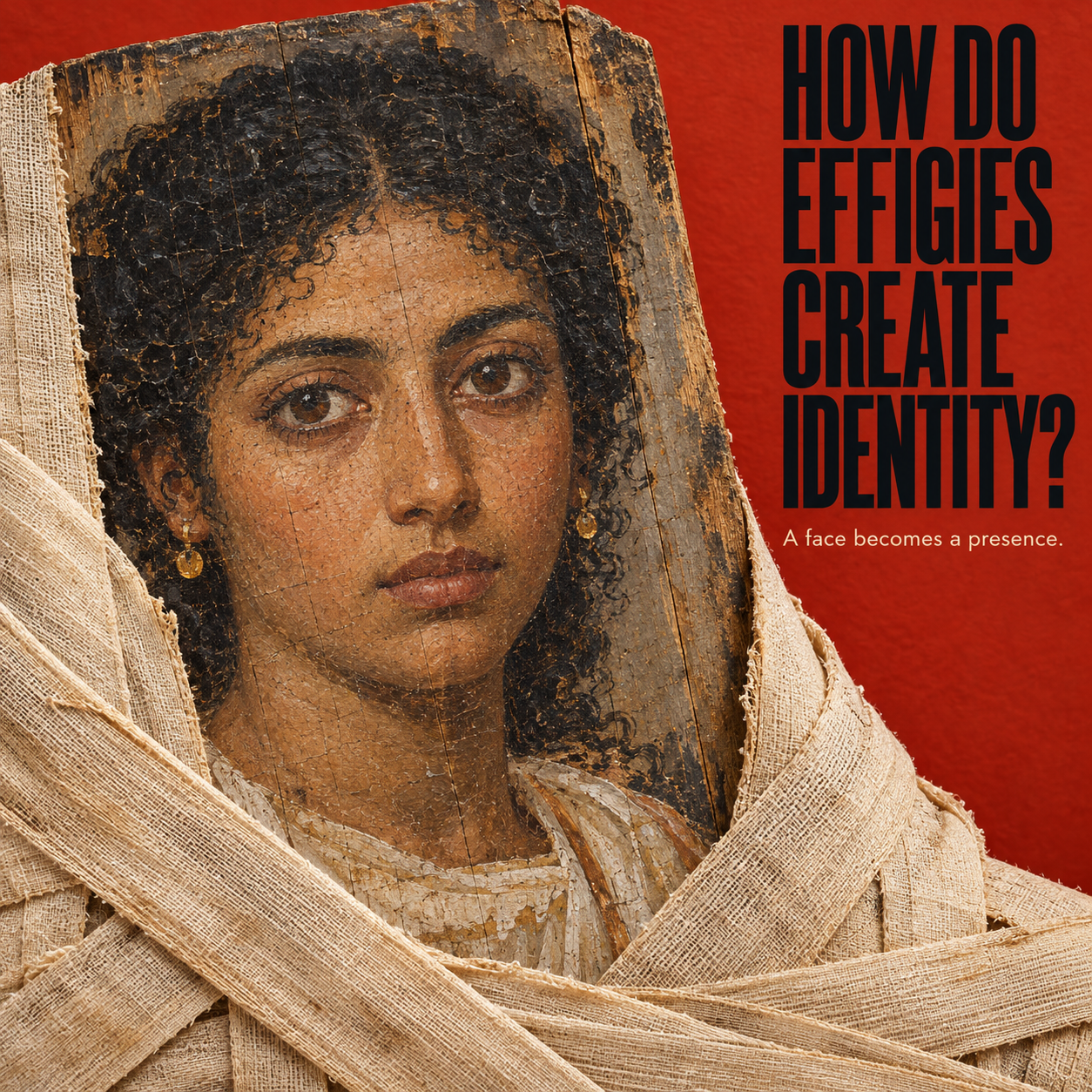
The face in the cover looks outward from a weathered panel. An earring, a necklace and a pale garment distinguish the figure, while loose fabric surrounds the painted surface. A red background and a typographic question frame this as an editorial composition. These visible elements can be described; the image alone cannot establish the identity, date or provenance of a historical sitter. Here it illustrates how a face, clothing and a designed setting can work together to propose a presence.
This is where a discussion of design and identity can begin. A garment does not arrive in a neutral world, and the body used to show it is not an empty support. A jacket gains one meaning on a moving person, another on a shop mannequin and another in a museum case. The material may remain similar while its relationship to work, memory, aspiration or belonging changes. Design participates in that change through choices about what is shown, who appears to inhabit it and how the encounter is organised.
The research behind this essay concerns effigies and embodied representation. Its most useful question for contemporary design is how a material form comes to stand for somebody. That question connects clothing, display figures, uniforms, exhibition interiors and visual identity. It also establishes a limit. A designed appearance can invite recognition, but it cannot exhaust a person's identity or prove what somebody believes. The person wearing a garment retains a life, an interpretation and a capacity to refuse that the display figure does not possess.
What an effigy contributes to a design discussion
An effigy is a material representation that can stand for a person or social presence. Its effectiveness may depend on much more than a recognisable face. Jakub Stejskal distinguishes substitution through portrayal from substitution that works through a more generic figurative form [1]. This distinction is useful because it separates physical resemblance from the conventions that make an object count as a representative. A figure may stand for a role without reproducing an individual's appearance.
That does not make every mannequin a ritual effigy. Their uses, institutions and histories differ. The connection developed here is an analytical comparison: both allow a designed body to carry associations supplied by objects, surroundings and viewers. A retailer may use a figure to propose an imagined wearer. An exhibition may use one to make a historical garment spatially intelligible. Neither operation can be understood completely by inspecting the isolated torso alone.
This essay draws on a supplied research overview and checks selected bibliographic records and abstracts against publisher and university sources. It does not claim a full independent reading of every original study. The historical and archaeological findings are identified separately from our design interpretations. The proposals for garments, shops and exhibitions are applications to be tested in their own settings, not consumer research results established by the cited papers. No sales effect, psychological response or environmental saving is assumed to have been measured.
Clothing gives a figure a social address
Clothing can make a body legible within a setting. A cut, fastening, material or arrangement of layers can indicate an intended activity. Accessories may suggest a professional role or ceremonial occasion. These meanings depend on learned conventions, personal experience and context. They can also be misunderstood. The same garment may be ordinary to one audience and unfamiliar to another, so a designer should distinguish an intended association from an interpretation that has actually been established.
A helpful design brief therefore asks what relationship the garment is meant to support. Is it intended to identify a member of staff, allow a wearer to express an affiliation, explain a historical practice or present a collection's formal language? These purposes overlap, but their tests differ. Recognition across a lobby is one task. Comfort during a working day is another. A symbolic reference that photographs well cannot answer whether the wearer can sit, reach, carry objects or move between different thermal conditions.
Consider a hypothetical jacket displayed on a rigid figure. Its silhouette appears precise because the shoulders remain still and the arms never bend. Place the same design on a person who works at a counter, and new questions emerge about sleeve movement, pockets and the interaction with furniture. This example does not establish that a particular jacket fails. It shows why a designed identity needs to be examined through the activities of its wearer as well as through the coherence of its appearance.
The royal figure and the setting that sustained it
Catriona Murray's study of Anna of Denmark's funeral in 1619 examines a wooden effigy displayed above the coffin and the layered meanings produced through the funeral sequence. Her account relates the sculpted figure to dynastic, maternal and transnational identities, and to meanings that weakened after the ceremonies ended [2]. The important point for this discussion is the dependence of representation on an organised setting and repeated acts of recognition.
The contemporary design implication is that identity requires more than a finished object. A uniform needs a situation in which its role is understood. A ceremonial garment needs an account of the occasion and the people authorised to use it. A museum figure needs interpretation that explains why it is present. Moving the object into another room, removing an associated item or changing its label may alter what viewers take it to represent, even if its material construction remains unchanged.
This is an argument for coordinating disciplines. A fashion designer, curator, interior designer and graphic designer can each produce competent work while the combined presentation remains incoherent. The garment might suggest one period, the pose another, and the label a role that the display does not explain. A shared account of the person, activity or idea being represented provides a basis for resolving those differences. Coordination begins with the meaning of the ensemble, before it becomes a discussion about matching colours.
The mannequin is already a design decision
A mannequin makes the support itself available for design. Its proportions and range of gestures are selected before clothing is added. Choosing such a form is a decision about which bodily conditions the display will make available for inspection. A garment fitted tightly around one torso demonstrates its appearance on that torso. It cannot by itself show how the garment accommodates other dimensions, seated movement, an assistive device or different ways of dressing.
There is no single display body that can communicate every possible use. The practical response is to define the purpose of the representation and supplement what it cannot show. A shop may combine figures, garment measurements and images of actual wear. An exhibition may explain why a support was selected and which elements are reconstructed. A product presentation may include movement and adjustment rather than rely entirely on a static frontal view. These are proposed strategies, not a claim that every project needs the same set of media.
The body itself also has a visual language. A face can individualise a display, while a blank head can redirect attention toward form or clothing. A missing head does not automatically make a figure neutral. Proportions, stance and grouping still establish a particular proposal about the wearer. The designer's task is to make that proposal deliberate and assess its implications, including the difference between an artistic abstraction and an assertion about the people a collection is meant to serve.
Space decides how a figure is encountered
Javier Rodríguez-Corral's study of warrior statues associated with the Castro culture of northwestern Iberia examines how material images participate in social meaning and identity within their settings [3]. Its relevance here lies in the relationship between a figure and the encounter it helps organise. This historical case does not establish a direct lineage from ancient sculpture to contemporary shop windows. It offers a way to ask what placement contributes to representation.
In an interior, the same figure can be encountered as a distant silhouette, an obstacle, a focal point or an object available for close inspection. A plinth changes its relationship to the viewer's eye level. Lighting can emphasise fabric texture or reduce the figure to an outline. A mirror can reveal a back or multiply an image. A route can allow visitors to approach from several directions or restrict them to a single frontal view. These are spatial choices with interpretive effects that should be reviewed in the actual installation.
For the architect, this makes display part of the room's programme. The layout should account for viewing, passing, maintenance and the movement of garments or figures. A dramatic grouping may be unsuitable if it blocks the route required for ordinary use. A carefully lit silhouette may conceal information that visitors came to inspect. The question is how the installation serves its stated purpose across the life of the space, including the people who clean it, change it and work around it.
Identity can be shared without becoming identical
Fisher and Loren's introduction to embodied identity in archaeology places appearance, representation and the experience of bodies within social contexts [4]. It encourages attention to the multiple relations through which a person is understood. For design, this is a useful caution against treating a complete identity as something contained in a pattern, silhouette or accessory. A visual element can contribute to belonging without supplying a full explanation of its wearer.
Research by Cornelison, Lackey-Cornelison and Goldstein on Wisconsin effigy mound communities distinguishes evidence of broad shared identity from more local variation [5]. It concerns particular archaeological and mortuary contexts, not clothing brands. Our design interpretation is narrower: shared form and meaningful difference can coexist. A system of visual identity need not require every person, place or occasion to produce the same appearance.
A uniform programme, for example, can establish recognisable common elements while considering different activities and preferences. A consistent colour relationship might coexist with choices of fit, sleeve length or layering where the role permits them. A cultural exhibition can show variation within a tradition rather than appoint one outfit as its permanent representative. The practical challenge is to identify what truly needs consistency and where variation supports the people concerned. This cannot be settled by an image board without their participation.
Cultural identity needs people as well as motifs
A motif can be detached from the knowledge that gives it significance. Once it becomes a repeatable surface, its origin may disappear behind the language of inspiration. A responsible design process asks whose practice is being referenced, what is known about its use and who should participate in interpreting it. These are questions for the commission and its research, rather than assumptions that can be resolved by visual resemblance or a broad geographic label.
The distinction between a historical object, a reconstruction and a contemporary interpretation should remain explicit. An exhibition can state that a garment was produced for the display, identify the evidence informing it and acknowledge uncertain details. A designer can describe a contemporary adaptation without presenting it as the definitive dress of a community. Clear language makes room for both creative work and disagreement, while reducing the risk that an attractive image becomes a misleading historical claim.
Naming also matters. A label that describes people only through a costume can conceal occupation, authorship, change and ordinary life. The designer can counter that reduction by including the makers' and wearers' accounts where these are available and authorised. When those voices are absent, the gap should be acknowledged. A coherent visual identity is not sufficient evidence that the people represented accept it, and the possibility of changing the presentation should remain part of the design process.
A uniform must survive the working day
The uniform is a particularly clear meeting point between clothing and interior architecture. It helps an organisation become visible through the people who work in its spaces. Those people also sit at desks, handle tools, move through doors and perform tasks that cannot be inferred from a formal portrait. A programme developed only around the reception photograph can overlook the conditions under which its appearance must be maintained.
A useful review brings the proposed garment into representative activities and spaces. The wearer can assess movement, access to pockets, layering and the practical demands of care. The interior team can examine how counters, storage and changing facilities support the intended use. The organisation can decide how staff roles need to be recognised without making untested assumptions about status or trust. Any claimed improvement should follow observation and feedback rather than be written into the brief as an accomplished fact.
The same approach helps distinguish identity from unnecessary restriction. Some consistency may be central to the role, while other details may simply reflect an inherited preference. Giving wearers a meaningful way to explain problems can reveal which is which. The resulting design may remain visually disciplined while becoming more workable. Its success should be judged through both public recognition and the experience of the people asked to sustain that recognition throughout the day.
Display has an afterlife
A figure can move from a public setting into storage, be repaired, redressed or reused. Each transition changes its relationships. The research on effigies makes that biography relevant to interpretation; a practical design response is to plan for change from the start. What is removable? Which parts can be adjusted? What information accompanies the object when it leaves the gallery or shop floor? Who decides when its representation no longer fits the project?
For a temporary installation, these questions connect meaning to procurement. A durable support that can be adapted may offer a different maintenance path from a form made for one pose and one collection. But durability alone does not prove a lower environmental impact. Materials, production, transport, repair and the number of actual reuses would need to be considered in a defined comparison. The responsible claim is about the decisions documented, rather than an unmeasured declaration that a display is sustainable.
Garments also acquire histories through alteration, use and care. An exhibition may choose to make those histories visible rather than present every object as untouched. A commercial display has a different purpose, but can still avoid confusing an ideal presentation with a guarantee about every wearer's experience. In both cases, the designer works with time as well as surface. An identity that requires continuous replacement or concealment of ordinary wear has operational consequences that belong in the discussion.
The digital body needs the same scrutiny
An avatar or generated model offers another body through which clothing and identity can be presented. Digital tools can make it easier to propose variations in pose, composition and setting. Their images still require an account of what they represent. A plausible fold does not establish the behaviour of a fabric. An apparently natural fit does not verify the garment's pattern, construction or suitability for the person who might buy or wear it.
Separate the purposes of the image. An expressive illustration can be identified as such. A simulation used to support a technical claim needs a relevant method and validation. A photograph of actual wear has its own limits of viewpoint, styling and selection. These distinctions help teams decide what must be checked before publication. They also help prevent a hypothetical wearer from becoming the only visible account of the people for whom the design is intended.
There is a further risk of flattening variation. If a team repeatedly chooses the same polished body and pose because the output is convenient, the convenience can become an unstated design norm. This is a potential failure to examine, not a measured outcome asserted by the historical studies. A practical review asks which bodies are shown, which activities are missing and whether the presentation offers enough information to support the decision expected of its audience.
A practical brief for a clothing exhibition
Consider a hypothetical exhibition about everyday workwear. An initial proposal uses identical figures, a dramatic line of light and a title about collective identity. The arrangement is visually coherent, but it leaves the subject imprecise. Does it explain the work, the development of the garments, the institutions that commissioned them or the experiences of the people who wore them? Each question requires different evidence, and no mannequin can supply missing testimony.
A revised brief might choose to examine how garments respond to specific tasks. It could present a documented garment alongside a clearly identified display support, an account of its use and images that show relevant movement where permissions allow. Variations could be explained rather than treated as visual noise. The spatial sequence could allow both close inspection and passage. Uncertain dates, reconstructions and contemporary additions would be labelled consistently, so that the installation remains understandable when photographed in fragments.
Before opening, a review could ask visitors what they believe the display shows, which elements they take to be original and whose experience they think is represented. The team would also inspect access, label readability and maintenance. These checks would not prove that the exhibition captures an entire community. They would reveal whether its limited, stated argument is being communicated as intended. The result would be a display that can account for its choices and respond to evidence of misunderstanding.
Designing a relationship rather than a finished person
Return to the face, garment and framing of the cover. Their combination proposes a presence, but it does not tell us how every viewer interprets that presence. The same distinction matters in an exhibition or a shop: representation begins with choices about the body and continues through clothing, the room, the label, the viewing position and the encounter with a person who brings an interpretation of their own.
Clothing and display design gain depth when identity is treated as a relationship that can be negotiated and revised. The task is to make an intended role or affiliation understandable while leaving room for the lives that exceed it. A well designed figure may help a garment speak, and a well designed room may help its story become accessible. The decisive test is whether that arrangement enables people to recognise, question and inhabit the identity being proposed, rather than asking them to disappear inside its image.
Cover: An editorial composition combining a painted portrait, fabric and typography. It illustrates the relationship between design and identity and is not used as evidence of a specific archaeological object or of the hypothetical exhibition discussed here.
Sources
- Stejskal, J. Substitution by Image: The Very Idea. The Journal of Aesthetics and Art Criticism, 2019, 77(1), 55–66. DOI: 10.1111/jaac.12611.
- Murray, C. The queen’s two bodies: monumental sculpture at the funeral of Anna of Denmark, 1619. Sculpture Journal, 2020, 29(1). DOI: 10.3828/sj.2020.29.1.3.
- Rodríguez-Corral, J. The Empowerment of Imagery: Stone Warriors in the Borders. Cambridge Archaeological Journal, 2013, 23(2), 283–306. DOI: 10.1017/S0959774313000280.
- Fisher, G., and Loren, D. D. Introduction. Special section: Embodying Identity in Archaeology. Cambridge Archaeological Journal, 2003, 13(2), 225–230. DOI: 10.1017/S0959774303210143.
- Cornelison, J. B., Lackey-Cornelison, W., and Goldstein, L. Contextual and Biological Markers of Community Identity in the Effigy Mound Manifestation of Southern Wisconsin. Archeological Papers of the American Anthropological Association, 2017, 28(1), 66–81. DOI: 10.1111/apaa.12089.