The Consulting Pyramid Is Collapsing From the Bottom Up

Advancements in technology and artificial intelligence have collapsed the distance to information, undermining authority based solely on status. In professional services like consulting and architecture, AI automates entry-level data gathering and analysis, effectively dissolving the traditional pyramid hierarchy that relied on a large base of junior workers.
As AI assumes foundational tasks, the structural model transforms into a narrow, machine-supported stem topped by specialized experts. However, removing entry-level roles eliminates the traditional apprenticeship needed to cultivate future expertise, leaving industries with fewer experts and no clear pathway to train new ones.
A note before the story begins. What follows opens with an account I heard in a lecture hall, told with great confidence by a man of standing, and I have not been able to verify its historical or biological particulars. I repeat it not as fact but as a scene, because the point of the piece is precisely what happens to a story when the cost of checking it falls to nothing.
I was sitting in a session with a professor of economics, a man clearly enjoying himself, defending an idea the way I catch myself defending my love of building and of writing about it. He was telling us about a concept the old jurists called the sleeping pregnancy. A widow, he said, some centuries ago, was found to be with child long after her husband had died and long after the waiting period the faith prescribes for the purity of lineage had passed. A judge investigated, found the woman honorable and rarely leaving her home, and reasoned that there existed a biological phenomenon, a dormancy, in which the seed of life could rest suspended and complete itself much later, so that no shadow fell on her name. The professor told it with the warmth of a man defending something dear to him, and the room received it as wisdom, because his standing was itself part of the evidence.
While he spoke, I did something the room a thousand years ago could not have done, and something even the students of my own youth could not have done quickly. I looked it up. Within a minute I understood that the biology does not hold for us, that such a suspension belongs to certain reptiles and not to the human body, and that the story, however tender, was a comfort rather than a fact. I did not interrupt him. I had no wish to win a small point against a generous man. But something had shifted under my chair, and I have been thinking about it ever since, because the important thing was not that he was wrong. The important thing was that his authority had once been the answer, and now it was merely a claim, sitting exactly level with a search I could run from my seat. The reliance had moved. It had left the man and gone into the network.
That word, reliance, is the whole matter. For most of human history we relied on the person who knew, because reaching the knowledge ourselves was expensive, slow, and often impossible. The scholar, the physician, the master builder, the consultant, each sold the same underlying thing beneath their various titles, which was privileged access to an answer the rest of us could not easily reach. We were not paying for the answer alone. We were paying for the distance between us and it. And when that distance collapses, as it has collapsed in my lifetime and violently in the last few years, everything built on the old distance begins to lean.
The Shape of the House of Expertise
I come to this from architecture, and so I cannot help but see the consulting firm as a structure, a thing with load paths and a shape. For a century the shape was a pyramid, and it was an honest pyramid, engineered like any good building to carry weight down to a broad and stable base. At the apex stood the partner, and beneath the partner the directors, and beneath them the managers, and beneath them the senior consultants, and at the wide foundation, holding the entire mass, the analysts and the juniors and the researchers.
That base was not decoration. It was the structural footing of the economic model. The juniors gathered the data, built the spreadsheets, assembled the benchmarks, ran the market research, drew the comparisons, formatted the presentations that carried the firm’s authority into the client’s boardroom. Each layer above them reviewed, distilled, and compressed, and by the time the work reached the partner it had been squeezed into a single confident judgment delivered to the client’s face. The pyramid was expensive precisely because it was wide at the bottom. You were paying for an army of careful people converting raw information into refined counsel, floor by floor, and the price reflected the size of the crowd doing the lifting.
Artificial intelligence does not strike this structure at its apex, and this is the point almost everyone misses when they imagine the machine coming for the boss first. It strikes at the base and the middle, at exactly the layers on which the whole construction rested. The work of the researcher, the analyst, the junior who spent a year learning to make a clean spreadsheet, is the first work the machine does well, tirelessly, and without the small human failures that used to require a second human to catch. So the wide foundation of the pyramid begins to dissolve, and the shape it leaves behind is no longer a pyramid at all.
From the Pyramid to the Wine Glass
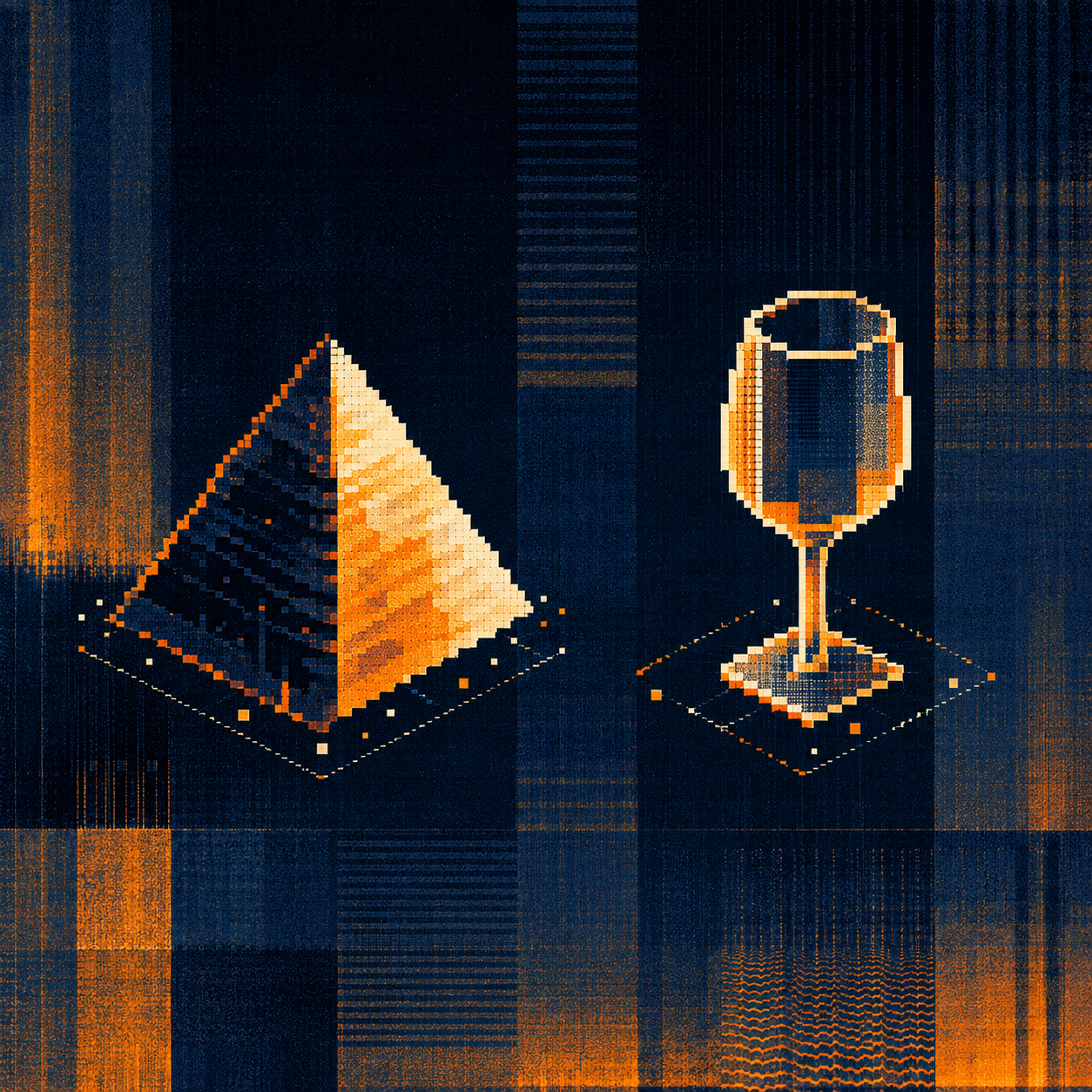
Watch what the structure becomes as the base thins. A few names have been offered for the new silhouette, and each one carries a different diagnosis. Some call it a wine glass, which is generous and hopeful, a small base of data and people, a slender stem of automation, and at the top a bowl that opens out again to hold judgment and specialists and the people who decide. Others, more cautious, call it an hourglass, narrowing sharply at the middle where the analytical layers used to transmit and refine, still human at both ends but pinched cruelly in between. And in the most severe reading it becomes something close to an inverted pyramid, or a diamond balanced on its point, a small human crown resting on an enormous machine.
The name I would use is less important than the direction of the collapse, which is upward from below. The old order stacked from the top down. The partner’s judgment sat on the manager’s synthesis, which sat on the analyst’s data, and the client bought the top of the stack. The new order rearranges that same material into a thin vertical thing, a narrow column of a very few genuinely expert people standing above a vast layer of automated capacity, which stands in turn on the live data at the bottom. It is barely a human pyramid anymore. It is a slender mast rising out of a machine.
And here the inversion becomes almost unbearable to say plainly, so let me say it plainly. There was a time when the human being reviewed the machine, when a person checked the arithmetic of the calculator. We have crossed into the time when the machine reviews the human. In the careful work of data, in the catching of the dropped digit and the forgotten figure and the small fatigue that no honest person is free of, the reliable reviewer is now the agent, and the thing being reviewed is us. The stem of the wine glass does not merely support the bowl. It corrects the base. This is not a comfortable sentence for anyone who built a career on being the careful one, and I include the world I know, where an editor once sat above a writer as the final eye, in the discomfort.
The Architect’s Table
Because I want this to be honest rather than abstract, let me bring it to a table I have actually sat at, the table where a hotel gets designed. Around the design of a single hotel you will find an astonishing procession of consultants, each arriving with a report and an invoice. The hotel consultant, the operator, the financial consultant, the feasibility consultant, the cost consultant, the food and beverage consultant, the lighting consultant, the acoustic consultant, the traffic consultant, the sustainability consultant, the project manager, each of them a specialist, each of them expensive, each of them holding a piece of the answer.
And then one of them says the sentence that decides the projects fate. The market here will not carry a five star property. The recommendation is four star. Ten years ago, to test that single sentence, you needed his data, his methodology, his time, and his years, and you did not have them, so you paid for his authority and you trusted the shape of his confidence, exactly as the room trusted the professor telling the story of the sleeping pregnancy. His standing was part of the evidence.
Now put the same sentence in front of a project team that can feed a machine the average daily rate, the revenue per available room, the occupancy curves, the development pipeline, the tourism figures, the competitor set, the land costs, the capital expenditure, the operating assumptions, and can run dozens of scenarios in an afternoon. What survives of the consultant’s value? The honest answer is that a great deal can survive, but not the part he thought he was selling. So we do not say the consultant is finished. We turn to him and we ask a harder set of questions, and the questions are the most important thing in this entire piece. Do you own the data, or did you merely fetch it? Do you carry knowledge that lives nowhere in the data, in your body and your scars and the deals you have watched go wrong? Will you put your name on the recommendation and bear its consequences? Can you sit across from the operator and negotiate? Do you know something the team simply cannot reach? Or do you gather what is already available and arrange it neatly in a slide deck? Only the last man has a real problem, and his problem is that the machine arranges slides better than he does and never asks for a fee.
The Missing Base and the Vanishing Partner
Now I arrive at the paradox that I find more serious than anything else, the one that keeps me from celebrating the wine glass as pure progress. If the base of the pyramid disappears, where does the partner of the future come from?
The junior who built spreadsheets for fifteen years was not only a cost to be optimized away. He was a partner in slow gestation. Those years of assembling data and being corrected and watching the senior people reason were the apprenticeship, the only apprenticeship the profession ever really had. The wide base of the pyramid was also its school. You climbed it by carrying weight up it, and the carrying was the education. Remove the base to save money today and you have quietly removed the training ground that produced the judgment you will need to buy at the top in twenty years. The machine can do the junior’s tasks. It cannot yet be the junior, cannot serve the invisible sentence that a career of small labors slowly writes into a person, the intuition that lets an old expert glance at a scheme and feel that something is wrong before he can say why.
This is not a problem unique to consulting, and I see it clearly in my own field, in the way we now train, or fail to train, the young. The architectural research that will matter most in the coming decade is not about the machine’s capabilities, which advance on their own and need no help from us. It is about how a profession renews its own expertise once the tasks that used to grow an expert have been automated away. We have optimized the bottom of the house and forgotten that the bottom of the house was where the next generation of the top was being built.
I think, in the end, of the professor again, still defending his tender story, unaware that the reliance had already left him. The market changed around him while he spoke, and the market does not wait for anyone to notice. If you do not change yourself, no one will change you, and no one will tell you the moment your authority stopped being evidence and started being merely a claim. The consultants and the experts and the men of standing who continue to trade on the old reliance, who still sell the distance between the client and the answer as if that distance had not collapsed, are living, without knowing it, in a house whose foundation has already been poured out.
So I do not believe the machine will kill consulting, and I do not believe it will kill the architect or the expert or the careful counsel we will always need. What it will kill is the pyramid that made all of it expensive, the broad human base that we once paid for by the head. The news will keep announcing that the professions are ending, and the competitions and the conferences will keep debating whether the machine can replace judgment, and both will miss the quieter truth, which is that the shape of the house is changing under us while we argue about the roof. The cities we build, the hotels we plan, the counsel we sell, will be made by far fewer people standing on far more machine, and the thesis I would leave on the table is the sharpest sentence I know for this moment. The machine may not kill consulting. It will kill the pyramid that made consulting expensive, and in doing so it will demand that the few who remain at the narrow top be worth incomparably more than the crowd they replaced, in a profession that has just demolished the only staircase it ever had for getting them there.
✦ ArchUp Editorial Insight
The essay’s structural insight is its correct identification of where automation strikes the professional pyramid — not at the apex, where the imagination places the machine coming for the boss, but at the base and middle, at exactly the layers on which the economic model rested, which means the pyramid does not shrink proportionally but inverts, leaving a slender human mast rising from an enormous machine. What makes this more than a labor-market observation is the second-order consequence the piece names with unusual precision: the wide base was never merely a cost to be optimized but the profession’s only apprenticeship, the school through which juniors became partners by carrying weight up the structure, so that removing the base to save capital today quietly demolishes the staircase that produced the judgment the firm will need to purchase at the top in twenty years. This is the same structural contradiction this archive traced in Between Two Films, where scarcity of judgment becomes valuable only to those who already possess it, and in Astra, Could This Make You a Maestro, where the conductor’s authority rests on a formation the agent era is eliminating — and it connects directly to what Le Client Is Not Roi exposed as the profession’s unresolved verification problem, because the reliance the essay watches migrate from the man into the network was always the thing being sold beneath every professional title: privileged access to the distance between the client and the answer. When that distance collapses, the consultant who owned only the fetching cannot survive, and the discipline is left with a governance failure it has not named as one: it has optimized away the formation layer while retaining the assumption that expertise will continue to appear at the top, as though the narrow crown could go on being replenished by a base the profession has just poured out.
Ibrahim Fawakherji — ArchUp
Sources
- Christensen CM, Wang D, van Bever D. Consulting on the Cusp of Disruption. Harvard Business Review, 2013.
- Susskind R, Susskind D. The Future of the Professions: How Technology Will Transform the Work of Human Experts. Oxford University Press.
- NACTO and industry commentary on automation and professional-service labor structures.
- Firm workforce-pyramid and leverage-model literature in professional-services economics.
- Reporting and analysis on generative AI adoption in management consulting and audit, 2024 to 2026.