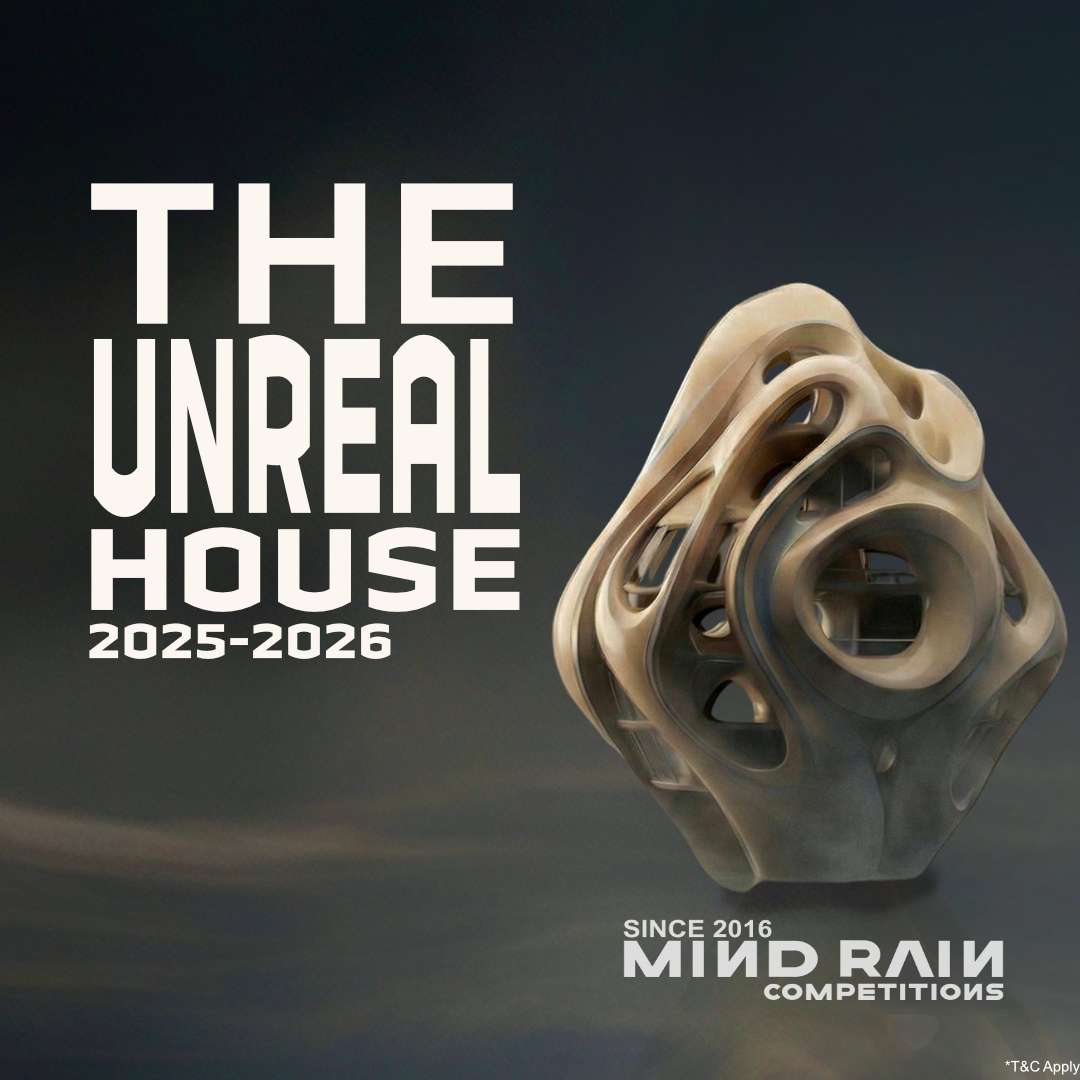
The Unreal House — Edition 06: Mind Rain Architecture Competition 2025–2026

Competition Brief
The Unreal House is an annual imaginary home design challenge organized by Mind Rain, an India-based architecture competition platform that has been running student-focused design competitions since 2016. Now in its sixth edition (2025–2026), the competition invites architecture and design students to imagine and design a home beyond the limits of reality — a visionary dwelling for a fictional family (Mr. and Mrs. Vance and their two children) within a setting that does not need to conform to physical or material constraints of the real world. The competition is open internationally and free to browse. Registration opened 19 February 2026 with final submission closing 30 June 2026 and results announced 1 August 2026.
The competition is structured into two parallel student categories and two participation tracks (Group A with monetary awards, and Group B without monetary awards), making it one of the more granularly structured student competition platforms currently active.
Intent
The Unreal House challenges students to think beyond conventional constraints — physics, materials, gravity, geography, and building codes — and to design a dwelling that is purely an expression of imagination, narrative, and spatial vision. The fictional Vance family provides a client framework that grounds the fantasy in human inhabitation and lived experience, requiring participants to think about domestic space, family dynamics, programmatic richness, and the relationship between the imagined and the inhabitable.
The competition is specifically aimed at students in their early and later years of architectural education, with separate prize categories recognizing different levels of academic formation. The brief encourages speculative, experimental, and visionary approaches over technically grounded or buildable proposals.
Purpose
The competition operates as a design education platform and student portfolio exercise. Participants in Group A (monetary track) are eligible for cash prizes in Indian Rupees. Participants in Group B (non-monetary track) receive participation certificates and digital recognition. All participants gain portfolio exposure through Mind Rain’s platform. The platform includes an “Earn with Us” affiliate program suggesting a community-building commercial model beyond the competition itself.
Requirements
Open to architecture and design students internationally. Participants select their track (Group A monetary or Group B non-monetary) and their entry type (Solo — 1 member, or Group — up to 3 members) and their applicant type (Indian or International). Submissions are made through the Mind Rain platform after registration. Full brief and Terms and Conditions are available for download from mindrain.org. Group discounts for institutions of 30 or more participants available by emailing support@mindrain.org from an official university email.
Jury
Individual jury member names and the jury panel composition are not publicly listed on the competition page at the time of writing.
- Jury panel: Not publicly disclosed on the competition page. Contact Mind Rain at support@mindrain.org for jury information.
Registration Fees
| Period | Dates | Indian (Solo) | International (Solo) | Track |
|---|---|---|---|---|
| Early Bird | 19 Feb – 22 Mar 2026 | Lower rate (see mindrain.org) | Lower rate (see mindrain.org) | Group A or B |
| Advance | 23 Mar – 31 May 2026 | Mid rate | Mid rate | Group A or B |
| Late / Last Minute | 1 Jun – 25 Jun 2026 | ₹999 (solo, monetary track, Indian) | See mindrain.org | Group A or B |
The late registration fee for Indian solo participants on the monetary track is ₹999 (approximately $12 USD at current rates). International fees and group entry fees are listed on the mindrain.org registration page. A flat 35% student discount is available for group registrations of 30 or more participants from the same institution. Cash prizes (monetary awards) are given to Group A participants only.
Prizes and Rewards
| Category | Award | Prize (INR) | Approx. USD |
|---|---|---|---|
| Category 1 (1st and 2nd Year students) | 1st Prize | ₹11,000 | ~$130 |
| Category 1 | 2nd Prize | ₹8,000 | ~$95 |
| Category 1 | 3rd Prize | ₹6,000 | ~$71 |
| Category 2 (3rd, 4th and 5th Year students) | 1st Prize | ₹11,000 | ~$130 |
| Category 2 | 2nd Prize | ₹8,000 | ~$95 |
| Category 2 | 3rd Prize | ₹6,000 | ~$71 |
Monetary awards are available to Group A participants only. Group B participants receive digital certificates and recognition but no cash prizes. Total cash prize pool: approximately ₹50,000 (~$595 USD) across both categories and all three placement positions.
Key Dates
| Milestone | Date |
|---|---|
| Competition Opens / Early Bird Begins | 19 February 2026 |
| Early Bird Registration Ends | 22 March 2026 |
| Advance Registration Ends | 31 May 2026 |
| Late Registration Ends | 25 June 2026 |
| Final Submission Deadline | 30 June 2026 |
| Results Announced | 1 August 2026 |
✦ ArchUp Competition Review
The Unreal House is organized by Mind Rain, an India-based student architecture competition platform with documented activity since 2016 and a self-described track record as a non-sponsored, imagination-focused competition. Now in its sixth edition, the platform has a history of past winners accessible on its website. The competition brief — designing an imaginary home with no material or physical constraints for a fictional family — is one of the most creatively open briefs available in student competitions, with no site restriction, no program mandate, and no technical feasibility requirement. This makes it well-suited for early-stage students developing their spatial imagination and representational skills rather than their technical knowledge. The two-category structure (1st–2nd year students vs 3rd–5th year students) is a thoughtful recognition that architectural education produces very different practitioners at different stages, and the monetary vs non-monetary track gives cost-sensitive students the option to participate without the pressure of a competitive fee tier. The cash prizes are modest: ₹11,000 (~$130 USD) for first place in each category, with a total prize pool of approximately ₹50,000 (~$595 USD). This is honest for a student-focused low-cost platform but should be contextually understood as a symbolic recognition amount rather than a substantive financial award. The jury is not publicly disclosed on the competition page, which limits independent assessment of evaluation credibility. The late registration fee of ₹999 (~$12 USD) for Indian solo participants on the monetary track is very accessible, making this one of the lowest-cost student competition entry points available globally. International fees are not publicly listed on the competition page and require visiting the registration form to determine. For students — particularly those in India and the wider South Asia region — looking for a creatively unconstrained, low-cost portfolio exercise with peer recognition, this competition offers an accessible and imaginatively generous brief.
Final Thoughts
The Unreal House 2025–2026 Edition 06 is a student imagination competition with a fully speculative brief, a tiered student category structure, and one of the lowest entry costs available in any international architecture student competition. The final submission deadline is 30 June 2026 — meaning the current late registration period is active. Results are announced 1 August 2026.
The competition is most valuable as a creative exercise for early-stage students developing their spatial imagination beyond the constraints of real building. For practitioners seeking credentialed award recognition or significant cash prizes, the platform’s modest prize pool and undisclosed jury limit its professional weight. Download the full brief and Terms and Conditions from mindrain.org before registering.
Registration Deadline
Brought to you by the ArchUp Editorial Team
Inspiration starts here. Dive deeper into Architecture, Interior Design, Research, Cities, Design, and cutting-edge Projects on ArchUp.