Beyond the R-Value: Why Smart Walls Are No Longer About Insulation Alone

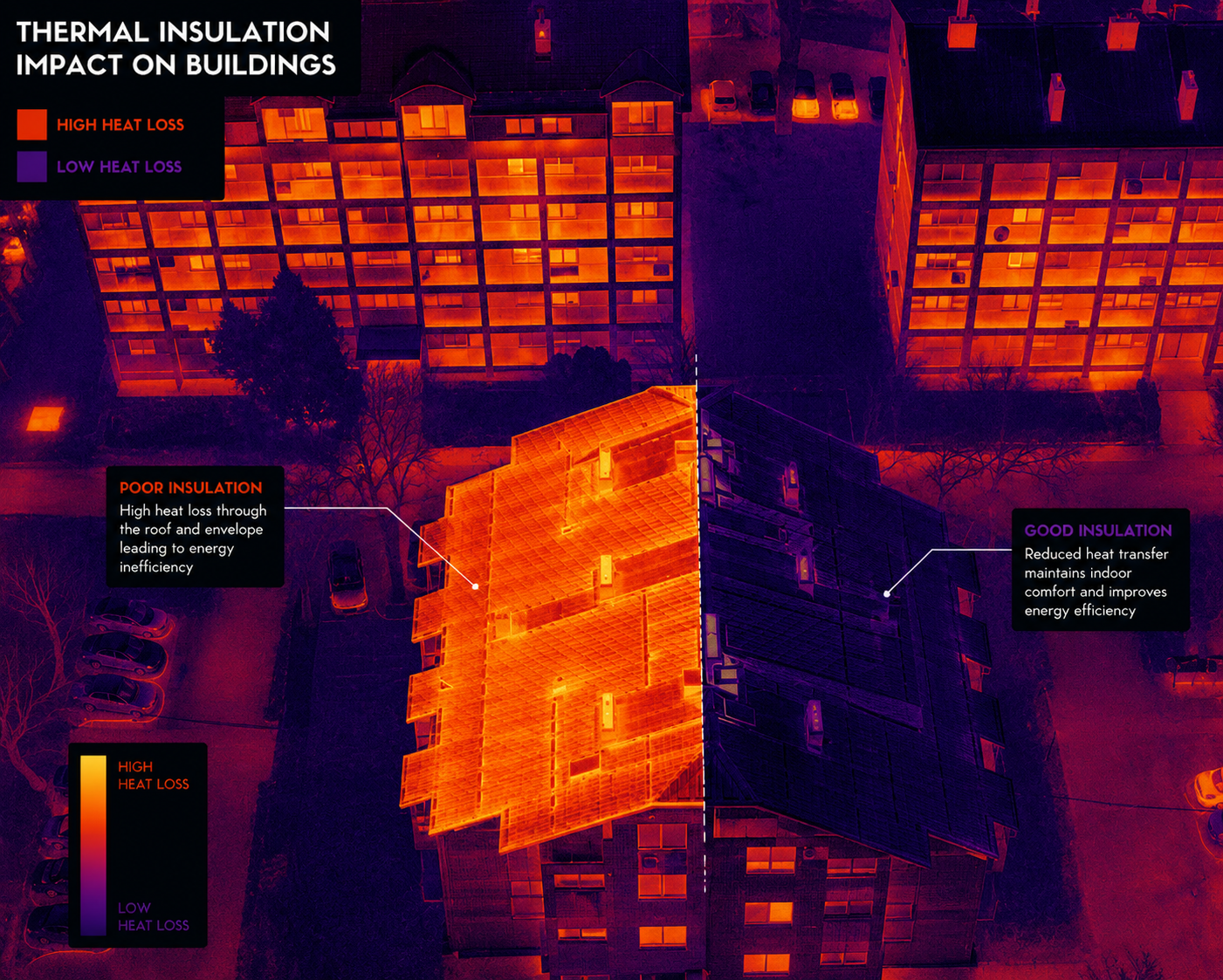
Building envelope performance can no longer be reduced to a single thermal metric. Climate zone, wall orientation, material embodied carbon, and long-term cost all shape whether an insulation strategy is genuinely effective, and optimal assemblies vary significantly across regions.
Lifecycle cost analysis and multi-criteria frameworks are replacing code-minimum thinking in professional practice. The external wall influences energy use, maintenance cycles, carbon emissions, and asset value simultaneously, making early strategic decision-making more consequential than incremental gains in thermal resistance alone.
Walk into almost any design meeting discussing building envelopes and the conversation eventually arrives at a familiar question:
“What is the R-value?”
For decades, this single number has dominated discussions around thermal performance. Higher R-values meant better insulation, lower energy bills, and supposedly better buildings.
Yet contemporary building science is increasingly revealing an uncomfortable truth: walls do far more than resist heat transfer.
A wall is not a material specification. It is an environmental system, a financial decision, a carbon investment, and, increasingly, a long-term risk management strategy.
The era of evaluating exterior walls through a single thermal metric is ending.
Today, architects, engineers, and developers are being forced to confront a more complicated question:
What makes a wall truly perform over the lifetime of a building?
Climate as the Invisible Designer
One of the most persistent misconceptions in contemporary construction is the belief that there is a universally “correct” insulation thickness.
Research consistently demonstrates the opposite.
The optimal wall assembly in Stockholm is fundamentally different from the optimal wall assembly in Riyadh, Athens, Miami, or Shanghai.
Climate is not merely a background condition. It actively shapes the economic and environmental performance of every layer within the building envelope.
Parametric studies across multiple climate zones have shown that insulation thicknesses capable of minimizing operational energy consumption may not be the same thicknesses capable of minimizing lifecycle carbon emissions.
In Mediterranean regions, for example, studies have identified optimum insulation ranges between 11 and 23 centimeters depending on wall orientation, solar exposure, and insulation material.
The implication is significant.
The question is no longer:
“How much insulation should we add?”
The better question is:
“How much insulation makes sense here?”
The Cost of Chasing Performance
Modern building envelopes have evolved far beyond traditional cavity walls.
Developers today can choose between:
- Exterior Insulation and Finish Systems (EIFS/ETICS)
- Insulated Concrete Forms (ICFs)
- Prefabricated Insulated Concrete Panels
- Advanced Composite Assemblies
- Hybrid Envelope Systems
At first glance, comparing these solutions appears straightforward.
However, the lowest installation cost rarely produces the lowest lifecycle cost.
This reality has shifted professional practice toward Life Cycle Cost Analysis (LCCA), a methodology that evaluates performance over periods ranging from 30 to 50 years.
What often emerges from these analyses is a phenomenon economists know well but designers frequently overlook:
The law of diminishing returns.
Beyond a certain point, every additional centimeter of insulation produces progressively smaller energy savings while construction costs continue to rise.
In other words, more insulation does not automatically mean a better investment.
Energy Savings Versus Carbon Reality
The sustainability conversation has also become more nuanced.
Historically, operational energy dominated environmental assessments.
Today, embodied carbon and embodied energy are becoming equally important.
Every insulation product requires energy to manufacture, transport, install, and eventually replace.
This means an insulation system can reduce operational energy consumption while simultaneously carrying a significant environmental burden from its production process.
The most advanced studies therefore evaluate two parallel performance tracks:
- Operational performance throughout the building’s life.
- Environmental impacts associated with manufacturing and construction.
The best-performing wall is increasingly defined not by energy savings alone but by its balance between operational efficiency and embodied environmental cost.
The Rise of Multi-Criteria Decision Making
The future of wall design lies in integration.
Leading researchers are moving toward multi-criteria assessment frameworks that simultaneously evaluate:
- Thermal performance
- Lifecycle cost
- Carbon emissions
- Durability
- Climate responsiveness
- Construction complexity
- Maintenance requirements
This shift reflects a broader evolution within architecture itself.
Buildings are no longer judged solely by how they perform on opening day.
They are evaluated by how they perform over decades.
Perspective
For many projects, insulation selection still occurs late in the design process and is often driven by code compliance rather than strategic thinking.
This may be one of the most expensive mistakes in contemporary construction.
The external wall is not simply a technical detail. It is one of the few building systems that simultaneously influences energy consumption, operating costs, maintenance cycles, carbon emissions, occupant comfort, and asset value.
The next generation of high-performance buildings will not be defined by thicker walls.
They will be defined by smarter decisions.
The future belongs to designers who understand that thermal resistance is only one variable in a much larger equation.
✦ ArchUp Editorial Insight
The reduction of building envelope performance to a single metric—the R-value—is a clinical symptom of architectural fiduciary failure. Data layering reveals that evaluating insulation strictly by thermal resistance ignores a multi-criteria reality: climate zone variations, wall orientation, embodied carbon, and long-term lifecycle costs dictate the true efficiency of a structure. This systemic pressure generates an institutional decision framework where “Smart Walls” are no longer just passive thermal barriers, but strategic assets that directly influence operational expenditure and asset valuation.
Consequently, the architectural outcome is the rejection of code-minimum compliance in favor of comprehensive lifecycle cost analysis. In 2026 cities, the built enclosure is engineered as an active mechanism, where material specifications must justify their carbon footprint and financial return on investment over decades. The role of the architect transitions from selecting products off a shelf to performing an economic and environmental audit of the envelope, finalizing the evolution of design from aesthetic packaging into the rigorous management of physical and financial risk.