

595 West Georgia Street and Vancouver’s Urban Vertical Shift

Urban Context and Project Height
Vancouver has a clearly defined urban fabric shaped between the mountains and the water, giving the city a powerful natural framework that strongly influences its urban formation. Despite this strong context, the city skyline has long remained relatively conservative in character. Within this framework, 595 West Georgia Street was proposed as a case study for a supertall tower rising to 1,033 feet, placing it above the minimum threshold for classification as a supertall buildings. The project is also part of a larger development comprising three buildings, while this tower represents the tallest and most prominent element within the ensemble.
Biological Reference in Design
The architectural composition draws on a reference derived from glass sponges (Hexactinellids) found along the coasts of British Columbia. These organisms are characterized by a structure that combines porosity with structural rigidity, which has been translated into an overarching design concept for the building. Consequently, the influence is not limited to visual form alone but extends to the way the relationship between space and structure is conceived, through interpreting natural properties and re-translating them architecturally.

Structural System and Façade Impact
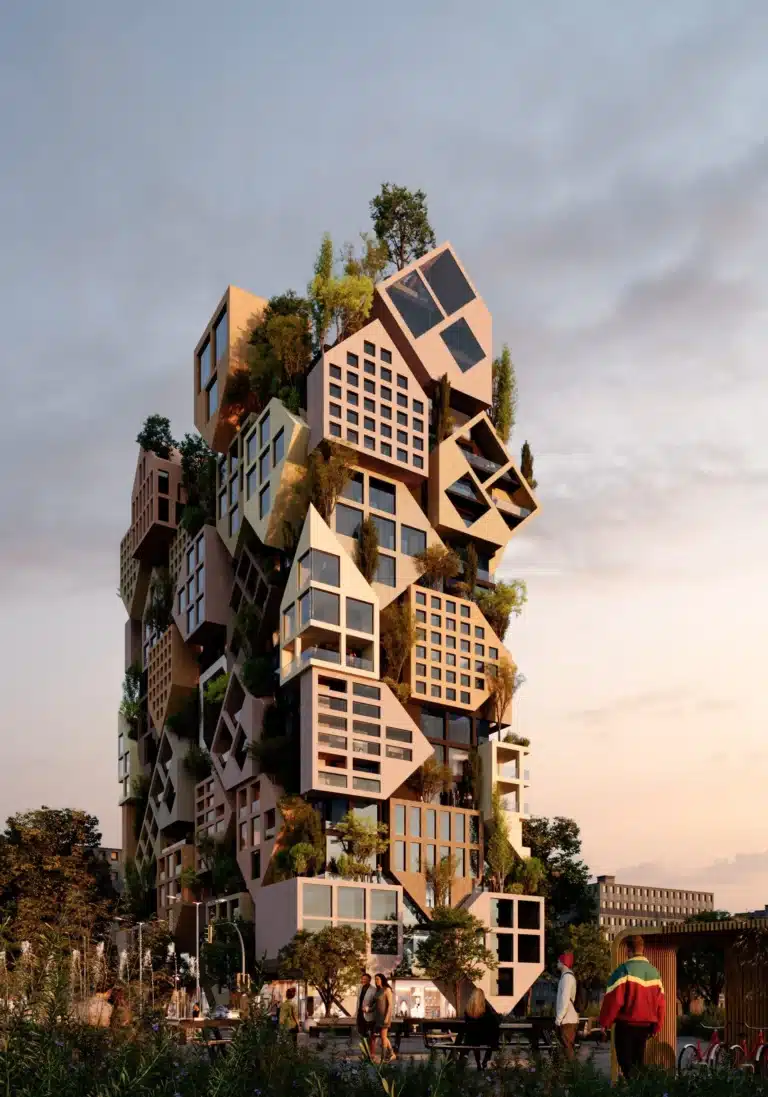
The building consists of an external steel structure clad with panels of white glass fiber reinforced polymer, with extensive use of glass across the façades. This structural system allows for a reduction in internal load-bearing elements, enabling more open floor plates and less compartmentalized spaces. As a result, the façade does not read as a uniform surface, but rather as a lattice-like structure that generates variations in shadow and visual depth. The perception of the mass also shifts with viewing angle and time of day, giving the building a dynamic visual character compared to conventional glass towers.
Local Specificity and Conceptual Reference
The design concept is framed as an attempt to connect the building to its geographical and environmental context in British Columbia. Within this framework, the specificity of the local reference emerges as a core element of the conceptual formation, particularly through the abstraction of both form and structure from glass sponges found in coastal waters. As a result, the building achieves conceptual coherence that ties it directly to its place, rather than being a design that could be relocated to other cities without losing its meaning.

Programmatic Function and Urban Relationship
The project’s functional program includes hotel uses, alongside conference facilities and a restaurant on the upper floor, in addition to a public observation deck at the summit. This distribution alters the nature of the relationship between the building and the city, as public access is granted to parts of the tower despite its primary identity as a hotel tower. Consequently, the functional role is not limited to private use, but extends into a form of public presence within the urban fabric.
Urban Transformation and Biomimetic Approach
The project is situated within a broader context related to the trend of biomimicry in architecture, where design solutions are derived from natural models. At the same time, it reflects a shift in the city’s stance toward height restrictions, as Vancouver moves toward reconsidering its traditionally low-density character. However, this transformation remains tied to the project’s ability to justify its design concept within its urban context. Thus, the building raises questions about the limits of urban expansion and the potential redefinition of the city’s visual skyline.


✦ ArchUp Editorial Insight
595 West Georgia Street emerges as a direct outcome of the recalibration of height policies in Vancouver, where regulatory deregulation intersects with a capital logic seeking to maximize vertical return within a constrained urban market near the waterfront. The primary driver is not a design decision but an investment model based on mixed hotel use and the intensification of real estate value through height. Regulatory constraints related to skyline preservation are reinterpreted through a biomimetic narrative, which functions as a planning justification device that reduces friction with review committees. The external structure is not a formal gesture but a mechanism for risk distribution and the optimization of leasable area. The presence of a public observation deck represents a regulatory trade-off between limited public access and institutional approval, turning the building into a settlement between tourism flows, land value dynamics, and insurance logic, rather than an autonomous architectural creation.





I’ve found that taking a step back helps me clear my mind and focus.