Invisible Architecture Beneath the Surface: How Microscopic Organisms Redraw the Carbon Map of Our Lakes — and What It Means for Tomorrow’s Cities

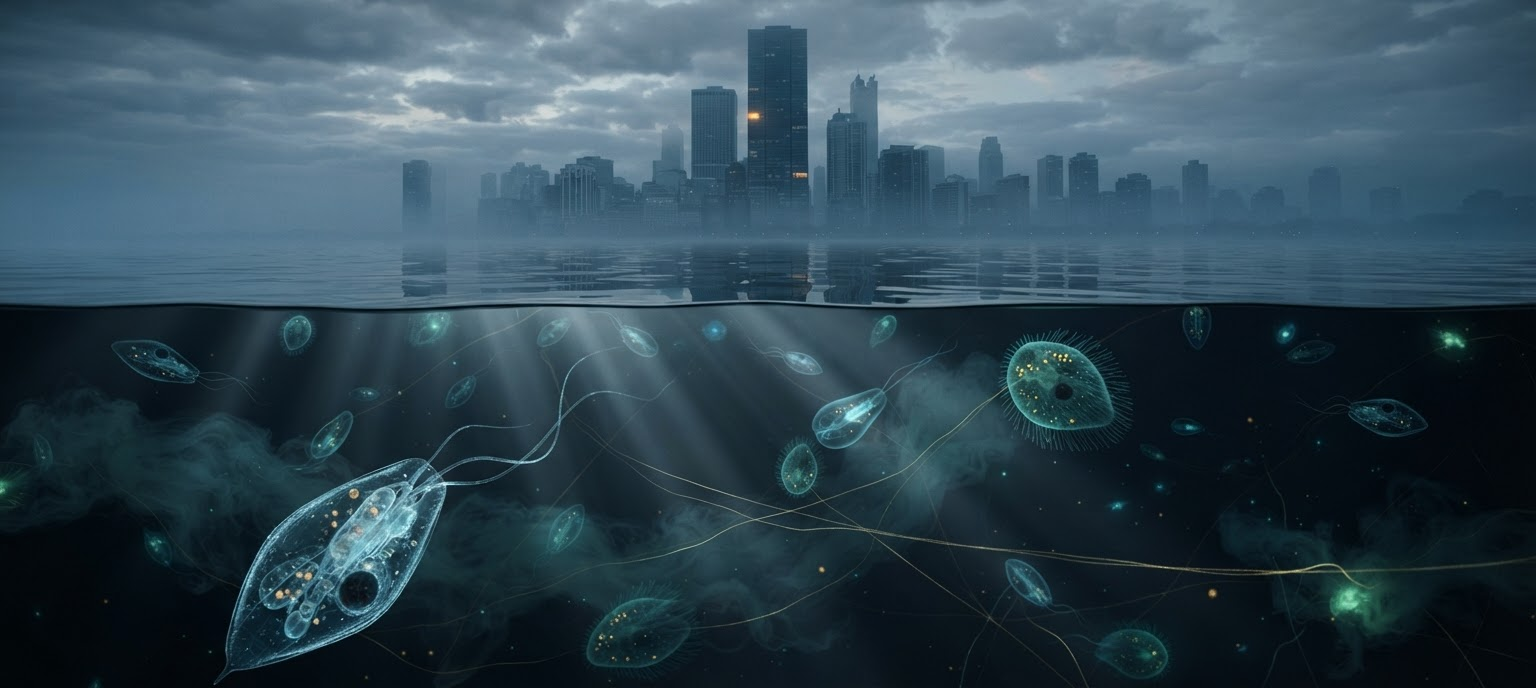
Imagine standing at the edge of a still lake in the heart of a European city, gazing at its placid surface and assuming the scene is motionless. At that very moment, one of the most complex ecological machines on the planet is turning beneath your feet: millions of protozoa — flagellates no larger than twenty micrometers and ciliates invisible to the naked eye — devour bacteria, release carbon dioxide, and recycle phosphorus and nitrogen, thereby determining whether this lake will remain fit for strolling and drinking or will degrade into a toxic, green-scummed swamp. At first glance this hardly seems like an architectural or urban concern, yet it sits at the core of what city planners and infrastructure designers face today: how do we design urban waterfronts, biological treatment plants, and stormwater retention basins if we do not understand the microbial engineering that governs water quality and carbon emissions from those surfaces?
The Loop the Architect Never Sees
In 1983, a research team led by Azam and colleagues coined the term “microbial loop” to describe a pathway science had long overlooked: dissolved organic carbon — whether it arrives from decomposing leaves in an urban lake or from the excretions of microscopic algae — neither evaporates nor simply settles. Instead, microscopic bacteria capture it and convert it into their own living biomass. These bacteria, in turn, are not the end of the chain; ultra-small protozoa — chiefly heterotrophic nanoflagellates and ciliates — consume them, releasing a portion of their carbon as carbon dioxide into the atmosphere while excreting the remainder as dissolved nutrients that fertilize algae anew. This nearly closed cycle, which operates around the clock in every lake, pond, and urban canal, directly answers three questions any responsible urban planner must ask: will the water in this body remain clear or turn turbid? Will its surface emit carbon that accelerates global warming or absorb it? And will these waters sustain a biodiversity that adds ecological and aesthetic value to the surrounding urban development?
To understand this dynamic, we need to trace the path of carbon through every “station” in the microbial loop, from predation to the efficiency of transfer to larger organisms, while keeping in mind that a nutrient-poor alpine lake operates nothing like a nitrogen-and-phosphorus-saturated basin on the outskirts of an industrial city.
Dust-Sized Predators: How Flagellates and Ciliates Govern Bacteria and Algae
Heterotrophic nanoflagellates — protozoa ranging from two to twenty micrometers in size — serve as the first line of defense against bacterial populations in the water column. In Lake Oglethorpe, a nutrient-rich lake in the United States, Sanders, Porter, and Bennett recorded ingestion rates of one to seventeen bacteria per flagellate per hour, peaking during summer thermal stratification when bacterial density surges in the warm surface layer. More strikingly, mixotrophic flagellates — those that combine photosynthesis with bacterial predation — accounted for roughly sixty percent of total bacterial grazing in winter, meaning that a substantial share of the winter carbon cycle in urban lakes passes through hybrid organisms that are neither purely plant nor purely animal.
The picture grows more complex in a mesotrophic lake. In Lake Lacawac, Pennsylvania, Princiotta and Sanders documented that flagellates of both types — heterotrophic and mixotrophic — together removed up to eighty-one percent of the standing bacterial stock each day. Crucially, mixotrophic flagellates outperformed their heterotrophic counterparts in the upper and middle layers of the water column, with ingestion rates reaching roughly thirteen bacteria per cell per hour, while heterotrophic flagellates dominated the deep, dark layer. This vertical distribution is not a mere academic detail; it means that the depth and geometric profile of a lake — both design decisions in any artificial water body — determine which type of protozoan will prevail, and therefore how much carbon is recycled or released into the air.
Ciliates, meanwhile, play an escalating role as lake fertility increases. Since the early 1980s, Beaver and Crisman established a foundational relationship between ciliate abundance and lake trophic state: in nutrient-poor lakes their numbers barely reach ten cells per milliliter, while in highly eutrophic systems they leap past one hundred and fifty cells per milliliter. The shift is not merely quantitative but compositional: oligotrophic lakes are dominated by relatively large, algae-eating ciliates, whereas eutrophic lakes are ruled by small-bodied species specialized in bacterial predation. This compositional shift means, in practical terms, that an artificial lake in an affluent residential neighborhood receiving low nutrient discharge will operate through an entirely different carbon mechanism than a stormwater collection pond in an agricultural zone infiltrated by fertilizer runoff.
In shallow, nutrient-rich lakes, Zingel and Nõges added another dimension when they demonstrated that ciliates graze on bacteria and microalgae at rates exceeding those of large metazoan zooplankton by hundreds to thousands of times. They observed that the microbial loop weakens in lakes dominated by large aquatic plants and strengthens when the lake shifts to a turbid, phytoplankton-dominated regime — a distinction of critical importance for designers of constructed wetlands used in wastewater treatment or urban stormwater purification.
The pattern extends well beyond ordinary lakes. In hypertrophic fishponds, Šimek and colleagues discovered that ciliate bacterivory was nearly equivalent to that of flagellates, with ciliates contributing roughly fifty-six percent of total protistan grazing. The surprise was that the most voracious species were not the bacteria-specialist ciliates but omnivorous taxa of the genera Halteria and Pelagohalteria, which consume everything from bacteria to small algae and alone accounted for seventy-one percent of total ciliate bacterivory. This finding dismantles the long-held assumption that flagellates are the undisputed masters of bacterial predation and redraws the carbon flow map in highly productive water bodies — precisely the type found in drainage ponds, biological treatment facilities, and engineered wetland systems.
Even in extreme environments this dynamic holds. In alpine lakes, Kammerlander and colleagues studied two adjacent lakes of radically different transparency and found that the turbid glacial lake harbored ciliate numbers and species richness far exceeding those of the clear lake, and that the underwater light regime — governed by water depth and suspended particle concentration — was the most important variable explaining this difference. Here a direct intersection with design emerges: when a landscape architect decides the depth of an artificial lake or its permissible turbidity level, they are in effect making a decision about the microbial community that will inhabit it, and consequently about the volume of carbon it will emit or absorb.
The Hidden CO₂ Factory: Microbial Respiration Beneath the Surface
Every bacterium a flagellate devours, and every flagellate a ciliate swallows, loses a portion of its carbon as carbon dioxide that rises to the lake surface and from there into the atmosphere. This microbial respiration is far from marginal. In Lake Pamvotis, a shallow eutrophic lake in Greece, Kagalou and Leonardos found that total planktonic community respiration correlated statistically with bacterial abundance more strongly than with chlorophyll concentration — meaning that bacteria, not algae, are the primary engine of carbon dioxide production even in a lake so green that chlorophyll levels reached one hundred and ninety-three micrograms per liter. This result overturns the common assumption that algae-rich lakes are necessarily carbon sinks; the organic load arriving from outside the lake — urban wastewater, fallen leaves, surface runoff laden with organic matter — feeds bacteria with additional fuel that drives their respiration beyond what algae produce in oxygen and organic carbon, turning the lake into a net source of carbon dioxide.
The protozoa themselves contribute directly to this respiration. In Lake Michigan, a vast system ranging from oligotrophic to mesotrophic, Carrick, Fahnenstiel, and Taylor estimated that heterotrophic protozoan production — flagellates and ciliates combined — equaled forty percent of bacterial production. Given that protozoan growth efficiency hovers around only thirty percent, seventy percent of the carbon they ingest dissipates as carbon dioxide. Notably, ciliate production exceeded flagellate production by a factor of three, making ciliates a major carbon “smokestack” in this system. These calculations cast new light on the urban architectural debate around “blue infrastructure” — the canals, ponds, and wetlands integrated into development projects as sustainable solutions: if these water bodies are not designed with careful attention to incoming organic load and microbial community composition, they may shift from climate solution to additional source of carbon emissions.
In the nutrient-poor lakes of British Columbia, Weisse and MacIsaac added an important temporal dimension: on three of five sampling occasions, bacterial production and grazing losses were nearly balanced, meaning that everything the bacteria produced was immediately consumed and converted into respiration and new protozoan biomass. This tight coupling implies that any external disturbance — a change in nutrient inflow from a nearby construction project, or a temperature rise driven by climate change — can break this equilibrium and transform the lake from a stable system into an excessive carbon emitter.
The Invisible Fertilizer: How Protozoa Re-Enrich the Water
Protozoa do not merely convert carbon into gas; they also excrete dissolved nutrients — primarily ammonium and phosphate — that feed algae and restart the wheel of primary production. This fertilizing function is amplified by the high metabolic rates and short generation times of these organisms. Beaver and Crisman noted that ciliates excrete phosphorus at a rate exceeding that of large zooplankton by one to two orders of magnitude per unit of body weight. They estimated that even if ciliates constituted just one percent of total planktonic biomass, they could contribute fifty percent of the dissolved phosphorus in a lake — a proportion that climbs further when small-bodied ciliate species with high surface-area-to-volume ratios dominate.
This excretion creates what is known as the “microbial carbon pump”: when protozoa consume bacteria, they release labile dissolved organic carbon that fuels further bacterial growth, generating a positive feedback loop that accelerates carbon cycling within the microbial loop. In the hypertrophic fishponds studied by Šimek and colleagues, the high densities of omnivorous Halteria and Pelagohalteria ciliates and their rapid turnover likely intensified nutrient regeneration, helping sustain the massive algal biomass characteristic of these systems.
In oligotrophic and mesotrophic lakes, mixotrophic flagellates play a unique dual role: they acquire carbon through photosynthesis and nutrients — especially phosphorus and nitrogen — through bacterial predation. Princiotta and Sanders documented that this bacterivory by mixotrophic flagellates was critical in the surface layer of Lake Lacawac during thermal stratification, when dissolved nutrient concentrations in surface waters drop. This predatory acquisition of nutrients gives mixotrophic flagellates a competitive edge over purely photosynthetic phytoplankton, reshaping the algal community that a visitor sees in an urban lake and affecting water clarity and color — two aesthetic factors that landscape designers build into their calculations.
The Trophic Bridge: Does Bacterial Carbon Reach the Fish?
The central question determining the ecological value of any urban water body is this: does the microbial loop succeed in transferring carbon to larger organisms — crustacean zooplankton and then fish — or is it merely a respiration machine that converts organic matter into gas and heat?
In the lakes of British Columbia, Weisse and MacIsaac used radiotracer techniques to follow the path of bacterial carbon through the food web. The primary pathway ran from bacteria to small flagellates, then to ciliates and microzooplankton, and finally to copepods. When copepods were added to experimental containers, the accumulation of the radioactive label in the ciliate fraction dropped, indicating that copepods directly consumed flagellates and ciliates, thereby channeling microbial loop carbon to higher trophic levels. Yet the efficiency of this transfer remains conditional on top-down control: when copepod densities rise due to the absence of predatory fish, protozoa are suppressed and bacteria are partially released from grazing pressure.
In Lake Michigan, Carrick and colleagues estimated that protozoan production was large enough to account for most bacterial production, meaning that protozoan biomass is theoretically available to support crustacean zooplankton. They noted that small ciliate taxa such as Halteria, Strobilidium, and Urotricha achieved growth rates comparable to those of bacteria, making them potentially important prey for larger zooplankton.
Direct measurement of transfer efficiency, however, tells a less optimistic story. In Lake Okeechobee, Florida — a nutrient-rich, turbid lake — Havens measured the transfer of radiolabeled carbon from bacteria and algae to large zooplankton and found that the proportion transferred never exceeded one-tenth of one percent to one percent at best, with bacterial carbon transfer slightly lower than algal carbon transfer. This low efficiency stems from two causes: first, the dominance of large filamentous cyanobacteria that copepods cannot ingest, and second, the multiple trophic steps in the microbial loop pathway, each of which loses roughly seventy percent of carbon to respiration.
Havens did, however, point to an important exception: in lakes dominated by cladocerans — particularly the genus Daphnia — transfer efficiency rises because these organisms can directly filter bacteria and small algae without passing through protozoan intermediaries. Here the impact of design re-emerges: the fish community composition of an urban lake — which can be managed through stocking practices — determines whether zooplankton will be large and effective at carbon transfer or small and limited in impact.
Sudden upheavals in food web structure reveal the fragility of this balance. Lischke and colleagues studied two shallow eutrophic lakes following a winter fish kill and found that surviving young-of-year fish suppressed crustacean zooplankton, releasing ciliates from predation pressure so that they came to dominate between thirty-eight and seventy-six percent of total zooplankton biomass. These ciliates grazed aggressively on small algae — at clearance rates exceeding the entire water column volume one to three times per day — but failed to control large algae, which accumulated and degraded water quality. This scenario foreshadows what can happen in an urban pond or artificial lake that experiences a sudden disruption in its fish community.
The Grand Carbon Balance: Production Versus Respiration Across Fertility Gradients
The balance between primary production and community respiration determines whether a lake functions as a carbon sink or a carbon source. The microbial loop stands at the heart of this balance because bacterial respiration often constitutes the largest share of total respiration. In Lake Pamvotis, as noted above, respiration correlated more closely with bacteria than with algae, suggesting the lake is a net source of carbon dioxide despite its green waters. This equation repeats in lakes around the world and explains why inland lakes collectively contribute measurable carbon emissions at the global scale — a fact that must be factored into the carbon footprint calculations of urban developments that incorporate water bodies.
In extremely nutrient-poor lakes, the relative weight of bacteria in total planktonic biomass rises. Weisse and MacIsaac documented that bacterial carbon comprised roughly twenty-four percent of combined phytoplankton-bacterial carbon in the most oligotrophic British Columbia lakes, declining to less than eleven percent as productivity increased. This pattern confirms that the microbial loop proportionally dominates carbon flow in clear lakes — often the most visually appealing lakes and the most attractive to high-end tourism and residential projects — meaning that any nutrient pollution altering their microbial structure threatens the aesthetic and economic value on which the project was built.
Across the trophic gradient, clear patterns in carbon transfer efficiency crystallize. In oligotrophic lakes, bacterial production is tightly balanced by flagellate grazing, and the food chain is long and multi-stepped: bacteria to flagellates to ciliates to copepods, with each step losing sixty to seventy percent of carbon. Transfer efficiency to fish is low, but the microbial loop remains the sole support for the zooplankton community that in turn feeds freshwater fish. In mesotrophic lakes, mixotrophic flagellates gain rising importance and can shorten the food chain by linking bacterial carbon directly to the zooplankton prey pool, while phototrophic flagellates contribute roughly twenty-four percent of primary production, as in Lake Michigan. In eutrophic lakes, ciliate biomass swells and may dominate both zooplankton biomass and algal grazing, and the microbial loop strengthens as bacterial production rises, but transfer efficiency to large zooplankton remains low — below one percent in Lake Okeechobee — due to the multiple intermediate links and the dominance of large, inedible algae. In hypertrophic systems, the comprehensive analysis by Šimek and colleagues — spanning lakes from oligotrophic to hypertrophic — revealed a clear positive relationship between chlorophyll concentration and the proportion of bacterial stock consumed by ciliates, confirming that the role of ciliate predation increases proportionally with fertility.
The overarching conclusion of these studies is that the microbial loop, while essential for recycling organic carbon and sustaining microbial food webs, operates at relatively low efficiency in transferring carbon to higher trophic levels. Each step in the pathway — from bacterium to flagellate to ciliate to copepod — wastes roughly seventy percent of carbon through respiration, assuming a gross growth efficiency of thirty percent, yielding an overall transfer efficiency of less than one percent from bacterial production to fish. Nevertheless, the absolute quantity transferred can be substantial in highly productive systems where bacterial production reaches ten to one hundred milligrams of carbon per cubic meter per day. Moreover, the microbial loop remains indispensable for retaining and recycling carbon that would otherwise be lost from the pelagic food web, particularly in oligotrophic lakes where direct grazing of algae by crustacean zooplankton alone cannot capture all primary production.
What This Means for a City Built Around Water
When we gather these threads together, something that might be called “the microbiology of urban aquatic design” takes shape — a cross-disciplinary field whose boundaries have not yet fully crystallized but whose contours are now clear. The designer of a constructed wetland needs to know that the basin will become a microbial reactor governed by flagellates and ciliates, and that the basin’s depth, geometry, light exposure, and incoming water quality will determine whether this reactor works in the project’s favor — purifying water and cycling nutrients — or against it by generating carbon emissions and nuisance algal blooms. The urban planner who lays out a waterfront needs to know that the clear, attractive lake being marketed to investors depends on a fragile microbial balance among bacteria, flagellates, and ciliates, and that any nutrient leakage from sewer lines or fertilizer-laden surface runoff will break this balance and convert the planned aesthetic landscape into a pollution hotspot and a source of gaseous emissions. And the biological treatment engineer needs to know that omnivorous ciliates — those that consume both bacteria and algae simultaneously — may be the best ally in high-load treatment basins because they control both bacterial and algal biomass at once.
Architecture that engages with water — from the skyscrapers of Singapore that harvest rainwater in surface ponds, to the riverbank regeneration projects in Copenhagen and Seoul, to the sponge city master plans in China — can no longer treat the water body as a merely decorative, static element. Beneath the surface of every lake, canal, and pond, a complex microbial carbon machine is at work, and understanding its fundamental gear — the protozoa — is no longer an academic luxury but a prerequisite for designing urban water infrastructure that respects the carbon cycle rather than violating it.
✦ ArchUp Editorial Insight
The proliferation of decorative lakes and retention basins across contemporary master plans is the logical outcome of municipal stormwater mandates combined with ESG-driven asset valorization. Urban developers integrate “blue infrastructure” primarily as a speculative visual amenity and decarbonization claim to secure permitting and extract real estate premiums. Yet because regulatory frameworks evaluate these interventions solely through hydrological volume and superficial aesthetics rather than metabolic kinetics, spatial design remains detached from microbial realities. Basin geometries characterized by shallow cross-sections, uncalibrated solar exposure, and unmitigated runoff inflows inadvertently foster high bacterial respiration and nutrient saturation. The resulting urban water feature functions not as the passive carbon sink promised in municipal marketing, but as an active, unmetered emission source—revealing how current procurement and rating systems incentivize aestheticized greenwashing over functional biochemical performance.
References
Sanders, R.W., Porter, K.G., Bennett, S.J. “Heterotrophic, Autotrophic, and Mixotrophic Nanoflagellates: Seasonal Abundances and Bacterivory in a Eutrophic Lake.” Limnology and Oceanography, 1990.
Princiotta, S.D., Sanders, R.W. “Heterotrophic and Mixotrophic Nanoflagellates in a Mesotrophic Lake: Abundance and Grazing Impacts Across Season and Depth.” Limnology and Oceanography, 2016.
Beaver, J.R., Crisman, T.L. “The Trophic Response of Ciliated Protozoans in Freshwater Lakes.” Limnology and Oceanography, 1982.
Zingel, P., Nõges, T. “Protozoan Grazing in Shallow Macrophyte- and Plankton-Dominated Lakes.” Fundamental and Applied Limnology, 2008.
Lischke, B., Weithoff, G., Wickham, S.A., et al. “Large Biomass of Small Feeders: Ciliates May Dominate Herbivory in Eutrophic Lakes.” Journal of Plankton Research, 2015.
Šimek, K., Grujčić, V., Nedoma, J., et al. “Microbial Food Webs in Hypertrophic Fishponds: Omnivorous Ciliate Taxa Are Major Protistan Bacterivores.” Limnology and Oceanography, 2019.
Kammerlander, B., Breiner, H.W., Filker, S., et al. “Ciliate Community Structure and Interactions Within the Planktonic Food Web in Two Alpine Lakes of Contrasting Transparency.” Freshwater Biology, 2016.
Kagalou, I., Leonardos, I. “Planktonic Respiration in a Shallow Eutrophic Lake.” Journal of Freshwater Ecology, 2006.
Carrick, H.J., Fahnenstiel, G.L., Taylor, W.D. “Growth and Production of Planktonic Protozoa in Lake Michigan: In Situ Versus In Vitro Comparisons and Importance to Food Web Dynamics.” Limnology and Oceanography, 1992.
Weisse, T., MacIsaac, E. “Significance and Fate of Bacterial Production in Oligotrophic Lakes in British Columbia.” Canadian Journal of Fisheries and Aquatic Sciences, 2000.
Havens, K.E. “Relative Efficiencies of Carbon Transfer from Bacteria and Algae to Zooplankton in a Subtropical Lake.” Journal of Plankton Research, 2000.