The Value Is in the Verb, Not the Noun

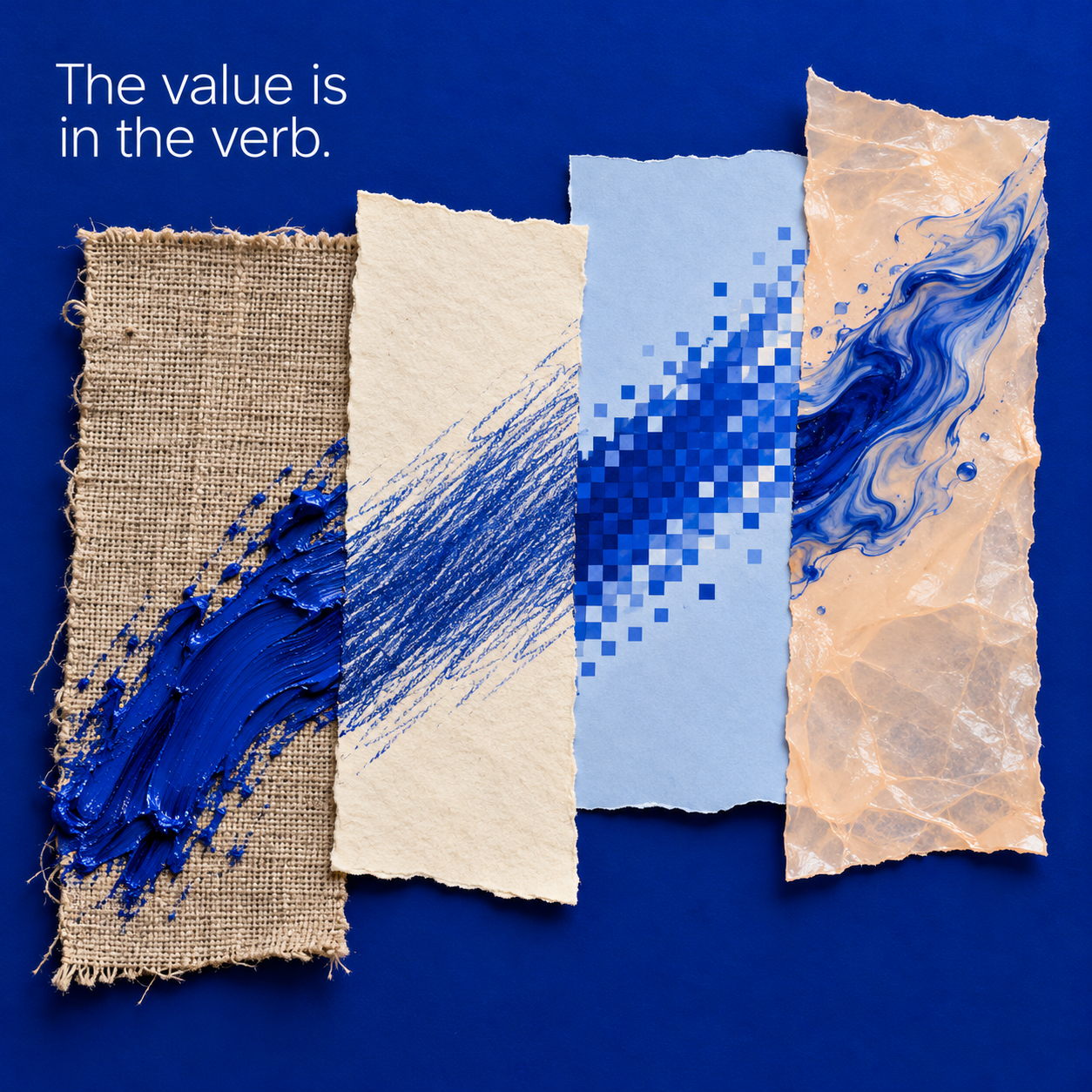
Place two images side by side on a screen, pixel for pixel identical, and tell one room of people that the left one was painted by a human hand across many weeks, and another room that the very same left image was generated by a machine in nine seconds. Then ask both rooms what the picture is worth. You will get two different numbers, sometimes dramatically different, for a thing that is, to the eye, exactly one object. This is not a thought experiment. It is close to the design of several controlled studies, and their result is remarkably stable. The same perceptible object carries different value depending only on what the viewer believes about how it was made. Once you absorb that single finding, the entire anxious argument about digital art and artificial intelligence reorganizes itself, because it tells you that the value of an artwork was never sitting in the surface we look at. It was sitting in the act we infer behind the surface. The value is in the verb, not the noun.
I want to take this seriously and follow it all the way to a clear answer, because the question of what digital art is actually worth has been drowned in noise, in headlines about machines replacing painters and in auction prices that read like lottery numbers. The evidence, when you gather it patiently, is not vague at all. It points somewhere definite. So let me build the case in order, from the eye, to the hand, to the market, to the law, and then state plainly where the value of digital art truly lies.
What the Experiments Actually Found
Begin with perception, under controlled conditions, because this is where belief and object can be separated cleanly. In one large priming study, the same pool of paintings was shown to hundreds of people, labeled for some as human made and for others as generated by a machine. The works labeled as machine made were rated lower on liking, on beauty, on novelty, and on meaning, even though the images were the same. And when people were asked to actually tell which was which, they performed only a little better than a coin toss, with accuracy hovering in the mid fifties of a hundred. Read those two facts together and the conclusion is uncomfortable and precise. People cannot reliably see the difference, but they reliably punish the difference once they are told it exists. The penalty lives in the belief, not in the retina.
A second study put money on the table rather than ratings. Using the same images attributed sometimes to a person and sometimes to a machine with an invented name, participants assigned a significantly higher price when they believed a human made it, and the effect was large by the standards of this kind of research. More revealing still was a contrast effect that surfaced in the data. The machine made works were valued higher when they sat among other machine made prices, and lower when they sat among human made ones, as though audiences file algorithmic work into a separate category entirely and refuse to let it compete inside the category of human art. The mind is not scoring the picture. It is sorting the maker.
Then comes the finding that, for the subject of digital art in particular, matters most. When researchers showed people drawings made by a robot, the identical drawings were rated higher when the viewers had watched the machine at work than when they were merely told the source afterward, and higher again than when they were told nothing at all. Watching the process produced value. And in a separate, much older line of work on authenticity, perfect physical duplicates of artworks were consistently valued far below the originals, with two mechanisms doing the work, the sense of a unique creative performance, and a kind of contagion, the feeling that the original had been touched by the artist. Even when the effort was held equal, the original won. This is the deepest clue in the entire literature. The object is not the asset. The documented act of making is the asset, and the object is merely its certificate.
The Three Things the Eye Is Really Pricing
If you distill these experiments, the audience is not reacting to beauty alone. It is pricing three things it cannot see directly and must infer. The first is effort and time, the sense that a life’s hours went into this. The second is creative control and authenticity, the sense that a human mind governed the decisions rather than merely wished for an outcome. The third is embodiment and contact, the trace of a hand, the irregularity that proves a body was present. These three inferences are the hidden engine of artistic value, and the reason this matters so much for digital art is that digital work has always had to fight on exactly this terrain. A file has no brushstroke. A file can be copied perfectly a million times, so it struggles to carry the contagion of contact. For a long time this is precisely why serious collectors discounted digital work, not because it looked worse, but because it seemed to fail all three of the inferences the mind uses to assign worth.
There is a lesson here that anyone trained in architecture already knows in their bones, that structure precedes surface and that the discipline of the process is what finally shows in the result. And here is where the careful distinction has to be drawn, because the public debate collapses everything into a crude war of human against machine, and the evidence refuses that framing. The studies that separate the stages of machine involvement find something far more useful. When the machine is disclosed as having done the ideation, the brainstorming, the first spark, audiences penalize the work less. When the machine is disclosed as having done the implementation, the actual generating of the layout and the surface, audiences penalize it far more. The same final painting is judged less authentic and less valuable when the algorithm executed it than when the algorithm merely suggested it. Authenticity, the sense of human creative control, turns out to be the dominant variable, strong enough to outweigh the extra novelty that machines can bring. And two things were shown to repair the penalty almost completely. One was revealing substantial human labor, for instance that the artist had trained the system on a body of their own curated images rather than typing a wish into a public tool. The other was communicating a genuine artistic vision. Both are forms of design authorship, and both are, crucially, forms of process that can be made visible.
Why Process Visibility Is the Whole Game for Digital Art
Now the pieces lock together, and the answer to the real question begins to shine through. The thing that destroys the value of digital and machine assisted art is the perception that no governed human process stands behind it, that it was a wish typed into a box and collected in seconds. The things that restore its value are effort, creative control, and above all the visibility of the making. And digital art that passes through documented stages of work, sketch to structure to refinement to final state, is the one category positioned to supply exactly what the eye is secretly pricing. A painting on canvas carries its process in its surface, in the sediment of its brushstrokes. A digital work carries no such sediment on its face. But it can carry something the canvas cannot, a complete and honest record of its own becoming, every layer, every version, every decision, timestamped and preserved. The very stages of work that a serious digital artist moves through are not overhead to be hidden. They are the asset itself, because they are the documented performance that the whole psychology of value rewards.

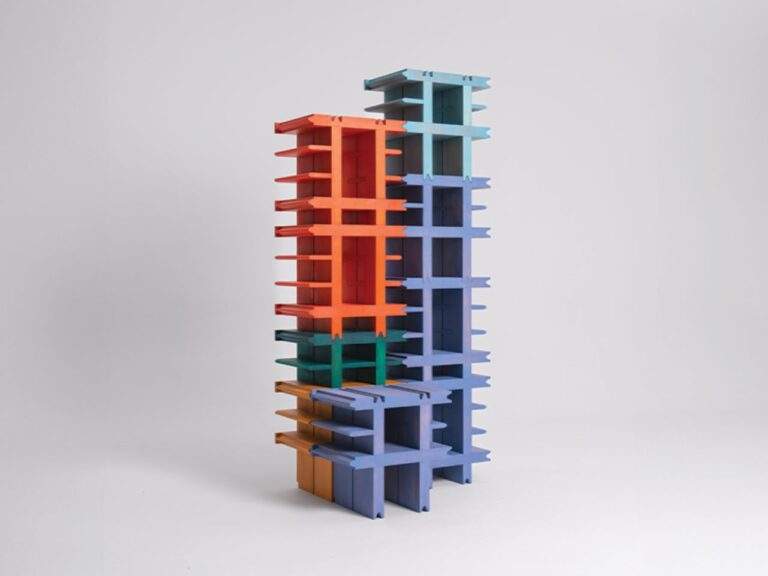
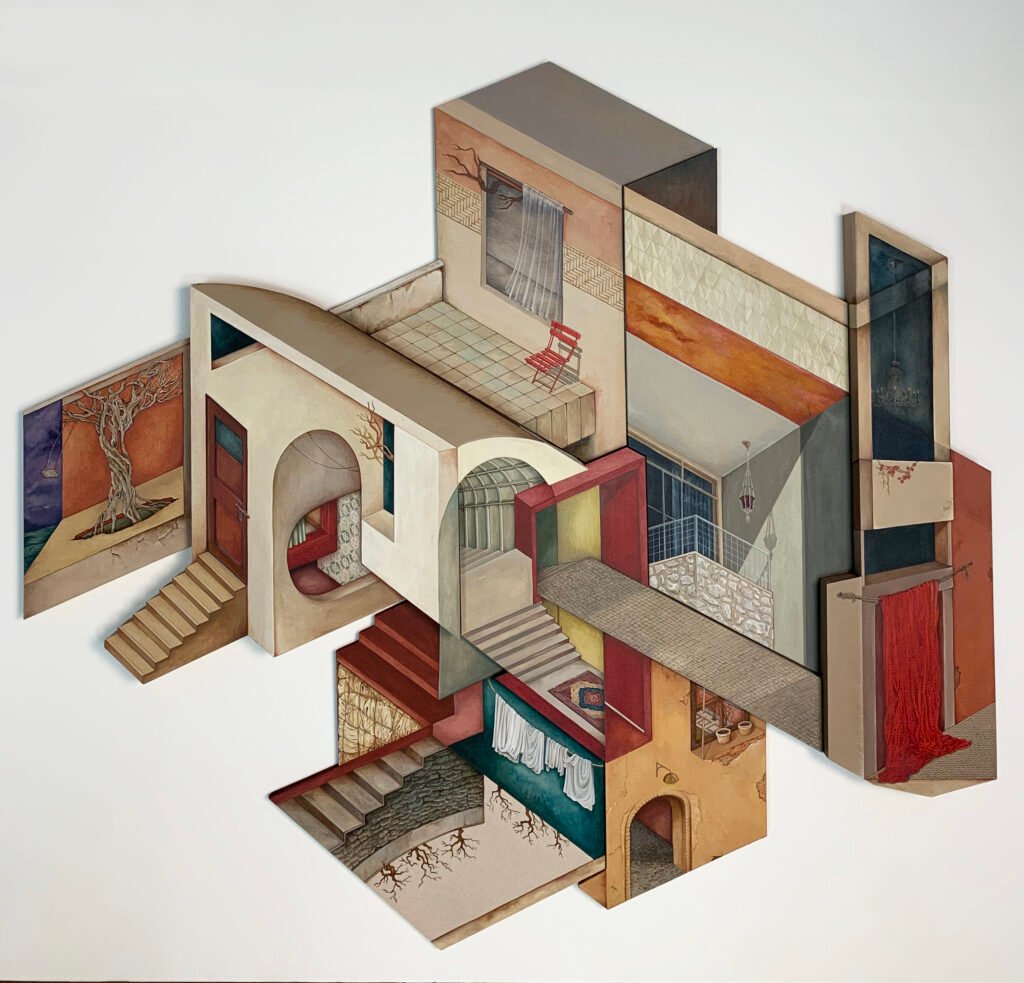
TopoArtic, 2026
Based on real topographic data, this work translates contour lines into a layered digital relief, presented from above. Two rectangular cuts intersect the terrain at different depths, introducing straight edges within its irregular contours. Burgundy, grey and camel distinguish successive layers, while restrained shading reveals their thickness and the depth of the cuts. The work develops through terrain modelling, geometric subtraction, colour assignment and digital composition.
This is why the technology of provenance has mattered so much to digital art, far more than to painting. Painting never needed a certificate of uniqueness because its uniqueness was physical. Digital work, perfectly copyable, needed to manufacture scarcity and an unbreakable record of origin, which is what the blockchain registries were built to supply, an ownership layer and an immutable provenance trail stapled to a file. When one purely digital work sold for sixty nine million at a major house, it was not because the image was more beautiful than a million others. It was because a verifiable chain of authorship and ownership finally let a digital object carry the one thing it had always lacked, a provenance that made its unique performance legible to the market. And the market confirms this in its finer grain too. On curated digital platforms, where institutional vetting acts as a scarcity and quality signal, works sell for many multiples of what the same kind of work fetches on open, unvetted platforms. The vetting is not decoration. It is the supply of trust that the eye cannot supply on its own.
The Market, the Law, and the Labor
The rest of the evidence falls into place around this spine. In the traditional market, scarcity and provenance produce measurable premiums, an artist’s death, which fixes the supply forever, is associated with auction price premiums of roughly sixteen to nineteen percent, and public exhibition raises resale prices by a similar order, because the museum functions as a scarce certificate of legitimacy. The sensational machine art auctions, by contrast, the ones that sold for forty times their estimate, are repeatedly shown to be confounded by heavy promotion and speculative buyers rather than settled connoisseur demand, which is precisely why they are poor evidence of durable value and strong evidence of a bubble in search of a provenance story. Meanwhile the law has drawn its line in the same place the psychology did. Copyright frameworks are built on human authorship, and work generated without sufficient human creative contribution falls into a gray zone where protection thins or vanishes. The moral author of a work made with a machine is held to be the human who supplied the intentional decisions, not the tool and not the toolmaker. The law, the market, and the museum have independently converged on the same criterion the laboratory found, that value tracks the degree of governed human creative control.
Even the labor question, the fear that the machine simply erases the economic value of the artist, turns out to be subtler than the panic suggests. The early causal evidence shows little sign of immediate collapse in artists’ earnings from exposure to these tools, with effects near zero or modestly positive in the short run, and a pattern more consistent with task reallocation and intensified work than with wholesale replacement, artists reporting that they reach for the machine most in ideation and least in the parts of the work that face the client or define the vision. The machine is entering the studio as an instrument, and the artists who direct it are not being deleted. They are, for now, being asked to do more, and to prove more clearly than ever that a human vision governs the result. This connects the whole question to the larger shift running through every field, the one the serious architectural research of this decade keeps circling, that the tool does not abolish the author but raises the premium on authorship that can be demonstrated.
The Clear Answer
So let me state the conclusion without the fog, because the subject deserves a verdict and the evidence supports one. The value of a work of art does not reside in its visible surface. It resides in what the audience, the market, the museum, and the law all believe about the process that produced it, and every one of those four institutions prices the same three things, governed human effort, creative control, and a legible record of the making. Handmade art scores high on all three automatically, because the hand leaves its proof in the material. Purely machine generated art, a wish typed into a public box and harvested in seconds, scores low on all three, which is why it is devalued across every register and left stranded in a legal gray zone, and no amount of auction theater changes that underlying fact. And digital art made by a human who moves through real stages of work sits in the strongest position of all the new forms, not the weakest, provided it does the one thing its medium makes uniquely possible. It must make its process visible. It must preserve and present the stages, the sketch and the structure and the revisions and the final state, as the documented performance they are, and it must bind that performance to a verifiable provenance, so that the governed human act behind the file becomes as legible as the brushstroke on a canvas.
This is the finding that cuts through the noise, and it is good news for the digital artist rather than bad. The projects and the works that will hold their value are not the ones that hide the labor to seem effortless, and not the ones that pretend the machine did nothing, but the ones that turn the entire journey of making into the thing on offer. The cities of the art world, its galleries and its registries and its curated platforms, are already rewarding exactly this, paying their premiums to legible provenance and vetted authorship, and the construction of a serious digital practice now means building the record of the work as deliberately as the work itself. The news will keep announcing that the machine has killed art, and the speculative competitions will keep inflating whichever machine made image has the loudest publicity, and both will keep missing the quiet and decisive truth that the laboratory, the auction house, the museum, and the court have all independently confirmed. Art was always the trace of a governed human act, and the digital work that survives will be the one honest enough, and organized enough, to show its hand. In a world where the surface can be faked in seconds by anyone, the one thing that cannot be faked, and therefore the only thing left that reliably carries value, is the visible, verifiable record of a human process of becoming. The sustainability of the digital artist’s worth depends entirely on learning to exhibit the verb, and to stop selling only the noun.
✦ ArchUp Editorial Insight
The essay’s governing finding — that identical images carry different value depending only on what the viewer believes about how they were made — is not primarily an observation about aesthetics but about the economics of provenance, because it establishes that the asset was never the surface but the inferred act behind it, which means the entire market for art has always been pricing a documented performance rather than a perceptible object. What makes this structurally consequential is the mechanism the essay then exposes: value tracks three inferences the eye cannot see directly — effort, governed creative control, and the trace of contact — and the institutions that price art, the market, the museum, and the law, have independently converged on the same criterion, protecting and premiumizing the work in proportion to demonstrable human authorship. This is the same authorship-under-automation thread this archive traced in Who Pays for the AI Hallucination and The Consulting Pyramid Is Collapsing From the Bottom Up, where the collapse of the distance between the client and the answer forced professional value to relocate from execution to the judgment and process that execution once concealed. The essay’s sharpest move, however, is its inversion of the usual panic: the very process documentation that digital artists were tempted to hide as overhead is the one asset their medium can supply that canvas cannot — a complete timestamped record of the work’s becoming — which connects directly to what An Elegy for Architecture identified as the private archive’s survival function, and reframes the provenance registry not as speculative theater but as the infrastructure through which a governed human act is made legible in a world where the surface can be faked in seconds. The structural verdict is therefore precise: in an economy where the noun is infinitely reproducible at zero cost, the only thing that reliably carries value is the verb — the visible, verifiable record of the making — and the discipline that learns to exhibit its process rather than conceal it is the one positioned to retain its worth.
Ibrahim Fawakherji — ArchUp
Sources
- Newman GE, Bloom P. Art and authenticity: The importance of originals in judgments of value. Journal of Experimental Psychology: General, 2012.
- Chamberlain R, Mullin C, Scheerlinck B, Wagemans J. Putting the art in artificial: Aesthetic responses to computer generated art. Psychology of Aesthetics, Creativity, and the Arts, 2018.
- Modlinski A. A(I)rtist or Counterfeiter? Artificial Intelligence as a (D)Evaluating Factor on the Art Market. The Journal of Arts Management, Law, and Society, 2021.
- Messer U. Co-creating art with generative artificial intelligence: Implications for artworks and artists. Computers in Human Behavior: Artificial Humans, 2024.
- Ragot M, Martin N, Cojean S. AI-generated vs Human Artworks: A Perception Bias Towards Artificial Intelligence? CHI Extended Abstracts, 2020.
- Bowman KM, et al. What’s wrong with AI art? Implications of generative AI on the value of creative media. Behaviour and Information Technology, 2026.
- Bara A, et al. Algorithmic aesthetics: Cognitive perspectives on AI generated visual art. iScience, 2025.
- Cuntz A, et al. Is there a premium for legacy artists? The death effect in exhibition shows and auction transactions. Journal of Cultural Economics, 2025.
- Sidorova Y. The Cyber Turn of the Contemporary Art Market. Arts, 2019.
- Guan S, et al. From Digital Art to Crypto Art: The Evolution of Art Brought by NFT. International Journal of Human Computer Interaction, 2024.
- Watiktinnakorn A, et al. Blurring the lines: how AI is redefining artistic ownership and copyright. Discover Artificial Intelligence, 2023.
- AI as artist: agency and the moral rights of creative works. AI and Ethics, 2025.
- Wang S. The value of art in the absence of the author: a juxtaposition of artificial intelligence and artists’ posthumous works. AI and Society, 2026.
- Makridis C. The labor market effect of generative artificial intelligence on artists. Journal of Cultural Economics, 2026.