
Yongping Warehouse Renovation: Huadi Adaptive Reuse

Repurposing Grain Warehouses on the Huadi River
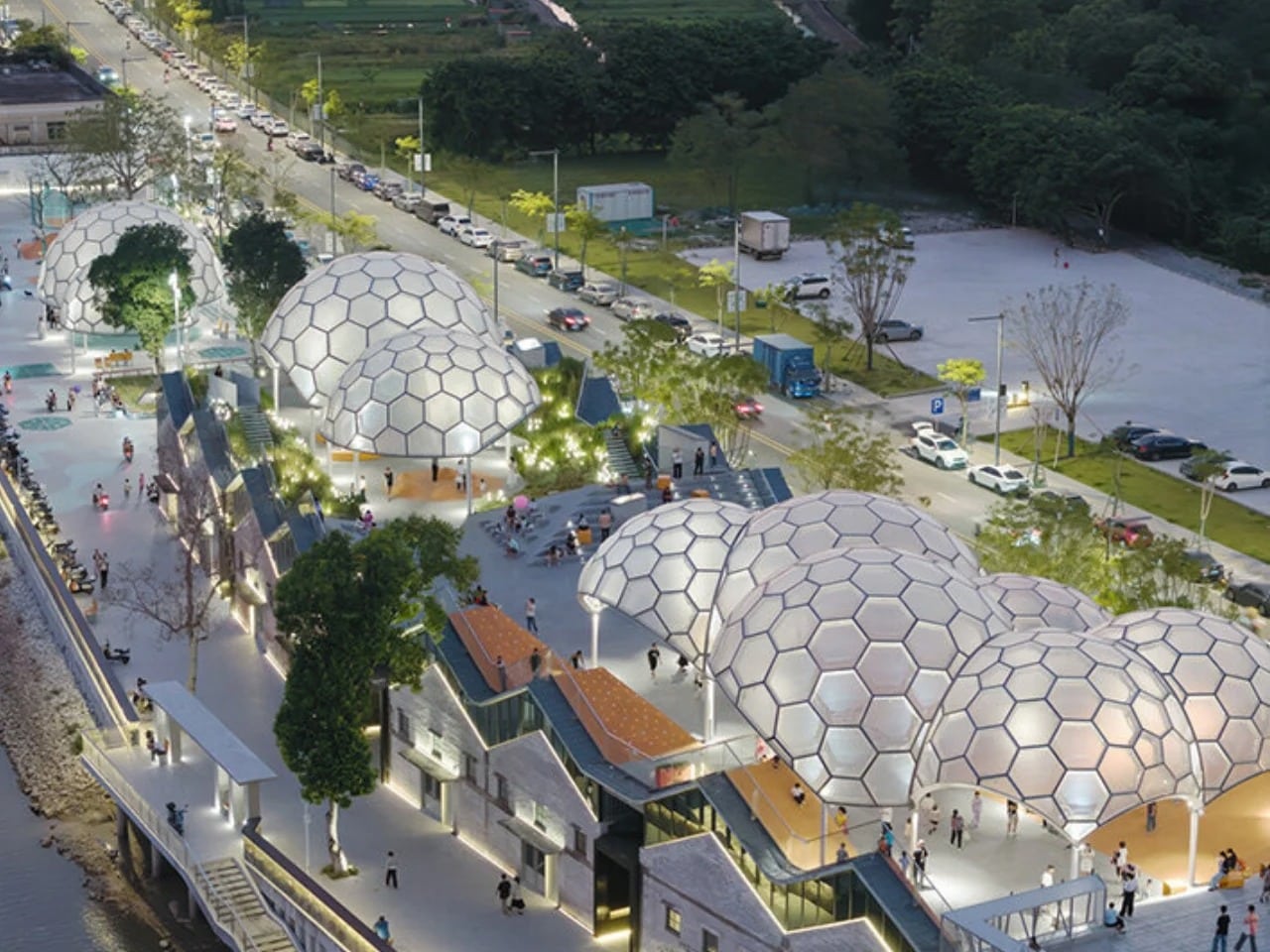
On a site stretching along the Huadi River in Foshan, China, a group of old grain warehouses has been transformed into a new Projects based on adaptive reuse. The project, known as the Yongping Warehouse Renovation, was completed in 2025 by Atelier cnS as a case study in converting abandoned industrial buildings into a new function. The core idea was to work with Buildings that had lost their original purpose without radically altering their overall character.
Urban Transformation Context in Dali Town
The site is located in Dali Town within Nanhai District, an area historically defined by its industrial character linked to the Pearl River Delta. Over time, the district has begun shifting toward a more publicly oriented environment. Within this context, the warehouses stood along the riverfront without a clear function. As a result, the project emerged as part of a process of reintegrating these Architecture into the urban fabric rather than demolishing or replacing them.
Vertical Organization and Gradation of Visual Experience
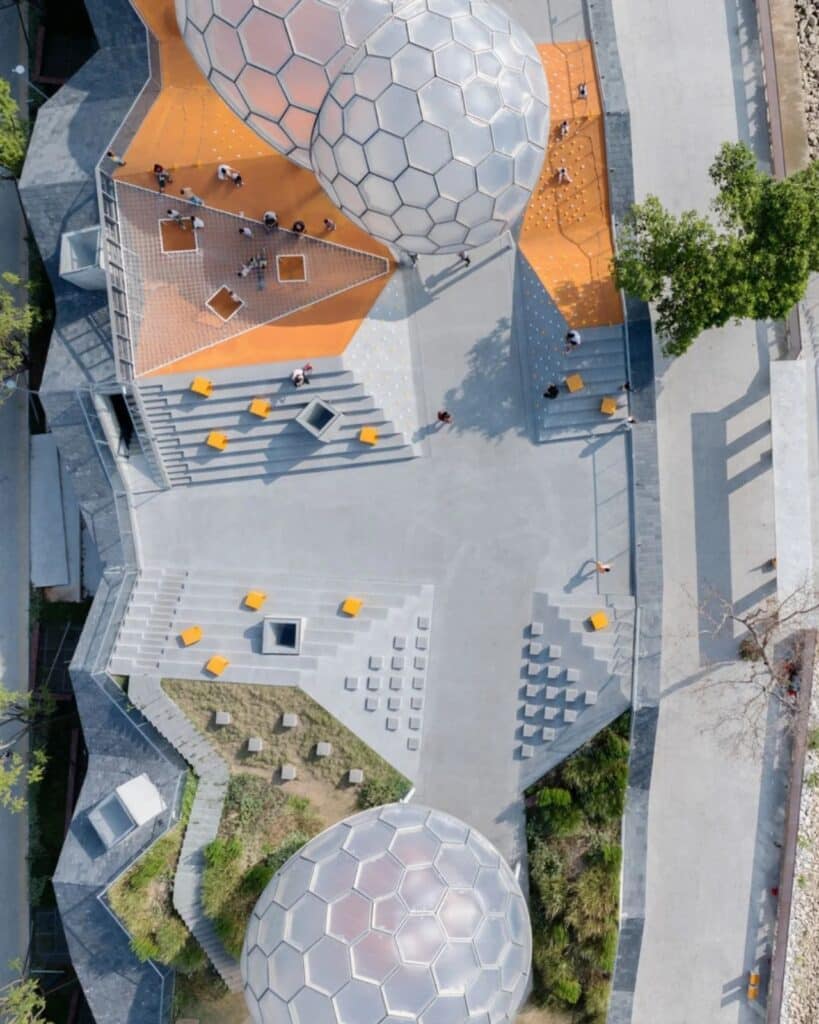
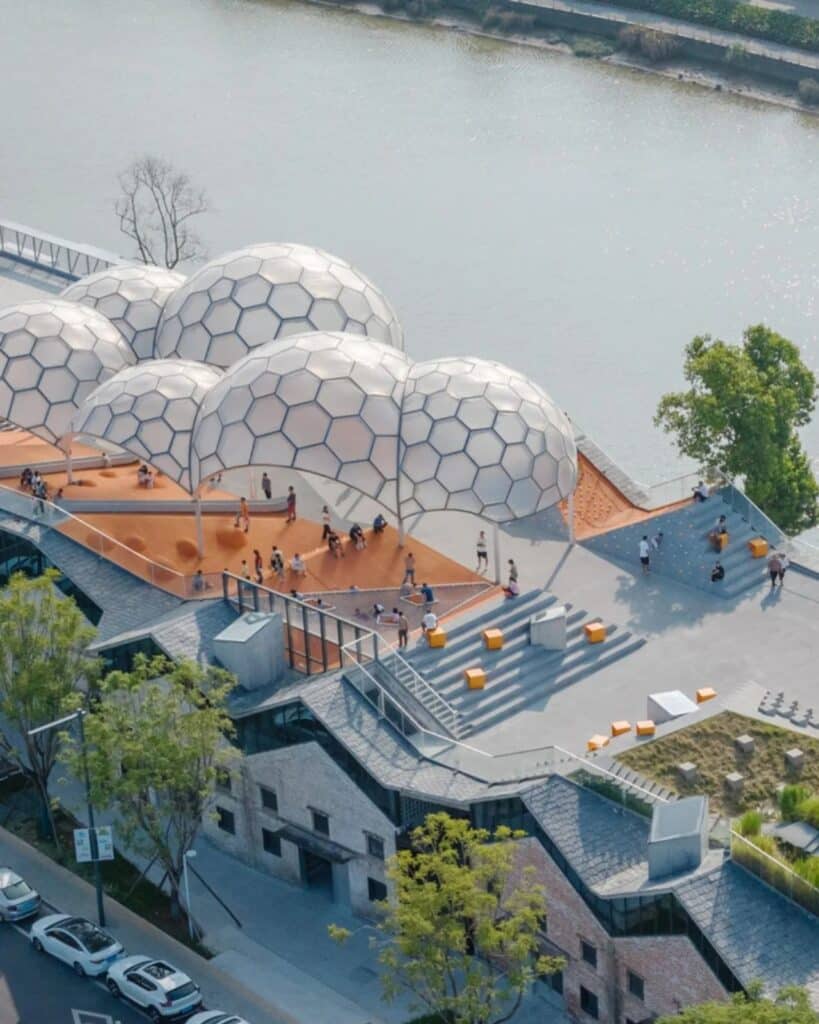
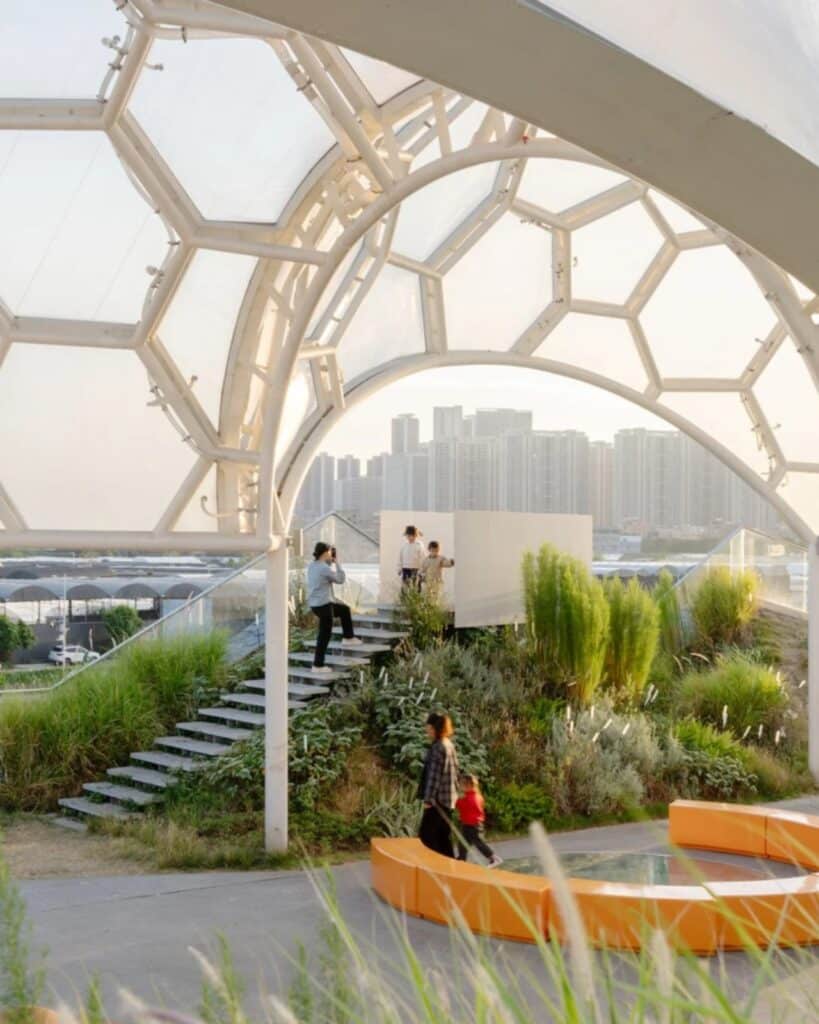
Due to the limited site area, part of the public program was relocated upward through the creation of a rooftop garden above the commercial spaces on the ground floor. Instead of closing off the gaps between the warehouse volumes, they were preserved and expanded to function as internal passages. This arrangement allows movement through the Construction to gradually reveal fragments of the river before reaching the roof, where the view opens up completely. The result is a visual experience based on a gradual transition between levels rather than an immediate exposure.
Rooftop Dome Canopies
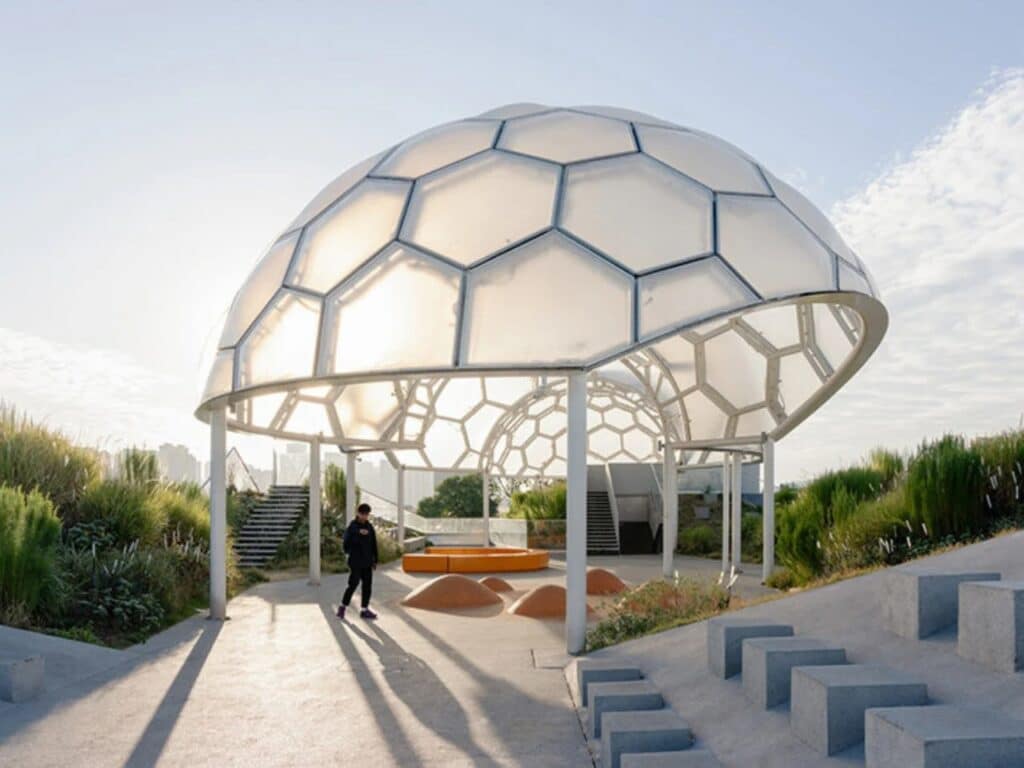
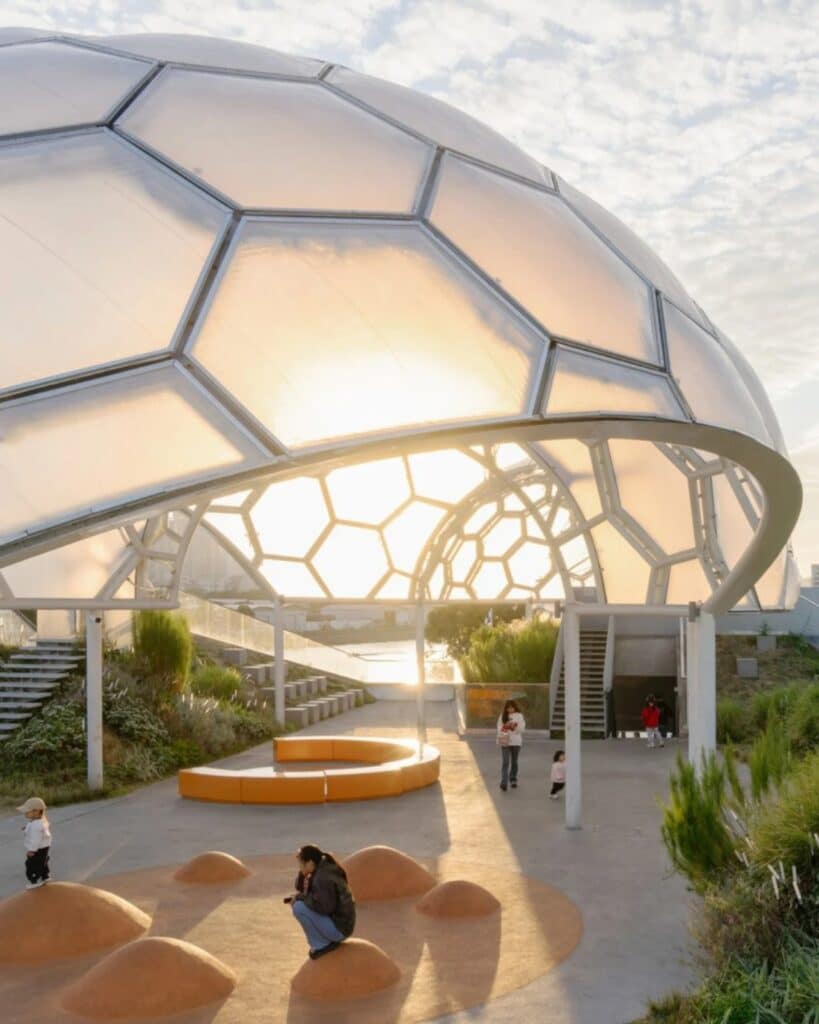
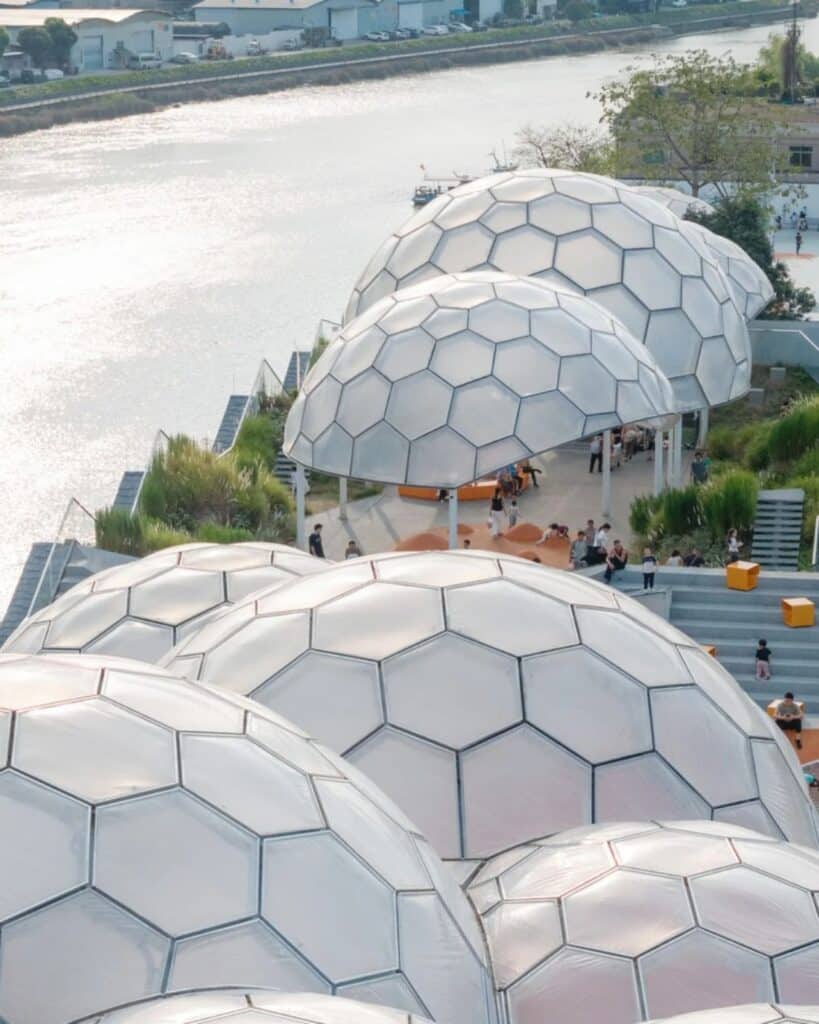
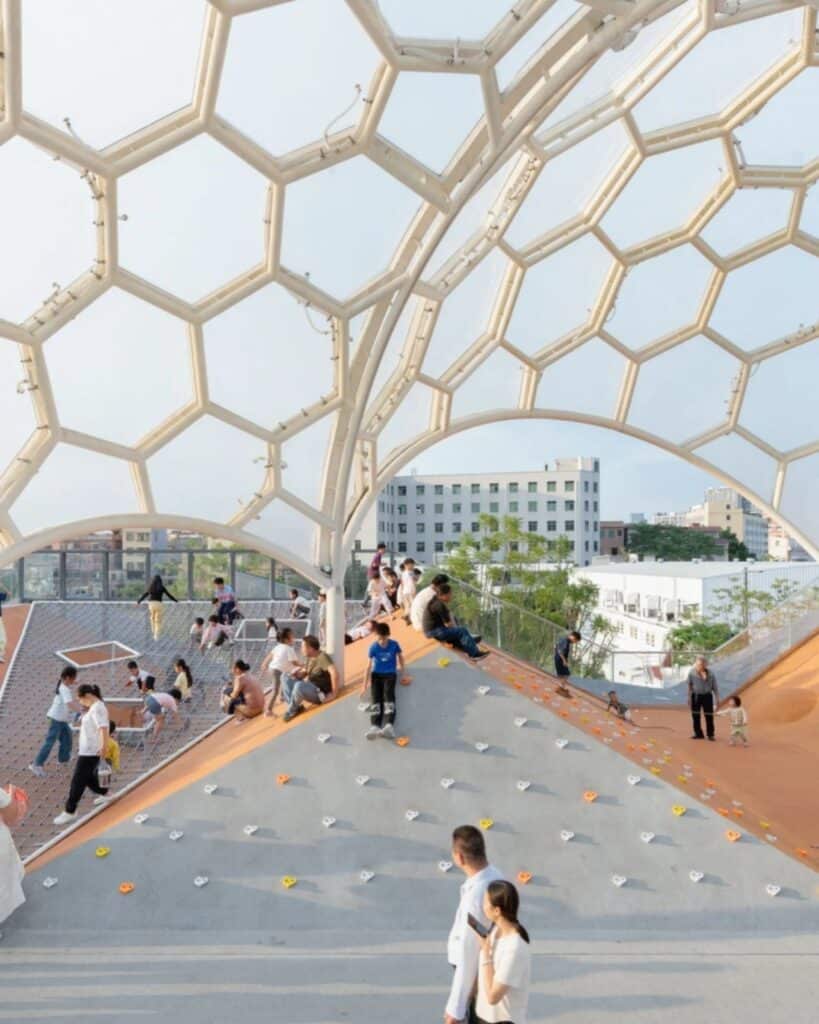
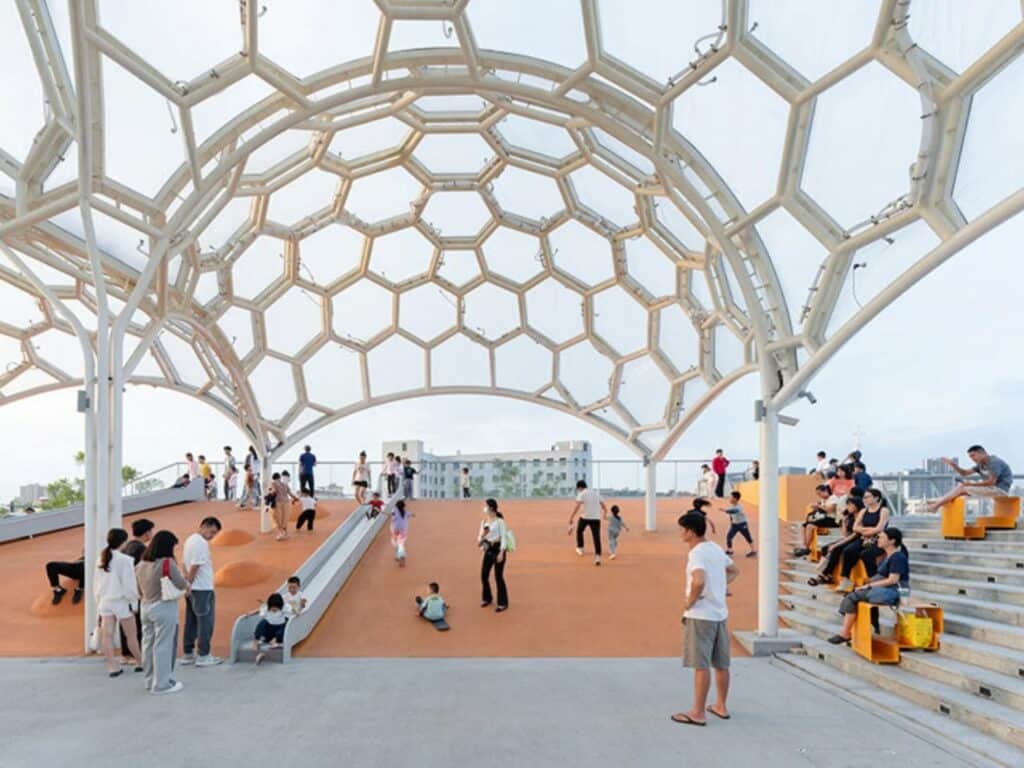
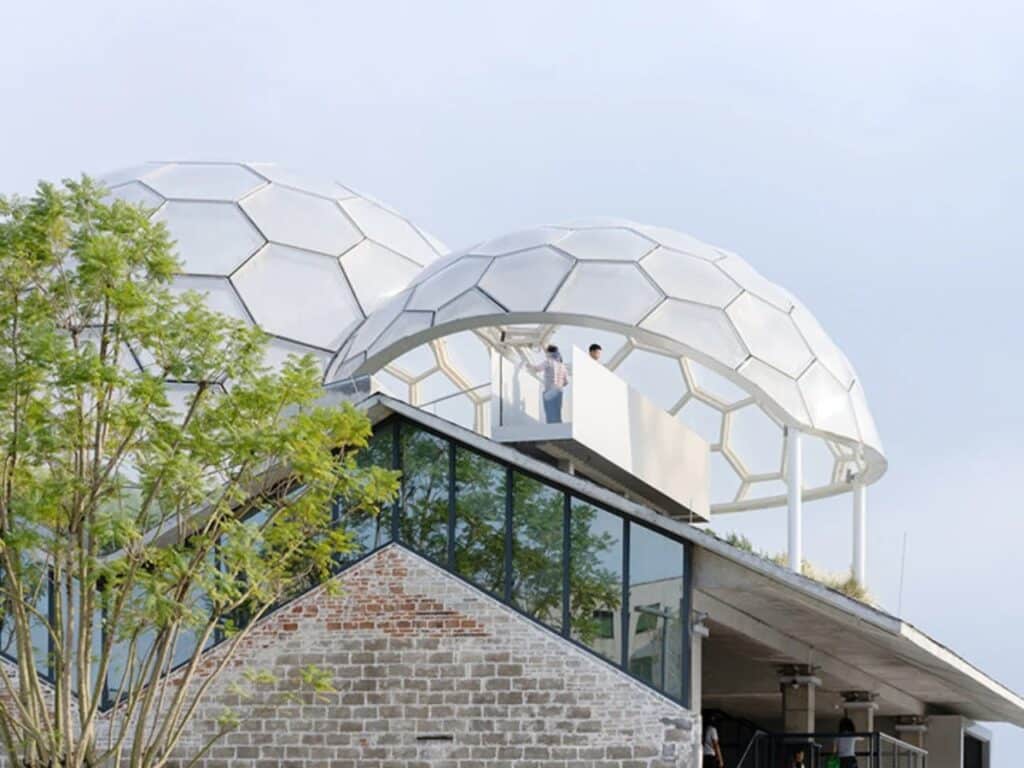
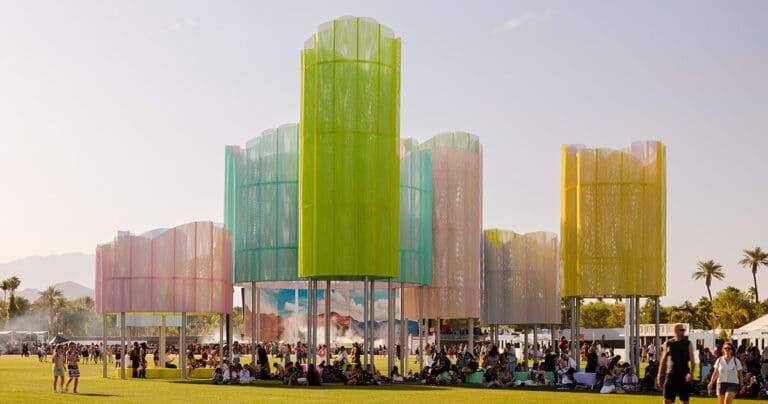
The canopies appear as an element covering the roofline through a series of transparent dome structures built from hexagonal frames. These elements are arranged across the roof in a sequential pattern resembling lightweight formations. Visually, these domes diffuse light and create soft shadows without obstructing the view of the river. At the same time, they provide multiple zones for seating, movement, and activities without enclosing or isolating the space, remaining subtly integrated within it.
Shaping the Roof as an Extension of Structural Memory
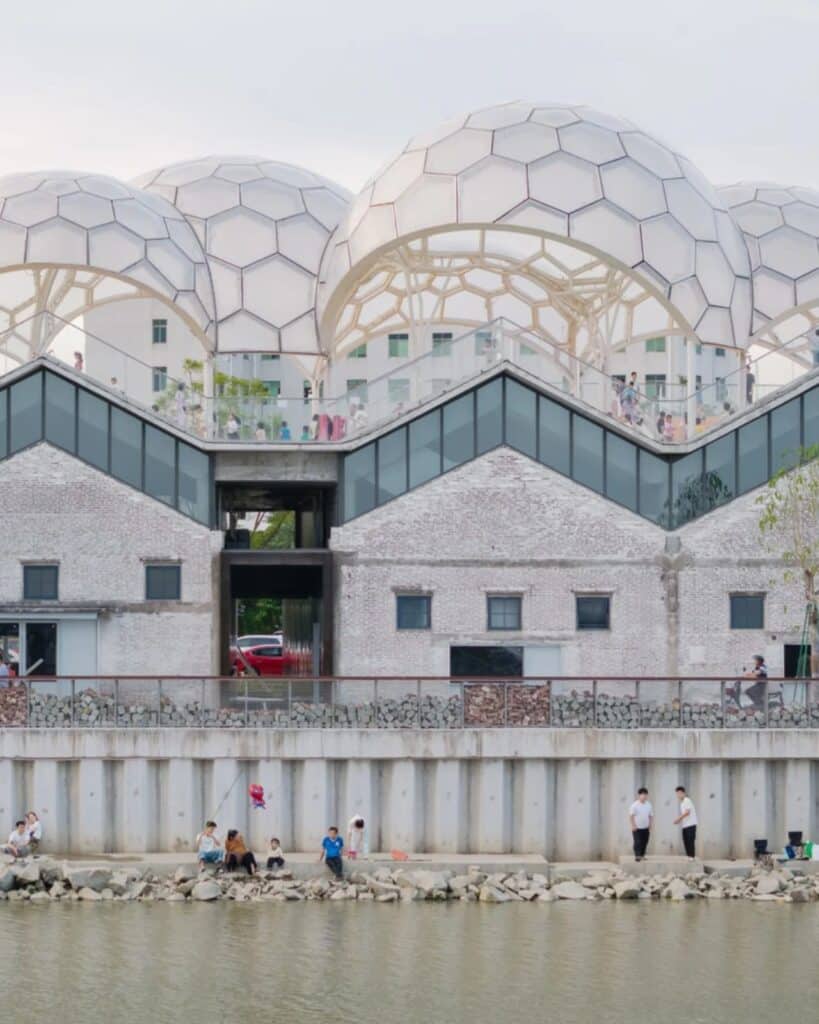
The roof is designed as a composition of slopes, stepped surfaces, and usable areas, reflecting the inclination of the original warehouse roofs. This configuration is not presented as a separate element but as a continuation of the existing Building Materials characteristics. As a result, the intervention becomes part of reading the previous structure rather than an independent addition. In this way, the trace of the original building is preserved within the new composition, while simultaneously engaging it in a direct relationship with the introduced functions.

Reuse and the Relationship Between the Existing Building and the New Intervention
The Yongping project demonstrates a balanced approach to adaptive reuse of industrial buildings, where the new Design does not dominate the original structure, but instead allows the old building to remain present as a defining element of the overall composition. The warehouses continue to play a fundamental role in shaping rhythm and circulation paths, while also contributing to the project’s visual language. In this way, the building is not treated as a neutral backdrop, but as an active framework that can be perceived without requiring an explicit reading of its history.
The Evolution of Atelier cnS’s Approach to Adaptive Reuse
This project sits within a broader developmental trajectory in the work of Atelier cnS, which has previously explored concepts related to public movement across rooftops and the reactivation of existing voids. Among these earlier works is the White House Guesthouse project, which introduced an early exploration of this direction. Within this context, the Yongping project appears as a more mature stage, where the intervention is characterized by greater precision and deeper integration with the surrounding Cities fabric, without a clear separation between the old and the new. For further Research on adaptive reuse strategies, and to stay updated with the latest Architectural News, you can explore the Archive for more case studies and discussions on similar transformations.
Site Scale and the Role of Public Use
The project spans an area of 4,311 square meters and fundamentally raises a question that extends beyond the boundaries of direct architectural intervention. Converting a renovated commercial building into an accessible rooftop public park reflects a shift in the building’s function within a context where the industrial character of the district is gradually fading. Within this framework, the space is not presented as a private or enclosed element, but as part of the public realm connected to the surrounding neighborhood.
The Relationship Between Architecture and Public Visibility
The architectural condition here does not treat the building as a mass that needs to assert itself visually, but rather as an element performing a specific function within a changing environment. The project demonstrates a level of restraint in its presence, where the organizational idea remains more prominent than direct formal expression. At the same time, public use remains the dominant factor in shaping the spatial experience. This approach aligns with contemporary Interior Design principles that prioritize user experience over pure form, and invites Discussion within the architectural community about the role of public accessibility.
A Final Reading of the Overall Form
The architectural composition concludes with a roof carrying a series of transparent domes, functioning as a light covering layer over the landscape. From a distance, this extension appears as a visual element connected to the river without overpowering the original structure. In this way, the project emerges as a condition that combines adaptive reuse with a quiet integration into its surrounding context.
✦ ArchUp Editorial Insight
Along the Huadi River corridor in Foshan, the Yongping Warehouse Renovation project functions less as an independent architectural decision and more as an urban recalibration of underutilized industrial land. The primary driver here is the transformation of obsolete grain storage assets within a Pearl River Delta development policy that prioritizes land-value activation and the reintegration of riverfront edges through adaptive reuse rather than demolition. The constraints are evident in structural preservation requirements, regulatory setbacks along the riverbank, and the economic pressure to embed commercial functions within an existing framework without significantly increasing Construction costs. The spatial resolution emerges through a vertical distribution of program: commercial activities at ground level, overlaid with a public layer on the roof, where the existing structure is reconfigured into a device for organizing movement rather than acting as a purely formal envelope. The canopy system operates as an intermediate mechanism, regulating visual exposure without increasing spatial isolation, reflecting a negotiated balance between commercial return logic and the requirements of public accessibility. For more insights on innovative Projects and Architecture Competitions, you can browse the Archive for relevant case studies and outcomes.

★ ArchUp Technical Analysis
Technical and Documentary Analysis of the Yongping Warehouses Renovation Project – Foshan, China:
This article presents an architectural analysis of the Yongping Warehouses renovation project as a case study in the adaptive reuse of abandoned industrial buildings on riverfronts. To enhance its archival value, we would like to present the following key technical and design data.
The project was completed in 2025 by Atelier cnS in Dali Town, Nanhai District, Foshan, along the Huadi River, with a total area of 4,311 square meters. A group of old grain storage warehouses was transformed into an architectural project while preserving the old building as a defining element of the overall composition, where the spaces between the warehouse blocks were preserved and expanded to function as internal passageways.
Part of the public program was elevated by creating a rooftop garden above the ground-floor commercial spaces, with the roof designed as slopes, steps, and usable spaces that reflect the pitch of the original warehouse roofs. The roof is covered with transparent domed canopies built from hexagonal frames assembled in a sequential manner, providing multiple areas for sitting, movement, and activities while diffusing light and casting light shadows without blocking the river view, transforming at night into illuminated lanterns.
The project maintains the river-facing facade with the industrial rhythm of the original warehouses while updating it with contemporary glazed facades.
Related Insight: Please refer to this article to understand the context of modern architectural preservation:
Adaptive Reuse of Industrial Buildings on Waterfronts: Strategies for Conversion into Public Spaces.


✅ Official ArchUp Technical Review completed for this article.