The Building Never Sleeps: Why Bedrooms Need a Night Commissioning Test

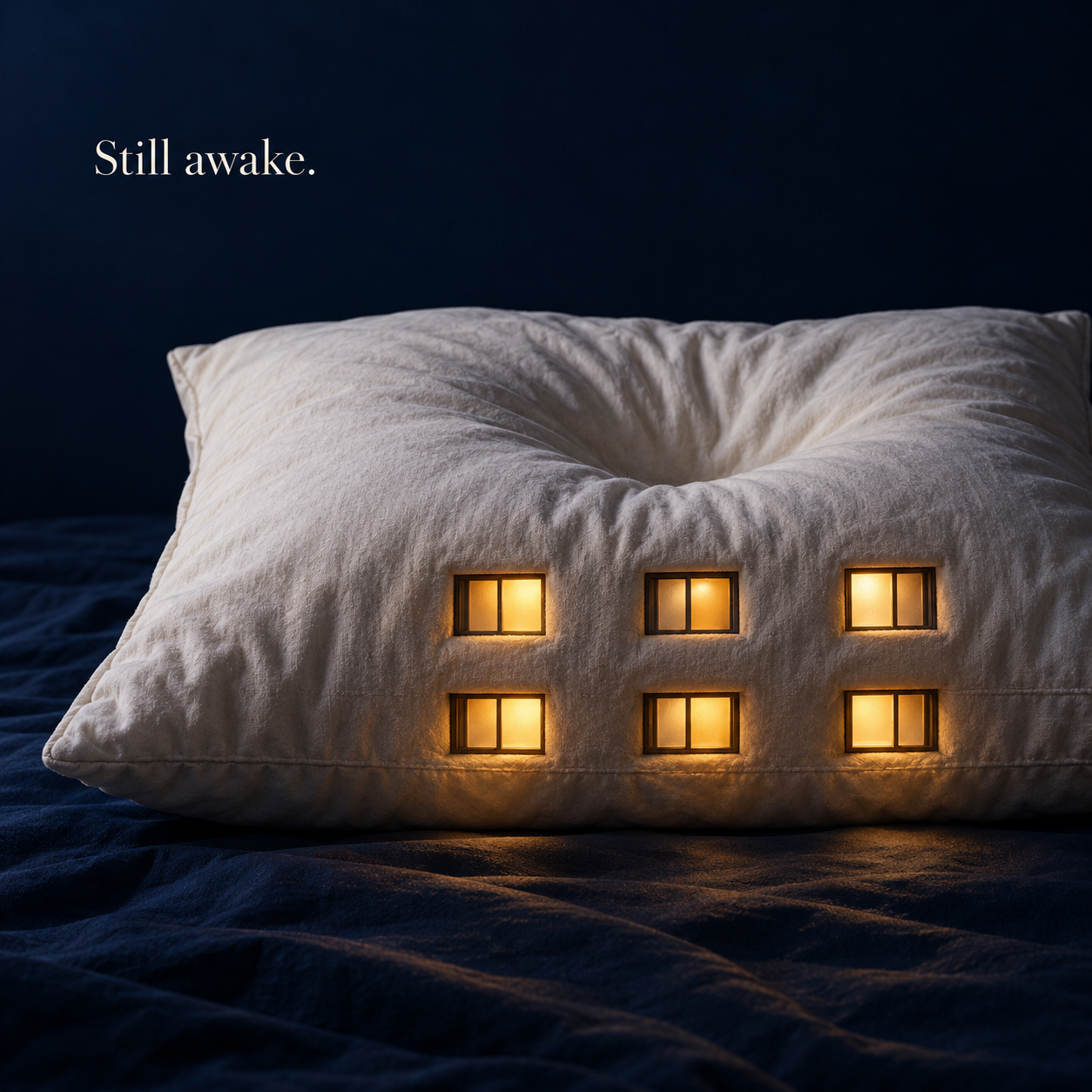
A bedroom can comply with a lighting schedule and still expose its occupant to biologically meaningful light. The reason is not that conventional illuminance is useless. It is that visual adequacy and circadian response are different design questions, measured at different times and often from different positions.
This research-led analysis connects experimental chronobiology to one architectural decision: how a bedroom should be commissioned at handover. The proposed night test is an ArchUp hypothesis for project verification. It was not tested by the cited researchers, and it is not a medical prescription.
What the laboratory study measured
Andrew J. K. Phillips and seven colleagues studied 55 healthy adults aged 18–30 across 351 laboratory nights. Participants received a dim-light control below 1 lux and evening exposures between 10 and 2,000 photopic lux for five hours. The researchers repeatedly measured salivary melatonin and built dose–response curves within individuals.
The group-level light dose associated with half-maximal melatonin suppression was 24.6 lux. Yet the individual estimates ranged from 6 lux in the most sensitive participant to 350 lux in the least sensitive. Exposures at 10, 30 and 50 lux also produced apparent melatonin onsets 22, 77 and 109 minutes later, respectively.
Those numbers require careful language. The study measured melatonin suppression during a controlled evening exposure; it did not demonstrate that a particular bedroom causes disease, or that every occupant will sleep poorly at 24.6 lux. The later “apparent onset” partly reflects suppression obscuring the measured rise in melatonin and should not be read automatically as an equal shift of the internal clock.
What happened in real homes
Sean W. Cain and colleagues later monitored 163 evenings from 59 adults in Melbourne homes using wearable spectrophotometers positioned near the upper body. They combined those recordings with individual dose–response data from a separate laboratory sample. Their model predicted that 48% of the monitored homes produced enough evening light for at least 50% melatonin suppression in an average sensitivity calculation. For the median-brightness home, the predicted response ranged from 0% to 87% across individual sensitivities.
Greater evening light relative to a participant’s own average was associated with more wakefulness after bedtime. The study also reported nearly twice the melanopic illuminance in homes using energy-efficient sources compared with homes using incandescent lighting. That comparison should not be turned into a recommendation to return to inefficient lamps: source spectrum, output, distribution, controls and duration can all be designed, whereas lamp category alone does not determine exposure.
Limits that matter to architecture
The laboratory participants were young adults under a fixed five-hour protocol. The home study was observational, conducted during Melbourne autumn and winter, and used a chest-area sensor as a practical proxy rather than a continuous measurement at the cornea. Its predicted suppression combined field measurements and dose–response curves obtained from different participants. Association with wakefulness did not prove that lighting alone caused it. The authors also disclosed research funding or consulting relationships involving lighting and building-wellness organisations; disclosure does not invalidate the work, but it belongs in a critical reading.
A 2022 expert consensus led by Timothy M. Brown translated the wider evidence into melanopic equivalent daylight illuminance, or melanopic EDI. It recommended more than 250 lux during daytime at the eye, below 10 lux during the three hours before habitual sleep, and below 1 lux during sleep for healthy adults. These are consensus recommendations rather than results of a single clinical trial. The authors explicitly noted differences involving age and other groups, and that visual safety can take priority where requirements conflict.
Architectural proposition: commission the bedroom twice
A conventional handover may confirm installed fittings, switching, dimming and horizontal illuminance. ArchUp proposes a separate night-scene test for bedrooms in houses, hotels and inpatient rooms. The purpose would be to document what reaches the likely eye position during actual use, including light from corridors, bathrooms, controls, equipment, façades and external sources.
The test should not declare a room “circadian safe.” Individual sensitivity is too variable for that claim. It could instead verify whether the project delivers its own defined night condition and whether the lighting system can reduce exposure without compromising movement, caregiving or emergency safety.
How the proposition could be tested
- Define scenes before procurement. Specify daytime, evening, sleep and necessary night-movement scenes, with operating hours and control responsibilities.
- Measure at the occupant. Record vertical photopic illuminance and melanopic EDI at representative eye positions: seated, standing and lying in bed. Document spectrum, direction and duration rather than relying on a ceiling plan alone.
- Test the whole route. Operate corridor doors, bathroom lighting, bedside controls, screens and required equipment. Include façade and blackout conditions after exterior lighting is active.
- Preserve safety. Evaluate steps, obstacles, caregiving tasks and emergency operation. A low biological-light target cannot override safe movement or clinical need.
- Compare alternatives. In a representative room, compare the specified night scene with the standard scene using repeated measurements. For research projects, pre-register a crossover study using personal light sensors, actigraphy and sleep reports; melatonin sampling would require appropriate ethics and expertise.
- Record exceptions. Document users, operational periods or clinical tasks for which the general scene is unsuitable, and keep manual override and maintenance logic visible.
The architectural hypothesis would gain support if the night scene reliably lowers eye-level melanopic exposure while maintaining predefined visual and safety performance. It would not prove a health benefit by itself. That would require a sufficiently powered intervention study with sleep or circadian outcomes and a population matching the intended users.
✦ ArchUp Editorial Insight
Energy targets and procurement schedules reward lighting systems that deliver required output efficiently, while handover typically verifies equipment and visible performance during working hours. This decision structure can leave the bedroom’s night condition without an institutional owner: the consultant specifies fittings, the contractor demonstrates operation, and the operator later chooses scenes, schedules and overrides. None of these actions is inherently negligent; each follows a different brief. The research on individual sensitivity makes the gap consequential because an “average” compliant scene cannot describe every occupant’s biological exposure. ArchUp therefore proposes treating night-scene commissioning as a governance instrument rather than a wellness label. The employer would define who approves evening and sleep modes, the commissioning agent would measure at representative eye positions after exterior and adjacent spaces are active, and the operator would receive the control logic as an auditable handover item. This remains an unproven project mechanism: the cited studies did not test contracts or commissioning protocols. Its value is that it keeps the consequence attached to the decision chain. Without it, the party selecting or value-engineering controls may leave before night operation is observed, while guests, patients or residents inherit an exposure that conventional daytime acceptance never measured.
References
- Andrew J. K. Phillips, Parisa Vidafar, Angus C. Burns, Elise M. McGlashan, Clare Anderson, Shantha M. W. Rajaratnam, Steven W. Lockley and Sean W. Cain. High sensitivity and interindividual variability in the response of the human circadian system to evening light. Proceedings of the National Academy of Sciences, 2019.
- Sean W. Cain, Elise M. McGlashan, Parisa Vidafar, Jona Mustafovska, Simon P. N. Curran, Xirun Wang, Anas Mohamed, Vineetha Kalavally and Andrew J. K. Phillips. Evening home lighting adversely impacts the circadian system and sleep. Scientific Reports, 2020.
- Timothy M. Brown, George C. Brainard, Christian Cajochen, Charles A. Czeisler, John P. Hanifin, Steven W. Lockley, Robert J. Lucas, Mirjam Münch, John B. O’Hagan, Stuart N. Peirson and colleagues. Recommendations for daytime, evening, and nighttime indoor light exposure to best support physiology, sleep, and wakefulness in healthy adults. PLOS Biology, 2022.