Busan Oryukdo Tram: Transit as Urban Spectacle

Breaking the Visual Constraint and Reframing Urban Space
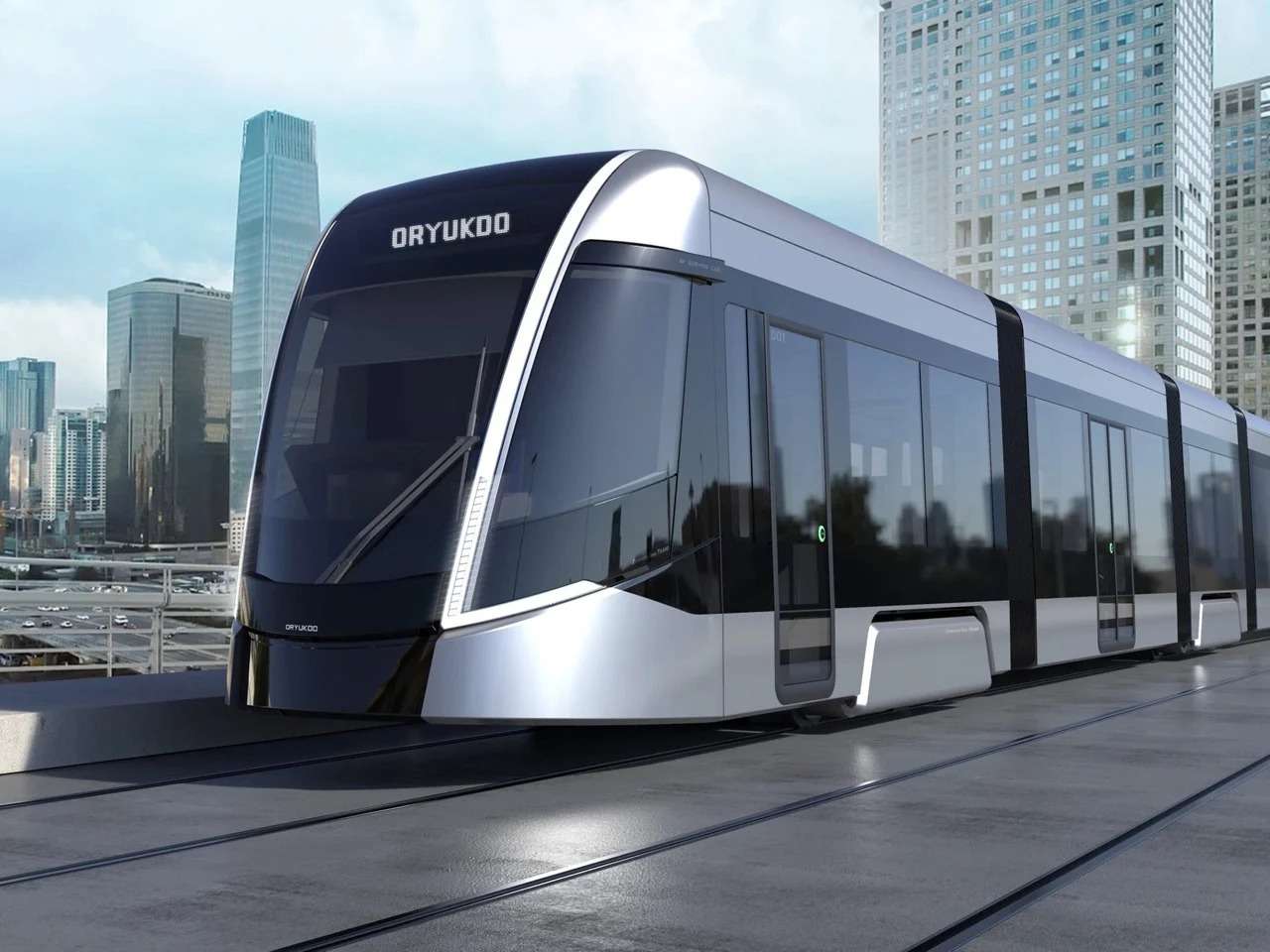
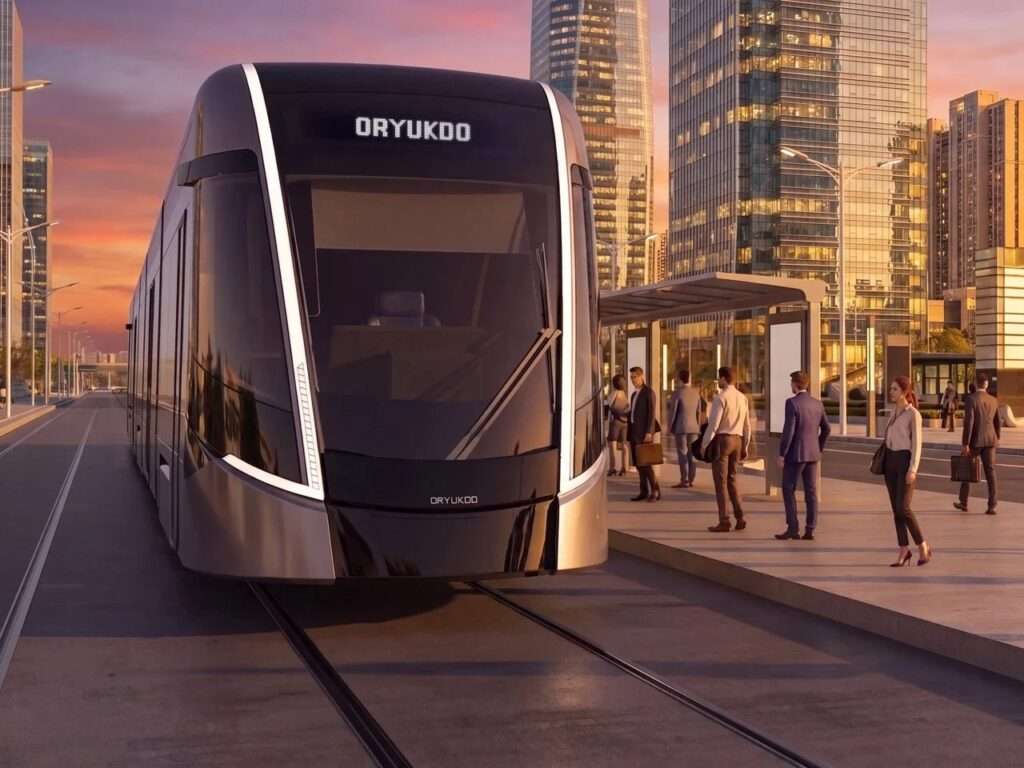
The Busan Oryukdo Tram moves as an independent sculptural mass that redefines the image of public transportation. Its most defining feature lies in the complete removal of traditional overhead catenary systems. This engineering shift reduces visual clutter in the urban environment and restores clarity and continuity to the sky, granting squares and streets a more open presence and a clearer vertical extension.
Rather than being perceived as an intrusive visual element, the tram becomes an integrated part of the urban fabric, moving smoothly through the city while drawing on global precedents in ground-level power supply systems such as Alstom APS used in Bordeaux and Nice, alongside similar limited urban implementations elsewhere.
Dynamic Mass and Reflective Surfaces Dialogue
The identity of the tram is expressed through a curved, fluid frontal façade that relies on dark panoramic glazing wrapping around a silver metallic structure, enhancing visual depth while reducing exposure of the driver’s compartment.
Polished metal surfaces establish a shifting relationship with light, reflecting the surrounding environment and urban motion as interconnected tram units move through flexible articulations.
This precise material and surface treatment elevates the vehicle from a functional transport unit into a highly refined design object, aligning with Busan’s ambition to strengthen its presence as a design-driven city competing with major global urban centers.
Human Experience and Horizontal Spatial Transition
The interior experience is based on seamless accessibility and fluid movement, enabled by a fully low-floor configuration that minimizes barriers during entry and circulation.
Users move through the cabin between the three tram modules via flexible gangways that allow continuous visual and kinetic flow, reinforcing a sense of spatial connectivity.
Large windows further enhance visual openness, transforming daily travel into a perceptual urban experience where passengers engage directly with the surrounding cityscape.
Visual Scenography and Dynamic Surface Dialogue
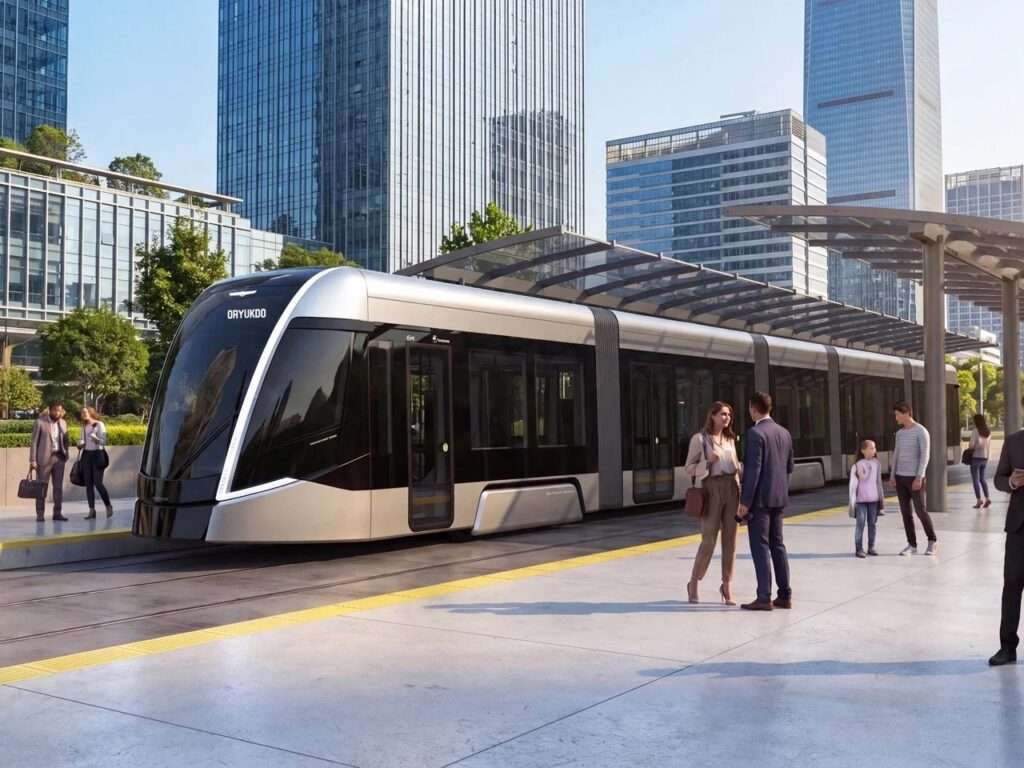
The external composition transcends technical function to establish a strong Visual Scenography presence within the city. The frontal shell tilts at a sharp angle, drawing its language from aerodynamic aviation-inspired design.
Despite the contradiction between this “dynamic” aesthetic and the tram’s relatively limited operating speed, its aesthetic value emerges at the level of urban perception and pedestrian experience.
The contrast between dark glazing and the silver structure produces a strong visual identity, distinguishing the tram from conventional rolling stock.
Mass Continuity and Framing of Luminous Identity
The tram is perceived as a continuous unified mass through precise detailing of surfaces and joints, where flexible connections are visually minimized to enhance structural cohesion.
This creates the impression of a single extended form composed of three connected vehicles functioning as one continuous body.
A linear lighting system integrated into the front façade reinforces this perception, forming clear luminous lines that give the vehicle a distinctive nighttime presence and strengthen its continuous visual identity.
Reflective Finish Interaction with the Urban Horizon
The Reflective metallic surface acts as an interactive layer that merges movement with the surrounding urban fabric. It functions not merely as an external shell but as a visual medium that reflects the city in motion.
Glass buildings and towers appear as a constantly shifting layer across the tram’s surface, establishing a continuous dialogue between the vehicle and the urban landscape.
In this way, the tram becomes a dynamic visual agent that re-produces the city’s image while moving, rather than simply passing through it.


Interior Space Transformation from Industrial Environment to Urban Lounge
The Interior Space Transformation shifts away from traditional industrial aesthetics toward a calmer and more visually organized interior environment, based on neutral tones and illuminated spaces that enhance spatial openness.
Color accents (red and visual indicators) are used for functional guidance, while differently colored seating elements introduce visual balance within the space.
As a result, the interior becomes a compact urban lounge, more comfortable, legible, and visually refined.
Visual Extension and Transparency with the Urban Fabric
Full-height glass façades enable a direct relationship between interior and exterior, offering passengers a continuous panoramic view of the city.
This transparency is integrated with digital display systems that provide information without compromising spatial clarity.
The low-floor design further enhances accessibility and ease of movement, particularly for people with disabilities and strollers.
Connected Space and Kinetic Fluidity
Connected Space and Kinetic Fluidity between tram units eliminate the perception of internal segmentation, creating a continuous space that allows smooth movement throughout the vehicle during operation.
This connectivity enhances a sense of openness rather than traditional compartmentalization, turning internal circulation into part of an ongoing urban experience that reflects the rhythm of the city itself.

Urban Hegemony and the Reconfiguration of Inter-City Relations
The catenary-free transport systems represents a notable step in the evolution of transport infrastructure, particularly given the still limited global diffusion of such solutions. Its implementation in Busan acquires a symbolic urban dimension, especially as the city introduced this type of project ahead of the capital, Seoul, reflecting a shift in the distribution of urban initiatives between center and periphery rather than a direct form of “supremacy.”
This system is embedded within a broader context in which Busan seeks to strengthen its international presence through multiple cultural and infrastructural projects, such as its 2030 Expo bid, its film festival, and the expansion of its port capacities. These initiatives integrate with modern transport projects to construct the image of a city with escalating global ambition.
Industrial Design Philosophy and Material Strategy (CMF)
The Industrial Design Philosophy of the Busan Oryukdo Tram project treats the vehicle as an integrated design system that goes beyond the conventional commercial character of modern transit vehicles. The design office developed a precise Color, Material, and Finish (CMF) strategy aimed at balancing functional performance with visual identity.
This approach does not aim to produce a transient visual effect, but rather to establish a relatively stable material language capable of maintaining clarity and aesthetic value within rapidly changing urban environments.
The Mobile Ambassador and the Redefinition of Urban Image
The tram transcends its role as a transportation medium to become a moving visual element within the city, contributing to the construction of its daily image and its visual reinterpretation in motion.
The reduction of the mass into a pure, coherent form, combined with the absence of traditional overhead wiring, grants it a clear visual presence within the urban fabric, positioning it closer to a Mobile Ambassador than a conventional vehicle.
The interaction between interior and exterior, mediated through reflective surfaces and transparent façades, creates a continuous relationship between the user and the Urban Image, transforming the journey into a perceptual experience tied to the rhythm of the city rather than a purely functional transfer.
✦ ArchUp Editorial Insight
The Busan Oryukdo Tram is reframed as an urban device that merges infrastructure with visual representation through the removal of overhead wires in favor of a clean visual surface that reshapes the perception of the street. The design integrates material strategy, reflective façades, and low-barrier mobility to transform transportation into a tool for re-producing the city’s image within a broader urban competition driven by image-making and functional efficiency.
However, this aesthetic framing tends to overemphasize the centrality of visual experience while underestimating the weight of operational infrastructure. Catenary-free systems rely on complex and costly ground-based infrastructure with high maintenance demands, limiting scalability beyond controlled pilot corridors. Furthermore, the emphasis on reflective surfaces and design identity obscures challenges related to reliability, battery degradation, and performance variability in large-scale urban network operations.