Charleroi Palais des Expositions Revamp Wins Mies van der Rohe Award 2026


The European Union Prize for Contemporary architecture 2026 has honored the transformation of the Charleroi Palais des Expositions in Belgium. The project revives a neglected mid-century complex through adaptive reuse. Moreover, it highlights structural clarity and cultural renewal within a limited budget.
Adaptive Reuse Anchors the Winning Project
The Mies van der Rohe Award, presented biennially since 1988, selected the Charleroi renewal from 410 entries. The project reactivates a 1950s exhibition complex built during Belgium’s postwar reconstruction. However, decades of industrial decline left the vast halls underused and fragmented.
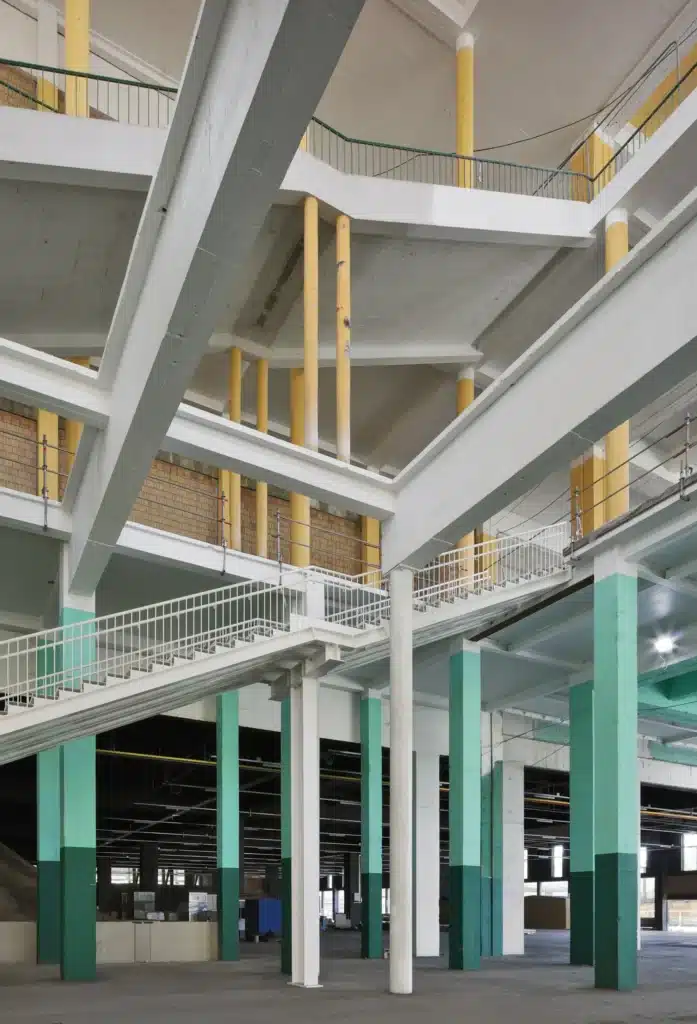
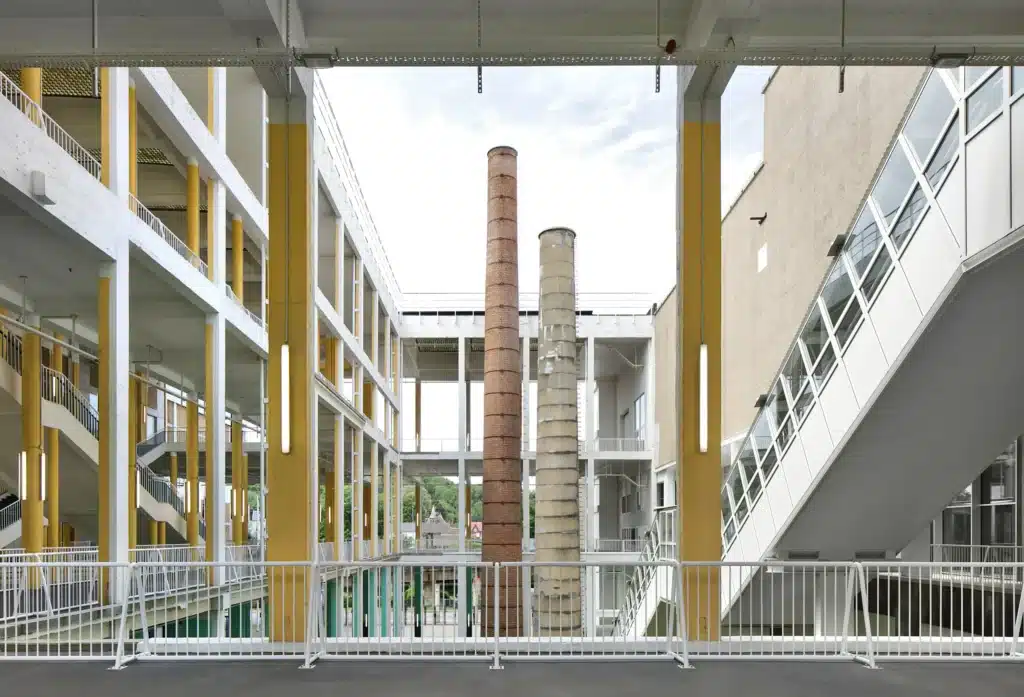
The redesign favors reduction over replacement. Teams removed selected sections and exposed the original concrete skeleton. As a result, the structure now frames covered outdoor areas around a central atrium. Preserved industrial chimneys anchor the space in its coal-era memory. This strategy positions the project within broader debates on reuse in construction and existing buildings.
Structural Clarity and Public Space
The renewed foyer reveals its raw concrete frame and organizes three public levels around the atrium. Monumental staircases connect these levels and improve circulation. Meanwhile, the open structure increases natural light and visual continuity.
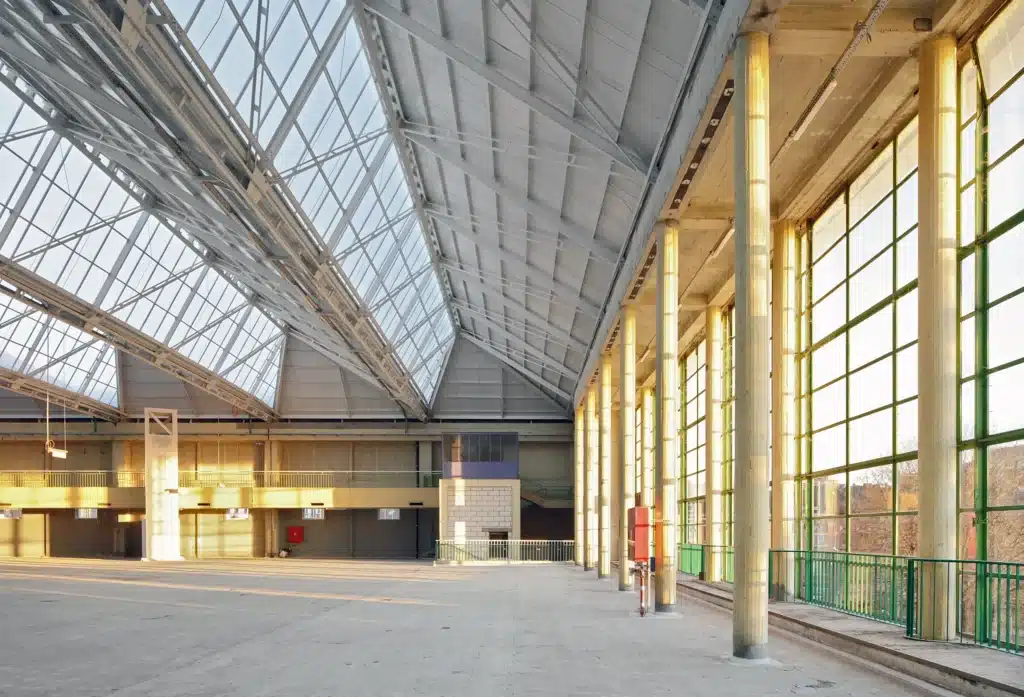
The 50,000 square meter complex now supports flexible programming. Some halls accommodate exhibitions and public events. Others function as meeting areas, an auditorium, or temporary parking. Therefore, the site adapts to changing civic needs without major structural additions. The approach reduces demand for new building materials and strengthens long-term sustainability.
Landscape Integration and Urban Impact
The project also rethinks the surrounding landscape. Designers removed mineralized surfaces and introduced continuous green areas. Consequently, the site now connects more clearly with adjacent neighborhoods. This move reinforces its role within Charleroi’s broader urban planning framework.
The intervention treats the complex as architectural archaeology. It preserves traces of postwar optimism while enabling contemporary use. Meanwhile, selective demolition limits waste and controls costs. The result demonstrates how European cities can reactivate large-scale modernist structures instead of replacing them.
The award ceremony will take place in May at the Mies van der Rohe Pavilion. The announcement has already generated significant attention across international news platforms.
A Quick Architectural Snapshot
Project: Renewal of Charleroi Palais des Expositions
Location: Charleroi, Belgium
Size: 50,000 square meters
Strategy: Selective demolition and structural exposure
Focus: Adaptive reuse, flexibility, and sustainability
Award: Mies van der Rohe Award 2026 winner
✦ ArchUp Editorial Insight
The selection of this project reflects a shift in European economic priorities and urban management strategies. Architecture functions here as a symptom of tightening municipal budgets and the exhaustion of greenfield development options. The decision to retain the existing concrete skeleton is not a stylistic choice but a response to the rising costs of raw building materials and carbon taxation. By stripping the structure instead of demolishing it, the city addresses the fiscal burden of industrial decay without the capital expenditure required for new construction. The project mirrors a broader behavioral change in governance where the preservation of embodied energy takes precedence over the creation of new landmarks. This intervention is the logical outcome of industrial stagnation + climate regulation + public funding constraints.