Nanotectonics of Hidden Networks: How the Physics of Confined Molecular Channels Reimagines Building Infrastructure from Within

When Narrowness Becomes a Virtue
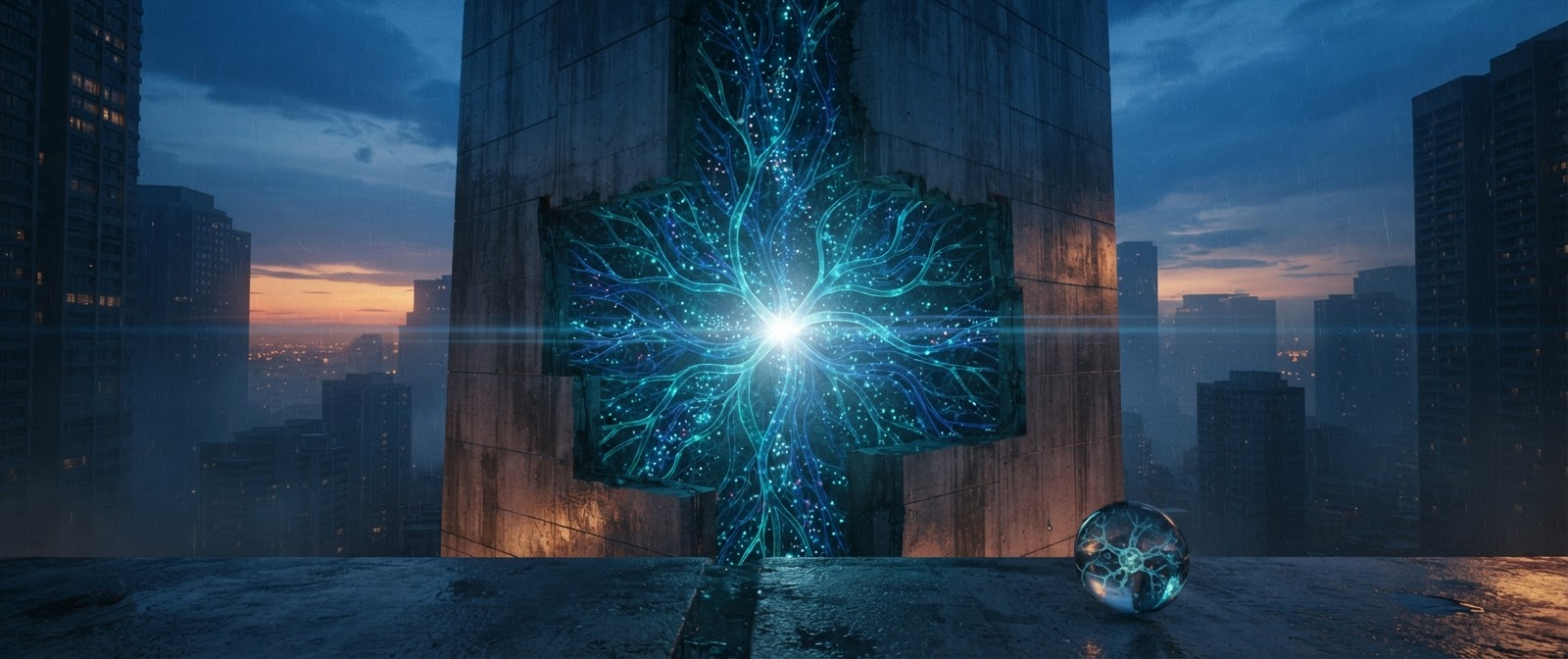
For two centuries of architectural practice, the profession has repeated a single axiom: if you need to move more, widen the pipe. More water? Larger diameter. Cleaner air? Broader duct. Faster data? Thicker cable. Yet a remarkable physical phenomenon is now cracking this axiom wide open, demonstrating with startling clarity that narrowness — not expansiveness — is what accelerates flow and drives efficiency to rates the conventional engineering mind struggles to accept. Deep within molecular physics, researchers have found that the hydrogen ion — the proton — when squeezed into a channel millions of times narrower than a human hair, does not slow down as logic would predict. It accelerates, reaching speeds roughly forty times faster than in open water. The secret is confinement itself: the extremely narrow channel forces water molecules into a single orderly file, transforming water from a chaotic medium into a “molecular railway” along which the proton hops with almost zero friction. This discovery does not belong to chemistry laboratories alone. At its core, it is a design principle capable of overturning our understanding of the most complex problem facing supertall buildings and vertically compacted cities: how to deliver life — water, air, energy — from base to summit without consuming the building from the inside out.
The Leap That Defies Logic: Grotthuss Mechanics in a Tube Invisible to the Eye
To understand how this principle might migrate from the physics laboratory to the architect’s studio, we first need to grasp the phenomenon itself in accessible terms. In an ordinary glass of water, the proton does not swim the way a grain of sand drifts in a pond. The hydrogen proton is an almost massless entity carrying a positive charge. More than two centuries ago, Theodor Grotthuss demonstrated that this proton moves in a manner unlike any other ion: it does not travel physically through the water but “hops” from one water molecule to the next along hydrogen bonds, like an electrical spark passing through a chain of clasped hands without any of the hands moving from their positions. This mechanism, detailed with precision by Miyake and Rolandi in their landmark review of Grotthuss mechanisms and their applications in bioprotonic devices, grants the proton a mobility roughly ten times greater than any other positive ion in ordinary water.
The picture grows more compelling when this water is confined inside a nanochannel. Dellago, Naor, and Hummer ran computational simulations of carbon nanotubes with diameters no greater than eight angstroms — a bore wide enough to accommodate only a single file of water molecules. The result was extraordinary: water molecules inside this tube spontaneously aligned into a perfect single-file chain, their electrical dipoles oriented in one direction, turning the tube into what amounts to a “superconducting rail” for protons. The proton diffusion coefficient inside this single file exceeded its counterpart in open water by roughly a factor of forty. The reason is not that individual hops are necessarily faster, but that the forced alignment eliminated disorder: the proton no longer had to search for its next hopping partner amid a random crowd of molecules. It found before it a single straight path with no interference and no branching.
Laboratory experiments then converted this theoretical prediction into a measurable reality. Tunuguntla and his team succeeded in inserting carbon nanotube porins with a diameter of 0.8 nanometers into synthetic lipid membranes and measured the rate of proton transport through a single channel. The results confirmed that these single-file channels transport protons at rates exceeding all known biological proton channels, and even surpassing Nafion membranes, the gold standard in hydrogen fuel cells. When the diameter was widened to 1.5 nanometers — less than double the original — the advantage collapsed entirely, and transport reverted to ordinary open-water rates. The message was unambiguous: extreme confinement is the decisive structural condition for ultrafast conduction.
The Proton That Builds Its Own Path: When the Traveler Becomes the Infrastructure Builder
Among the most compelling findings in this field is the discovery that the proton is not merely a “passive traveler” waiting for a ready-made water corridor to appear. In multiscale reactive molecular dynamics simulations conducted by Peng, Swanson, Kang, Zhou, and Voth, the proton, upon approaching the mouth of a hydrophobic nanochannel — a completely dry channel containing no water — does something no other ion can do: it shoves water molecules ahead of itself into the channel through a variant of the Grotthuss hopping mechanism, creating a transient water wire and then crossing it. Other ions such as potassium do the exact opposite — they block water entry and keep the channel dry — because they lack the proton’s ability to delocalize its charge across the hydrogen-bond network. This “proton-induced wetting” lowered the free-energy barrier for permeation from more than 36 kilocalories per mole in the dry state to roughly 18 kilocalories per mole — a reduction by half.
This concept moved from computational simulation to biological experimental verification in the hands of Kratochvil, Watkins, Mravic, and their team, who designed artificial transmembrane proton channels from pentameric helical bundles containing a polar proton-loading site adjacent to a twenty-angstrom hydrophobic pore. Reactive simulations demonstrated that the arrival of a proton triggers the formation of transient water wires spanning the entire hydrophobic gap, enabling Grotthuss conduction. The practical result was striking: these minimalist channels, designed from scratch, conducted protons at rates comparable to the influenza M2 proton channel, with selectivity exceeding one millionfold in favor of the proton over the sodium ion. The reason is elegant in its simplicity: a transient single-file water wire in a hydrophobic pore cannot host or stabilize a sodium or potassium ion surrounded by a bulky hydration shell, but it can pass a proton that needs no such shell.
The architectural projection of this principle runs deep. Imagine a service network embedded inside a building wall that operates only when summoned — channels that remain “dry” under normal conditions but activate and self-assemble when “demand” arrives (water, heat, current). These would not be permanently filled pipes consuming space and energy around the clock, but activation-based networks operating on a principle of “formation on demand,” exactly as the proton builds its water path the moment it arrives and the path vanishes after it crosses.
Wall Chemistry Controls Flow Direction: When the Channel Surface Matters More Than Its Diameter
One of the most consequential discoveries in this field is that “channel narrowness” alone is insufficient to achieve optimal transport; the chemical nature of the channel’s inner surface is what determines the mechanism, efficiency, and direction of transport. This shifts the subject from a question of pure geometric dimensions to one of “surface design” — a language the architect understands intimately.
In a comprehensive computational study by Duan, Ying, Tian, Cheng, and Shi on slit channels between various types of graphene sheets, a surprising result emerged: when the channel walls are made of pristine graphene — a smooth, hydrophobic surface — the confined water slips at enormous speed with almost no friction, but the hydrogen-bond network between its molecules fragments. In this regime, the proton moves by a “vehicular” mechanism, riding atop a fast-sliding water molecule rather than hopping between molecules — a mechanism that is rapid but chaotic and undirected. When the walls are instead coated with hydroxyl groups (as in hydroxygraphane), these groups supply additional hydrogen-bonding anchor points that keep the network intact even under extreme confinement, and the proton reverts to the orderly Grotthuss hopping mechanism. The inner surface of the channel thus functions as a “toggle switch” between two entirely different modes of transport.
Zhang, Song, Ruan, and their team went further still in their study of carbon nanotubes decorated with fluorine atoms — a simplified model of the channels found in perfluorosulfonic acid membranes used in fuel cells. They found that fluorination arranges water and hydronium molecules into alternating chains near the wall, lowers the free-energy barrier for hydronium entry while raising it for ordinary water, and suppresses the “bifurcated” hydrogen bonds that scatter the proton’s direction. In wider fluorinated tubes, a spiral-like sequential hydrogen-bond network formed, promoting directional long-range transport. The cooperative effect of confinement dimension and surface chemistry is what determines proton conduction efficiency — not either factor in isolation.
For the architect, this means that designing the “interior of the wall” — the inner lining of service channels — is not a secondary detail to be left to the contractor. It is a fundamental design decision that determines the efficiency of the entire building. Just as the inner membranes of nanochannels control the speed, direction, and mechanism of proton transport, the interior coatings of ventilation ducts, water pipes, and cooling channels can be re-engineered at the micro — and even nano — scale to direct flows, reduce friction, and exclude contaminants with a selectivity that mirrors the proton channel’s preference for protons over sodium.
The Molecular Valve: Channels That Permit Passage in One Direction Only
The next layer of this research addresses “rectifying” channels — channels that allow the proton to pass in one direction and block it in the reverse, functioning exactly like a check valve in a water pipe, but at the molecular level and without any moving parts.
Li, Zhang, Yu, and their team fabricated a hybrid nanochannel from a sub-nanometer metal-organic framework — specifically MIL-121 and MIL-53 — grown on one side of a polyethylene terephthalate polymer nanochannel. Molecular simulations revealed that water inside the narrow metal-organic framework pores organizes into ordered pentagonal and tetragonal hydrogen-bonded chains, while water in the wider polymer region remains disordered and random. At this junction — the transition point from disorder to order — the physics shifts decisively: density functional theory calculations showed that the energy barrier for proton transport from the disordered polymer water into the ordered metal-organic framework water is roughly half the barrier in the reverse direction. The result is proton rectification of up to five hundredfold, with proton conductivities one to two orders of magnitude above bulk hydrochloric acid solution, and high selectivity for protons over chloride, potassium, sodium, and lithium ions. Crucially, this effect vanishes entirely in symmetric cylindrical control channels — proving that the junction between two water structures of differing order, not mere pore geometry, is what generates unidirectional Grotthuss proton transport.
This concept — a valve with no moving parts that operates through the structural-order differential between two media — represents a prototype for what we might call “junction design” in building service networks. Instead of mechanical valves that fail, corrode, and require maintenance, designers could engineer junction points between channels with different surface structures that permit flow in one direction by the laws of physics alone — in cooling systems, natural ventilation networks, or even fine-grained sewage infrastructure.
The Façade That Generates Power: When the Proton Climbs Against the Current
Among the findings most likely to captivate the architect is the work of Xia, Zhou, Qu, and their team on lamellar films of MXene combined with polyvinyl alcohol. When a drop of water infiltrates the two-dimensional channels between the layers of this material — channels no wider than two nanometers — the water reacts with hydroxyl groups on the surface and releases protons. These protons, instead of following the water in the direction of its capillary seepage, do something unexpected: they diffuse in the opposite direction, climbing “upstream,” because their surface Grotthuss mobility is far faster than the sluggish movement of water inside the narrow channel. This separation between proton speed and water speed generates an electrical potential of up to four hundred millivolts from a single five-microliter water droplet, sustained for more than five and a half hours.
An architectural façade built from materials containing such two-dimensional channels ceases to be a “passive skin” shielding the building from rain and heat. It becomes an “energy-generating membrane” that harvests electricity from every raindrop and every shift in ambient humidity. This is not speculative fiction: the published experimental figures demonstrate that the principle works, and the engineering challenge lies in scaling up the effective surface area and developing materials durable and inexpensive enough to clad building façades.
Beyond Grotthuss: When the Atom Hops Through the Wall Itself
At still smaller scales — pores three to four angstroms in diameter decorated with carboxyl and hydroxyl groups — the picture transforms once more. Simulations by Cao, Zhou, Shen, Qiu, and Guo, combining quantum mechanics with reactive molecular dynamics, revealed a mechanism entirely distinct from conventional Grotthuss hopping: a “knock-on” mechanism in which an incoming hydronium forms a new covalent O–H bond with a functional group on the pore wall while simultaneously knocking the group’s original hydrogen onto the next water molecule — a concerted single-step covalent swap rather than a series of hydrogen-bond hops. The energy barrier for this mechanism — roughly 0.54 electron volts — represents one-third of the conventional hopping barrier through the same pore. More remarkably, this process produces distinctly nonlinear current-voltage curves with a “blocked gap” at low bias — a proton Coulomb blockade phenomenon arising from the single-proton charging energy combined with the covalent bond-switching barrier. This phenomenon disappears in wider pores — above 0.8 nanometers — where continuous water wires re-form and ordinary ohmic Grotthuss conduction prevails.
What this means for the architect is not the construction of a proton transistor inside a wall — though that is theoretically possible — but the understanding that “the wall material itself can participate in transport” rather than serving as a mere container. The future wall is not a barrier between inside and outside but an active medium that switches chemical bonds and passes or blocks ions with a selectivity the designer programs through the choice of functional groups on the inner surface.
At the ultimate limit of confinement — interlayer gaps between hexagonal boron nitride sheets of no more than 3.0 to 3.5 angstroms — simulations by Hosseini, Yarahmadi, Azizi, Habibnejad Korayem, and Savary demonstrated that water itself disintegrates mechanically: forced orbital overlap between water and the surface drives the oxygen atom to bond with the electrophilic boron atom, hydroxylating the surface and releasing protons and hydrogen that can then migrate through the interlayer space via a Grotthuss-type mechanism. Water here is no longer a passive medium transporting the proton; it has become a chemical reagent that modifies the channel structure. This extreme regime has direct relevance to the durability of nanomembranes used in filtration and water purification — technologies that are already finding their way into building façades and greywater recycling systems in green buildings.
The Architect as Micro-Flow Engineer: Reimagining the Building’s Interior
What connects all of these disparate discoveries — from carbon nanotubes to MXene lamellar membranes to hybrid metal-organic framework channels — is a single design principle that translates directly into the language of architecture: the hidden networks inside a building — water pipes, air ducts, power cables, drainage channels — should not be designed on the logic of “wider pipe, better,” but on the logic of “smarter channel, more efficient.” The intelligent channel combines three elements: the correct confined dimension that forces the flow into order, the engineered inner surface that determines the transport mechanism and its direction, and the carefully designed structural junctions that function as valves without moving parts.
Supertall buildings and vertically compacted cities — those towers aspiring to exceed a kilometer in height — face an existential challenge in pumping water and air to their summits. The conventional solution relies on massive pumps and fans that consume up to twenty percent of the building’s total energy. The solution inspired by the physics of confined channels is fundamentally different: a network of extremely narrow, highly regular channels integrated into the thickness of walls, ceilings, and floors, transporting flows through “successive hops” between intermediate stations — each station reorganizing the flow and propelling it to the next with minimal energy, exactly as the proton hops between aligned water molecules. Confinement here is not a constraint but a tool: the narrower the channel and the more regular its inner lining, the lower the friction and the higher the efficiency.
This shift requires the architect to master a new language: the language of surface design, functional chemistry, and nanoscale dimensions. It is no longer sufficient for the architect to know pipe dimensions and pump pressures. The architect must understand how the channel lining interacts with the fluid passing through it, and how altering a layer a few atoms thick can transform an ordinary pipe into a superconducting pathway, a unidirectional valve, or even a microscopic electrical generator. The future building is not a concrete mass threaded with pipes. It is a living organism with a microscopic vascular network that breathes, pumps, distributes, and generates — and the physics of confined nanochannels is the genetic code of that network.
✦ ArchUp Editorial Insight
The real subject of this article is not nanotechnology but the approaching physical ceiling of vertical urbanization. Supertall towers already dedicate up to twenty percent of their total energy to mechanical pumping — water, air, thermal exchange — and this ratio worsens nonlinearly with height. Conventional MEP engineering responds by scaling up: larger ducts, heavier pumps, thicker service cores that cannibalize rentable floor area. The confined-channel research reveals that this scaling logic has hit a thermodynamic wall. The pressure to maintain vertical density in land-scarce cities will eventually force the construction industry to abandon the paradigm of the pipe-as-object and adopt the paradigm of the wall-as-network, dissolving the century-old disciplinary boundary between structural enclosure and mechanical distribution. The buildings that emerge will not look different from the outside; their transformation will be entirely internal, invisible, and molecular.
References
Miyake, T., Rolandi, M. “Grotthuss Mechanisms: From Proton Transport in Proton Wires to Bioprotonic Devices.” Journal of Physics: Condensed Matter, 2015.
Dellago, C., Naor, M. M., Hummer, G. “Proton Transport through Water-Filled Carbon Nanotubes.” Physical Review Letters, 2003.
Tunuguntla, R., Allen, F., Kim, K., Belliveau, A., Noy, A. “Ultrafast Proton Transport in Sub-1-nm Diameter Carbon Nanotube Porins.” Biophysical Journal, 2016.
Kratochvil, H. T., Watkins, L. C., Mravic, M., et al. “Transient Water Wires Mediate Selective Proton Transport in Designed Channel Proteins.” Nature Chemistry, 2023.
Peng, Y., Swanson, J. M. J., Kang, S., Zhou, R., Voth, G. A. “Hydrated Excess Protons Can Create Their Own Water Wires.” The Journal of Physical Chemistry B, 2014.
Zhang, N., Song, Y., Ruan, X., et al. “Structural Characteristics of Hydrated Protons in Conductive Channels: Effects of Confinement and Fluorination Studied by Molecular Dynamics Simulation.” Physical Chemistry Chemical Physics, 2016.
Duan, H., Ying, Z., Tian, L., Cheng, Y., Shi, L. “Aqueous Proton Transportation in Graphene-Based Nanochannels.” Langmuir, 2022.
Li, X., Zhang, H., Yu, H., et al. “Unidirectional and Selective Proton Transport in Artificial Heterostructured Nanochannels with Nano-to-Subnano Confined Water Clusters.” Advanced Materials, 2020.
Xia, H., Zhou, W., Qu, X., et al. “Electricity Generated by Upstream Proton Diffusion in Two-Dimensional Nanochannels.” Nature Nanotechnology, 2024.
Zhu, F., Schulten, K. “Water and Proton Conduction through Carbon Nanotubes as Models for Biological Channels.” Biophysical Journal, 2003.
Cao, Y., Zhou, W., Shen, C., Qiu, H., Guo, W. “Proton Coulomb Blockade Effect Involving Covalent Oxygen-Hydrogen Bond Switching.” Physical Review Letters, 2024.
Hosseini, A., Yarahmadi, A. M., Azizi, S., Habibnejad Korayem, A., Savary, R. “Water Molecules in Boron Nitride Interlayer Space: Ice and Hydrolysis in Super Confinement.” Physical Chemistry Chemical Physics, 2024.