Dallas Votes to Fund New City Hall Site Search, Leaving Brutalist Landmark’s Future Unresolved

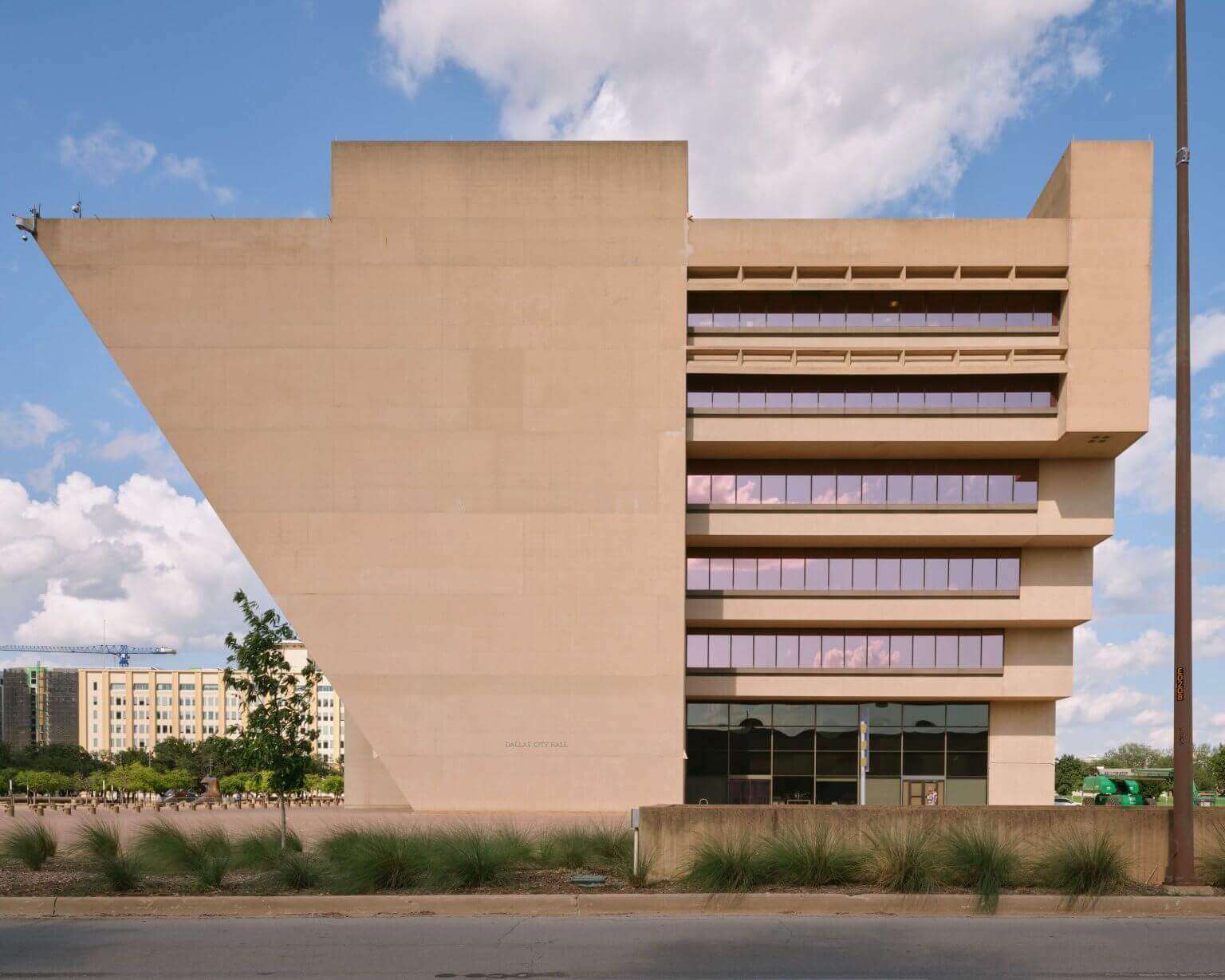
Dallas City Council has authorized up to $3 million to investigate potential relocation sites for its municipal headquarters, setting in motion a process that places one of the most architecturally significant Brutalist civic buildings in the American Southwest under serious institutional pressure. The vote does not commit the city to vacating the building, but it opens a formal due-diligence process across up to four candidate sites. What happens next will determine whether a mid-century civic monument survives as a functioning public institution or becomes a site cleared for redevelopment.
The council passed the resolution on June 17 by a 9–5 margin, with one member absent. The authorization allows the city manager to negotiate pre-acquisition agreements and conduct studies on up to four potential sites intended to house a new City Hall and a 911 call center. The city manager carries an obligation to return those site locations to the council in August.
A Contested Vote Within a Disputed Process
The June 17 vote followed a contentious special meeting held on June 10, at which the council rejected a repair plan for the current building by a separate 9–6 margin and directed staff to continue evaluating alternative sites. That earlier meeting triggered immediate legal action. Three council members obtained a court order blocking certain relocation votes, on the grounds that the city had not provided the public with adequate notice.
On June 16, two of those council members filed a motion asking a judge to hold city officials in contempt. They argued that a substitute motion the council approved on June 10 revived business the court had already barred. A hearing was scheduled for June 18, one day after the council cast the authorizing vote.
Repair Costs and the Fiscal Argument for Relocation
Cost estimates for repairing and upgrading the existing building have varied considerably. One engineering assessment places the minimum expenditure at $329.4 million. Estimates for a comprehensive, long-term overhaul extend to approximately $1 billion. Those figures have formed the primary fiscal argument that relocation proponents have advanced before the council.
Two amendments proposed at the June 17 meeting, which would have shaped constraints on any new building site, failed by the same 9–5 margin as the primary vote. One amendment sought to prevent the city from occupying any building older than the current structure. The other required that any new site include adjacent public open space. Both measures fell without adoption.
The Building’s Position in Dallas’s Civic and Urban Fabric
The existing City Hall sits at 1500 Marilla Street in Downtown Dallas. The council first voted to explore relocation in March, and discussion of the site’s potential reuse has circulated publicly since at least last fall. Speculation has included the possibility that the cleared site could serve future development tied to a new arena for the Dallas Mavericks basketball franchise.
A public engagement process this spring received more than 400 submissions addressing the building’s future. Among those submissions, a studio at the University of Texas at Arlington contributed a formal proposal. The breadth of that response signals the degree to which the question extends beyond operational logistics and into civic identity and urban planning.
The city’s mayor issued a statement following the June 17 vote, framing relocation as both a fiscal responsibility and a development opportunity. He described the prospect as “a once-in-a-generation opportunity to reimagine 1500 Marilla Street as something that unlocks new economic potential in Downtown Dallas.”
“In addition to being the most fiscally responsible decision, relocation presents a once-in-a-generation opportunity to reimagine 1500 Marilla Street as something that unlocks new economic potential in Downtown Dallas.”
Civic Threshold and Programmatic Pressure: Reading the Architectural Stakes
The Dallas City Hall presents a specific typological problem that the relocation debate tends to obscure. The building operates as a civic threshold — a Brutalist mass positioned to mediate between the scale of downtown infrastructure and the symbolic expectations of public institutional space. Brutalist civic structures of this generation carry an inherent tension between their formal ambition and the operational demands of contemporary municipal programs. Repair cost projections ranging from $329 million to $1 billion reflect not just deferred maintenance but the structural and systems incompatibility between a mid-century envelope and present-day 911 dispatch, accessibility, and energy performance standards. The failure of the amendment requiring adjacent public space at any new site is architecturally significant: it removes a programmatic safeguard that would have preserved the public-realm logic the current building, whatever its condition, still anchors.
✦ ArchUp Editorial Insight
The relocation debate in Dallas reveals a growing rift between the preservation of monumental civic identity and the brutal pragmatism of modern municipal logistics. The city’s decision to fund a site search prioritizes operational efficiency over the maintenance of a difficult architecture whose formal power now conflicts with contemporary budgetary constraints. It reframes the existing landmark not as a permanent democratic anchor, but as a depreciating asset whose physical upkeep outweighs its cultural capital within evolving cities. However, this move risks treating civic presence as a disposable commodity. Relocating to a modern facility might solve immediate programmatic failures, but it assumes that a new, likely generic, structure can replicate the symbolic gravitas of the original site. Abandoning this monument risks hollowing out the downtown core’s historical narrative for short-term fiscal relief.
Project Team: Original building designed by I. M. Pei. Repair cost assessment conducted by AECOM. University of Texas at Arlington studio contributed a proposal to the public engagement process. Location: 1500 Marilla Street, Downtown Dallas, Texas, United States.
Project Notes: Dallas City Council authorized up to $3 million for site due diligence on June 17, by a 9–5 vote. The city manager expects to present up to four candidate sites to the council in August. The vote does not commit the city to relocating. Repair estimates range from $329.4 million to approximately $1 billion. Legal proceedings related to the June 10 special meeting were ongoing at the time of the vote. Developer and client for any future relocation: not specified in source.