
De’Longhi Miniature Café Coffee Machine Concept


Consumer Perception Between the Café and the Home
Some consumption patterns indicate that a large segment of users still associates coffee quality with cafés, where it is believed that preparation there yields better results compared to home brewing. In contrast, some connoisseurs prefer preparing coffee themselves, especially when adequate expertise and proper equipment are available. This contrast reflects a perceptual gap between the home experience and the café experience. This gap is at the heart of many debates within the Architecture of interior spaces, where the design of the home environment directly influences consumption habits.
Transforming the Café Idea into a Miniature Visual Representation
In this context, the idea of home coffee was approached through a De’Longhi project based on transforming appliances into miniature models that emulate cafés. The concept was presented through a visual interpretation that condenses various cafés around the world into small-scale forms linked to home coffee products. This approach was developed in collaboration with the agency LOLA Madrid, within a framework focused on re-staging the environment rather than merely fulfilling the appliance’s function. Similar approaches can be seen in how contemporary Design strategies seek to embed emotional and spatial narratives into everyday objects.
Miniature Craft as a Tool for Embodying the Concept
The execution of the models relied on miniature construction techniques associated with the expertise of Simon Weisse, known for his work in building cinematic miniature worlds, along with Cindy Schnitter. This type of production is visually aligned with the aesthetic seen in Wes Anderson films such as The Grand Budapest Hotel and Asteroid City, where miniature details are used to construct fully realized environments within a limited scale, serving the representational idea more than direct functionality. This meticulous process often requires consulting extensive Research on material behavior and visual perception.
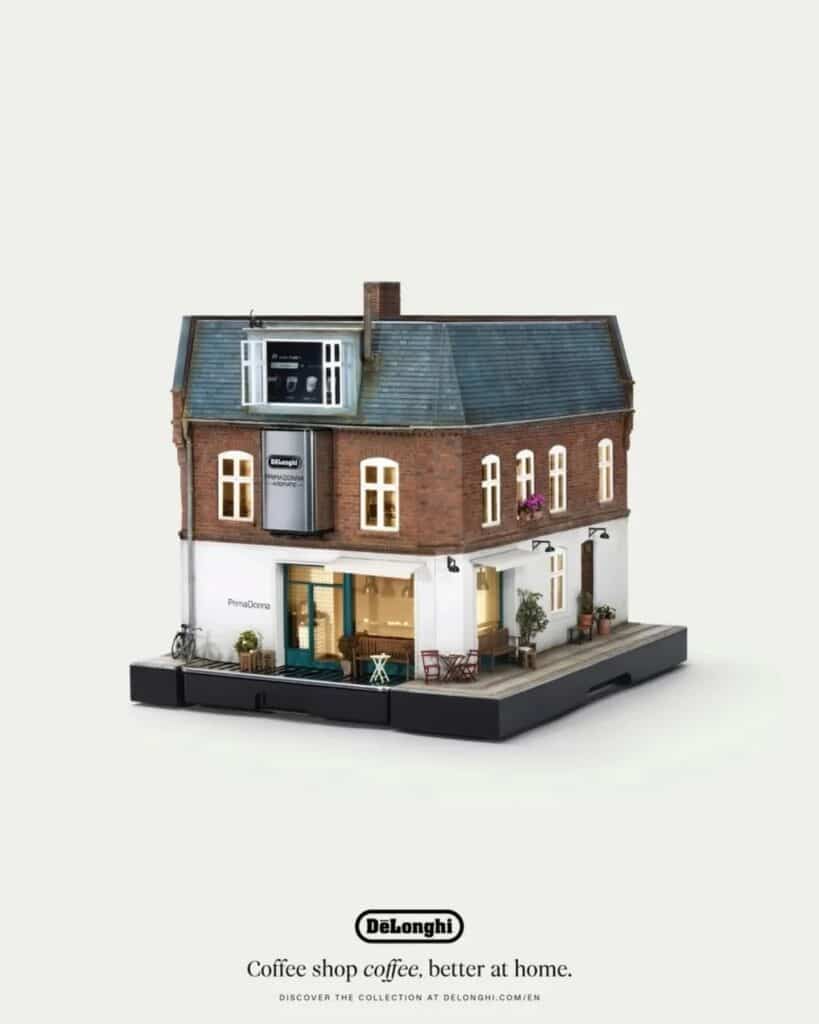
Transforming Café Facades into Miniature Architectural Frontages
Five miniature café facades were designed and handcrafted, then directly mounted onto De’Longhi coffee machines. Each café was inspired by a city known for its coffee culture and visually linked to a premium coffee device, so that the machine becomes a carrier of a miniature spatial representation rather than merely a functional object. This transformation reinterprets how we perceive everyday Buildings by compressing their most iconic features into a domestic scale.
Handcrafted Construction and Visual Simulation Techniques
The execution of the models required more than 1,500 hours of work using traditional model-making techniques. This included the integration of architectural materials, aged-looking finishes, and highly detailed elements such as windows and miniature signage, all developed with a high level of precision. The result resembles a miniature architectural model treated as a complete environment within a confined scale. The selection of appropriate Building Materials played a crucial role in achieving the aged, authentic look of each miniature facade.
Forced Perspective and the Reconfiguration of Visual Perception
The execution relied on the cinematic technique of “forced perspective,” used in filmmaking to create a sense of realistic scale within miniature scenes. This technique allows the viewer’s perception of the relationship between scale and reality to be reshaped. In this context, it was applied to an everyday coffee machine, shifting the focus away from direct function toward a visual re-reading of the origin of the coffee experience. Technical specifications and physical properties of the components are detailed in specialized Material Datasheets, ensuring precision in every layer of the construction.
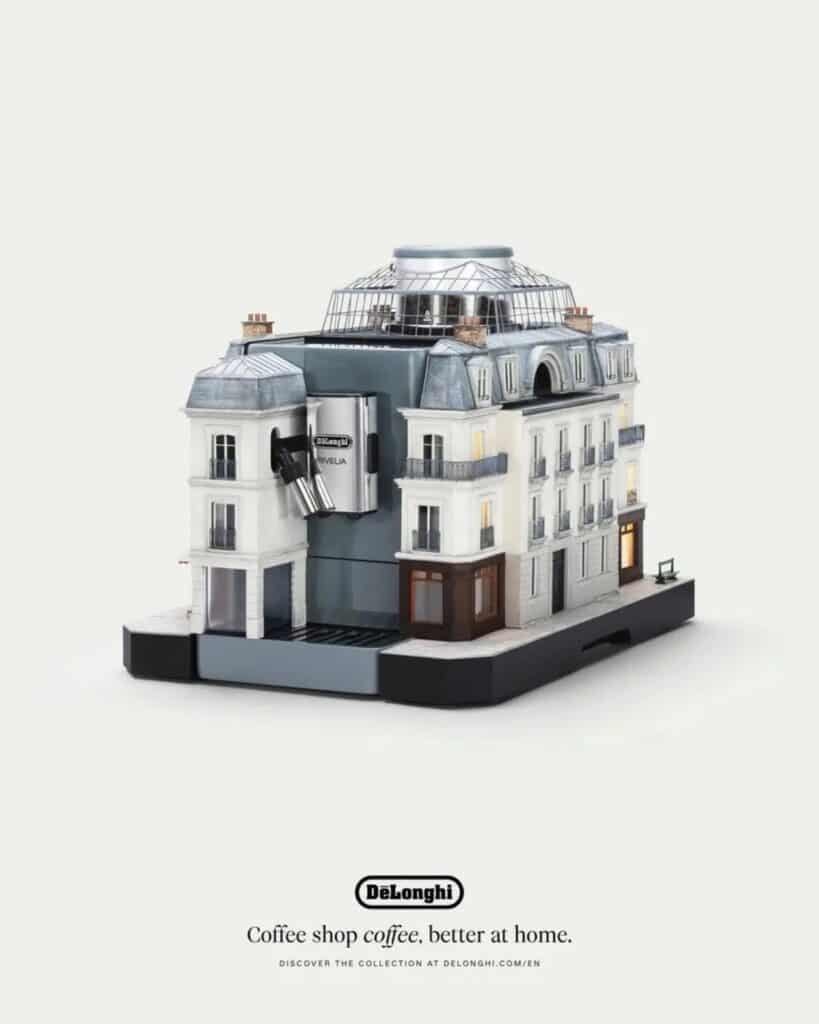
The Visual Experience Between the Machine and the City
These models create a direct relationship between the coffee machine and the mental image of the café. When looking at each device, urban scenes associated with coffee culture in cities such as Paris or Tokyo are evoked. In this way, the machine shifts from a functional tool into a visual medium that re-represents the café environment within a confined, miniature scale. This approach invites us to rethink how we experience Cities through the lens of product design, bringing the essence of urban coffee culture into the home.
Design Presentation and Its Cultural Context
All devices were presented for the first time during Milan Design Week 2026, within an exhibition context that brings the five models together in a single space. This presentation comes within the broader shifts of contemporary lifestyles, where the functions of the home increasingly overlap to include work, relaxation, and daily services, including the café experience. Such events are often covered under Events that showcase the intersection of design, technology, and spatial arts.
Redefining the Relationship Between Design and Everyday Use
Within this context, the device is positioned as a reconfiguration of the idea of place rather than a purely technical product. The café is visually and symbolically transferred into the home, so that design becomes a means of reinterpreting everyday experience. In this way, craftsmanship and visual perception intersect to form a different reading of the function of everyday objects. This project aligns with the broader vision of Interior Design, where objects are no longer merely functional but act as anchors for emotional and cultural narratives.
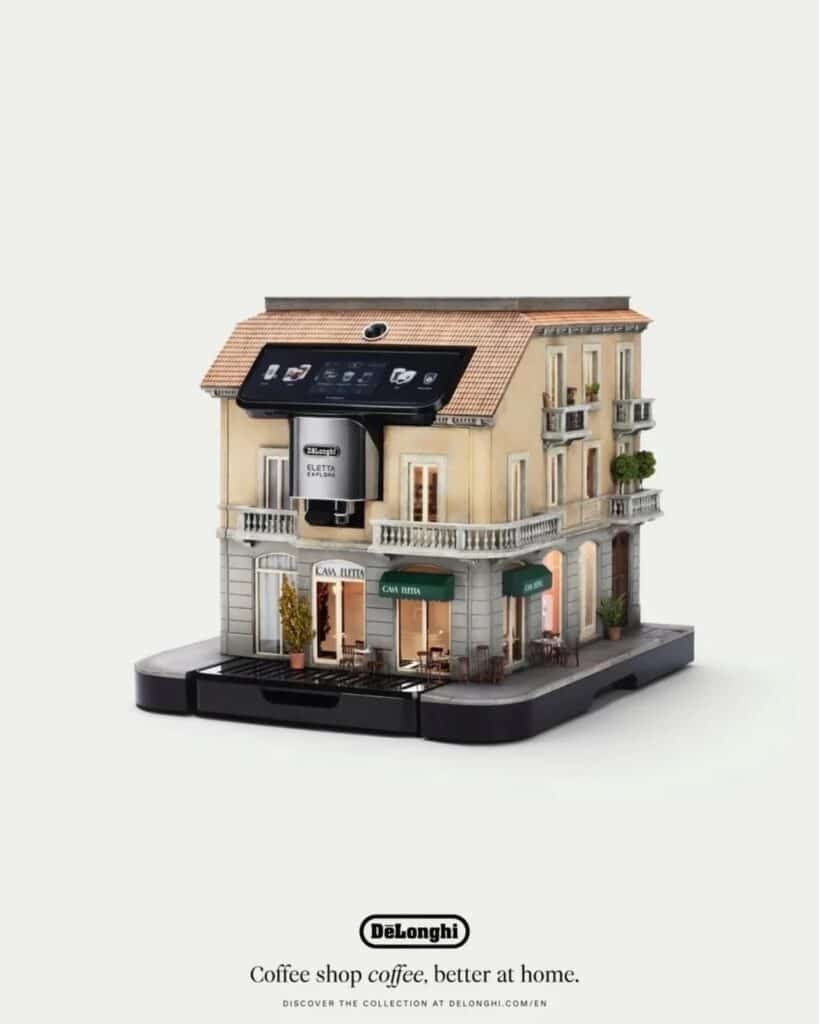
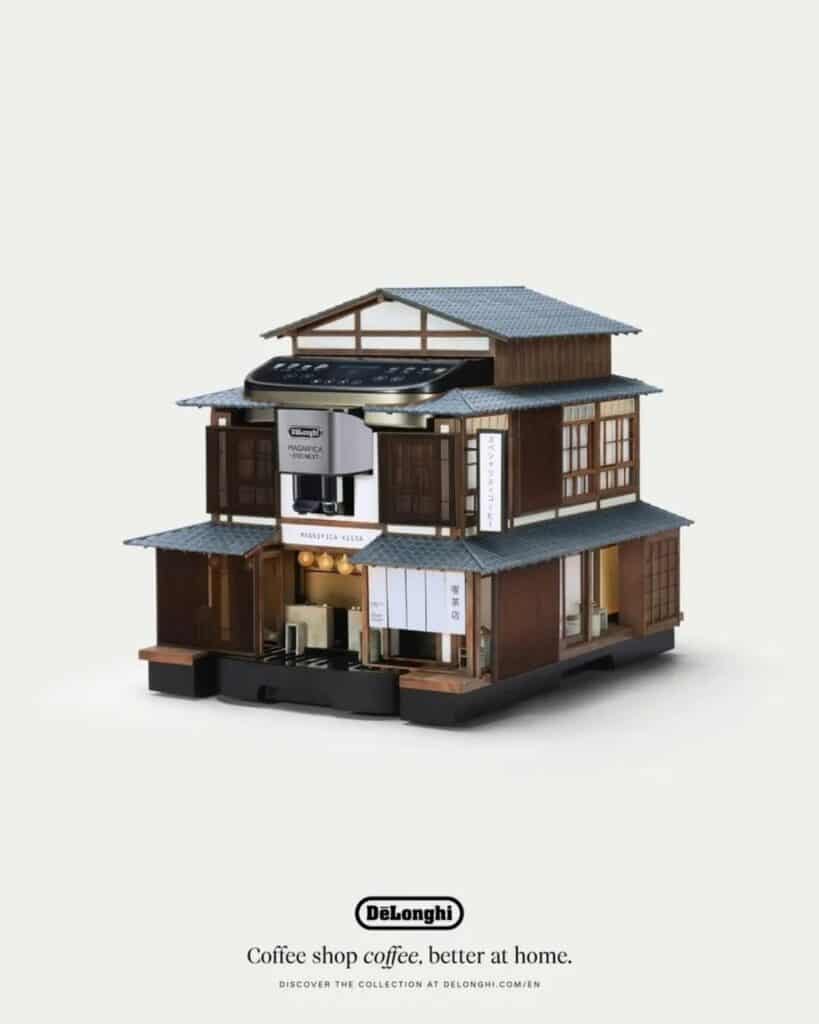
✦ ArchUp Editorial Insight
The De’Longhi project operates as a marketing response to a persistent perceptual gap between the value of home coffee preparation and the perceived legitimacy of café-based experiences. The primary driver emerges from competition within the premium home appliance market, where product quality is still evaluated through an external reference tied to the service infrastructure of cafés. The constraints are not regulatory in nature, but are instead rooted in demand elasticity, the limits of experiential substitution, and the cost of constructing symbolic value within a domestic environment. This strategic approach is frequently discussed in Discussion forums dedicated to the future of domestic spaces.
Spatial outputs are transformed into miniature architectural facades integrated onto the surfaces of the machines, effectively reconfiguring the device as a carrier of urban representation rather than merely a functional tool. User behavior is directed toward a visually framed domestic consumption experience, where the perception of space is redistributed through the reduction of cafés into surface-level cues embedded within the product. This approach reinforces brand positioning by transferring the experience itself, rather than altering the machine’s core functionality. A comprehensive look at similar innovative projects can be found in the Archive of architectural and product design experiments.

★ ArchUp Technical Analysis
Technical and Documentary Analysis of the De’Longhi Project – Milan, Italy:
This article presents an architectural analysis of the De’Longhi project as a case study in redefining the relationship between the coffee machine and the micro-café. To enhance its archival value, we would like to present the following key technical and design data.
The project was developed in collaboration with LOLA Madrid agency and relied on miniature construction techniques linked to the expertise of Simon Weisse and Cindy Schnitter in creating miniature worlds within cinema. Five handcrafted miniature café facades were designed, requiring over 1,500 working hours using traditional model-making techniques, and were mounted directly onto De’Longhi coffee machines.
Each café was inspired by a city known for its coffee culture: a classic-style (Northern European) café facade on the PrimaDonna machine, Haussmann architecture in Paris on the Rivelia machine, a Mediterranean Italian villa style on the Eletta Explore machine, and traditional Machiya architecture in Kyoto on the Magnifica Evo machine.
The execution relied on the “forced perspective” technique used in cinematography to create a sense of realistic scale within miniature scenes, incorporating diverse building materials, aged-looking finishes, and fine details such as miniature windows and signage. All machines were presented for the first time during Milan Design Week 2026.
Related Insight: Please refer to this article to understand the context of modern architectural preservation:
Miniature Architecture in Marketing Design: Between Functional Sculpture and Visual Perception.



✅ Official ArchUp Technical Review completed for this article.