The Owl Does Not Promise a Silent Façade: Testing Wind Noise in Screens and Fins

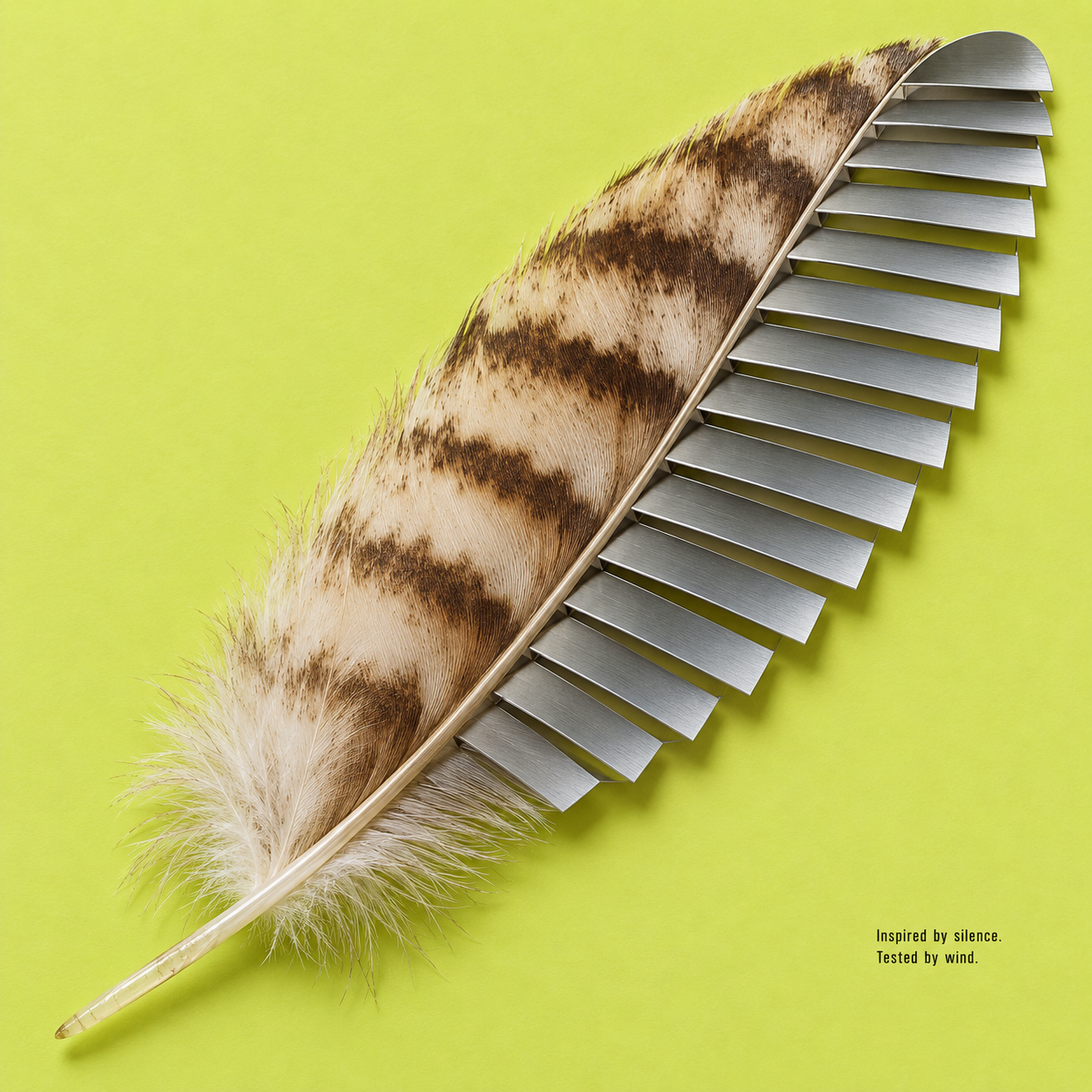
A façade element can remain structurally secure and still become an acoustic source. A thin fin, perforated screen or louvre meets moving air at an edge; under particular wind speeds and directions, the resulting flow may create broadband noise or a distinct tone. The nuisance may appear only after occupation, when the full assembly, adjacent surfaces and local wind environment begin to interact.
Research on owl wings offers a compelling mechanism but not a ready-made façade detail. ArchUp asks a narrower architectural question: can fringe-like or serrated edge variants be used as test candidates when a screen or fin is suspected of producing wind noise? The proposal is to compare them experimentally with the project’s baseline component. It does not assume that copying the appearance of a feather will reproduce an owl wing’s acoustic behaviour.
What the owl-wing research found
Jiaxin Rong and colleagues constructed two three-dimensional owl-wing models from the geometry of a real wing: one with trailing-edge fringes and one without. They used large-eddy simulation and the Ffowcs Williams–Hawkings acoustic analogy rather than testing a building component. Their 2023 study reported comparable computed aerodynamic forces between the models and lower far-field acoustic pressure for the fringed model. The simulations attributed the change to two mechanisms: breaking up large vortices near the trailing edge and reducing vortex shedding associated with interactions between separated feathers at the wingtip.
An earlier study by Chen Rao and colleagues combined large-eddy simulation, particle-image velocimetry and force measurements in a low-speed wind tunnel. On single-feather-inspired models, leading-edge serrations altered the transition of flow over the upper surface across tested angles of attack from above 0° to below 20°. The result was conditional: serrations reduced aerodynamic performance below 15°, while at higher tested angles they could combine noise reduction with aerodynamic performance comparable to the clean edge.
Transfer between machines was not automatic. Jinxin Wang and colleagues tested four owl-inspired blade designs in a mixed-flow fan. A simply fabricated slotted leading edge reduced specific noise by about 1.4 dB while sustaining aerodynamic performance, but the trailing-edge serrations tested in the same study failed. This negative result matters architecturally: the position and geometry of the modification, the flow regime and the surrounding assembly can reverse the value of the idea.
ArchUp’s architectural interpretation
A façade fin is not an owl wing or a fan blade. It may have a blunt section, brackets, joints and nearby cavities; it faces turbulent, multidirectional wind rather than a controlled inflow. The biological studies therefore support only a testable hypothesis: changing edge geometry may reorganise vortices and alter sound without removing the component’s primary function.
The relevant design object is not a decorative serration applied across an elevation. It is a defined edge condition connected to a suspected noise mechanism. For one project, the candidate might be a replaceable trailing-edge strip on a vertical fin. For another, the source may be a perforation, joint or cavity, making an owl-inspired edge irrelevant. Source identification must precede modification.
A project-specific test protocol
ArchUp proposes a staged comparison for screens, fins or louvres whose exposure, slenderness or repetition makes wind noise a material risk. The acoustic consultant, wind engineer, façade specialist and supplier should define the method appropriate to the project.
- Establish a baseline. Test the project component with its real section, joints, brackets and neighbouring geometry. Record background noise and verify that the source is the specimen rather than the facility.
- Compare controlled variants. Change one edge parameter at a time where practicable: fringe or serration depth, spacing, stiffness, coverage or location. Maintain equivalent support conditions and the performance variables being compared.
- Vary the inflow. Test the relevant range of wind speeds and yaw angles, including intermediate conditions. A solution that suppresses one tone may create another at a different operating point.
- Measure sound and flow. Record spectral levels at defined receiver positions, not only a single overall value. Flow visualisation or pressure measurements can help link an acoustic change to a physical mechanism.
- Retest the coordinated assembly. Repeat the preferred option with realistic interfaces, drainage paths, tolerances and finishes. Confirm that structural, fire, water, access and cleaning requirements have not been compromised.
The comparison should be made against equal functional conditions. A quieter option that blocks more daylight, changes ventilation, increases wind loads or cannot be maintained is not an equivalent solution. Acceptance criteria must be agreed before testing and should distinguish tonal emergence from changes in broadband sound.
How the hypothesis could be verified after installation
Laboratory evidence should be followed by a limited field check where the risk justifies it. During suitable wind periods, correlate wind speed and direction with sound spectra at the façade and at representative occupied positions. Compare the signature with laboratory observations and inspect whether dirt, rain, loose fixings or construction tolerances have altered the edge condition.
A stronger research design would test matched façade specimens with and without the candidate edge treatment under the same inflow sequence. Primary outcomes could include changes in narrow-band tonal peaks, one-third-octave levels and aerodynamic loads. Secondary outcomes could record constructability, damage and cleanability. Randomising the order of test conditions and repeating runs would reduce drift and learning effects. ArchUp has not conducted this experiment and claims no specific reduction for a façade.
Limits of the evidence
The principal owl-wing result was computational, even though it used geometry derived from a real wing. The earlier leading-edge study included wind-tunnel measurements, but on a feather-inspired model. The fan study demonstrates that an edge treatment can succeed in one position and fail in another. None of these studies tested architectural screens, façade-scale Reynolds numbers, weathering, repeated modules or sound transmission into rooms.
Scale is especially important. Preserving the visible ratio of a serration does not ensure similarity in flow, stiffness or acoustic frequency. Flexible feather fringes also differ materially from metal, composite or polymer attachments. The architectural value of the research lies in identifying variables and mechanisms for controlled testing—not in licensing a universal biomimetic detail.
✦ ArchUp Editorial Insight
Procurement pressure tends to convert façade screens into measurable packages: open-area ratio, solar performance, structural capacity, finish and price. Wind-generated sound is harder to guarantee because it depends on local flow, interfaces and operating conditions that emerge only when the assembly is complete. If the contract treats acoustic behaviour as an unspecified consequence rather than an acceptance criterion, the rational decision is to optimise the attributes that can be signed off. The risk then moves forward in time. The design and installation teams may leave before a seasonal wind direction reveals the source, while occupants and facilities staff inherit diagnosis, access and retrofit. This is not proof of negligence; it is a gap between what procurement can compare and what operation later experiences. A project-specific aeroacoustic mock-up could act as a governance tool if it defines the baseline, test range, receiver positions and responsibility for substitutions before manufacture. Owl-inspired edges would enter that process as controlled variants, not as a branded solution. The final architectural consequence might be a replaceable edge strip, a revised fin section or removal of a resonant cavity. Each makes the future acoustic risk visible at the moment when geometry is still negotiable.
Prepared by ArchUp Research Lab.
References
Jiaxin Rong, Yajun Jiang, Yuta Murayama, Ryoto Ishibashi, Masashi Murakami and Hao Liu. Trailing-edge fringes enable robust aerodynamic force production and noise suppression in an owl wing model. Bioinspiration & Biomimetics, 2023.
Chen Rao, Teruaki Ikeda, Toshiyuki Nakata and Hao Liu. Owl-inspired leading-edge serrations play a crucial role in aerodynamic force production and sound suppression. Bioinspiration & Biomimetics, 2017.
Jinxin Wang, Kenta Ishibashi, Masaaki Joto, Teruaki Ikeda, Takeo Fujii, Toshiyuki Nakata and Hao Liu. Aeroacoustic characteristics of owl-inspired blade designs in a mixed flow fan: effects of leading- and trailing-edge serrations. Bioinspiration & Biomimetics, 2021.