Hilltop House: Light and Coastal Topography Redefined


Dialogue Between Mass and Topography: Spatial Configuration and the Experience of Transition
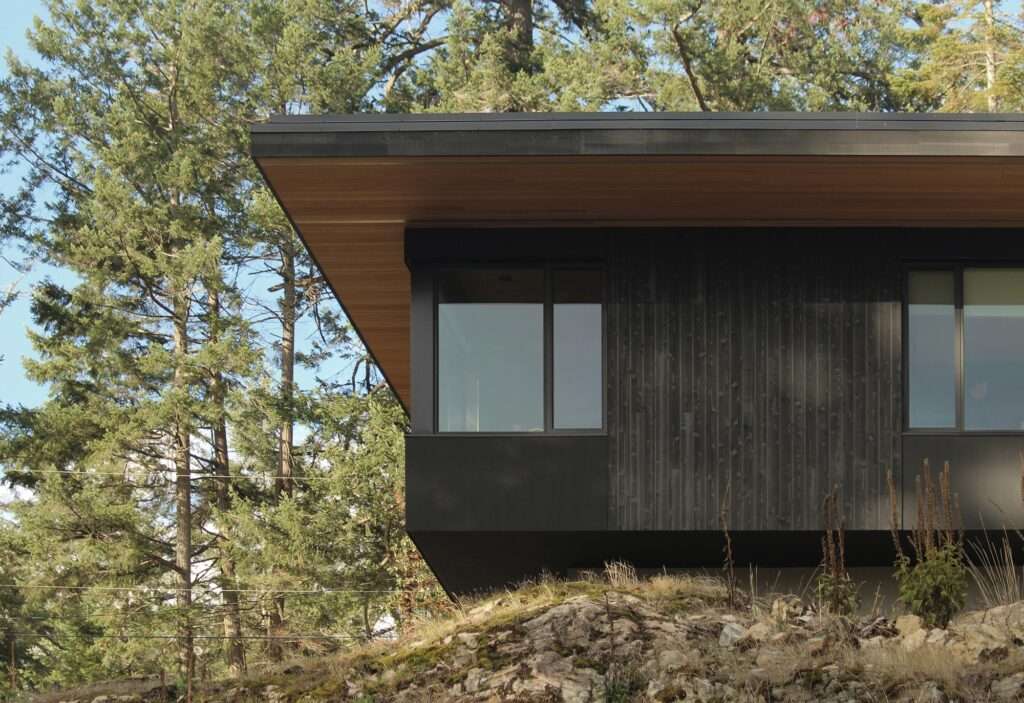
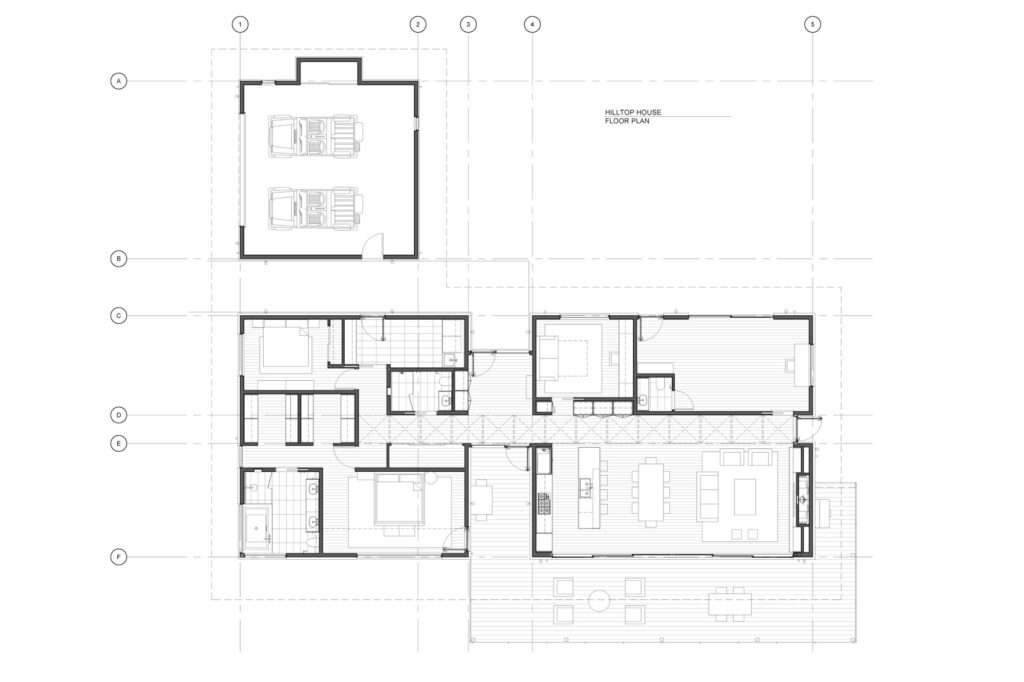
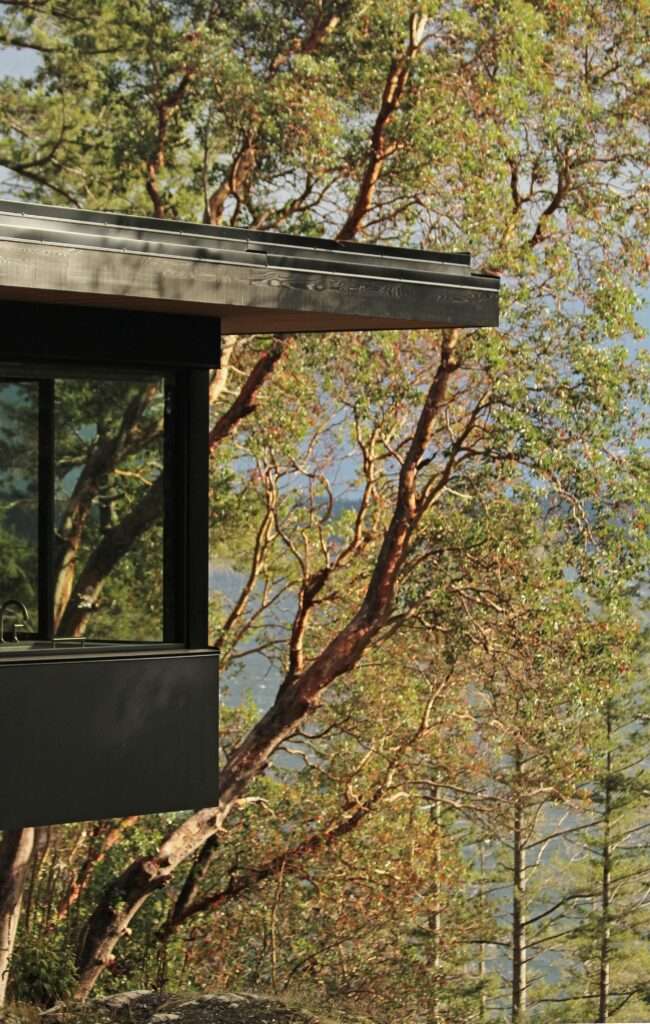
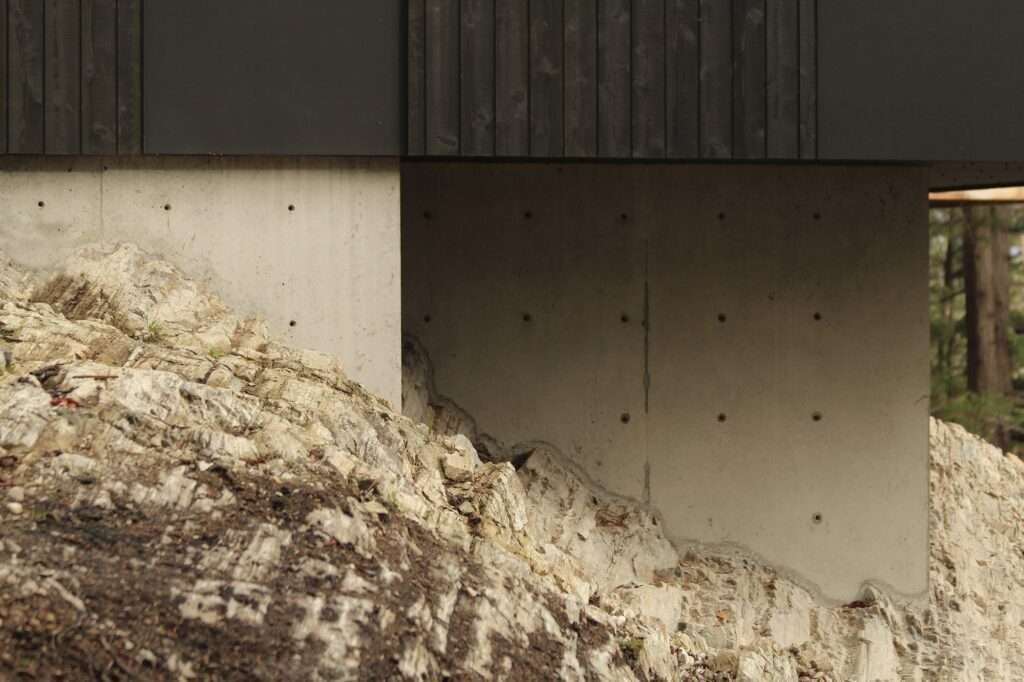
The rocky topography of the site imposes its direct presence on the architecture of Hilltop House; the mass does not attempt to impose a new reality on the slope, but instead wraps around it, echoing its contour lines through a plan that takes the form of an L-shape. This angular configuration operates as a dual architectural device: on one hand, it negotiates the steepness of the terrain, and on the other, it decomposes the exterior void to generate a sheltered inner courtyard protected from coastal winds.
Here, the entrance threshold transforms from a mere point of passage into a scenographic transitional experience; the user undergoes a gradual shift from an open coastal environment into the intimate space of the courtyard, achieving a psychological and spatial separation that isolates the inhabitant from urban noise while reconnecting them to the surrounding environment through a carefully choreographed design design circulation path.
Lively Interaction: The Movement of Light and the Shaping of Psychological Impact
The building’s façades and volumes become a stage upon which the movement of natural elements unfolds throughout the day; the architectural form is oriented to follow the sun’s path, allowing shadows to intersect with sharp massing edges and generating a constantly shifting visual dynamism within interior spaces and transitional courtyards. The role of materials extends beyond functional performance, as their color and texture deepen the perception of time and sustainability, with their visual qualities changing according to the intensity of incident light. This scenographic interaction enhances the experience of inhabiting the space, turning the house into a device for observing subtle natural transformations and a material embodiment of calmness and grounding.
Scenography of Passage: From Intimate Courtyard to Panoramic View
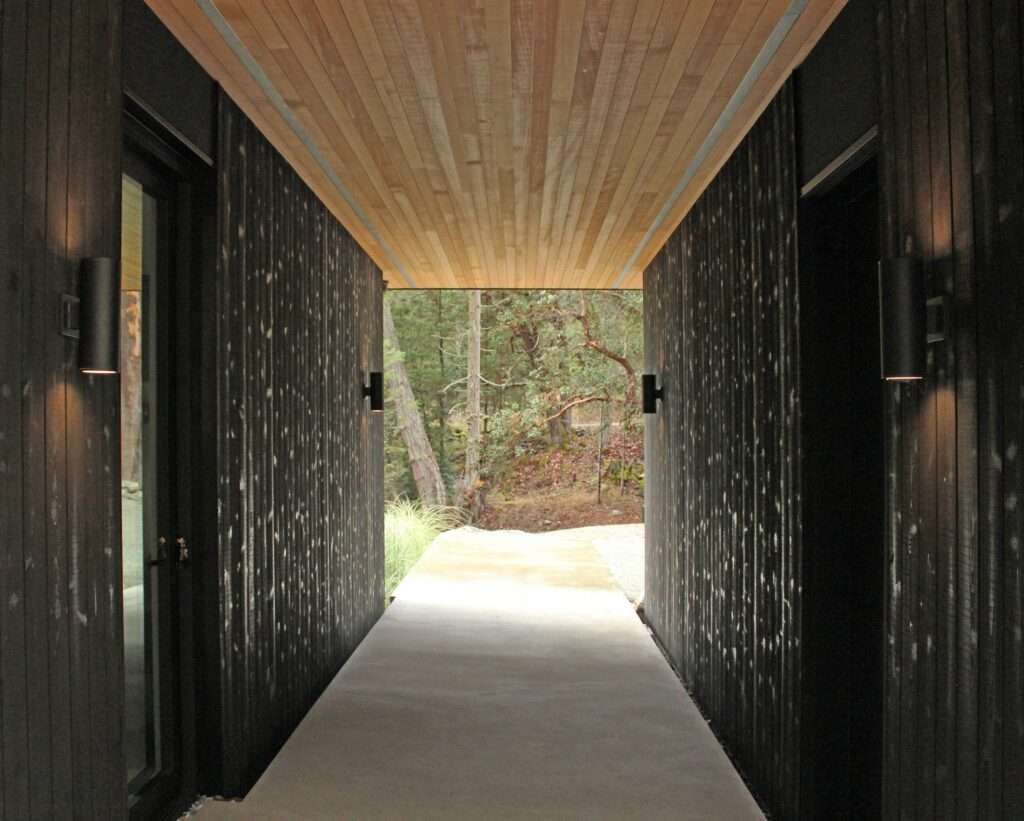
The spatial journey begins with an exposed corridor acting as a transitional void that prepares the senses visually and materially through a gradient of light and shadow. This path overlooks the isolated inner courtyard before culminating in a quiet and restrained entrance threshold. Upon crossing the entry, a sudden yet carefully orchestrated spatial transformation occurs in response to the visitor’s movement; the sense of enclosure dissolves, replaced by an expansive visual openness through a carefully structured circulation path.
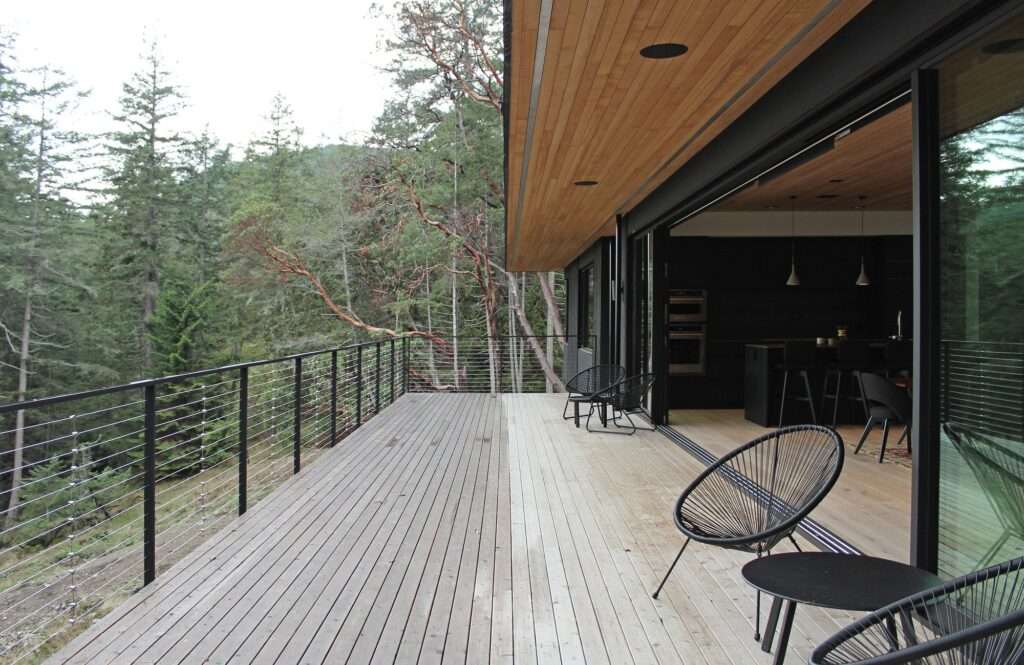
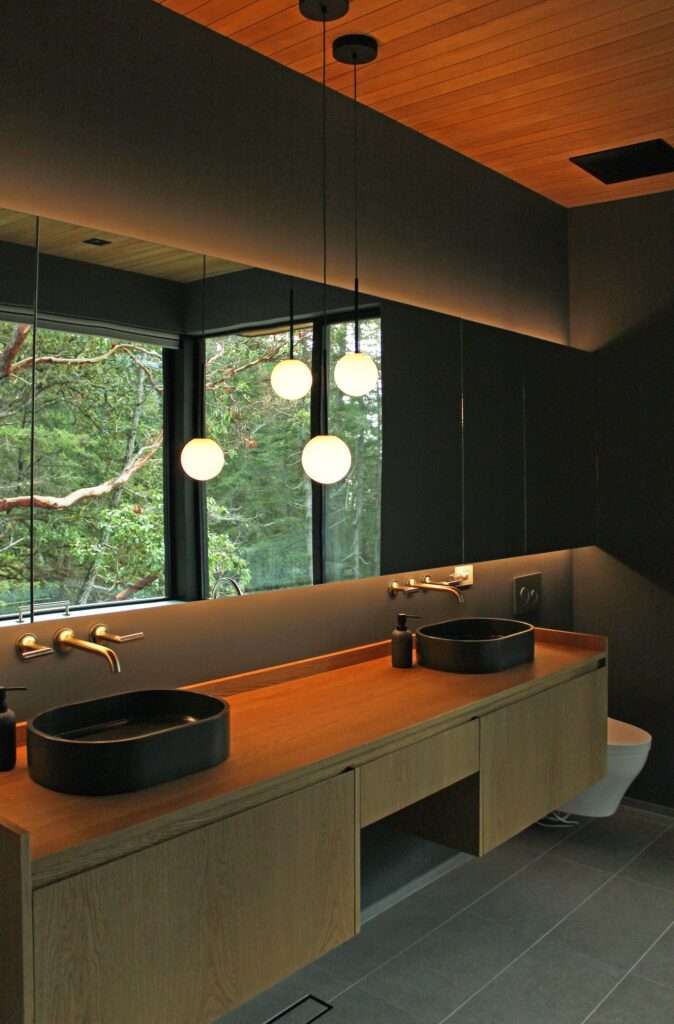
Here, the glass wall becomes an architectural framing device that captures the terrain of the forest and the Salish Sea below, deeply integrating the external horizon into the living space and making nature a constant element in the user’s daily experience.
Light Capture: Shaping Space in Response to Climatic Challenges
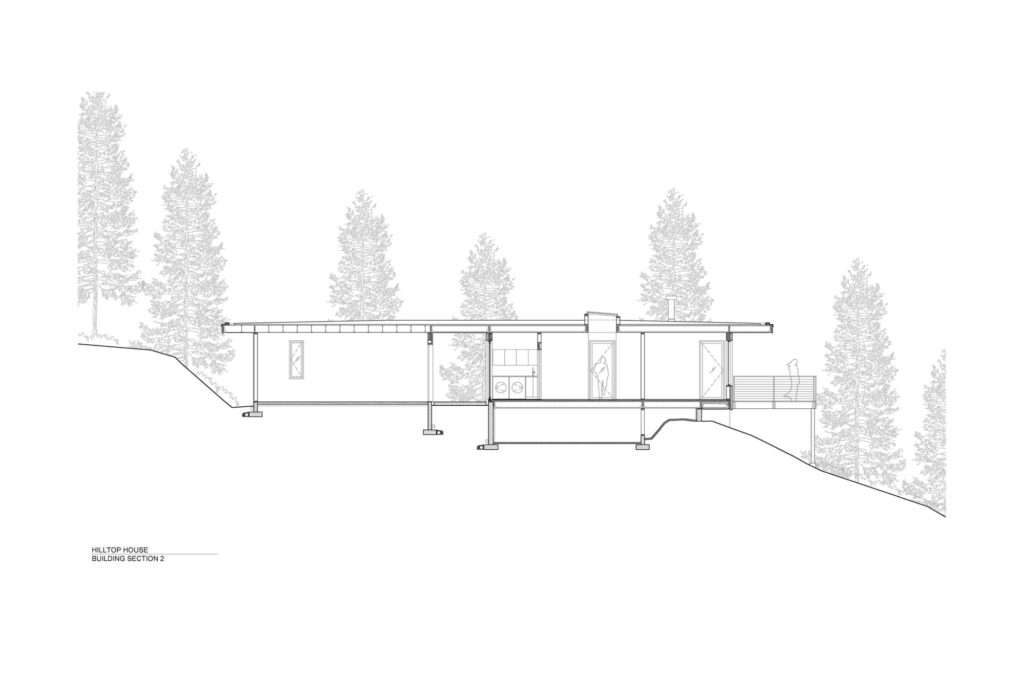
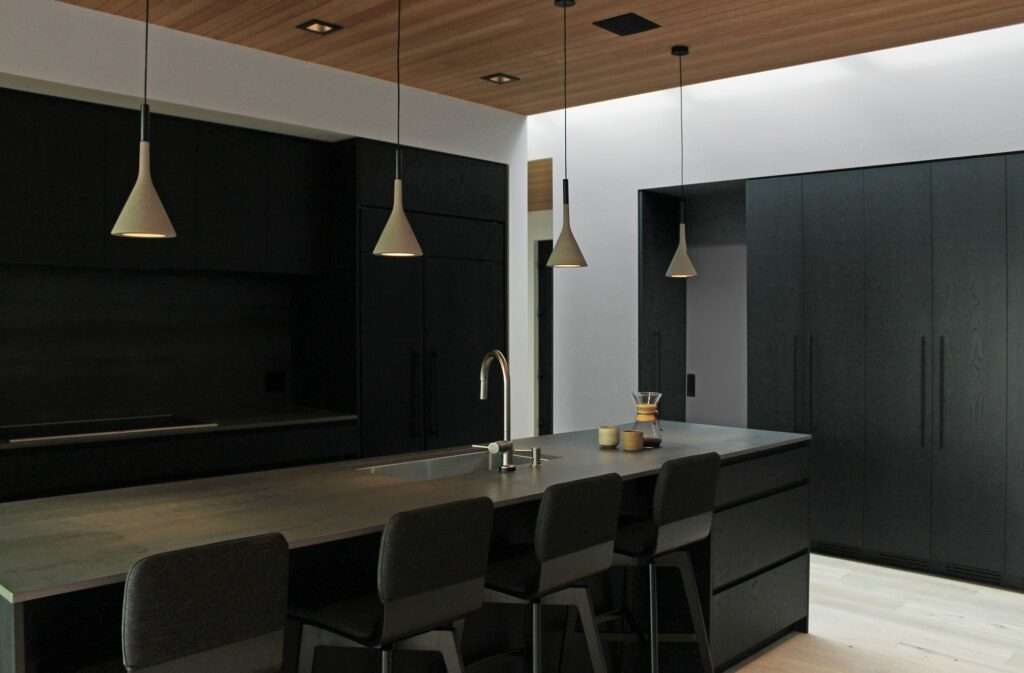
The design addresses the harsh coastal climate and the intense winter darkness of British Columbia as an opportunity to reshape the psychological impact of interior space through light. Rather than withdrawing inward, the building employs a longitudinal skylight extending 61 feet (18.5 meters) along the main circulation axis. This upper architectural slit functions as a light trap, flooding circulation corridors, living spaces, and sleeping zones with continuous overhead illumination that compensates for the absence of direct sunlight and mitigates seasonal affective darkness.
Through this scenographic solution, the inhabitant’s perception of time and climate is transformed, as the gray sky, moving clouds, and rainfall become a living, dynamic canvas that continuously animates the interior space throughout the year.
Dissolving Boundaries: Visual Extension and Cantilevered Structural Solutions
The great room continues to embody the dialectic of openness and environmental connection through full-height sliding glass façades extending from floor to ceiling, effectively dissolving the physical boundaries between interior and exterior space. The user moves fluidly and visually toward an external cantilevered terrace, structurally designed to appear suspended among the surrounding treetops through refined structural solutions.
This direct spatial transition transforms simple daily routines into recurring sensory rituals experienced in constant dialogue with the surrounding wilderness, enabled by a language that liberates space from conventional enclosure.
Structural Efficiency: Self-Sufficiency and the Engineering of Quiet Sustainability
The environmental performance of the residence relies on a precise mechanical system operating invisibly to ensure thermal and psychological stability throughout the year. The building envelope is based on a tightly controlled thermal insulation strategy surrounding the mass, supported by a heat pump system and an advanced heat recovery ventilation system (HRV) to regulate indoor air quality and temperature.
The philosophy of self-sufficiency, aligned with coastal living, is completed through the integration of a drilled well and an independent wastewater treatment system, granting the structure full operational autonomy and reinforcing the concept of long-term sustainability without introducing visual or mechanical noise that would disrupt the scenographic experience of the place.
Adaptive Resilience: Integrating Safety Systems into the Scenographic Environment
The design engages with critical environmental threats, particularly forest fires, as an integral part of the architectural mass’s resilience and capacity for survival, without compromising the building’s aesthetic values within contemporary architecture. The proactive defensive line relies on a water sprinkler system integrated into the roof structure, activated automatically and directly supplied by dedicated on-site water tanks to combat airborne embers. This functional integration transforms safety elements from mere sterile technical additions into an embedded operational layer within the essence of the structure itself, granting the inhabitant a sense of reassurance and psychological stability within the space, and reinforcing the concept of architecture adapted to the risks of its natural context.
Sustainable Spatial Production: Harmony with Natural Rhythms
The residence transcends its conventional function to become a device that enhances the quality of human experience within isolated sites, demonstrating that sustainability constitutes an added value that serves the sensory dimension of the user rather than merely representing technical compromise within sustainable design. Spatial tranquility is achieved here through the formulation of an architectural language that resonates with the movement of light, the topography of the land, and cyclical climatic transformations. This close relationship allows the user to live in complete harmony with environmental fluctuations, redefining the notion of the coastal retreat as a material and spatial embodiment of alignment with nature and its continuously shifting rhythms over time.
✦ ArchUp Editorial Insight
The text characterizes the model of the isolated coastal dwelling as a valid case study of strict local contextual concentration, where harsh topography imposes a defensive spatial configuration within building typologies. Through the use of an L-shaped massing strategy, the design succeeds in resisting extreme microclimatic conditions, transforming difficult environmental constraints into a precisely controlled contextual space. This spatial enclosure reconfigures climatic vulnerability into a self-sustaining spatial product, turning isolation into a deliberate and carefully calibrated programmatic advantage within contemporary construction practices.
However, this insular model reveals a romantic blind spot through an excessive idealization of architectural autonomy in highly fragile ecological environments explored in broader architectural research. This structural isolation relies on complex, high-carbon independent systems, contradicting the broader socio-economic reality of local resource distribution. Elevating private residential sanctuaries above fragile rocky cliffs represents a privatization of climate resilience capacity, overlooking the shared infrastructure required to support remote communities and ignoring the collective frameworks necessary for equitable environmental adaptation within contemporary cities discourse and regional planning.