
Light House: Vertical Housing Redefined

Deconstructing the Traditional Plan
The project raises a fundamental question about what housing becomes when the traditional floor plan is abandoned. In this context, residential space is treated as a reconfigurable idea rather than a fixed distribution of rooms. This approach aligns with contemporary Architecture trends that challenge conventional layouts.
Organizing Functions as Independent Volumes
Each core activity within the home, such as cooking, dining, gathering, and relaxing, is assigned its own distinct architectural volume. These volumes are then stacked vertically into a single composition, redefining the relationship between function and space within the dwelling. For more innovative spatial concepts, explore the Archive of similar case studies.
Vertical Composition and Urban Context
The project is located in the Centrumeiland district, part of a contemporary urban development completed in 2025. With a total area of 257 square meters, Light House presents a model of housing understood as a vertical assembly of life units, rather than a traditional residential mass with a fixed horizontal layout. Such interventions reshape how we experience Cities and their evolving skylines.


Gradient of Spaces and Internal Circulation
Movement within the house is achieved through open corridors interspersed with compressed zones, creating a strong contrast in spatial perception. Smaller, more enclosed spaces are used as environments suited for activities that require focus and calm, while larger volumes provide visual extensions that connect different levels and reduce the traditional separation between upper and lower floors. The careful selection of Building Materials enhances these sensory transitions.
Vertical Sequencing of Functions
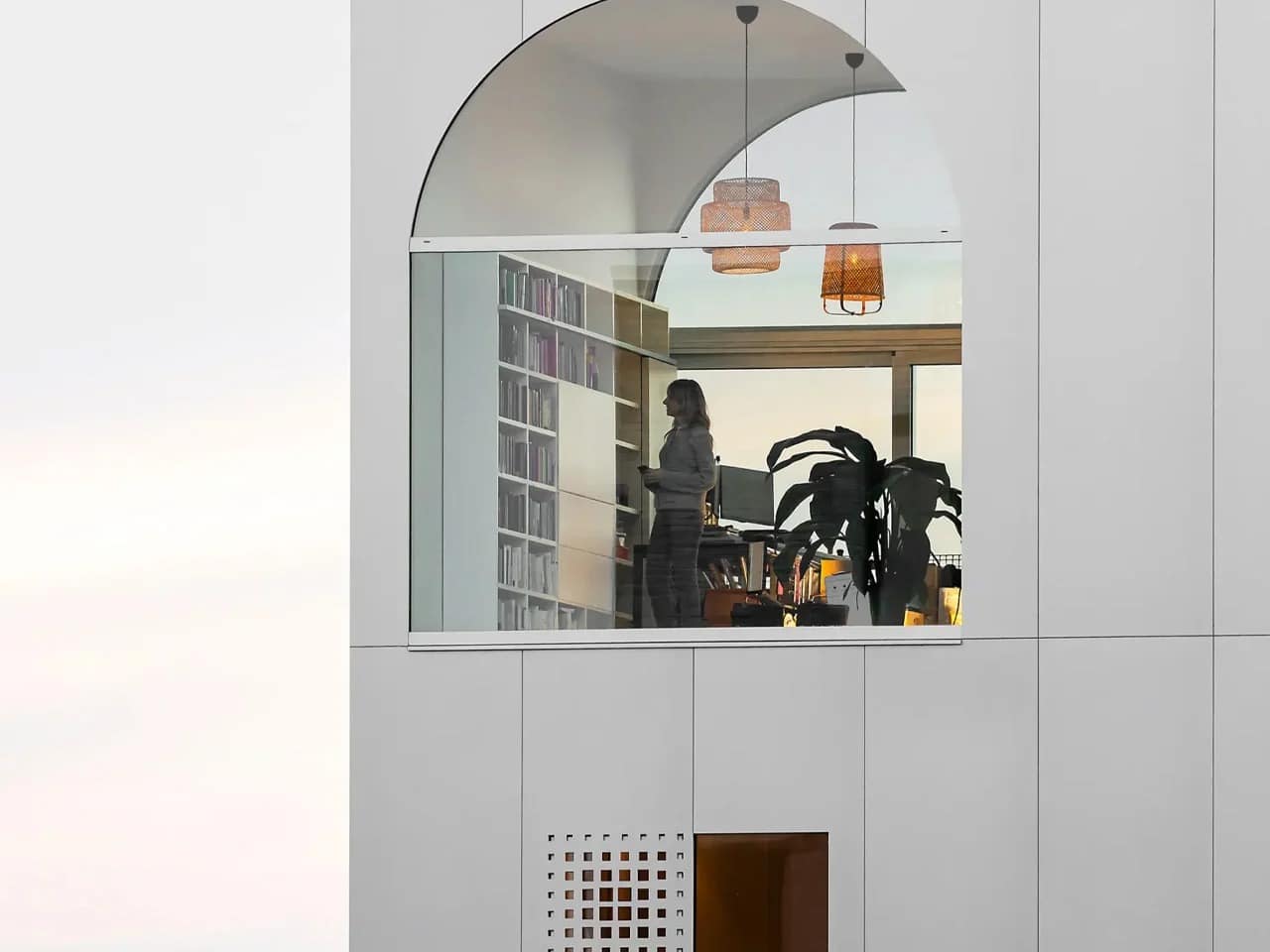
Directly above the kitchen sits a relatively isolated architectural volume used for activities such as yoga or viewing. As one moves upward, the spatial organization culminates in a large upper void described as an urban relaxation zone within the home, reaching approximately 14 meters in height. This space relies on arched glass openings that frame views toward IJmeer Lake, enhancing the visual continuity at the upper level. Detailed technical data can be found in the Material Datasheets.
Façade and Natural Light
The façade plays an organizing role in mediating the relationship between interior and exterior. A wall of square glass blocks wraps around the front elevation, filtering natural light as it enters the interior spaces while maintaining a degree of visual privacy. At night, the façade transforms into an internally illuminated surface, revealing traces of the building’s interior use without directly exposing it. This façade strategy is a recurring theme in many Projects focused on light and transparency.


Structural System and Sustainability
The project relies on a lightweight structural system based on prefabricated timber components within a steel frame. This configuration follows a modular and circular logic, enabling flexibility in execution, adaptability for long-term use, and ease of disassembly when required. The integration of Construction techniques with sustainable principles is critical to the building’s longevity.
Adaptability and Reconfiguration
The internal layout is not fixed; instead, it is designed to respond to changing family needs over time, such as children growing or shifting daily priorities. As a result, spaces can be continuously reorganized. In this context, the relationship between architecture and everyday life becomes fluid, allowing the design to accommodate evolving patterns of use without imposing a fixed final form. This flexibility is a central theme in Interior Design thinking.


✦ ArchUp Editorial Insight
The Light House project functions less than an intentional architectural proposition and more as a spatial sedimentation of the intersections between capital logic and urban regulations that govern contemporary housing production within the expansions of Amsterdam’s Centrumeiland district. The driving mechanism emerges from a hybrid financial and regulatory framework that links circular construction standards, long-term adaptability, and compliance requirements with urban policies, thereby redefining residential space as a reconfigurable asset rather than a fixed typology. For ongoing debates, follow Discussion platforms that critique such hybrid models.
Points of friction materialize in structural efficiency constraints, standardized supply chains, and cost-reduction pressures, producing a vertical volumetric system that redistributes programmatic functions as productive solutions rather than formal design decisions. Ultimately, the project becomes a spatial compromise between the expectations of user flows and the scarcity of urban land, where flexibility operates as a tool for managing future risks associated with shifting patterns of habitation. To see how regulations shape outcomes, browse the Competition Results for similar innovative housing schemes.
★ ArchUp Technical Analysis
Technical and Documentary Analysis of the Light House – Amsterdam, Netherlands:
This article presents an architectural analysis of the Light House as a case study in the use of glass blocks as a primary facade element. To enhance its archival value, we would like to present the following key technical and design data.
The project relies on a lightweight structural system based on prefabricated timber components within a steel frame, following a modular and circular logic that allows for flexibility in execution, adaptability for long-term use, and facilitates disassembly processes when needed.
The facade employs a grid of glass bricks to filter natural light while maintaining visual privacy for residents, with varying degrees of transparency as warm interior light glows through the square blocks. The rear facade opens to its surroundings through large glazed expanses (sliding glass doors on the ground floor and a metal mesh screen on the upper levels), contrasting with the more closed front facade.
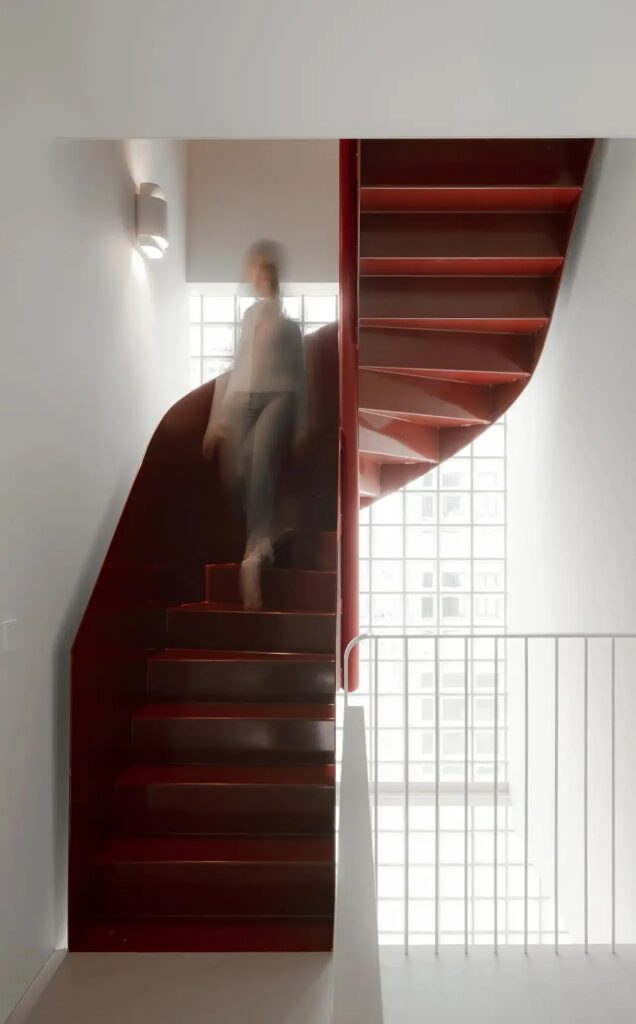
The interior layout is designed to be non-fixed and continuously reconfigurable to respond to changing family needs over time, incorporating an indoor tree that grows through the floors via a circular opening in the floor slab, and a sculptural red spiral staircase that provides vertical circulation as a functional and bold element within the home.
Related Insight: Please refer to this article to understand the context of modern architectural preservation:
Glass Brick in Contemporary Facades: Between Privacy and Natural Lighting.



✅ Official ArchUp Technical Review completed for this article.