Bird-Inspired Lishui Airport Opens After 17-Year Development

Mountain Terminal Completes Extended Construction Timeline
Lishui Airport in eastern Zhejiang Province has officially opened to passengers following a prolonged 17-year design and construction period. The 12,000-square-meter terminal showcases organic architecture inspired by natural forms found in the surrounding mountainous landscape.
Design Concept Mirrors Natural Environment
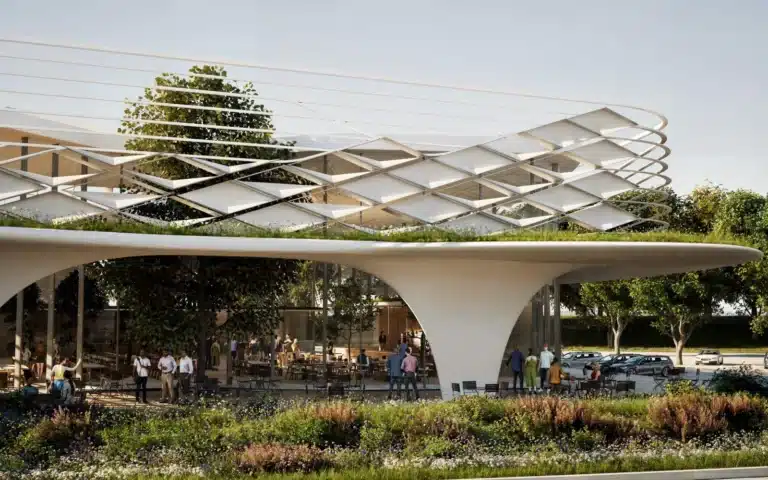
The terminal building appears as a giant white bird resting among peaks. A double-layered roof clad in silver-white aluminum evokes mist-covered hills and soaring birds. This approach to architectural design integrates the structure seamlessly into its environment.
Fourteen umbrella-shaped structural columns support the 14-meter-tall lightweight roof. Additionally, a spindle-shaped skylight channels natural daylight into interior spaces. Transparent curtain walls blur boundaries between indoor and outdoor zones.

Interior Spaces Prioritize Passenger Experience
The sloping first-floor lobby varies dramatically in height, ranging from 4.5 meters to 13 meters. Narrow acoustic slots embedded between interior design panels reduce ambient noise levels. The terminal uses materials with warm tones and natural textures to create bright, airy spaces.
A one-and-a-half-story layout keeps the airport compact while supporting daily operations. Below the terminal, a sunken parking structure follows natural topography. Meanwhile, a landscaped promenade runs underneath the building to guide passengers toward the departure hall.
Operational Capacity and Future Expansion
Lishui Airport features eight aircraft bays with capacity for one million passengers annually. The facility can handle 4,000 tonnes of cargo each year. Initially, operations will focus on domestic flights only.
However, the design allows for future expansion. Plans include an international terminal that could increase passenger capacity to five million yearly by 2050.
Challenging Construction Process
The construction phase required significant earthworks. Cut-and-fill differences often reached nearly 100 meters due to mountainous terrain. The project was conceived in 2008 and originally scheduled to open in 2024.

The extended timeline reflects the complexity of building large-scale infrastructure in challenging geographical conditions. Despite delays, the completed terminal now serves as a regional transportation hub.
Will this bird-inspired design approach influence future airport architecture in mountainous regions?
A Quick Architectural Snapshot
The 12,000-square-meter Lishui Airport terminal in Zhejiang Province features a double-layered aluminum roof supported by fourteen umbrella columns. The lightweight structure reaches 14 meters in height with transparent curtain walls. The facility accommodates one million annual passengers across eight aircraft bays, with expansion plans targeting five million by 2050.
Max
✦ ArchUp Editorial Insight
A 17-year timeline from conception to operation is not a design failure. It is the predictable result of layering provincial infrastructure ambition onto mountainous terrain with limited fiscal urgency. Cut-and-fill differentials reaching 100 meters confirm that site selection prioritized political geography over construction feasibility.
The one-million-passenger capacity paired with eight bays positions this terminal within a familiar pattern: regional airports scaled for projected demand curves that justify state capital expenditure today while deferring utilization risk to future administrations. The 2050 expansion clause to five million passengers functions less as planning and more as embedded fiscal justification.
Compact massing with a single-level passenger flow eliminates vertical circulation cost, a decision driven by operational budget constraints rather than spatial philosophy. The sunken parking structure following natural topography reduces excavation volume, converting a geographic limitation into an engineering economy.
This terminal is the logical outcome of terrain constraint plus provincial connectivity mandates plus long-horizon political investment cycles.