The House That Helped Make the Fog

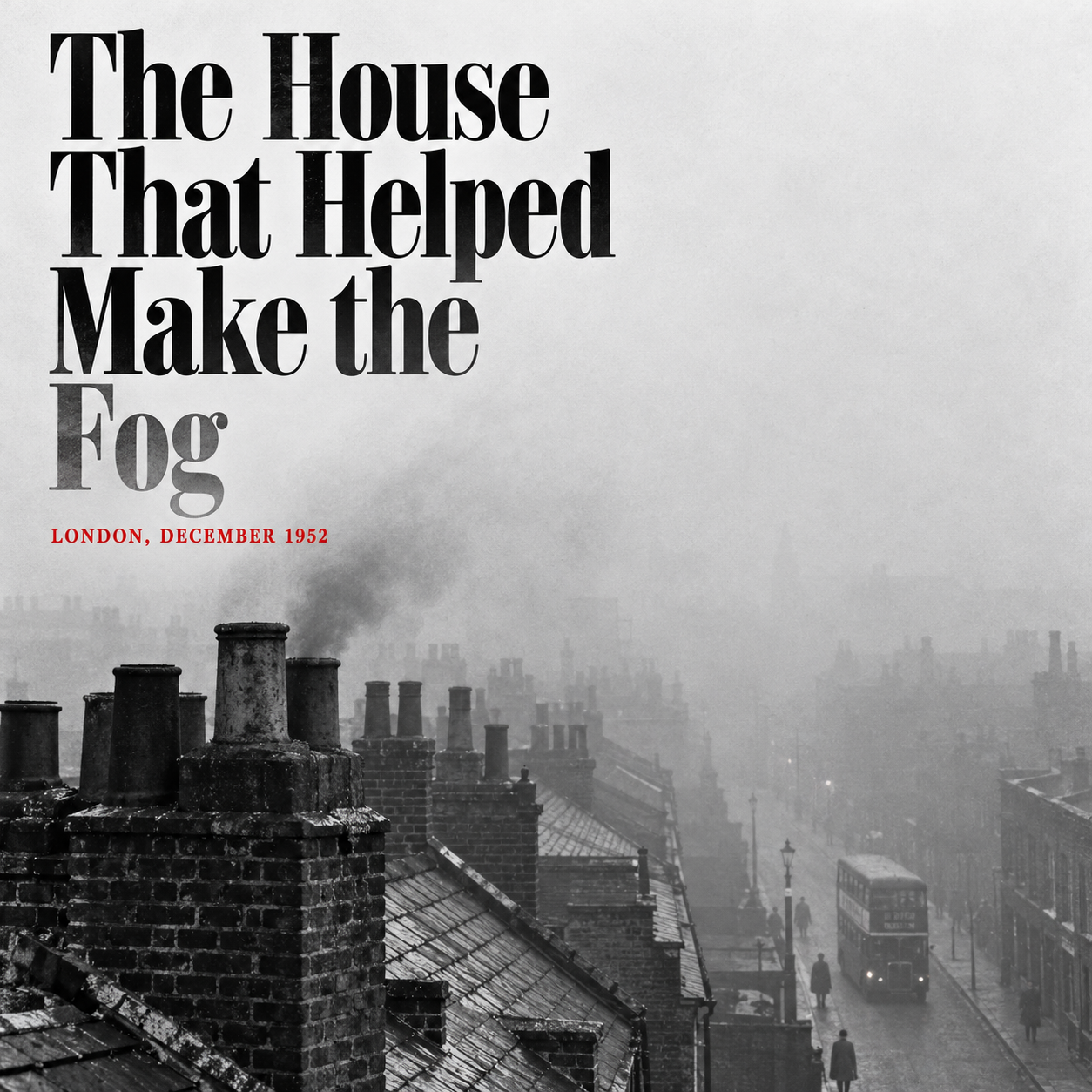
Imagine a man in London on the evening of the fifth of December, 1952, standing at the window of his small terraced house as a strange yellow darkness thickens in the street outside. He cannot see the lamp post across the road. The air has a taste, metallic and sour, and it is seeping under the door and around the window frames, so he does what any sensible person would do. He shuts the windows tight, draws the curtains, and crosses the room to build up the fire, shovelling more coal onto the grate to keep his family warm against the cold that is pressing in with the dark. He is protecting them. He is doing the most ancient and instinctive thing a dwelling is for, sealing out the hostile world and keeping the hearth burning. And he does not know, because almost no one in the city knows it yet, that the fire he is feeding to escape the fog is one of a million fires feeding the fog itself. His chimney, and the chimney of every house on his street, and the chimneys of a thousand streets like it, are at that moment exhaling the very poison he is trying to shut out. The house built to shelter him from the air is helping to kill the air.
This is not merely a tragic irony. It is, I want to argue, one of the most instructive moments in the entire history of the built environment, because it exposes a truth about buildings that we are still, seventy years later, refusing to fully absorb. We think of a house, and of architecture in general, as a refuge from the environment. The Great Smog of 1952 revealed that the house is also a maker of the environment, that the line between inside and outside which architecture pretends to draw is a fiction, and that the way we heat and cool and seal our dwellings reaches out through the chimney and the vent and the flue to compose the very sky we all then have to breathe. Over five days that December, this fiction killed thousands, and the full reckoning of how it did so, and what we did about it, and what we have quietly failed to do about it since, is a story every architect should carry.
A Catastrophe Made at Home
Let me establish the hard facts first, because the scale of it still shocks. Between the fifth and ninth of December 1952, an anticyclonic temperature inversion settled over the Thames Valley, a lid of warm air trapping cold stagnant air below it, with calm conditions recorded a third of the time at Kew and almost no wind to carry anything away. Into that sealed bowl the city kept pouring its smoke. Monitoring across Greater London showed smoke concentrations climbing from a winter baseline of a few tenths of a milligram per cubic meter to an area average near one and a half, with a central site at County Hall in Lambeth reaching nearly four and a half, many times the normal load. Sulphur dioxide rose to several times its usual level, with peaks more than ten times normal. London was emitting on the order of two thousand tonnes of sulphur dioxide a day into an atmosphere that had, that week, lost only about four percent of its usual ability to cleanse itself. That thin margin, a mere four percent failure of the wind and the air to do their ordinary work, was the whole difference between a routine winter fog and a mass casualty event.
And here is the fact that matters most for us, the fact that turns this from a weather story into an architecture story. The emissions that accumulated were overwhelmingly domestic. Coal supplied the majority of London’s energy, and a large share of that was burned not in factories but in homes, in the open coal grate that sat at the heart of the ordinary English house. That grate was cheap, it was culturally beloved, it was the literal and symbolic center of family warmth, and the cleaner gas and electric alternatives cost roughly twice as much, so smokeless heating was a luxury of the comfortable classes while everyone else burned cheap, high sulphur, post war coal in an inefficient open fire. The epidemiological reconstruction done decades later found something no one wants to hear, that domestic coal use had the strongest association with later mortality of any category of fuel, stronger than industry, stronger than power generation. The killer was not primarily the dark satanic factory. It was the family fireside, multiplied across a dense city of low chimneys that discharged their smoke not high into the dispersing winds but directly down into the breathing zone of the street.
The chimney height is the quiet architectural variable in all of this. A tall industrial stack throws its pollution high, where it thins and scatters, its ground level concentration falling roughly with the square of the height. The low domestic chimney of a terraced house delivers its smoke straight back into the air at head height, and when you pack those low chimneys together at the density of riverside London, the pollution map of that December writes itself. The worst concentrations sat exactly over the boroughs of highest residential density, Westminster and Lambeth and Chelsea and Southwark, and the cleanest air was at the thinning edge of the city. The catastrophe mapped perfectly onto the housing. The deaths were not a visitation from outside. They were exhaled by the dwellings of the dead.
What the Deaths Finally Bought
The toll took years to understand honestly. The Ministry of Health at first counted around three to four thousand excess deaths in the weeks around the smog, and then tried to attribute much of the lingering mortality to an influenza epidemic. But the careful retrospective work dismantled that comfort. Influenza would have had to be twice as lethal and four times as common as the worst recorded epidemic to account for the excess, which was epidemiologically absurd, and the revised estimate of deaths attributable to the smog rose to around twelve thousand, with elevated mortality stretching across two and a half months. The harm did not even stop with that generation. Children who were in the womb or in their first year during the smog were measurably more likely to carry asthma into their lives, and an extraordinary study of three and a half million deaths found that the areas of England and Wales with the highest domestic coal use back in 1951 and 1952 still showed elevated mortality sixty years later, the signature of the fireside legible in the bodies of people long after the fires went out. The way a generation heated its homes had written itself into the health of entire cities for a lifetime and beyond.
It took this, all of this, to move the law, and that delay is itself a lesson in how slowly a culture will regulate its own hearth. Awareness was not the problem. John Evelyn had warned in 1661 that London’s coal smoke was shortening the lives of its citizens, nearly three centuries before the Great Smog proved him right in a single week. But the domestic fire was sacrosanct, smoke was read as a sign of warmth and prosperity, and so it took thousands of corpses to produce the Clean Air Act of 1956. That Act did something genuinely radical for its time. It reached past the factory and into the home. It prohibited dark smoke from any chimney, mandated minimum chimney heights for new industrial building, and, most importantly, created smoke control areas in which emitting smoke from the chimney of any building, including a private house, became an offence, with public compensation to help households convert their hated, beloved, lethal fireplaces to cleaner fuel. The state had finally recognized what the man at his window in 1952 could not, that the private decision of how to heat a single home is a public act with consequences in everyone’s lungs.
It worked, helped along by the broader shift from coal to oil, electricity, and eventually North Sea gas. Between 1950 and 2000, London’s smoke and sulphur dioxide concentrations fell by around ninety five and ninety eight percent. The visible catastrophe was defeated. And this is exactly where the story becomes dangerous, because a defeated visible problem is the easiest kind of problem to believe you have solved completely.
The Problem Did Not Die, It Moved Indoors
Here the honest architect has to resist the triumphant ending, because the deeper pattern of 1952 did not disappear. It migrated. The smog drove combustion out of the open grate, but the fundamental tension it exposed, between keeping a building warm and sealed on the one hand and keeping its air breathable on the other, simply relocated from the outdoor sky to the indoor room, and from the problem of smoke to the problem of carbon. Over the decades since, the entire discipline of sustainability in building has been bent toward sealing the dwelling ever tighter, to stop precious heated or cooled air from leaking out and to shrink the carbon cost of conditioning it. This is a worthy goal and I do not mock it. But watch what it reproduces. When researchers monitored real, modern, airtight homes built to good energy standards, they found bedroom carbon dioxide at night climbing to a mean peak above two thousand parts per million, nearly double the thousand part threshold of concern, because the building had been sealed for energy without a planned and effective ventilation strategy to go with it. The occupants, like the man in 1952, had shut the world out to stay comfortable, and in doing so had trapped the products of their own breathing and their own living in the space where they slept.
The parallel is almost exact, and it is the heart of what I want to say. In 1952 we sealed the house against the fog and fed the fire, not knowing the fire fed the fog. Today we seal the house against the waste of energy, and we risk trapping a quieter, slower degradation of the air inside, from our cooking, our materials, our own respiration, unless we deliberately engineer the breathing back in. The European evidence shows this is not hypothetical, with large fractions of dwellings in several countries failing to meet even basic air change rates, and a cruel new twist, that opening the building up to ventilate it can now pull in the outdoor traffic pollution that replaced coal as the city’s main poison. The inside and the outside are still one system. Architecture is still pretending they are two.
Have We Cleaned the Building, or Only Learned to Measure It?
This is where the modern frameworks enter, and where I want to be careful and fair rather than cynical, because the research itself is careful. The green building standards, LEED foremost among them, did not arise as a direct response to the Great Smog. That would be a tidy falsehood. They emerged decades later, out of a slowly maturing environmental consciousness, and the honest connection between the smog and LEED is a lineage of thought, not a line of cause. But the lineage is real, and it runs straight through the two categories of the certification that matter most here. Energy and Atmosphere, the category that governs how a building consumes power and what it emits, is the direct descendant of the realization that how we condition a building reaches out into the shared sky. And Indoor Environmental Quality, the category that governs ventilation and the air of the occupied room, is the direct descendant of that man at his window, the recognition that the air inside the dwelling is a matter of life and death. The construction and operation of buildings now accounts for roughly thirty seven percent of global energy and process related carbon emissions, so the stakes of the Energy and Atmosphere question are planetary, not local. The chimney has become the power plant and the supply chain, but it is still a chimney, and it still exhales into air we all share.
And yet the research delivers a genuinely sobering verdict on how well these frameworks actually encode the lesson. A content analysis of the major green standards found that fewer than twenty percent of their attributes address the specific targets of the global sustainability agenda, and less than ten percent of their scores reward truly transformative change, prompting the researchers to warn that claims these systems advance those goals are overstated and risk becoming a form of greenwashing. More pointed still, indoor air quality, the very thing the 1952 disaster should have burned into our priorities, receives on average only around seven and a half percent of the weight in green building rating schemes, and is typically assessed before anyone moves in, missing the real emission sources that arrive with occupancy. We measure the building empty and certify it clean, then fill it with people and furniture and cooking and stop looking. There is a trade off buried in the whole enterprise that the certifications only partly capture, the tension between pumping in fresh outdoor air for health and spending the energy to condition that air, a tension the pandemic threw into sharp relief when the demand for fresh air collided directly with the demand for lower energy use. The design of a truly healthy building is the optimization of that conflict, and a points based plaque on the lobby wall is a thin proxy for having actually solved it.
So I arrive at the question that the man at his window would ask us if he could see what we have built in the seventy years since his family shut their windows against the fog. Have we actually made the building clean? Or have we only become far more sophisticated at measuring, certifying, and relocating the pollution it produces? The answer, if we are honest, is some uncomfortable mixture of both. We genuinely banished the killing smoke, and that is no small thing, twelve thousand ghosts would insist it was no small thing. But we did not resolve the contradiction the smog revealed. We sealed the building tighter and moved the risk indoors. We shrank the operational carbon and discovered the embodied carbon waiting in the concrete and the steel. We wrote the air of the occupied room into a certification and then gave it seven percent of the weight and stopped measuring at move in day. The projects that win the awards and make the news announce their platinum ratings, and the glossy launches and the competitions celebrate the sealed glass tower as a triumph of efficiency, and somewhere in the mechanical plant the same old question hums unanswered, whether the way this building keeps its occupants comfortable is quietly degrading the air for someone, somewhere, inside it or downwind of it.
The most serious architectural research of this moment should treat the Great Smog not as a solved historical episode but as the permanent diagram of the problem, because what it showed is not a fact about coal. It is a fact about buildings. A building is never only a shelter from the environment. It is always also a machine that remakes the environment, inside its walls and beyond them, and the fiction that the facade is a clean boundary between a private inside and a public outside is exactly the fiction that filled a city’s lungs with its own fire. The lesson of 1952 is not that we burned the wrong fuel. It is that a dwelling reaches through its chimney into the shared sky and through its vents into the breathed room, and that every decision about how we warm, cool, seal, and certify our buildings is therefore a decision about air, and air was never a thing that stops politely at the window. We did not finish the work that December bought with twelve thousand lives. We relabeled it, and the relabeling is not the same as the cure, and a building is not healthy because we have grown clever enough to give its pollution a certificate and a score.
✦ ArchUp Editorial Insight
The essay’s governing insight is that the Great Smog was not a weather event or an industrial failure but a housing event, and the epidemiological reconstruction it cites makes the claim unavoidable: domestic coal use carried the strongest association with mortality of any fuel category, stronger than industry or power generation, which means the killer was the family fireside multiplied across a dense city of low chimneys that discharged their smoke directly into the breathing zone rather than high where the winds could disperse it. The chimney height is the quiet architectural variable, and the pollution map writing itself over the boroughs of highest residential density is the clearest evidence this archive has encountered that a building is never a shelter from the environment but a machine that remakes it — the fiction of a clean boundary between private inside and public outside being precisely the fiction that filled a city’s lungs with its own fire. What elevates the piece beyond historical reconstruction is its refusal of the triumphant ending: the contradiction the smog exposed did not die when the Clean Air Act banished the smoke, it migrated, from the outdoor sky to the sealed bedroom where airtight energy standards now trap carbon dioxide at nearly double the threshold of concern, reproducing the man at his window who shut the world out to stay comfortable and trapped the products of his own living in the room where he slept. This is the same liability structure this archive traced in The Hidden Cost of Breathing, and the essay’s sharpest contribution extends it into the certification regime itself, naming the greenwashing mechanism directly: indoor air quality receives on average seven and a half percent of the weight in green rating schemes and is assessed before anyone moves in, so the building is measured empty, certified clean, then filled with people and no longer watched — a plaque on the lobby wall standing in for a contradiction no one has resolved, which connects to what Green FIFA identified as the sustainability claim deployed as reputational instrument rather than measured commitment, the certificate performing a cleanliness the mechanical plant quietly contradicts, inside the building or downwind of it, where air was never a thing that stopped politely at the window.
Ibrahim Fawakherji — ArchUp
Sources
- Bell ML, Davis DL. Reassessment of the lethal London fog of 1952. Environmental Health Perspectives, 2001.
- Wilkins ET. Air pollution aspects of the London fog of December 1952. Quarterly Journal of the Royal Meteorological Society, 1954.
- Read C, Parton KA. The impact of the 1952 London smog event and its relevance for current wood smoke abatement strategies in Australia. Journal of the Air and Waste Management Association, 2019.
- Zhang D, Liu J, Li B. Tackling Air Pollution in China: What do we learn from the Great Smog of 1950s in London. Sustainability, 2014.
- Phillips DIW, Osmond C, Southall H, et al. Evaluating the long term consequences of air pollution in early life: coal consumption in 1951/1952 and current mortality in England and Wales. BMJ Open, 2018.
- Bell ML, Davis DL, Fletcher T. A retrospective assessment of mortality from the London smog episode of 1952: the role of influenza and pollution. Environmental Health Perspectives, 2004.
- Bharadwaj P, Graff Zivin J, Mullins JT, Neidell M. Early Life Exposure to the Great Smog of 1952 and the Development of Asthma. American Journal of Respiratory and Critical Care Medicine, 2016.
- Persily A. Challenges in developing ventilation and indoor air quality standards: the story of ASHRAE Standard 62. Building and Environment, 2015.
- Wei G, Yu X, Fang L, et al. A review and comparison of the indoor air quality requirements in selected building standards and certifications. Building and Environment, 2022.
- Howieson S, Sharpe T, Farren P. Building tight, ventilating right? How are new air tightness standards affecting indoor air quality in dwellings? Building Services Engineering Research and Technology, 2013.
- Dimitroulopoulou C. Ventilation in European dwellings: a review. Building and Environment, 2012.
- Mishra NK, Patel S. Need for a Holistic Approach to Assessing Sustainable, Green, and Healthy Buildings. Environment and Health, 2024.
- Rock M, Balouktsi M, Ruschi Mendes Saade M. Embodied carbon emissions of buildings and how to tame them. One Earth, 2023.
- Goubran S, Walker T, Cucuzzella C, Schwartz T. Green building standards and the United Nations Sustainable Development Goals. Journal of Environmental Management, 2023.