The Room That Stopped Being a Room

Argentine football culture transforms ordinary locations into talismans believed to influence outcomes through ritual and association. By preserving specific rooms or returning to previous hotels, teams attempt to capture the psychological essence of past victories, turning functional architectural spaces into symbolic vessels for collective memory and luck.
Environmental psychology suggests that familiar settings improve a person’s mental state, yet these spaces lack actual causal power. Argentina’s eventual defeat despite exhaustive ritualistic preparation demonstrates that while architecture can hold significant emotional weight and provide psychological comfort, it remains unable to guarantee results or control reality.
There is a room inside Qatar University that will never be rented again. It is a student dormitory room, room 201, indistinguishable in every measurable way from the rooms on either side of it. Same dimensions, same window, same modest furniture. Yet after December 2022 the university announced it would preserve the room rather than return it to use, because Lionel Messi had slept in it during the World Cup that Argentina won, and a space that had held a champion could no longer be treated as ordinary floor area. The room did not change. Its meaning did. And in that small administrative decision, to remove a functioning room from function and convert it into something closer to a shrine, sits one of the most revealing questions architecture almost never asks. How does a place stop being a container and become a talisman?
The Argentine case is the richest available, because Argentine football culture has a specific and openly acknowledged name for the mechanism. It is called the cábala, a body of rituals and habits repeated by players, coaches, and supporters in the belief that they attract fortune or hold misfortune at bay. It is not religious. The Associated Press has described it as woven deeply into Argentine society, a cultural reflex rather than a private eccentricity, and it operates with particular intensity on physical places. A seat, a route, a room, a hotel. The cábala takes a neutral location and, through repetition and association with a remembered victory, loads it with a causal charge it does not physically possess. This is not a story about superstition in architecture. It is a story about the moment a space acquires, in the mind of its user, a power its walls were never engineered to hold.
From a Museum Room to a Lucky Hotel
Trace the sequence and the mechanism reveals itself with unusual clarity. In Qatar in 2022, the charged place was room 201, later sealed as a museum. Two years later, during the Copa América of 2024, the Argentine squad stayed at the Hilton in Short Hills, New Jersey, and after lifting that trophy the hotel itself entered the cábala. It stopped being accommodation and became evidence, a place psychologically bound to winning. So when the 2026 World Cup arrived, the geography of belief had already been drawn before a single match was played, and the projects of hospitality and logistics that normally serve a team were quietly reorganized around it.


The base camp for 2026 was formally established elsewhere, at a hotel in Kansas City with a training center attached, a rational logistical choice near the group stage venues. But once Argentina cleared the group stage, the team returned to the Hilton in Short Hills. Not only for logistics. The players and the federation wanted the same hotel, the same rooms, the same routine, because they read that continuity as an extension of the cábala that had accompanied the Copa América title on the same ground. A functional decision about where to sleep had become a decision about where luck lived, and the two could no longer be separated.
Then the numerology began, and it is worth dwelling on because it shows how little the physical object matters once belief takes hold. In Kansas City, Messi had been placed in room 202 rather than the 201 of Qatar. Supporters and media noticed instantly. Two plus zero plus two equals four, read as an omen of a fourth star, a fourth title, while the 201 of Qatar summed to three, the star Argentina already wore. None of this came from the federation. It emerged from the crowd, from the collective will to read meaning into an arbitrary door number, which is precisely the point. The room did nothing. The reading did everything, and the reading attached itself to a coordinate in space.

The rituals then went further, and here the story becomes explicitly architectural. According to multiple reports, Cristian Romero and Lisandro Martínez brought palo santo, an aromatic wood burned in several Latin American traditions, and passed its smoke through the corridors and rooms of the hotel, treating the interior itself as something to be cleansed of negative energy before decisive matches. And the federation went further still. It changed the hotel’s interior wholesale, its pictures, its flags, its photographs, its motivational phrases, its décor, until the players moved through a space that no longer read as a foreign hotel but as the national team’s own house. This is the deepest move in the entire sequence, and most people missed its significance because they filed it under sport. A generic commercial interior was deliberately rewritten from within, its imagery replaced, its atmosphere rewritten, in order to convert strangeness into familiarity. That is not decoration. That is an act of design, performed for a psychological purpose, on a space the team did not own and would soon leave.
There is a structural pattern underneath all of this that is easy to miss inside the noise of a tournament. A place becomes a talisman through a fixed sequence. First an outcome of high emotional weight occurs in a specific location. Then the mind, which is built to find causes even where none exist, binds the outcome to the place, because the place was present and available to be blamed or credited. Then the person returns to the location deliberately, and the return is rewarded with a feeling, the confidence or calm that the memory carries, which is real regardless of whether the original causal link ever existed. Then that feeling is misread as evidence that the place works, and the belief hardens. Each cycle deepens the attachment, and the physical space, which contributed nothing beyond being the stage, becomes progressively more difficult to abandon. Qatar’s room 201 completed this loop in a single tournament. The Hilton in New Jersey completed it across two. The mechanism is identical at every scale, from a tennis player’s water bottles to a nation’s chosen hotel, and it explains why the most rational organizations on earth still guard their charged spaces with an intensity no spreadsheet could justify.
What the Place Actually Does
The honest question has to be asked directly. Did the hotel help Argentina win anything? Physically, no. A room does not intercept a pass or convert a penalty. But did the players believe it helped? Evidently yes, and that belief is not nothing, because it changes the psychological state of the person who holds it. Environmental psychology has names for what is happening here, and they are not mystical. Place attachment describes the bond a person forms with a specific location, binding it to particular emotions or particular successes, until the person resists changing it. The environmental cue describes how a setting becomes a trigger that summons a mental state, the same room, the same chair, the same route reactivating the confidence, or the calm, or the readiness that accompanied a previous success. The architectural research on these effects is substantial, and it points to a conclusion the profession rarely states plainly. A space cannot change an outcome, but it can change the internal condition of the person who will produce that outcome, and to the user those two things feel identical.
This is why the phenomenon is not confined to Argentine football, and gathering the parallels shows how general it is. Rafael Nadal arranges his water bottles with fixed precision before every match, orienting objects in space as a way of ordering his own mind. Teams on winning streaks refuse to change the locker room, treating the construction of a specific space as a condition of continued success. The instinct scales far beyond sport. Churchill insisted on the same command center through the war. The historical missions of mission control preserved the arrangement of their rooms and seats. Traders cling to particular desks and screens. Gamblers refuse to leave a seat that has been winning. Even Argentina’s president, Javier Milei, reportedly declined to attend the 2026 final in person, choosing to watch from home in the same clothes, because his own viewing setup had become part of the national cábala. In every case a place, or an arrangement of objects in a place, is promoted from setting to instrument, believed to participate in an outcome it can only ever witness.
For cities and the people who design their most charged spaces, stadiums, courtrooms, trading halls, operating theaters, this carries a lesson that is usually left implicit. The emotional performance of a space, its capacity to steady or unsettle the person inside it, is a real design variable, even though it produces no physical effect on results. The instinct to preserve room 201 forever, to remove it permanently from use, is the same instinct that drives heritage preservation and the broader sustainability argument for keeping meaningful buildings alive rather than demolishing them. We keep places not only for what they do but for what they hold, and what they hold is memory, which has no structural weight and enormous psychological mass.
The Final That Answered the Question
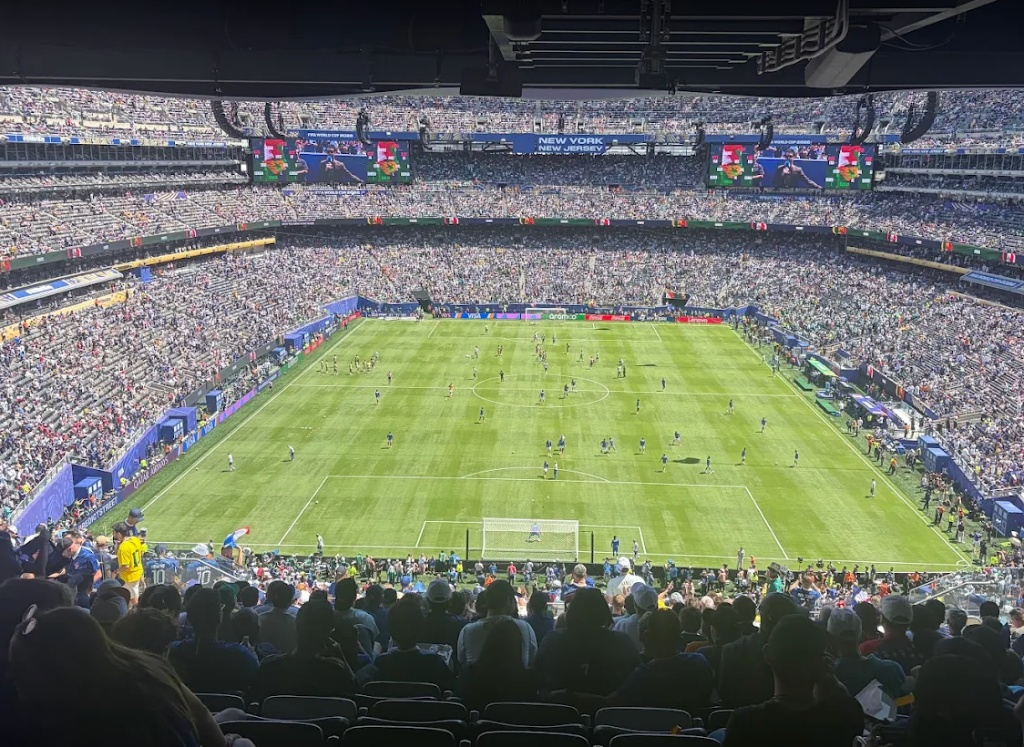
And then came the answer, delivered with an irony so precise it reads like an argument constructed on purpose. By the time of the 2026 final, the cábala had been pushed to its absolute maximum. The lucky state, New Jersey. The lucky hotel, rewritten into the national team’s house. The room mathematics aligned toward the fourth star. The corridors cleansed with smoke. The routine preserved to the smallest detail. Argentina was chasing a fourth consecutive major title and a place in history as the first repeat World Cup champion since 1962, and every environmental instrument the culture possessed had been deployed to help. The final itself was played at MetLife Stadium, in the very state the cábala had sanctified.
Spain won by a single goal, scored by Ferran Torres in the second half of extra time, after ninety minutes and more had passed without a breakthrough. The match was not close in any sense but the score. Spain took around twenty shots. Argentina managed a mere handful and did not register its first attempt until deep into extra time. Enzo Fernández was sent off in stoppage time of the second half, leaving Argentina a man down for the entire additional period. Emiliano Martínez set a record for saves in a World Cup final and still finished on the losing side, which is the cruelest possible summary of the evening. The most thoroughly consecrated space in modern sport, a hotel turned into a shrine in a state turned into a talisman, delivered precisely nothing of what it was believed to deliver. The smoke, the room number, the redecorated corridors, the preserved routine, all of it met twenty shots and a red card and dissolved.
This is the value of the Argentine case, and the reason it deserves an architectural reading rather than a sporting one. It ran the experiment to its limit and recorded the result cleanly. A space can be loaded with memory until it feels causal, and the loading is genuine, and it genuinely changes how the people inside it feel. But the space cannot store causation the way it stores meaning. It comforts, and comfort is real. It does not decide, and the belief that it decides is the illusion. The news cycle will remember the red card and the extra time goal. It will forget the palo santo and the repainted walls, which is exactly backwards, because the walls are the more interesting story. They record what human beings do when the outcome matters more than their control over it.
So the thesis is this, and it reaches well past football into every space we sanctify. We do not turn places into talismans because they work. We turn them into talismans because we cannot govern what actually works, and a charged room is the most available substitute for a guarantee we are never offered. The same instinct that governs a knockout match governs a design competition, a courtroom, a surgery, a first day in a new office. A space can hold a feeling with perfect fidelity and hold a result with none at all, and the moment we forget that difference we begin to worship the container and neglect the contents. Room 201 will sit sealed in Qatar for as long as the university keeps its promise, a room that stopped being a room, and it will continue to prove, silently, that architecture can preserve everything about a victory except the thing that caused it.
✦ ArchUp Editorial Insight
The decision to seal room 201 at Qatar University is not a sentimental act — it is a property management response to a sudden and unearned transfer of symbolic capital onto a generic dormitory unit, and its structural logic is identical to the mechanism that drives heritage preservation, landmark designation, and the premium pricing of any space whose coordinates have been touched by a sufficiently legible narrative. What the Argentine cábala exposes, when read as an institutional rather than a psychological phenomenon, is that the perceived causal power of a space is a real economic variable even when its actual causal power is zero: the federation redirected logistical decisions worth millions of dollars around a belief in a hotel’s lucky properties, and Qatar University permanently retired a revenue-generating room, both organizations responding rationally to the irrational valuations their communities had attached to specific coordinates. The article’s most analytically precise observation — that the space cannot store causation, only meaning, and that we consistently mistake the intensity of the second for the presence of the first — connects directly to what The Geography of Stigma identified in the opposite emotional register: in both cases, an event of high collective weight transfers a perceived causal charge onto a neutral space, collapsing its market value when the event was traumatic and inflating it when the event was triumphant, while the walls themselves remain unchanged, holding nothing but what the community’s memory has decided to project onto them, and pricing themselves accordingly until the memory fades or the institution that guards it runs out of reasons to maintain the fiction.