The Mona Lisa: From a House in Florence to a Room in Paris


The Mona Lisa represents a series of displacements, moving from its origins as a portrait of Lisa Gherardini in Florence to its status as a mythic object in Paris. While the subject lived and died in Italy, her image became a global icon through centuries of relocation.
A 1911 theft transformed the painting into a global celebrity, establishing a narrative that dictates modern visitor behavior. Within the Louvre, this cultural gravity overrides architectural design and surrounding masterpieces. Understanding the work requires recognizing both the historical life in Florence and the mythic presence in Paris.
Ibrahim Fawakherji — ArchUp
Before I stood in the Louvre in front of the most visited painting on earth, I had already stood in Florence in front of the house where the woman in the painting had lived.
The house on Via della Stufa is not marked by anything that would stop a person who was not already looking for it. There is no prominent museum entrance, no grand institutional presence. It is a building on a Florentine street that looks like the buildings around it, built in the stone and proportion that the city has used for centuries. Lisa Gherardini was born there in 1479. She lived in the city that I wrote about in an earlier piece for ArchUp, a city whose streets and light and material character are documented in the painting that carries her image across five centuries. The window in that house, or one very much like it, framed the same golden Florentine light that Leonardo da Vinci learned to use before he painted her.
Standing outside that building, I understood something that standing in front of the painting in Paris would later confirm in a different way. The Mona Lisa is not primarily a painting. It is a chain of displacements: a woman displaced from her life into a canvas, a canvas displaced from Florence to France, a painting displaced from its original context into a myth that has almost nothing to do with the specific woman who sat for it.
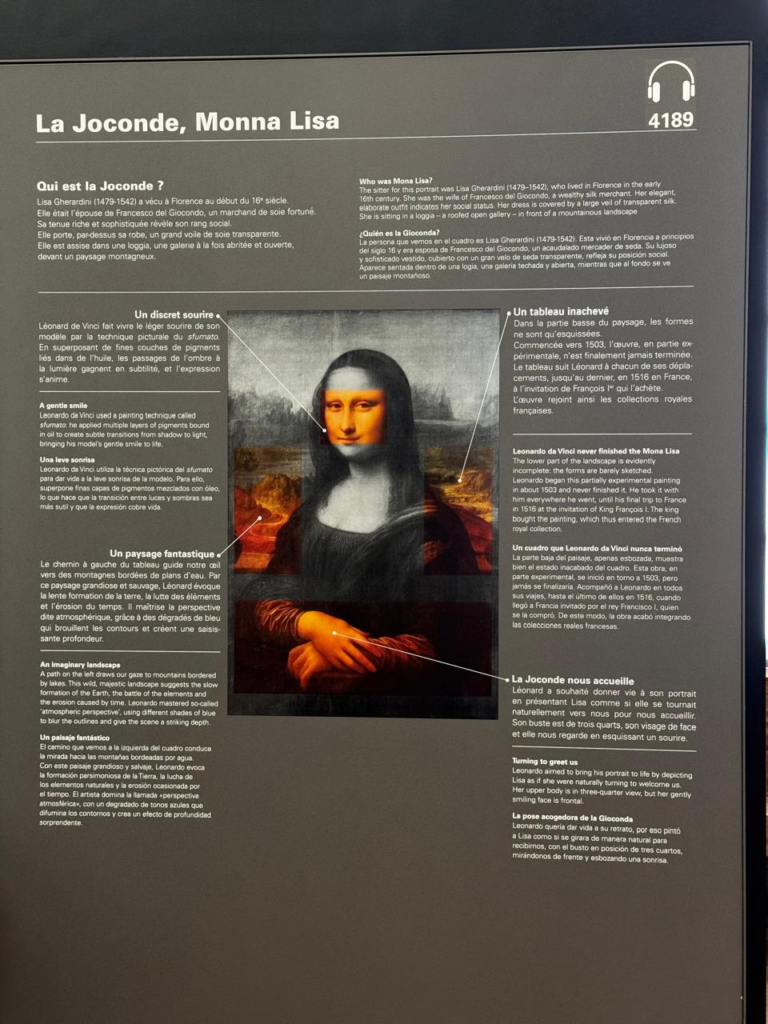
Lisa Gherardini married Francesco del Giocondo in 1495, which is why the painting is known in Italian as La Gioconda. Her husband commissioned the portrait from Leonardo, then working in Florence, reportedly to celebrate the birth of their second child. Leonardo began the work around 1503. He did not finish it on commission. He kept it, carried it to France when he accepted an invitation from King Francis I, and it entered the French royal collection after his death in 1519.
The painting never returned to Florence. Lisa Gherardini died in the city in 1542, thirty years after Leonardo had left with her portrait. She is buried at the convent of Sant’Orsola in Florence, a building that has been used for various purposes across the centuries and that most visitors to the city walk past without any awareness of what it contains.
The displacement that began when Leonardo carried the painting north continued when the French Revolution transferred the royal collections to the new Republic. The Louvre opened as a public museum in 1793. The Mona Lisa was among its holdings. Napoleon later moved it to his bedroom in the Tuileries, then returned it to the Louvre. It has been in the Salle des États, more or less in its current configuration, since 2005.
The woman in the painting has been in Paris for five hundred years. The city where she was born, where she lived, where she is buried, holds only the buildings that knew her, and none of them are marked in any way that most visitors would notice.
The theft of 1911 is the event that converted the painting from a respected masterwork into a global myth, and understanding how it worked reveals something important about the relationship between absence and cultural significance that goes beyond art history.
Vincenzo Peruggia had worked at the Louvre and knew its routines. On the morning of August 21, 1911, he removed the painting from the wall of the Salon Carré, hid it under his coat, and walked out. The theft was not discovered until the following day. When it was, the Louvre closed for a week. French newspapers ran it as a national crisis. The empty space on the wall drew more visitors than the painting had when it hung there. People came to see the absence, photographed the hooks, stood in front of the pale rectangle where the canvas had been.
The two years of absence produced an effect that five centuries of presence had not. The painting became a story comprehensible to anyone regardless of their relationship to art: something valuable was taken, the world searched for it, it was found. The search brought the painting to populations in Europe, North America, and beyond that had no prior connection to Florentine Renaissance portraiture. The recovery in 1913, when Peruggia attempted to sell it to an art dealer in Florence and was identified, gave the story its resolution.
What returned to the Louvre in 1913 was no longer quite the same cultural object that had left in 1911. The theft had added to it a layer of narrative that could not be removed. Historians of art who have studied this period with care are consistent in their assessment: the 1911 theft was the primary mechanism that transformed the Mona Lisa into the most famous painting in the world. The painting’s artistic quality is genuine and has been recognized across five centuries. But artistic quality, distributed across thousands of works of comparable achievement in collections around the world, does not produce the specific form of celebrity that the Mona Lisa now possesses. The celebrity required the theft.
The Bluetooth tracking research conducted inside the Louvre, which analyzed the movement patterns of visitors using the signal density from mobile devices, produced a finding that should be uncomfortable for everyone involved in museum design and management. Visitors who spent different amounts of time in the museum, from less than an hour to several hours, converged on approximately the same set of locations regardless of the time available. The extended visit produced more time at the popular points, not more exploration of the less-visited areas.
The Louvre covers approximately 72,000 square meters of exhibition space and holds around 35,000 works on display at any given time, drawn from a total collection exceeding 500,000 objects. The portion of that space and collection that receives the majority of visitor attention is a small fraction of the whole. The painting that concentrates the greatest density of visitor traffic is approximately 77 by 53 centimeters, displayed behind protective glass at a distance that makes close examination impossible for most of the people in the room.
This is not a failure of curation. It is a demonstration of how cultural gravity works at sufficient magnitude. When an object has accumulated enough narrative around it, the narrative becomes the primary reason for visiting, and the spatial organization of the building that contains it becomes secondary to the directional pull of the story. The Louvre’s architects and curators can arrange galleries, design circulation routes, and place other masterworks in positions of prominence. None of these interventions has significantly altered the fact that most visitors arrive with a specific destination and walk toward it.
The room designed to contain the Mona Lisa, the Salle des États, makes a spatial argument that is itself revealing. The painting hangs on one wall. Opposite it, Paulo Veronese’s Wedding at Cana occupies approximately 70 square meters of the same wall, one of the largest paintings in the collection, executed at a scale that should command the room. Almost no one looks at it. The cultural gravity of the small painting behind the glass on the opposite wall overrides the physical scale of the enormous canvas facing it.

Architecture, in this case, cannot compete with story.
The Galerie d’Apollon was built in the seventeenth century and served as the direct prototype for the Hall of Mirrors at Versailles. Its gilded ceiling and painted vaults established the visual vocabulary that Louis XIV’s architects subsequently elaborated at a larger scale in the palace they built outside Paris. In October 2025, a group entered the gallery through a window, removed crown jewels valued at approximately 88 million euros, and left by the same route. The operation took less than eight minutes. Several suspects were subsequently arrested.
The gallery reopened in July 2026 without the stolen objects, its display cases removed, the remaining collection relocated to a more secure location. What visitors now encounter in the Galerie d’Apollon is the architecture that preceded the collection and that the collection had, in a sense, been obscuring. The gilded ceiling is more visible without the competition of the objects below it.
Whether the theft of the crown jewels will produce the kind of cultural transformation that the 1911 theft produced for the Mona Lisa is a question that the available evidence does not yet answer. The narrative structure is less mythologically productive: multiple perpetrators rather than one, a rapid resolution rather than a two-year absence, recovered objects rather than a prolonged mystery. The story lacks the sustained suspense that the Mona Lisa’s disappearance generated. But the question itself, whether theft produces a form of cultural significance that legitimate institutional possession cannot, is one that the Louvre’s history now poses twice.
When I visited the Louvre, I had already been to Florence. I had stood outside the house where Lisa Gherardini was born and had walked through the city that trained the eyes of the man who painted her. I had seen the light that enters the streets of Florence in the early morning, the quality of illumination that Leonardo studied and used, the same light that the woman in the painting would have known from her window.
The experience of standing in the Salle des États, in the crowd, at a distance from a small canvas behind glass, was different in character from the experience of standing on a Florentine street outside a building that most people walk past without stopping. Both encounters were with the same chain of displacement, with the same woman who died in Florence in 1542 while her portrait was already in France.
What the Louvre offers is the painting as myth, the object that five centuries of displacement and two years of absence have converted into the most culturally loaded canvas in existence. What Florence offers is the life that preceded the myth, the streets and houses and light that the painting contains and that the painting’s celebrity has made invisible.
Neither is complete without the other.
The woman in the painting lived in Florence. The myth she became lives in Paris. Both addresses are worth visiting, and they illuminate each other in ways that neither can produce alone.
For the full account of Florence as an architectural manuscript, read the earlier piece in this series: Florence: City of Stone, Light, and Legend
✦ ArchUp Editorial Insight
The Mona Lisa’s celebrity is not the outcome of artistic supremacy — it is the outcome of a theft, which is to say it is the outcome of an absence, and the most structurally significant observation the article makes is that the empty wall attracted more visitors than the painting had when it occupied that wall, a finding that should permanently reframe how museum governance thinks about the relationship between an object and the narrative that inflates its institutional value. The Salle des États now contains what is effectively a crowd management problem masquerading as a curatorial decision: 77 by 53 centimeters of panel painting displayed behind protective glass at a distance that makes aesthetic encounter impossible for most of the people present, surrounded by Veronese’s Wedding at Cana — one of the largest canvases in the collection — which receives almost no attention because cultural gravity at sufficient magnitude overrides architectural scale, spatial design, and curatorial intention entirely. What the Bluetooth movement data confirms is that the Louvre is not, for the majority of its visitors, an art museum in any meaningful sense; it is a pilgrimage infrastructure organized around a single narrative node, which is the condition this archive identified in Lucky Room at the scale of a dormitory and in The Geography of Stigma at the scale of a residential unit — in every case, the space itself is neutral, the object it contains is neutral, and it is the community’s collective decision to project irreplaceable meaning onto specific coordinates that produces the spatial and economic distortion that follows, long after the event that triggered the projection has passed into history.