The Architecture of Feeling and Design Awareness: How the Debate Between Rogers and Gendlin Reshapes Spatial Perception


Long before the human mind grasps the geometric dimensions of a room or investigates an urban master plan through analytical tools, our bodies have already rendered a spatial verdict. The implicit sensation of comfort, constriction, or expanse is not a fleeting impression; rather, it represents a deep visceral and sensory response to the surrounding environment. In the mid-1950s, the University of Chicago fostered an intellectual collaboration between psychologist Carl Rogers and philosopher-psychotherapist Eugene Gendlin. This synergy extended far beyond the clinical setting, establishing the groundwork for what might today be termed the phenomenology of spatial experience. The interplay between Rogers’ Person-Centered Therapy and Gendlin’s Focusing approach provides architects and urban planners with a rigorous analytical framework to comprehend how human beings interact with the built environment, and how studio culture can evolve from a pressure cooker into a space that fosters creative self-actualization.

The Architectural Container and the Foundation of Spatial Safety
Carl Rogers’ philosophy posits that transformation and growth occur exclusively within an environment defined by specific core conditions: unconditional positive regard, empathy, and congruence. When translated into architectural and planning discourse, space functions as a “safe container.” Just as a therapeutic client requires a non-threatening atmosphere to engage in self-exploration, the user of an architectural space—whether a designer in a studio or a resident in a housing complex—requires a spatial environment that affords psychological and physical safety.
Akira Ikemi demonstrated that both approaches converge on the premise that environmental quality forms the primary foundation for any transformative process. While Rogers views an accepting and positive stance as the principal engine of development, Gendlin maintains that the relationship and the environment hold primary importance, followed by listening, with specific techniques and tools occupying a secondary role. In architectural practice, this indicates that successful design does not impose pre-packaged formal solutions; instead, it crafts a spatial container that instills confidence in occupants regarding the space’s capacity to accommodate their evolving needs and support their intrinsic potential for adaptation and growth.
From Spatial Repression to the Flow of Somatic Experience
In his earlier work, Rogers adopted a framework akin to the “repression paradigm,” assuming that certain visceral and bodily experiences are denied or screened from awareness because they conflict with the self-concept, and that the environment must assist the individual in integrating these suppressed experiences. Conversely, Gendlin introduced a radical conceptual departure, rejecting the repression model entirely. He proposed instead that consciousness and experiencing constitute a continuous, forward-moving, and inherently creative process.
Akira Ikemi observed that Rogers tended to view visceral somatic experiences as potential sources of threat requiring containment and integration. Gendlin, however, viewed these somatic sensations—which he coined the “felt sense”—not as threats, but as a rich intricacy harboring the implicit directions for living forward. In architectural terms, this divergence mirrors the contrast between defensive architecture, which seeks to curb movement and restrict sensory negotiation with place, and phenomenological architecture, which invites the user into direct somatic engagement with materials, light, shadows, and acoustics, transforming space from a rigid armature into a living, interactive process aligned with bodily rhythms.
Non-Directive Response Versus Active Spatial Facilitation
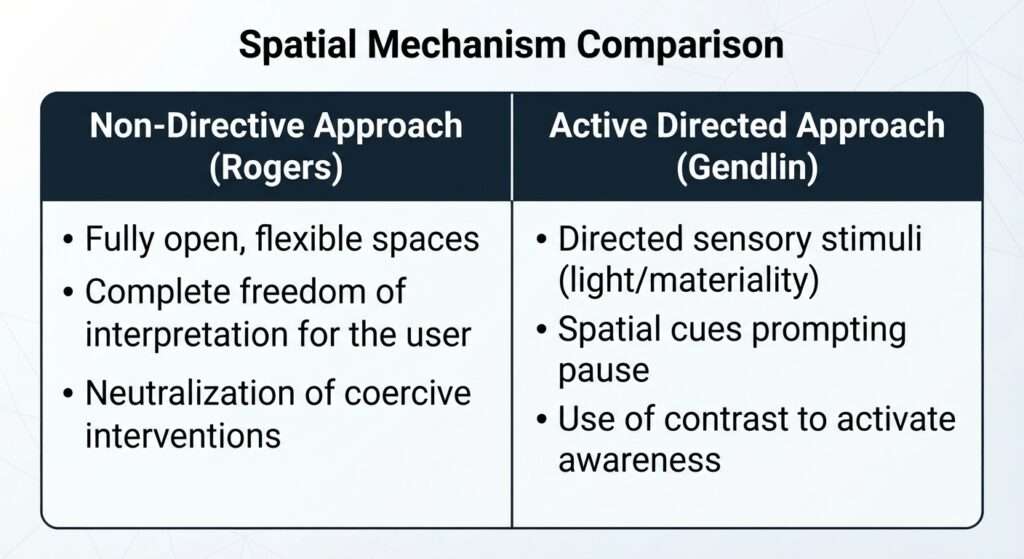
The most compelling point of divergence between the two paradigms lies in their operational methodology and intervention strategies. Rogers maintained a strictly non-directive stance, mirroring the individual’s feelings and following their lead without introducing specific techniques or predetermined pathways. In contrast, while Gendlin affirmed the primacy of the environmental relationship, he developed active facilitation tools designed to assist individuals in attending directly to their somatic responses.
In this context, Neil Friedman noted that Gendlin’s practice incorporated explicit invitations to attend to sensory experience, utilizing active interventions such as role-playing or even instructing individuals to desist from focusing when it proved counterproductive. Applied to architectural and urban design, this debate highlights the distinction between open-ended spatial layouts that grant users absolute latitude in interpreting and occupying space without explicit guidance, and intelligent spatial facilitation that employs texture, shifts in floor elevation, and lighting contrasts to convey subtle spatial cues—prompting the body to pause, reflect, or move in ways that heighten sensory awareness.
The Dynamics of Congruence and Phenomenology in Design Environments
For Gendlin, congruence was not a static trait, but a dynamic, moment-by-moment experiential state shaped through the interaction between the individual and the environment. As Soti Grafanaki demonstrated, congruence cannot exist in isolation; it emerges continuously within a relational interplay with others and the surrounding environment. This perspective aligns with Gendlin’s deep philosophical roots in the phenomenology of Martin Heidegger and Edmund Husserl, where the body remains inextricably bound to its environment.
Greg Madison expanded this concept, emphasizing that the body represents an ongoing body-environment interaction, meaning that the physical presence of the designer or occupant forms an integral component of the space itself. In academic and professional architectural environments—such as design studios and engineering practices—this dynamic congruence implies that spatial quality is measured not merely by geometric floor plans, but by the space’s capacity to generate vital resonance between the bodies of its occupants and the material properties of the site, thereby mitigating cognitive fatigue and sensory overload.
The “Felt Shift” and Moments of Architectural Discovery
In every architectural or research endeavor, designers encounter moments of creative impasse, often followed by a sudden spatial breakthrough where the optimal resolution for a massing or spatial distribution becomes acutely clear. This moment corresponds to what Gendlin defined as the “felt shift”—an experiential step felt physically as a sense of relief and forward movement.
Rogers observed this phenomenon early in his 1951 research, describing it as a releasing experience shared across individuals, as highlighted by Akira Ikemi. However, Gendlin operationalized this observation into a core methodological tool. Marion Hendricks demonstrated that measuring an individual’s manner of experiencing confirms that success relies not on abstract cognitive or formal content, but on how the body engages with the problem and unfolds solutions through implicit awareness. Within the design process, the felt shift marks the transition from dry theoretical analysis to an integrated sensory perception that resolves spatial challenges as a coherent whole.
Arthur Bohart summarized this integration by likening the diverse methodologies within person-centered theory to a “fuzzy set” sharing family resemblances. He noted that synthesizing these concepts enriches practical application without compromising core theoretical foundations, creating a supportive container where spatial and somatic awareness guide the creative process to fruition.
✦ ArchUp Editorial Insight
The integration of somatic perception and human-centered psychological paradigms into architectural discourse is the systemic outcome of escalating cognitive strain within high-density environments and hyper-efficient labor settings. As commercial real estate models and academic design studios optimize for yield, throughput, and operational velocity, the human nervous system encounters acute friction with the built environment. In response, the institutional adoption of Rogerian “safe containers” or Gendlinian “somatic facilitation” functions primarily as an operational risk-mitigation strategy rather than a purely theoretical preference. By deploying tactile materials, nuanced spatial cues, and flexible spatial layouts, institutional governance seeks to absorb the psychological overhead of cognitive fatigue. Ultimately, spatial phenomenology emerges not as a design trend, but as an adaptive mechanism designed to sustain human productivity without disrupting the financialized density and labor pressures that govern contemporary space production.
References
- Ikemi, Akira. “Carl Rogers and Eugene Gendlin on the Bodily Felt Sense: What They Share and Where They Differ.” Person-Centered & Experiential Psychotherapies, 2005.
- Friedman, Neil. “Eugene Gendlin’s Theory and Practice of Psychotherapy, A Personal Account.” Person-Centered & Experiential Psychotherapies, 2003.
- Madison, Greg. “Focusing on Existence: Five Facets of an Experiential-Existential Model.” Person-Centered & Experiential Psychotherapies, 2010.
- Bohart, Arthur C. “Can You Be Integrative and a Person-Centered Therapist at the Same Time?” Person-Centered & Experiential Psychotherapies, 2012.
- Ikemi, Akira. “The Radical Impact of Experiencing on Psychotherapy Theory: An Examination of Two Kinds of Crossings.” Person-Centered & Experiential Psychotherapies, 2017.
- Swildens, Hans. “Where Did We Come From and Where Are We Going? The Development of Person-Centered Psychotherapy.” Person-Centered & Experiential Psychotherapies, 2002.
- Bohart, Arthur C. “A Meditation on the Nature of Self-Healing and Personality Change in Psychotherapy Based on Gendlin’s Theory of Experiencing.” The Humanistic Psychologist, 2001.
- Grafanaki, Soti. “Experiencing Congruence and Incongruence.” Person-Centered & Experiential Psychotherapies, 2013.
- Hendricks, Marion N. “Focusing-Oriented Experiential Psychotherapy: How To Do It.” American Journal of Psychotherapy, 2007.