Nest Chapel Reorganizes Private Landscape Through Sinuous Concrete Forms


Felipe Caboclo Arquitectura completed a 10-square-metre religious space on a residential property in São Paulo, Brazil, in 2024. The project, known as Nest Chapel, occupies a 2,000-square-metre lot adjacent to a private home and utilizes a material palette of building materials including concrete, wood, and stone. The design team translates spiritual contemplation into a physical journey through a sequence of undulating walls and a central timber volume.
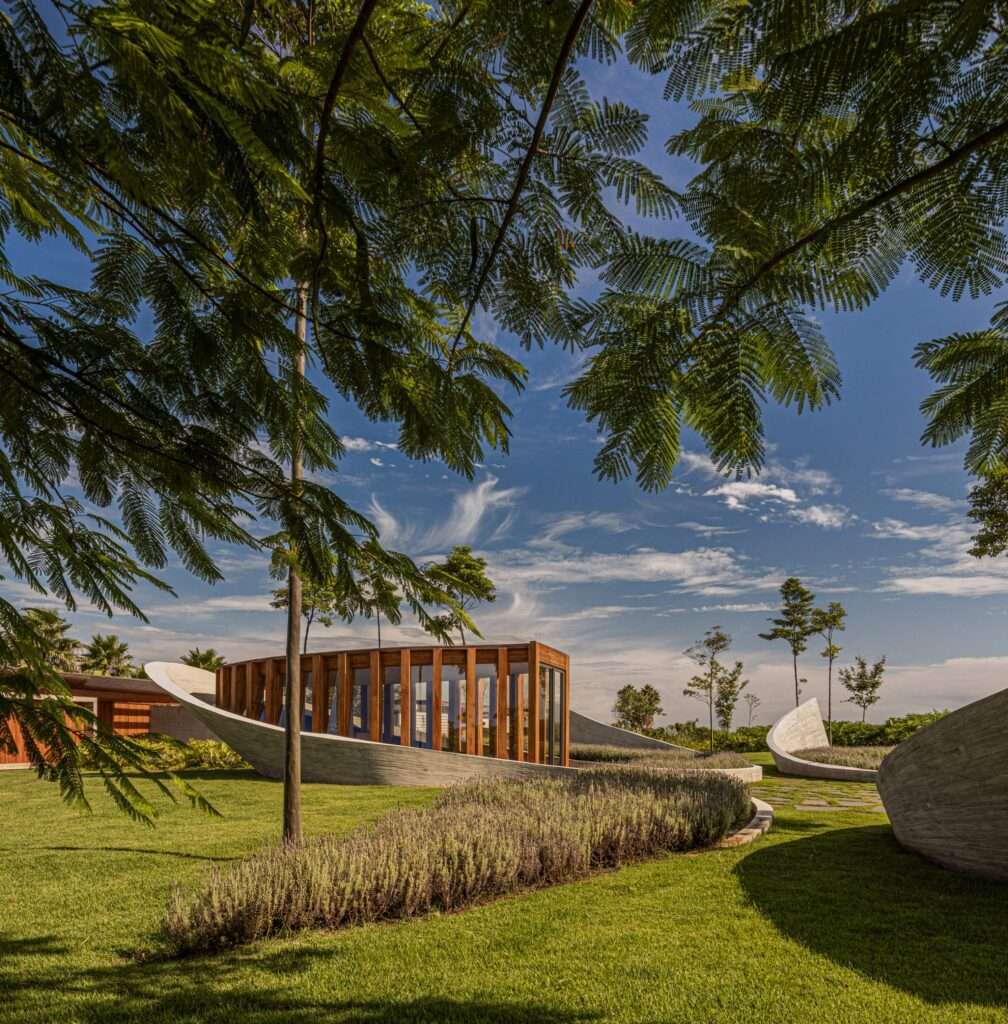
The architecture draws inspiration from the works of Le Corbusier, Tadao Ando, and Richard Serra. Two concrete walls emerge from the ground, winding across the site to define a promenade. Striations from wooden formwork mark the concrete surfaces, referencing varvito, a sedimentary rock native to the Itu region. These textures highlight the passage of time and the craftsmanship involved in the construction process.

Sinuous walls define the movement sequence
Rows of lavender follow the curvature of the concrete boundaries, adding fragrance and movement to the sensory experience. The walls rise and fall in height, eventually extending like the bow of a ship at the center of the site. This gesture creates a “sublime path” that emphasizes the journey as much as the destination, according to the design team. The arrangement transforms a previously unused lot into a dedicated zone for faith and quiet reflection.
The central prayer space consists of an oval enclosure made from laminated timber elements. These vertical members rise from the concrete base to support a slightly inclined roof. Glazing surrounds the timber structure, providing views of the garden in every direction. Two operable windows facilitate cross ventilation within the small buildings, maintaining environmental comfort during use.
Inside, Freijó wooden slats line the ceiling, creating a warm contrast to the stone elements. The flooring utilizes brushed São Gabriel black granite laid in a broken-stone pattern. This material extends from the exterior into the chapel, unifying the interior and exterior environments. The studio selected this material triad concrete, wood, and stone to maintain architectural continuity with the adjacent residence completed in 2022.

“The weight and brutality of concrete were softened by light and delicate forms and textures.”
Felipe Caboclo
The design team views the project as an exploration of both technical precision and spatial sensitivity. By integrating the chapel into the topography via the winding walls, the project achieves a scale that feels significant despite its minimal footprint. The intervention demonstrates how infrastructure for contemplation can effectively reorganize a large residential lot into a functional landscape.
✦ ArchUp Editorial Insight
Nest Chapel demonstrates how small-scale interventions can leverage material weight and landscape movement to define institutional character within a private realm. Felipe Caboclo Arquitectura uses the “path” as the primary architectural tool, moving beyond the simple shed-like typology of traditional private chapels. By employing heavy concrete walls to choreograph the approach, the project creates a transition from the domestic scale to a contemplative one. The choice of laminated timber for the sanctuary volume provides a technical lightness that balances the earthbound concrete. This project highlights a growing trend in Brazilian residential architecture where architects use auxiliary structures to explore materiality and sensory wayfinding away from the main residence.
Project Team: Felipe Caboclo Arquitetura (Lead), Oswaldo Pessano, Bianca Monti, Amana Roveri, Sylvia Pinheiro. Location: São Paulo, Brazil.
Project Notes: Completed in 2024. Rewood provided the timber structure while Seripierri Engenharia managed construction. Fernando Guerra provided photography.