When the Brain Miscalculates: Neuroscience Reveals the Hidden Logic Behind Architectural Wonder

When “Beauty” Is No Longer Enough of an Explanation
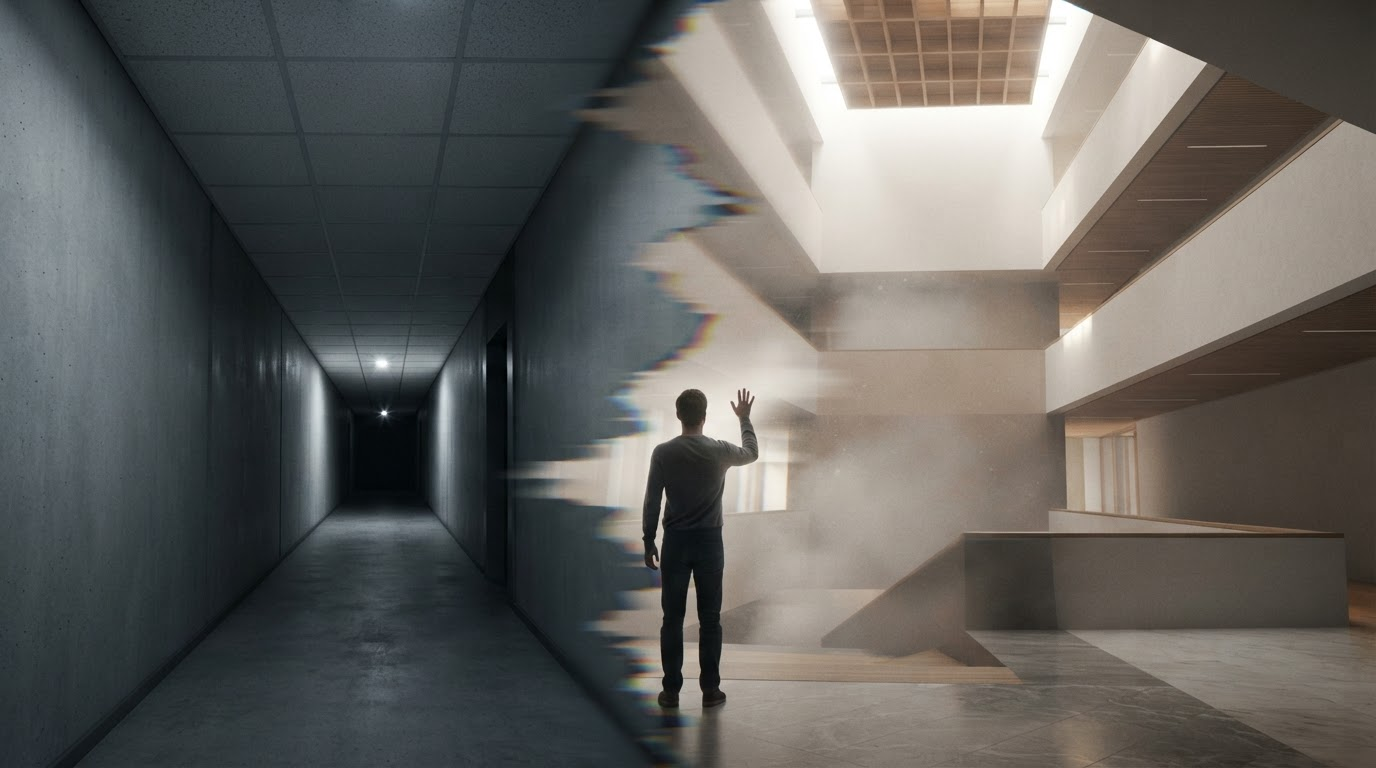
Imagine walking through a narrow corridor, its ceiling pressing low, its walls close enough to graze your shoulders — and then, without warning, a tall hall opens before you, flooded with light from openings you never anticipated. Much of this surprising experience can be explained by predictive coding architecture in the brain. That moment — the involuntary shiver that moves through you — is neither “taste” nor some vague aesthetic sensation. According to the latest findings in computational neuroscience, it is a precise, measurable biological response: a calculated prediction error.
This is the central claim of predictive coding theory, developed by researcher Sourabh Bhattacharya of the Interdisciplinary Statistical Research Unit at the Indian Statistical Institute in Kolkata, drawing on decades of research in cognitive science and artificial neural networks. The idea is at once foundational and unsettling: the brain does not receive the world the way a camera receives light. It operates instead as a relentless prediction engine, constructing in every instant an internal model of what the surrounding space “ought” to look like, then measuring the distance between that expectation and what it actually encounters. Consequentially, great architecture reveals itself as the disciplined art of managing that distance.
The Brain That Does Not See, But Anticipates
In 2004, neuroscientists David Knill and Alexandre Pouget established what became known as the Bayesian brain hypothesis, demonstrating that the brain does not process sensory information as fixed, certain data points. Instead, it represents sensory input as probability distributions — maintaining at every moment a map of the possible and the probable, not the certain alone. This is a functional necessity: sensory perception is inherently burdened with ambiguity. Neural noise, indeterminate sensory inputs, and the structural fragility of any inference built on a two-dimensional projection of a three-dimensional world all render perceptual certainty an illusion. What the brain actually does is continuously wager on the most likely.
What gives this hypothesis its particular architectural weight is the contribution of Spratling in his 2016 study, which demonstrated that the same neural circuitry that accounts for perceptual phenomena — attentional effects, surround suppression — simultaneously executes precise probabilistic inference operations. In other words, the mechanism that makes a corridor feel constricting, or a hall feel expansive, is the same mechanism that updates one’s internal model of the world. Architectural perception and cognitive perception are two faces of a single process.
The Architect as Engineer of Prediction Errors
From this premise emerges a genuinely radical redefinition of the architect’s role. The architect is not a designer of beauty but a designer of deviation — one who controls the distance between what a visitor expects and what that visitor actually finds. The term “prediction error” carries no negative connotation here; it is simply the quantitative measure of the gap between expectation and reality, whether that gap produces delight or disappointment, liberation or unease.
The narrow passage that terminates in a soaring hall — one of the oldest and most thoroughly documented devices in architectural history, from the temples of Luxor to Asplund’s Woodland Chapel — does not satisfy the visitor because it is beautiful. It satisfies because it generates a positively valued prediction error: the brain anticipated continued constriction and encountered openness instead. This calibrated contradiction releases a neural response experienced as wonder, a genuine biological reward that exceeds a purely aesthetic reaction. What distinguishes the most accomplished architect from others is the possession of an intuition — conscious or instinctive — for calibrating that deviation: enough surprise to elevate, not so much as to exhaust.
When the Brain Tires of Beauty
Here emerges one of the most valuable contributions this theory offers to architectural practice: a precise explanation for a phenomenon familiar to anyone who has visited a building described as visually overwhelming — spaces that appear arresting in photographs yet prove draining to inhabit or move through. Predictive coding theory provides a direct answer: the brain has failed to construct a stable predictive model.
Consider that any intelligent system, biological or artificial, requires what might be called anchor points — stable or anticipated references that allow it to build an internal model of its surroundings. Friston and colleagues demonstrated in their foundational 2006 study that minimizing “free energy” — the gap between expectation and reality — requires two parallel processes: recalibrating the internal model (perception) and moving physically through space in ways that confirm expectations (action). When both processes are obstructed — because a space offers no visual reference points to support orientation and provides no legible movement logic for the body — the result is what users typically describe as disorientation, and what neuroscience identifies as predictive modeling failure.
Labyrinthine corridors without visual anchors, commercial environments engineered to prevent free navigation, buildings that deliberately confuse vertical orientation and the relationship between inside and outside — all of these produce exhaustion because they compel the brain to sustain its prediction-error engine at maximum load without ever delivering the reward of a successfully updated model. Visual refinement offers no compensation for this. A labyrinth finished in the finest materials remains a labyrinth.
Hierarchical Expectation: From Lighting to the City
What deepens predictive coding theory considerably is its hierarchical structure — demonstrated by Guo and colleagues in 2019 through hierarchical artificial neural networks that achieved exceptional accuracy in unsupervised learning. The brain does not form a single expectation about a space. It constructs nested expectations across multiple simultaneous registers: an expectation about the material a hand might touch, an expectation about the ambient quality of light, an expectation about the social function of the space, an expectation about the city of which this building forms a part.
This provides the designer with a precise analytical instrument. Sustained architectural wonder — the kind that persists from a first visit through twenty months of daily use — does not arise from exceeding expectation at a single level. It arises from the controlled management of deviation across multiple levels simultaneously. A building such as David Chipperfield’s Bardolino House, or Javier Corvalán’s Valle Museum, registers as surprising at the moment of entry — a prediction error at the scale of immediate space — but continues to register as surprising twenty months into occupancy, as the relationship with shifting natural light produces new and unanticipated conditions, and surprises again from the street, where its dialogue with the urban fabric overrides prior assumptions about how buildings occupy their context.
Lighting design in particular acquires a new significance here, one that extends well beyond function and atmosphere. Light is the primary instrument through which the brain constructs its predictive model of a space: its source, its direction, the gradient of its intensity all feed the anticipation engine before a single step is taken. The lighting designer who understands this does not illuminate a building. They program the sequence of expectations that will form in a visitor’s mind, threshold by threshold.
Calibrating Trust: A Lesson from Artificial Intelligence for Urban Planning
Cognitive researcher Jakob Hohwy adds a further dimension in his 2017 study, one that unsettles many standard design assumptions. The hierarchical learning rate — the ratio by which the brain balances confidence in its prior model against trust in new incoming information — shifts with the degree of environmental ambiguity. In a volatile or unstable environment, the brain amplifies prediction errors arriving from the senses and reduces its reliance on prior expectations. In a stable and legible environment, it does the opposite.
The translation of this into urban planning carries significant consequences. A neighborhood that lacks consistency in scale and rhythm — where buildings from incompatible eras, of mismatched dimensions, and finished in conflicting materials occupy the same block without any mediating logic — compels the passing brain to operate at a persistently elevated learning rate, sustaining a condition of continuous sensory alertness. This is neurologically costly. It is not coincidental that historic districts with consistent facade rhythms and controlled scalar gradation — the al-Hussein quarter in Cairo, the medina of Fez, the Prinsengracht in Amsterdam — are invariably described as restful, despite their functional density and the complexity of their uses.
What the body of research connected to Friston and colleagues’ work establishes is that this restfulness is not a poetic indulgence. It represents an objectively measurable reduction in the neural cost of processing space. Planning interventions that destroy this rhythm — an abrupt tower inserted into a traditionally horizontal grain, a facade composition that fractures an established visual cadence without cumulative justification — do nothing less than inject an invisible negative load into the public realm, one that accumulates in residents’ experience day after day without ever becoming nameable.
From Theory to Instrument: What Changes on the Design Desk?
The real challenge now is not conceptual absorption of this theory but its translation into practice. Bhattacharya’s paper does not offer a ready-made prescription, but the principles it establishes — particularly those derived from predictive AI models such as the Predictive Coding Light (PCL) framework published in Nature Communications in 2025 — point toward several recalibrations in design methodology.
The first concerns the architectural promenade. The sequential spatial experience cannot be adequately evaluated from a two-dimensional plan. What matters is not the geometry of individual spaces but the sequence of surprises that a circulation path generates — how expectations accumulate, break, and reconstitute at each transitional threshold. The second concerns wayfinding. Spatial orientation elements are not a diagnostic amenity; they are a neurological necessity. At every point in a space, a person requires what allows them to construct a predictive model of what comes next. Their absence does not generate suspense — it generates anxiety. The third concerns the hierarchical organization of sensory experience: the register of material and texture, the register of immediate space, the register of the sequential promenade, the register of the building’s relationship to its urban context. At each level, there is an expectation that can be confirmed or exceeded by a measured and intentional degree.
The deeper truth that this science places on the architect’s desk is that the building’s user is not an aesthetic critic evaluating what stands before them according to visual criteria. The user is a predictive organism, driven emotionally by the measured distance between what was anticipated and what was found. Every moment in a space is, at its core, an answer to a question the visitor never consciously formulated: “Was my expectation correct?” And architecture, at its most resolved, is the quiet discipline of scheduling those answers.
✦ ArchUp Editorial Insight
The predictive coding framework arrives in architectural discourse at a moment when the profession is under institutional pressure to justify spatial quality in terms legible to procurement committees, environmental certifiers, and real estate developers — none of whom accept “wonder” as a measurable deliverable. What neuroscience now offers is not a new design philosophy but a technical vocabulary that reframes cognitive comfort as a quantifiable performance metric, placing it alongside thermal efficiency and structural load. The deeper consequence is this: if spatial disorientation can be demonstrated to impose a measurable neurological cost on occupants, then the planning decisions that routinely sacrifice scalar coherence — accelerated permitting for towers inserted into established horizontal grain, zoning frameworks that treat facade rhythm as an aesthetic preference rather than a public health variable — become defensible targets for evidence-based regulatory challenge, not merely aesthetic objection.
References
Spratling, M. W. “A Neural Implementation of Bayesian Inference Based on Predictive Coding.” Connection Science, 2016.
Aitchison, L., and Lengyel, M. “With or Without You: Predictive Coding and Bayesian Inference in the Brain.” Current Opinion in Neurobiology, 2017.
N’dri, A. W., Barbier, T., Teulière, C., and Triesch, J. “Predictive Coding Light.” Nature Communications, 2025.
Guo, S., Yu, Z., Deng, F., Hu, X., and Chen, F. “Hierarchical Bayesian Inference and Learning in Spiking Neural Networks.” IEEE Transactions on Cybernetics, 2019.
Friston, K., Kilner, J., and Harrison, L. “A Free Energy Principle for the Brain.” Journal of Physiology-Paris, 2006.
Hodson, R., Mehta, M., and Smith, R. “The Empirical Status of Predictive Coding and Active Inference.” Neuroscience and Biobehavioral Reviews, 2024.
Hohwy, J. “Priors in Perception: Top-Down Modulation, Bayesian Perceptual Learning Rate, and Prediction Error Minimization.” Consciousness and Cognition, 2017.
Knill, D. C., and Pouget, A. “The Bayesian Brain: The Role of Uncertainty in Neural Coding and Computation.” Trends in Neurosciences, 2004.