When the Pencil Becomes an Instrument

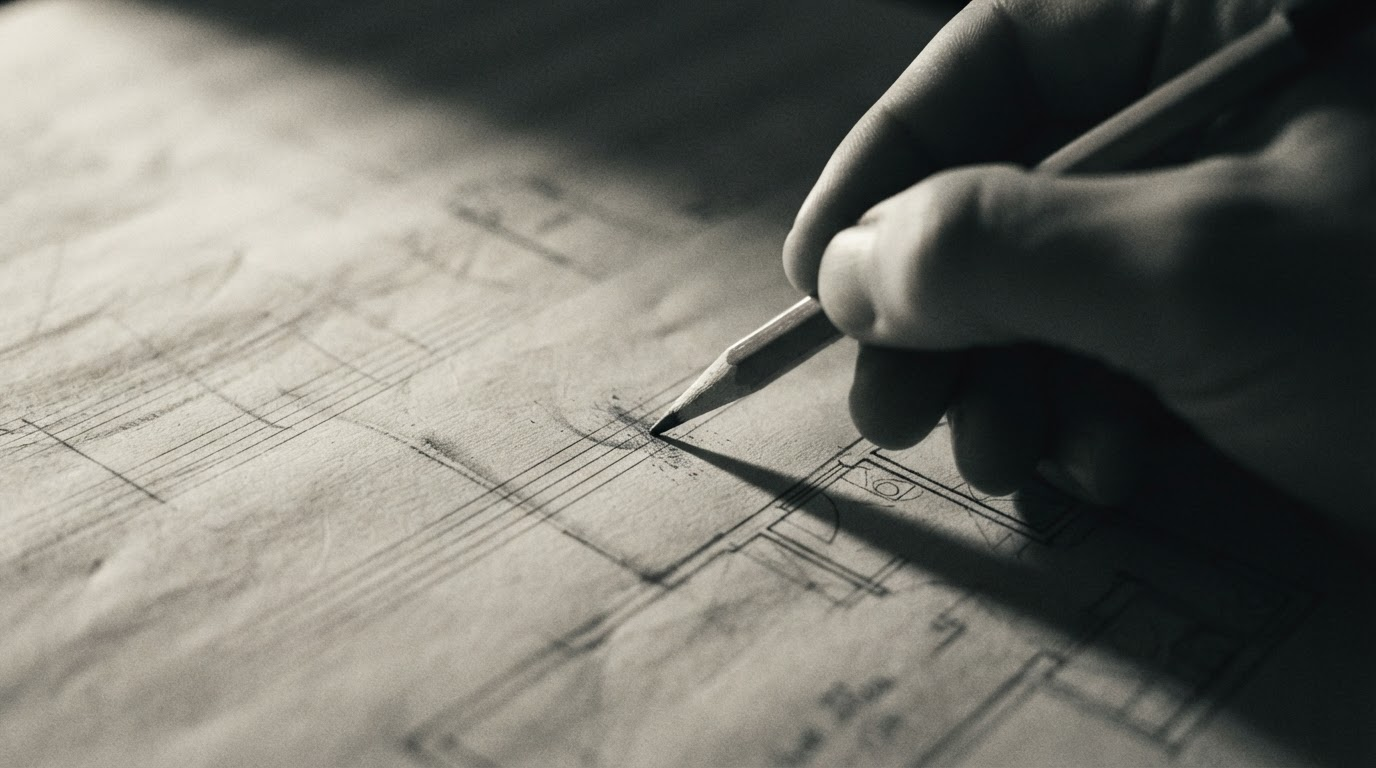
What if the moment of sketching not the completed building were the true epistemic event?
At a concert, no one asks a performer for a copy of the score in order to judge what they have delivered; the audience and critics listen to the moment itself—the hesitation, the improvisation, the mid-performance recalibration of sound. In architecture, the scene is entirely different. Juries, critics, and even clients stand before the final drawing or the polished model, and rarely does anyone ask about that earlier moment when the designer stood at the table, erased one line to draw another, and reconsidered a decision that had seemed settled minutes before. This gap between the moment of production and the product of production is precisely what a heated academic debate in a field seemingly distant from architecture has reopened: practice-based research in music, spanning both composition and performance.
For nearly two decades, scholars in musical institutions have been preoccupied with a question that appears simple but carries deep consequences: can playing or composing music itself constitute scholarly research, rather than merely an artistic practice studied after the fact? What is striking is that the answers proposed to this question translate, with modest adjustment, into a tool for dismantling one of the most sensitive issues in architectural education and practice: how do we evaluate the design process, not merely its outcome?
From Research Into Art to Research Through It: Frayling’s Framework Enters the Studio
The researcher Christopher Frayling introduced a classification that has become foundational in this field, distinguishing three modes of relationship between practice and knowledge: research into art, the historical or critical study of existing works; research for art, the development of tools and techniques in service of artistic production; and research through art, in which artistic practice itself becomes the instrument of inquiry. Mapped onto the architectural studio, this framework reveals that conventional architectural education tends toward the first two modes: students are taught architectural history (research into), and trained in new software and materials (research for), while it is rarely acknowledged formally that the critique session itself—with all its hesitations and split-second decisions—constitutes a research act in its own right.
Other scholars have refined this distinction further. The researcher Linda Candy differentiated practice-based research, where creative outputs demonstrate new knowledge in themselves, from practice-led research, which is concerned primarily with understanding the nature of practice. The concept of practice-as-research, addressed by researcher Deborah Blom and colleagues, goes further still, treating artistic practice as the primary research methodology rather than simply a site for data collection. This conceptual gradient gives architects a precise vocabulary for describing what actually happens when a building is designed: sometimes design documents prior knowledge, and sometimes it is itself the process by which that knowledge is discovered.
The Hermeneutic Spiral: When Design Refuses to Move in a Straight Line
Among the most notable methodologies proposed by researcher Melissa Trimingham for studying practice as research is what she terms the hermeneutic spiral, a model drawn from action research methodologies in education and management science. The core idea is that research does not advance in a straight line from question to answer, but through repeated cycles of practice, reflection, evaluation, reformulation of understanding, and a return to practice with sharper aims.
This model describes with remarkable precision what actually happens in any serious design studio: the designer begins with an open question—about the relationship between mass and void, for instance—tests a solution in a physical or digital model, reflects on the outcome, discovers that the original question itself was incomplete, reformulates it, and returns to experimentation with renewed understanding. The strength of this approach, as Trimingham notes, lies in accepting that “the question asked ultimately determines the answer,” and that understanding evolves through successive encounters with practice rather than through prior theoretical reasoning detached from it. This explains why good architectural design often feels like discovery rather than execution, and why the traditional linear model—analysis, then programming, then design—fails to capture what actually occurs inside the designer’s mind and hand simultaneously.
Knowledge That Cannot Be Spoken: Architectural Intuition as Research Data
One of the most provocative points in this field is the explicit acknowledgment of tacit knowledge—knowledge a practitioner possesses without necessarily being able to articulate it verbally. Through interviews with academic artists, Blom and colleagues found that these practitioners described their artistic practice as intuitive, serendipitous, and holistic, involving sensory, emotional, and even spiritual dimensions. Participants affirmed that aesthetic knowledge is “largely non-verbal by nature,” and that the creative process involves “tacit knowledge that people don’t know they have.”
This description matches precisely what many architects experience when asked to justify a design decision made intuitively during the sketching process, only to reconstruct that justification later in theoretical language after the project’s completion. The methodological question this research field raises is: how do we document this kind of knowledge without stripping it of its sensory nature through forced translation into dry academic text? Researcher Olivia Green proposed two practical tactics worth considering in the context of architectural education: playing together, collective practice as a mode of scholarly exchange among specialists, and musical sharing, integrating shared listening and aesthetic references into the core of research communication. Applying these two principles in the architectural studio means restoring value to collective table-side work sessions as a research instrument on par with the written report, rather than treating them as a secondary preparatory activity.
The Jury at a Crossroads: Judging the Outcome or the Moment of Decision?
Here we arrive at the detail most urgent to everyday architectural practice. Within the academic context of practice-based doctorates, researcher Brigid Paltridge and colleagues identified three models for the relationship between creative work and its accompanying written exegesis: the context model, which situates the creative work within its historical framework; the commentary model, which documents the creative process through pre- and post-completion reflection; and the research-question model, which frames the creative work as an answer to a specific gap in knowledge.
What is striking about this classification is what researchers Catherine Coady and Michael Webb discovered when studying jazz doctoral candidates in Australia: they found that these candidates frequently reject academically theorized exegetical models, preferring commentary approaches that prioritize communication with artistic peers over situating the research within formal academic discourse. This tension between institutional expectations and the values of a practice community is the same tension every architect confronts before an academic jury: is their ability to theoretically justify a decision after the fact being evaluated, or their actual capacity to make the right decision in the live moment within the studio? The distinction here is fundamental—the first evaluates a skill in retrospective writing, while the second evaluates, in effect, design skill itself.
Researcher Ian Pace argues that complex design questions—of the kind “how can one maintain sonic diversity within a contrapuntal texture without foregrounding one voice over the others?”—represent genuine research questions whose answers are not self-evident in advance. This stands opposed to the more rigid position of researcher John Croft, who holds that musical composition constitutes a “category error” when framed as research, because the cognitive dimension of music lies in embodiment and revelation rather than investigation and description, and that any compositional “research question” always yields an answer of trivial “yes,” carrying no genuine epistemic value. Transposing this dispute onto architecture reveals an identical divide: between those who see every new building as necessarily a self-evident “answer” to a pre-existing design question, and those who see certain architectural decisions as involving genuine inquiry whose outcome cannot be predicted in advance.
Live Documentation, Not Retrospective Reporting: From the Rehearsal Room to the Model Workshop
Researcher Michael Gurevich, in his study of research communities around New Interfaces for Musical Expression, distinguishes five coexisting research genres: practice-based research, technical reports, theoretical and philosophical papers, scientific papers, and qualitative research. Gurevich observed a decline in practice-based submissions alongside a rise in technical and scientific reporting, suggesting that quantifiable outcomes are increasingly privileged over experiential or theoretical contributions. This warning describes precisely the reality of many architectural competitions and academic juries, where preference is granted to measurable projects—environmental performance, structural efficiency—over projects involving authentic design inquiry that resists conversion into figures and indicators.
It is in this exact context that the idea of documentation-in-action becomes essential. Researcher Ben Carey, in his work developing interactive performance systems, explains how autoethnographic data—reflective memos, source code, audio recordings—allows the practitioner-researcher to trace the relationship between design and use moment by moment, rather than after the product’s completion. The researcher moves here through a repeated cycle of design, performance, and reflection, where research themes emerge from within practice itself rather than from predetermined hypotheses. Transposing this method into the architectural studio means the designer documents decisions during physical or digital modeling—through audio recording, momentary notes, or sequential captures of the model’s evolution—rather than settling for a final report written retrospectively that reconstructs justifications for decisions driven by intuition rather than written logic.
Quality Criteria When Knowledge Becomes Sensory, Not Textual
The research raises a practical question of equal importance: how are the outputs of practice evaluated in the first place? Pace notes that traditional peer review processes for text-based outputs do not translate easily to sonic or live performance events—a difficulty that applies directly to evaluating an architectural project by the standards of written reports. Blom and colleagues examine the criteria of the Organisation for Economic Co-operation and Development, known as the Frascati criteria, which require that research be investigative and systematic and produce an original contribution to knowledge, then ask how these criteria might apply to artistic practice without distorting its nature. Researchers Reiner and Fox propose that originality in composition can be assessed by peers with sufficient awareness of tradition and prior repertoire, and that aesthetic knowledge—concerning perception, taste, and appreciation of beauty—constitutes a legitimate form of knowledge in its own right, no less valuable than written theoretical knowledge. This opens the door to reformulating the criteria of architectural juries so that design originality is evaluated partly independent of the quality of its accompanying theoretical discourse.
Researchers Katie Burwell and Melissa Shipton offer an applied model for combining quantitative and qualitative methods in studying practice habits among university music students, through a questionnaire comparing practice approaches across age groups and academic levels. Although the study adopts quantitative tools, the researchers frame it as an interface opening dialogue between performance studies and research into instrumental teaching, supporting shared reflection among students, supervisors, and program leaders. The same model is applicable to evaluating architectural design programs: periodic surveys tracking how design decision-making style changes across years of study, rather than confining evaluation to the final project alone.
When Practitioners Resist Ready-Made Academic Templates
The case of jazz doctoral students studied by Coady and Webb reveals a tension worth pausing on: these students, despite their engagement with formal academic programs, tend to prefer communication with the community of artistic practitioners over full compliance with expected academic research templates. The same pattern recurs in architecture studios worldwide, where many practicing designers prefer to publish their work through exhibitions and professional publications directed at peers, bypassing—or resisting—the rigid demands of academic publishing. The Laboratory for Laptop and Electronic Audio Performance Practice, founded by Green, offers an inspiring alternative: researchers gather to learn from each other’s practices through collective music-making rather than conventional presentations, so that priority shifts to communication rather than final, exhibitable output. Transposing this idea into architecture means reimagining the collective critique as an epistemic act in itself, rather than a preparatory step toward the final project submission.
The fundamental question remains open, as Gurevich left it: multiple methodologies can coexist productively within a single field, but only on the condition that their epistemic commitments and methodological assumptions are made fully explicit. For architects, educators, and critics alike, the choice of how to evaluate design work—as live performance or as final product—is not a procedural detail but a foundational decision determining what kind of knowledge is recognized as legitimate within the walls of the studio.
✦ ArchUp Editorial Insight
The privileging of the final drawing over the decision that produced it is not an aesthetic preference but a liability-management outcome. Institutional review, procurement law, and professional insurance all require a fixed, auditable artifact — a stamped document that can be traced, blamed, or defended in court. Live design reasoning generates no such record; it cannot be filed, licensed, or cited in a dispute. Academic juries inherit this same logic from the professions they feed into, rewarding retrospective justification because it mirrors how liability, accreditation, and construction documentation actually function downstream. What looks like a preference for polish over process is therefore the studio absorbing the risk architecture of practice itself. Any shift toward evaluating the moment of decision would require institutions to first accept forms of evidence that current regulatory and insurance frameworks are not built to recognize.
References
Croft, John. “Composition Is Not Research.” Tempo, 2015.
Pace, Ian. “Composition and Performance Can Be, and Often Have Been, Research.” Tempo, 2015.
Green, Olivia. “The Situation of Practice-Led Research Around NIME, and Two Methodological Suggestions for Improved Communication.” Leonardo, 2016.
Blom, Deborah, Dawn Bennett, and David Wright. “How Artists Working in Academia View Artistic Practice as Research: Implications for Tertiary Music Education.” International Journal of Music Education, 2011.
Dallow, Paul. “Representing Creativeness: Practice-Based Approaches to Research in Creative Arts.” Art, Design & Communication in Higher Education, 2003.
Trimingham, Melissa. “A Methodology for Practice as Research.” Studies in Theatre and Performance, 2002.
Burwell, Katie, and Melissa Shipton. “Performance Studies in Practice: An Investigation of Students’ Approaches to Practice in a University Music Department.” Music Education Research, 2011.
Gurevich, Michael. “Diversity in NIME Research Practices.” Leonardo, 2016.
Carey, Ben. “Artefact Scripts and the Performer-Developer.” Leonardo, 2016.
Coady, Catherine, and Michael Webb. “Resisting Best-Practice in Australian Practice-Based Jazz Doctorates.” British Journal of Music Education, 2016.