Red Bridge Cabin: Place and Architectural Experience

First Impression: The Power of Architectural Imagery
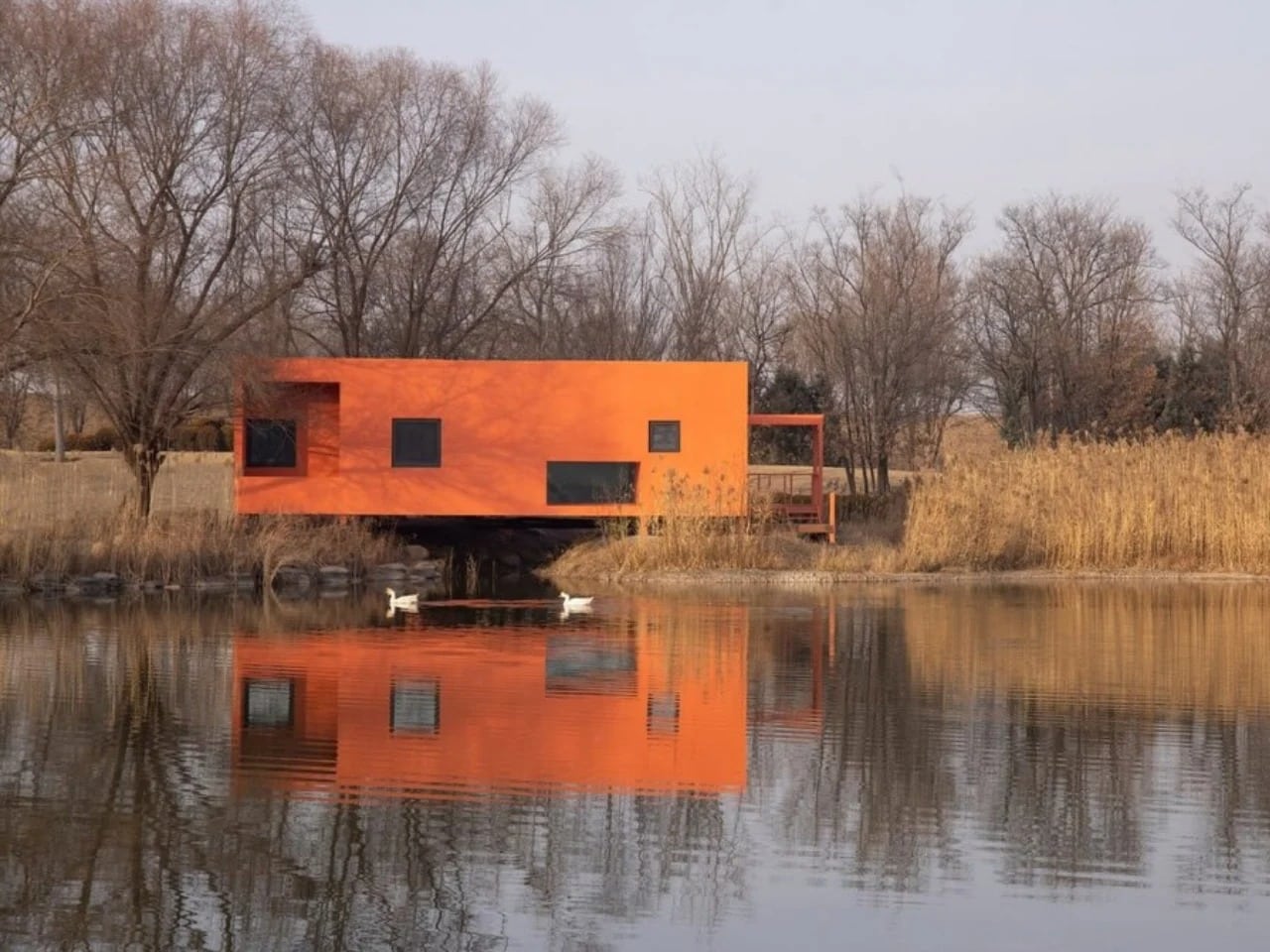
When first looking at the images of the “Red Cabin,” it becomes clear that the visual experience goes beyond simply observing an ordinary building. The small structure, with its striking red color, appears as an isolated visual element within a calm natural landscape, prompting the viewer to pause and reflect rather than casually scroll past. This approach to visual perception is deeply rooted in the principles of Architecture, where every element serves a purpose beyond mere aesthetics.
The reflection of the building on the surrounding water surface, combined with the serene natural background, creates a visual composition that conveys a sense of tranquility and balance. Over time, the scene begins to take on a more contemplative character, where the relationship between the building and its surroundings seems intentionally crafted to evoke calmness and a sense of detachment from external noise. Such Design strategies highlight the importance of context in shaping human experience.
Spatial and Historical Context
This cabin is located within the Yuancheng Cultural Park in Zhengzhou, China, a public space with a heritage character built around the site of the ancient city of Yuanling. This context makes the site more than just a natural setting; it is a layered environment shaped by history and cultural memory. The park is part of a nationally protected area, combining the preservation of historical heritage with spaces for ecological and recreational activities. Therefore, any architectural intervention within this context is not read as a mere formal addition, but as an element that interacts with the multiple layers of the site. Understanding such interactions is essential for Research focused on heritage and contemporary interventions.
Architectural Idea and the Framework of Experience
Within this framework, the cabin is presented as part of an experimental research project aimed at rethinking the concept of micro-housing. It belongs to a series of experimental dwelling prototypes that treat the idea of “home” as a spatial experience rather than a conventional living unit. This approach extends to the relationship between scale, function, and site, exploring how a small structure can establish a strong presence within a complex natural and historical environment. From this perspective, placing a vividly colored structure in the middle of a heritage landscape becomes a design decision grounded in a high degree of contextual awareness, relying on contrast as a tool to reinterpret the site rather than quietly blend into it. Many contemporary Projects explore similar themes of contrast and integration.
Accessing the Cabin: The Experience of Transition as Part of the Design
The name of the cabin is directly tied to the bridge that leads to it, as the building cannot be accessed directly, but only through a defined path that begins with a narrow, semi-transparent bridge extending over the water. This pathway does not function purely as a utilitarian element; rather, it plays a role in shaping the perceptual experience from the very first moment. From this perspective, the building is not presented as a sudden destination or an element that appears unexpectedly, but rather as a sequence that is gradually entered. Thus, the act of approaching itself becomes part of the architectural experience, not merely a means of reaching an end point. This careful choreography of movement is a key theme in Construction that prioritizes user experience.
Between Engagement and Detachment: Reading the Design Concept
Within this context, the designers describe the overall idea of the place as a space where seemingly opposing concepts overlap, such as comfort and wilderness, or immersion in the environment versus a sense of isolation from it. According to this interpretation, these notions do not remain clearly separated, but instead merge to form an intermediate condition whose boundaries are difficult to define precisely. This type of description reflects an attempt to capture a sensory experience rather than to provide a technical definition of the building. Nevertheless, regardless of the poetic tone used in describing the project, the architectural images themselves clearly indicate a strong focus on the experience of movement and the gradual perception of space, rather than presenting it as a static object understood at first glance. For more innovative ideas, explore the Archive of similar experimental dwellings.


Interior Space: When the Landscape Becomes Part of Living
Inside, the cabin is organized through a spatial strategy based on two internal courtyards and a wide glass roof. These elements do not operate independently; rather, they integrate to form a concept that embeds the natural landscape into the living experience itself, so that the exterior is no longer separated from the interior but becomes part of its daily composition. This integration relies heavily on the thoughtful selection of Building Materials that enhance the connection with nature.
Light as a Dynamic Element within Space
As the time of day changes, natural light becomes a dynamic element that continuously reshapes the perception of space. Instead of remaining a visually static environment, the interior constantly shifts in character depending on the intensity and direction of light, creating a sense of movement within an otherwise still setting. In addition, semi-transparent screens contribute to reinterpreting the exterior view, where the landscape is not presented directly but appears as soft visual layers that change with light and viewing angle. This interplay creates a condition of partial visual ambiguity rather than a sharp separation between inside and outside. Detailed Material Datasheets can provide insight into the technical aspects of such screens and glazing.
Redefining the Boundaries Between Inside and Outside
In contrast, carefully positioned windows guide the gaze toward specific points in the external landscape rather than opening a fully panoramic view. This design decision makes the experience of looking outward more controlled and selective. As a result, the cabin becomes a small-scale space yet rich in visual perception, where the boundaries between interior and exterior are not treated as fixed divisions, but as a negotiable threshold shaped by light, movement, and the way one engages with the environment. This redefinition of boundaries is a recurring topic in Interior Design, where space flows beyond traditional limits. To stay updated on such innovative concepts, follow the latest Architectural News.


Construction Methodology: Digital Precision and Site Sensitivity
The construction approach of the cabin is based on a structural system that relies entirely on laminated timber (glulam), allowing for a relatively lightweight structure with a high degree of control over form and detailing. Each irregular element, as well as every connection point between components, was designed using digital design tools, ensuring a high level of precision in fabrication and assembly. This method reflects a modern understanding of Construction, where technology and craftsmanship intersect.
Prefabrication and Reversibility
Within this approach, the components were prefabricated so that the entire cabin could be fully assembled prior to being transported and installed at its final site. The wooden elements are connected through small metal joints, which allow the parts to be fixed in place while still maintaining the possibility of disassembly and reassembly without leaving permanent traces on the ground. This type of structural solution is not used purely for technical reasons; it also reflects a different understanding of the relationship between building and site, where architectural intervention becomes less permanent and more flexible. Such innovative techniques are often documented in detail within Material Datasheets for advanced building systems.
Architecture as Part of the Landscape, Not Its Dominance
In this context, this construction strategy is presented as a deliberate design choice rather than a mere technical alternative. This is especially significant when dealing with a site of historical and environmental sensitivity, where preserving the land itself becomes an essential part of the design process. Accordingly, the cabin is not treated as a mass imposed upon the landscape, but as an element that can be inserted and removed without altering the essence of the place. Its presence is therefore defined by integration with the surrounding environment rather than an attempt to dominate or permanently reshape it. This philosophy aligns with contemporary Architecture that respects ecological and historical contexts.


Extending the Experience: Small-Scale Dwellings as a Design Thinking Approach
Within a broader context, the “Red Bridge Cabin” cannot be separated from a series of architectural experiments developed by Wiki World in natural environments. The project does not appear as an isolated case, but rather as part of an ongoing research trajectory that re-examines the concepts of habitation at a small scale and explores the relationship between humans and their surrounding space. To explore similar innovative concepts, you can browse the Archive of experimental dwellings and research projects.
The Small Scale and Redefining the Relationship with Material
This approach focuses on the idea of reducing the scale of living as a means of rebuilding the relationship between humans and construction materials. As the scale decreases, material elements become more present and perceptible in everyday experience, instead of remaining an unnoticed backdrop to life. From this perspective, minimizing spatial volume becomes a tool for increasing sensitivity toward details, whether in the building materials themselves or in the surrounding natural environment. The selection of appropriate Building Materials plays a crucial role in achieving this heightened sensory experience.
Design Philosophy as a Framework for Living
Within this framework, statements such as “smallness brings us closer to materiality” are proposed as a condensed expression of a broader design idea, one that rethinks the concept of comfort and dwelling beyond the conventional size of the home. Although this statement appears closer to a philosophical formulation, it also reflects a practical direction observable in the architectural experience itself, where reducing scale is not merely a formal choice, but a way of transforming how people perceive and interact with their environment. This transformative approach is a key theme in many Projects focused on human-centered design.


Color as a Visual Element within the Natural Landscape
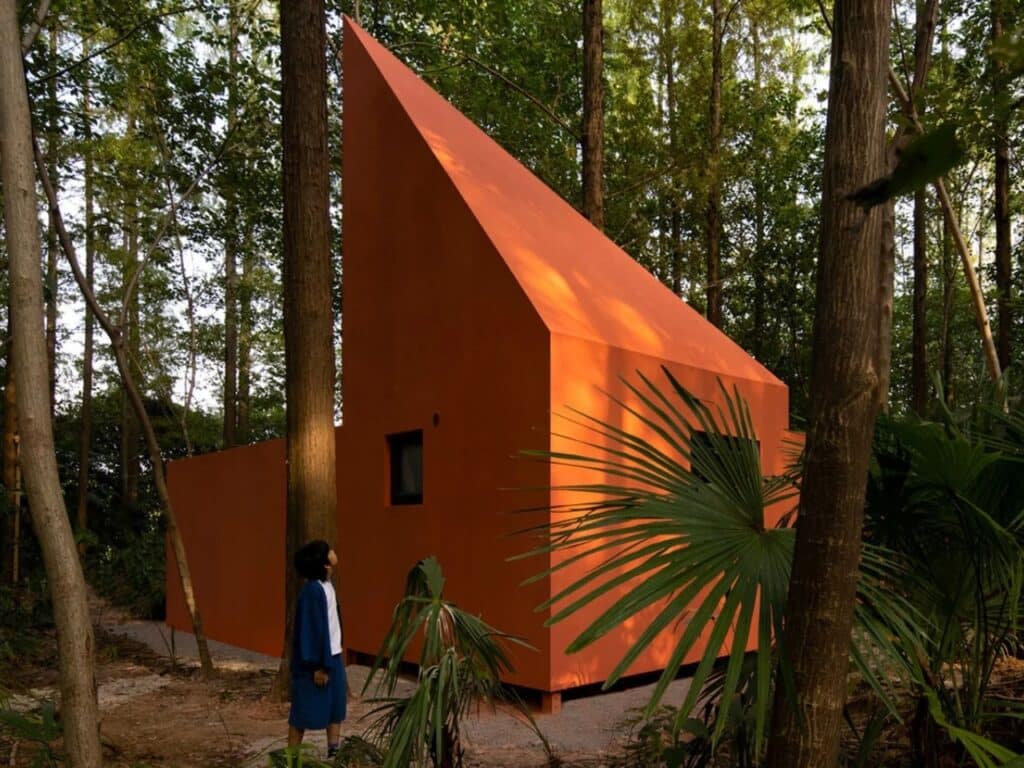
The use of deep red in the cabin stands out as one of the most visually striking elements, initially appearing as a sharply contrasting choice against the surrounding natural environment, characterized by calm tones of green and earthy browns. This contrast creates an immediate visual impact, making the building appear detached from its natural context at first glance. Understanding such visual dynamics is essential for Research in environmental psychology and architectural aesthetics.
From Contrast to Perceptual Harmony
With closer observation of the images, especially in moments where the building is reflected on the still water surface, the visual perception gradually shifts. Rather than reading the color as an intrusive element, the scene begins to appear as a balanced composition, where the presence of the strong chromatic mass becomes part of the overall landscape rather than its opposite. This shift in perception reflects how visual context can reinterpret design elements over time, moving from a sense of separation toward a form of visual acceptance or even integration. Many contemporary Design strategies explore similar principles of contextual harmony.
The Relationship Between Design and Image
In this type of project, it becomes difficult to separate the architectural value of the design itself from its visual representation. The image plays a fundamental role in shaping the final impression and may contribute to reinforcing or even constructing the sense of harmony. Accordingly, the question remains open as to whether the resulting effect is due to the strength of the architectural composition itself, the quality of the photography, or the interaction between the two. In any case, the repeated return to these images reflects a certain success in creating a lasting visual impact that extends beyond the first moment of viewing. For more insights on visual representation in architecture, follow the latest Architectural News and critical discussions.


✦ ArchUp Editorial Insight
The Red Bridge Cabin represents a direct outcome of an organizational and economic logic associated with the management of heritage sites within the Yuancheng Cultural Park in Zhengzhou, where cultural preservation policies intersect with low-impact tourism investments and models of demountable, reconfigurable construction. The choice of a laminated timber (glulam) structural system and removable metal connections reflects institutional requirements aimed at reducing operational risks and minimizing permanent impact on the land, rather than being purely an autonomous design decision. The access route, defined by a narrow bridge, functions as a mechanism for regulating visitor flow and guiding movement behavior before entering the interior space. The spatial organization and directed views redistribute perceptual intensity between interior and exterior within a controlled visual experience framework. Within this context, the project appears as a downstream result of a standardized financial and regulatory structure, where architecture is shaped as a direct consequence of the intersection between institutional constraints and operational requirements, rather than as an entirely free act of authorship. This pragmatic approach is increasingly discussed in Architects Lobby forums and professional networks.