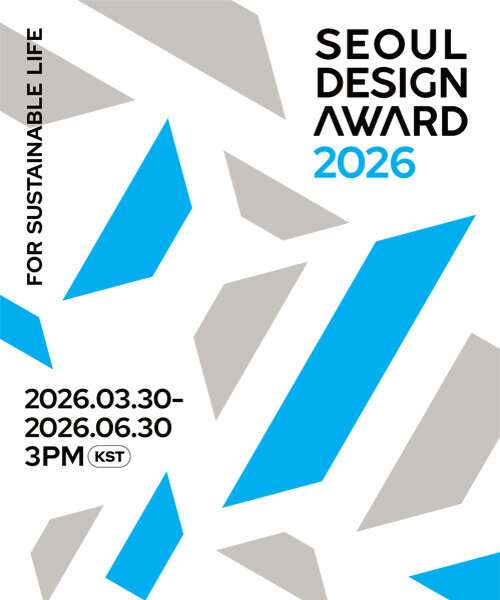
Seoul Design Award 2026

Competition Brief
The Seoul Design Award is an international design competition organized by the Seoul Design Foundation under the hosting of the Seoul Metropolitan Government. Now in its seventh documented cycle with winners going back to 2019, the award focuses on design projects that address sustainability, urban daily life, and the relationship between people, society, and the natural environment. The 2026 edition is open to realized design projects from all fields — including product design, spatial design, architecture, service design, graphic design, and beyond — completed within the past five years. The competition operates across three distinct award areas: the Main Award for realized projects, the Young Designer Award for design concepts and research, and the ESG Design Impact Award for corporate sustainable design projects nominated directly by the jury.
Intent
The award seeks design projects that address everyday challenges and propose solutions that foster harmony among people, society, and the environment. Projects are evaluated on whether they solve a real problem creatively, carry social impact, and present a globally scalable vision for the future. The Young Designer Award specifically targets concept-stage proposals and research projects from emerging designers, evaluated additionally on the feasibility of the design concept and proposed method of realization.
Purpose
The Seoul Design Award positions itself as a global recognition platform for design that contributes to sustainable urban life. Winning projects gain international exposure through the award’s media partnerships, including designboom, and are archived on the award website and published in the annual archiving book. The Top 10 winners in the Main Award present their projects at an International Design Conference held in Seoul in October. The award is hosted at the Dongdaemun Design Plaza (DDP), one of Seoul’s most prominent architectural and cultural venues. Designers interested in recognition within the global design competition circuit will find the award’s media reach and jury breadth notable.
Requirements
The competition is open to individual designers, groups, and enterprises from any country. Key requirements for each area:
Area 1 – Main Award:
- Design projects in all fields realized within the past 5 years
- Open to individuals, groups, and enterprises
- No age restriction
Area 2 – Young Designer Award:
- Design project concepts and realization methods (not necessarily built or produced)
- Targeted at young and emerging designers
- Evaluated on feasibility of concept and expected user experience
Area 3 – ESG Design Impact Award:
- Corporate projects in sustainable design
- Nominated directly by the jury, not submitted by participants
Submissions are made via the official award platform at seouldesignaward.awardsplatform.com. Submissions may be disqualified if content differs from the facts, is found to be false, or violates intellectual property rights. Copyright for submitted materials remains with the applicant; the Seoul Metropolitan Government, Seoul Design Foundation, and media channels may use submitted work for publicity purposes.
Jury
- Patricia Moore (USA) – President, Moore Design Associates. Specializes in industrial design, ageing, and ability for the lifespan.
- Pradyumna Vyas (India) – President, World Design Organization (WDO). Specializes in product design, design for social impact, and sustainable design.
- Andrea Cancellato (Italy) – Director, ADI Design Museum Milano. Specializes in design museum curation.
- Sungwon Jee (Republic of Korea) – Vice President, Hyundai Motor Company. Specializes in brand marketing and brand design.
- Dawn Lim (Singapore) – Executive Director, DesignSingapore Council. Specializes in economic development and business strategy.
- Martin Zelger (Switzerland) – CEO, DAAily platforms AG. Specializes in design, architecture, and software.
- Mi-ryeong Woo (Republic of Korea) – CEO, Lush Korea. Specializes in sustainable design.
- Sertaç Ersayin (Turkey) – President, Industrial Designers Society of Turkey; Creative Industries Council Association. Specializes in industrial design, branding, and product strategy.
- EunSook Kwon (Republic of Korea) – Chair, School of Industrial Design at Georgia Institute of Technology. Specializes in industrial design, design education, and strategy.
- Mugendi K. M’Rithaa (Kenya) – Professor of Industrial Design, Machakos University; UNESCO Chair on Cloud Computing for Sustainable Development. Specializes in industrial design, universal design, and design for sustainability.
- Dontae Lee (Republic of Korea) – President, Design Strategy Center, Lotte Corporation. Specializes in branding and industrial design.
- Han ning (Jimmy) Chang (Taiwan) – President, UID CREATE LTD. Specializes in industrial design.
- Alexandra Klatt (Germany) – Founder, Berlin Design Week. Specializes in branding and communication design.
- Tek-Jin Nam (Republic of Korea) – Professor, KAIST Industrial Design. Specializes in industrial design and interaction design.
- Myoungrang Youn (Republic of Korea) – Vice President, Pulmuone. Specializes in marketing.
- Mariana Amatullo (Argentina) – National Dean, School of Architecture, Art and Design at Monterrey Institute of Technology. Specializes in design for social innovation and design management.
- Katsutoshi Ishibashi (Japan) – Editor and Publisher, AXIS Inc. Media Group. Specializes in editorial and publishing.
- Ahmad Bukhash (UAE) – Chief Architect and Founder, Archidentity; Director of Urban Planning at the Dubai Development Authority. Specializes in urban planning, architecture, and design.
- Charry Jeon (Republic of Korea) – CEO, CFC. Specializes in branding and visual communication design.
- Xavi Calvo (Spain) – CEO, Design Foundation of the Region of Valencia. Specializes in graphic and industrial design.
- Jungwon Heo (Republic of Korea) – Senior Vice President, Creative Center, Amorepacific. Specializes in branding design, design management, and flagship retail management.
- Magdalena Klosek (Poland) – Country Head of Design, IKEA Korea. Specializes in retail design, interior design, design trends, and architecture.
- Suzanne Cotter (Australia) – Director, Museum of Contemporary Art Australia. Specializes in contemporary art and architecture.
- Jukka Savolainen (Finland) – Museum Director, Alvar Aalto Foundation. Specializes in design thinking and new areas of design.
- Sevra Davis (UK) – Director of Architecture Design and Fashion at British Council. Specializes in architecture, design for social innovation, fashion, textiles, and circular design.
- Sehoon Na (Republic of Korea) – CDO, athome Corp. Specializes in brand design and industrial design.
- Sofia Lekka Angelopoulou (Greece) – Editor-in-Chief, Designboom. Specializes in media and design communication.
- June Shim (Republic of Korea) – Vice President, Naver Corp. Specializes in branding.
- Eunjoo Maing (Republic of Korea) – Executive Director of Design Research Institute, Design House. Specializes in design strategy and environment/space design.
- CAI Jun (China) – Professor, Academy of Arts and Design, Tsinghua University. Specializes in industrial design and creative thinking.
- Hyunsook SEO (Republic of Korea) – Assistant Secretary-General of Korean National Commission for UNESCO. Specializes in international relations, sustainable development education, and creative cities.
- Mardis Bagley (USA) – Co-Founder, Nonfiction Design; 2025 Grand Prize Winner of the Seoul Design Award. Specializes in industrial design.
Fees
| Item | Details |
|---|---|
| Registration Fee | Not stated on the official website (refer to the submission platform for fee details) |
| Submission Platform | seouldesignaward.awardsplatform.com |
Rewards
| Award | Number of Winners | Prize |
|---|---|---|
| Grand Prize (Main Award, Area 1) | 1 winner (selected from Top 10) | 50,000,000 KRW (approx. 37,000 USD) |
| Best of the Best (Main Award, Top 10, Area 1) | 9 winners | 10,000,000 KRW each (approx. 7,400 USD) |
| Finalist (Main Award, Area 1) | 30 winners | No cash prize |
| designboom Special Prize (Area 1) | 3 winners | No cash prize; featured on designboom |
| Best of the Best (Young Designer Award, Area 2) | 2 winners | 5,000,000 KRW each (approx. 3,700 USD) |
| Finalist (Young Designer Award, Area 2) | 18 winners | No cash prize |
| Total Prize Fund | 60+ winners across all areas | 150,000,000 KRW total (approx. 111,000 USD, taxes included) |
| Additional Benefits for All Winners | All 60+ winners | E-certificate, award logo, global expert feedback, ceremony invitation, global promotion via newsletter and social media, website archiving, inclusion in the Archiving Book |
| Additional Benefits for Best of the Best (12 winners) | Top 10 Main Award and 2 Young Designer Award winners | Cash prizes, speaking invitation at International Design Conference (Top 10 only), 3-night hotel accommodation, partial round-trip airfare support |
Dates
| Milestone | Date |
|---|---|
| Submission Period Opens | 30 March 2026 (Monday) |
| Submission Period Closes | 30 June 2026 (Tuesday), 3:00 PM KST |
| 1st Round Screening | July to August 2026 |
| 2nd Round Screening | August to September 2026 |
| Citizen Vote and Final Screening | September 2026 |
| Award Ceremony and Conference | 14 October 2026 (Wednesday), venue TBA |
| Contact Email | seouldesignaward@seouldesign.or.kr |
| Contact Phone | +82-2-2096-0056 / 0122 / 0129 (Mon to Fri, 10:00 to 17:00 KST) |
✦ ArchUp Competition Review
The Seoul Design Award is hosted by the Seoul Metropolitan Government and organized by the Seoul Design Foundation, a well-established public cultural institution with a documented history of annual editions dating to 2019 and an active archive of past winners. The jury for 2026 is the most extensive of any competition covered on ArchUp to date: 32 named members spanning industrial design, architecture, brand strategy, sustainability, museum direction, and media, drawn from 18 countries. This breadth is both a strength and a structural consideration: a 32-member panel evaluating projects across all design fields simultaneously raises legitimate questions about evaluation consistency and thematic focus. The inclusion of a citizen vote as a component of the final selection process introduces a popularity dimension into what is otherwise a professional jury-based award. The prize structure is substantial: a Grand Prize of 50,000,000 KRW (approximately 37,000 USD) selected from the Top 10 by combined jury and public vote, with nine Best of the Best awards of 10,000,000 KRW each, makes the total prize fund of 150,000,000 KRW one of the larger in the international design award circuit. The competition accepts projects across all design disciplines, which means entries from spatial designers, architecture competition participants, product designers, and service designers compete within the same pool. For practices and individuals with strong realized work in sustainable and social design, the award offers genuine international visibility, a credible media partner in designboom, and meaningful financial rewards for top finishers.
Final Thoughts
The Seoul Design Award is one of the more institutionally grounded design awards in Asia. Its hosting by the Seoul Metropolitan Government, its use of Dongdaemun Design Plaza as the ceremony venue, and its documented track record since 2019 give it a level of legitimacy that distinguishes it from privately organized design awards of comparable scale.
The jury is extraordinarily large for a design competition. Thirty-two members is an unusual configuration that raises practical questions about how evaluation is structured across rounds and how individual jury perspectives are weighted. The inclusion of a past Grand Prize winner (Mardis Bagley, 2025) as a 2026 jury member is a notable and relatively unusual choice, one that adds practitioner credibility but also collapses the distance between participants and evaluators.
The citizen vote component deserves careful consideration. For a competition that evaluates projects on criteria including social impact and global scalability, public voting introduces a popularity metric that may not always align with expert assessment of those criteria. The Top 10 structure, where the Grand Prize winner is selected from a shortlist determined partly by expert scoring and partly by public vote, is a transparent process but one that rewards communicability as much as design quality.
The competition’s breadth, covering all design fields with no thematic or typological restriction, is both its most democratic and its most evaluatively complex feature. Entries from spatial design, product design, service design, and communication design are reviewed within the same framework and by the same pool of judges, which requires a jury of significant breadth to cover meaningfully. That breadth is present in the 2026 panel, though depth in specific areas varies across members.
For designers with strong realized work in sustainability, social design, or urban living, the Seoul Design Award 2026 represents a credible, well-resourced, and internationally visible recognition opportunity. You can explore additional international design and architecture competitions on ArchUp.
Registration Deadline
Brought to you by the ArchUp Editorial Team
Inspiration starts here. Dive deeper into Architecture, Interior Design, Research, Cities, Design, and cutting-edge Projects on ArchUp.