The Gym Floor Looks Clean. Is Exercising at Home Safer?

During a floor exercise, the room becomes a contact surface. Hands, forearms or a mat touch a finish that also receives shoes and cleaning equipment. The relevant design question is not whether the floor appears spotless, but how that contact is managed between users.
Is the same exercise safer at home? The research considered here does not provide a matched gym-versus-home trial that settles that question. A well-maintained shared surface and a poorly maintained domestic one cannot be ranked simply by their addresses. This review examines environmental evidence and official prevention guidance, then proposes an architectural comparison based on use, material condition and maintenance.
Detection is not an infection rate
Markley and colleagues cultured surfaces at a university fitness centre in a study published in 2012. Ten of 99 samples yielded Staphylococcus aureus; all of these isolates were methicillin-susceptible. The finding establishes contamination in sampled locations. It does not mean that 10% of gym users became infected, and it cannot be assigned specifically to every floor or exercise.
Mukherjee and colleagues’ 2014 investigation used bacterial-community analysis on fitness-centre surfaces. Such work describes microbial diversity and possible sources; detecting bacterial genetic material does not, by itself, establish viability, infectious dose or transmission to an individual. Neither study supplies a universal risk ratio between exercising at a gym and at home.
The distinction changes the brief. A surface survey helps identify where and when investigation is needed. Demonstrating that a particular finish reduces infections would require a different study, accounting for users, cleaning, exposure and clinical outcomes. A photograph cannot supply any of these measurements.
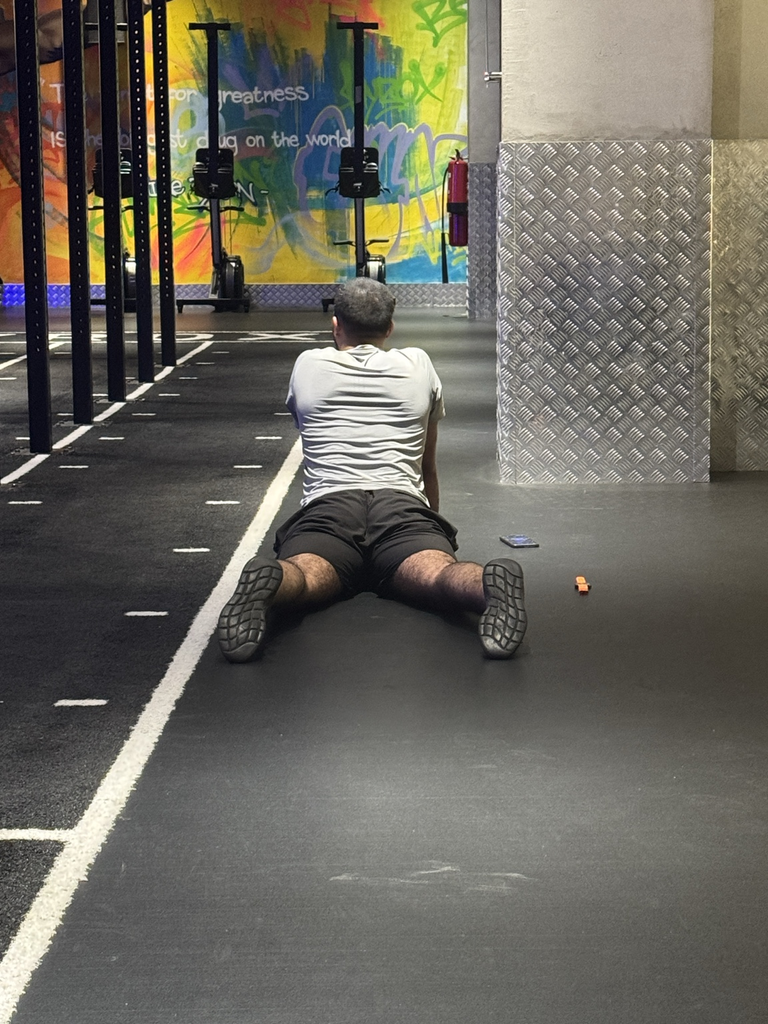
The personal observation shown here makes the research question concrete: floor exercise takes place directly on a continuous gym surface, beside a marked lane and training equipment. No separate exercise mat is visible. The image directs attention to the meeting of circulation and body-contact areas, a useful starting point for examining gym floor hygiene through gym design. It invites questions about where floor exercises are located, how cleaning reaches those zones and whether users have suitable individual equipment. Surface appearance alone cannot establish microbial contamination or determine whether this setting is safer than exercising at home.
Compare conditions, not labels
A useful comparison records the number of users, time since cleaning, whether outdoor shoes cross the exercise area, the condition of mats and joints, and which parts of the body contact the surface. These are proposed assessment variables, not a validated numerical risk score.
| Variable | Shared gym | Home exercise area |
|---|---|---|
| Turnover | Potentially many successive users; count actual sessions | Potentially fewer users; include other household activities |
| Surface use | Exercise may overlap with circulation and equipment movement | Exercise may overlap with shoes, pets or domestic circulation |
| Cleaning | A formal system may exist; check completion and timing | The user controls cleaning but may have no regular routine |
| Mat condition | Shared mats need an identifiable cleaning and drying sequence | A personal mat still needs cleaning, drying and suitable storage |
| Material | Check seams, wear and compatibility with the chosen product | Apply the same checks rather than assuming domestic finishes are safer |
Rubber is a material family, not a hygiene certificate
“Rubber flooring” does not specify the condition of joints, the integrity of a surface or compatibility with a cleaning product. Selection must reconcile exercise requirements with a documented maintenance method. A finish suited to impact loading may need a different specification from a dedicated floor-exercise zone. Neither a smooth appearance nor an antibacterial marketing claim substitutes for evidence applicable to the actual installed system.
The architectural proposal is to distinguish circulation from floor-contact exercise where space and operations allow it. Place mats, cleaning supplies and waste collection so that users and staff can follow the intended sequence. Provide storage that allows cleaned mats to dry without being immediately mixed with used ones. These measures make maintenance more feasible; they are not guarantees of infection prevention.
The time required to clean belongs in the programme
CDC guidance for athletic facilities recommends cleaning shared equipment after each use, allowing it to dry, maintaining damaged surfaces and following product instructions, including contact time and material compatibility. It also cautions against applying surface disinfectants to skin. The guidance supports targeted cleaning, not indiscriminate spraying as a substitute for an operating plan.
A room booked continuously may leave no workable interval for that process. Designers should ask how many mats are needed when some are being cleaned, where wet equipment waits, and who checks completion. Otherwise, an instruction to clean after use can exist on paper while the layout and booking system make it difficult to perform.
A practical evaluation rather than a cleanliness ranking
Start with a condition survey and cleaning audit across peak and quiet periods. Record damaged joints, unavailable supplies, drying provision and uncompleted tasks. If microbiological sampling is justified, define the question with an appropriate specialist: comparable surface area, matched timing relative to use and cleaning, and a method that answers the intended question. A general cleanliness check should not be presented as a pathogen-free certificate.
For the individual user, a clean personal mat can provide a managed contact surface, but its underside, storage and handling still matter. The more defensible choice is the setting where contact and maintenance can be reliably controlled, rather than a blanket claim that home is safer. Covering wounds and maintaining hand hygiene remain part of official prevention advice; a surface material cannot replace them.
✦ ArchUp Editorial Insight
A fitness business can sell access by the hour while purchasing cleaning as a fixed daily allowance. When these two systems are not coordinated, a higher turnover of users increases the work required without necessarily increasing the time or staffing available to perform it. The design consequence appears as a mat rack with no drying capacity, a floor-exercise area inside a circulation route, or cleaning supplies placed too far from the point of use. Those arrangements do not prove that an infection will occur. They reveal that the operating model relies on people compensating for missing space and time. A stronger procurement brief would require the flooring supplier, operator and cleaning contractor to agree on a maintainable system, including compatible products, access and replacement criteria. The relevant acceptance test would include a busy-period turnover exercise, not just a visual inspection of new flooring. This shifts evaluation from the appearance of cleanliness at handover to the facility’s capacity to reproduce it during ordinary use.
References
- Markley, J. D., Edmond, M. B., Major, Y., Bearman, G. and Stevens, M. P. Are gym surfaces reservoirs for Staphylococcus aureus? A point prevalence survey. American Journal of Infection Control, 40(10), 2012, 1008–1009.
- Mukherjee, N., Dowd, S. E., Wise, A., Kedia, S., Vohra, V. and Banerjee, P. Diversity of Bacterial Communities of Fitness Center Surfaces in a U.S. Metropolitan Area. International Journal of Environmental Research and Public Health, 11, 2014, 12544–12561.
- Centers for Disease Control and Prevention. Athletic Facilities: MRSA Prevention and Control. Updated 27 June 2025.