When the Owl Teaches the Machine to Be Silent

The barn owl’s stealth flight inspires a new generation of quiet drones — and may yet reshape the acoustic landscape of our cities
There is a certain irony in the fact that the creature which hunts by darkness and lives by silence has become the primary reference point for engineers working to solve one of the modern city’s most persistent irritants: noise. Every time a drone hovers above a public park, a residential street, or a construction site, it leaves behind that familiar, abrasive whine — the sound that has done more than almost anything else to slow the social and regulatory acceptance of unmanned aerial vehicles in urban airspace. The barn owl, by contrast, has been flying without being heard for millions of years, long before any engineer drew a rotor blade. The question researchers are now asking is not whether nature solved this problem, but whether we can understand the solution well enough to replicate it.
The Biology of Silence — What Makes the Owl Inaudible?
The owl’s silence is not incidental. Over evolutionary time, it has developed three distinct acoustic mechanisms embedded directly in the architecture of its feathers, each addressing a different source of aerodynamic noise. Bachmann and colleagues conducted a detailed anatomical study of the barn owl wing using computed tomography, surface digitizing, and confocal laser scanning microscopy, and their findings make clear that what appears to be a simple feather is in fact an integrated acoustic system.
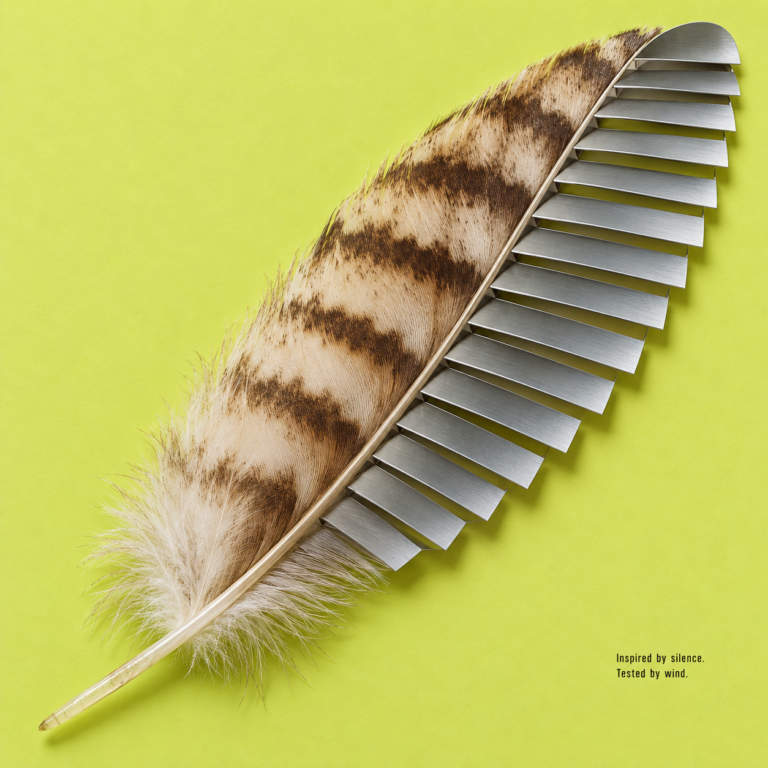
The story begins at the leading edge, where fine comb-like serrations function as vortex generators, breaking the boundary layer from a broad, chaotic flow into arrays of small, organized eddies. That reorganization of turbulence is what suppresses the noise that a smooth leading edge would otherwise produce. At the trailing edge, soft feather fringes intercept acoustic pressure fluctuations before they can radiate outward. And across the dorsal surface of the feather, a velvet-like down — with a density of approximately 79 pennula per square millimeter — forms a porous canopy suspended roughly half a millimeter above the feather surface, absorbing the energy of small turbulent eddies before they register as sound.
The result is an owl that flies on proportionally large wings — producing a wing loading of around 33 newtons per square meter — moving slowly and precisely through the air, without paying the acoustic price that would alert its prey.
From Feather to Blade — Translating a Living Wing into a Rotor
The central engineering difficulty is straightforward: an owl feather is flexible, three-dimensional, and dynamically adaptive, while a drone rotor blade is rigid, rotating, and operates under conditions that differ substantially from low-speed gliding flight. Despite this gap, researchers have achieved measurable results even from partial approximations of the biological model.
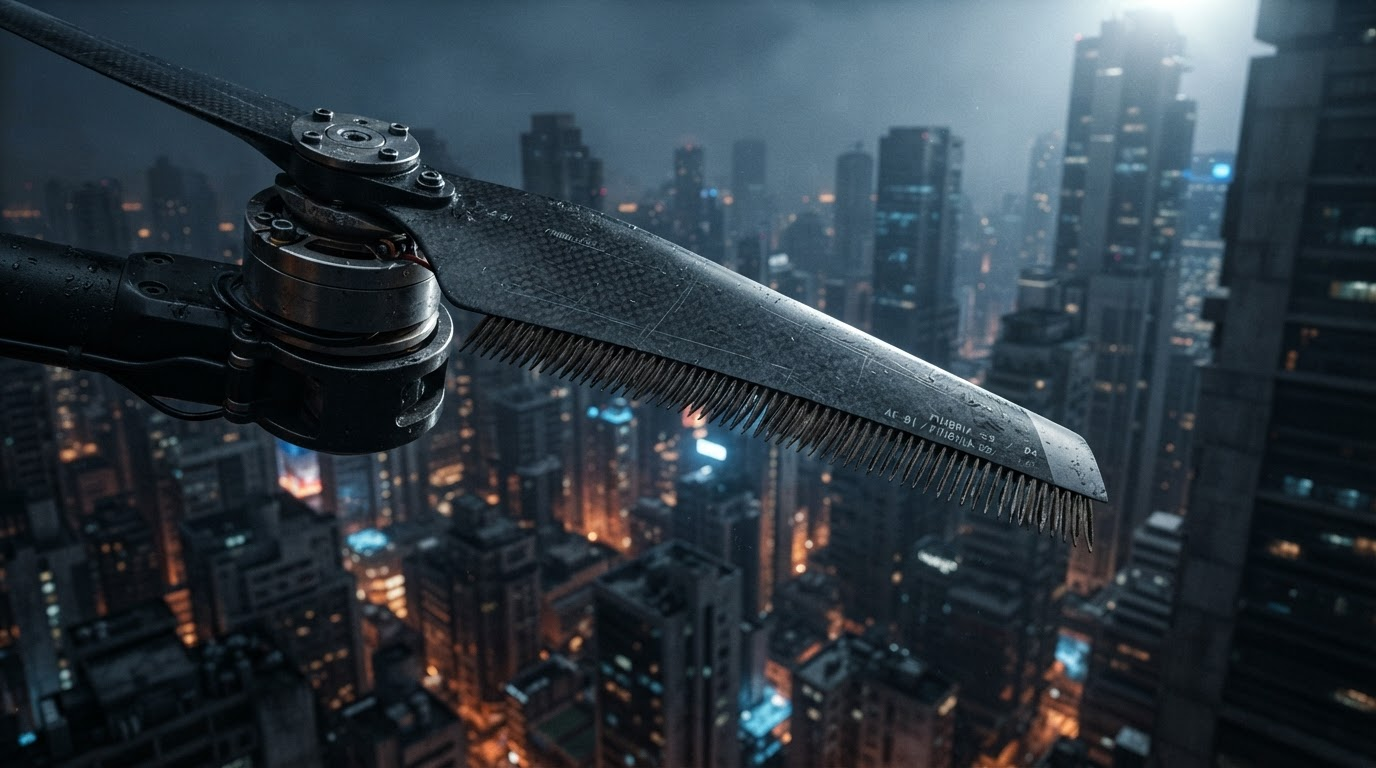
Work on the leading edge has been particularly productive. Rao and colleagues combined large-eddy simulations with particle image velocimetry and found that owl-inspired serrations suppress the Kelvin-Helmholtz instability within the separated shear layer above the blade surface — a specific aerodynamic instability that generates significant noise when left unchecked. In plain terms, the serrations convert large, disorganized turbulence into small, structured eddies, simultaneously reducing noise and improving lift at the low angles of attack that characterize typical owl flight.
When Hu and colleagues tested sinusoidal leading-edge serrations on multi-rotor systems inside an anechoic wind tunnel, the results translated directly into engineering terms: rotors fitted with the largest serration amplitude achieved up to 13 dB of broadband noise reduction and up to 4 dB of overall sound pressure level reduction compared to baseline rotors. The trade-off involved a modest thrust reduction of two to four percent and a slight increase in power consumption — a compromise that many designers working in urban contexts regard as entirely acceptable, given what is gained in acoustic performance.
Fringes and Down — The Quietest Weapon in the Arsenal
Perhaps the least celebrated of the owl’s three acoustic tools, at least within engineering circles, is the velvet-like downy surface. Clark and colleagues developed surface treatments inspired by this structure — which they termed finlet fences — and tested them on a standard airfoil at chord Reynolds numbers up to three million, conditions considerably closer to operational flight than most laboratory setups. The outcome was a trailing-edge noise reduction of up to 10 dB across a wide range of angles of attack, with no measurable penalty to lift and only a minor drag increase proportional to the added wetted surface area.
The operative mechanism is the disruption of spanwise correlation in boundary-layer turbulence. Rather than a single coherent pressure wave radiating from the trailing edge and producing an audible tone, the finlet treatments scatter that wave into multiple small, desynchronized sources that decay rapidly.
Rong and Liu extended this line of inquiry through a three-dimensional numerical study applying the Ffowcs Williams-Hawkings acoustic analogy to a clean wing fitted with trailing-edge fringes distributed across different spanwise positions. Their findings confirmed that midspan fringe distributions outperform those concentrated near the wingtip, and that three-dimensional configurations achieve five to six decibels of noise reduction — roughly double what two-dimensional simulations would suggest. That discrepancy alone explains why early laboratory results had sometimes underwhelmed: the three-dimensional spanwise flow dynamics that govern the fringe’s effectiveness simply do not appear in two-dimensional models.
The Lesson from the Cicada — When Owl and Insect Share a Single Blade
In 2024, Wei and colleagues published in Nature Communications what may represent the field’s most consequential finding to date. Rather than applying a single owl-inspired feature to a rotor blade, they combined three-dimensional sinusoidal leading-edge serrations drawn from the barn owl’s primary feather with a planform geometry derived from the cicada forewing — an insect recognized for aerodynamic efficiency unusual even among flying creatures.
The resulting design, which they designated 3D-SC, achieved simultaneously what single-feature approaches had been unable to accomplish: a 5.5 dB reduction in overall sound pressure level compared to the DJI Phantom 3 reference propeller, alongside a propulsive efficiency gain exceeding twenty percent at equivalent thrust levels. The three-dimensional serrations generated coherent vortex structures that suppressed tonal noise at lower Reynolds numbers and attenuated broadband noise at higher ones by stabilizing directional momentum and impeding the energy cascade toward small-scale turbulent eddies.
The deeper principle the study demonstrates is one that biologists have long understood but engineers are still internalizing: nature does not optimize a single variable at the expense of others. It finds solutions that satisfy competing constraints at once. The 3D-SC blade is a working demonstration of that logic applied to engineering.
What This Means for the City
This research may appear to belong entirely to the laboratory, but its connection to the built environment is more immediate than it seems. Drones have moved steadily into urban logistics planning — parcel delivery, infrastructure monitoring, construction-site surveillance — yet the primary barrier to their integration is not technical capability. It is noise. Dense residential neighborhoods, parks designed to specific acoustic comfort levels, and noise-sensitive public buildings such as hospitals cannot reasonably accommodate overhead corridors for fleets of buzzing aircraft.
What Noda and colleagues documented in 2018 — a practical test on a quadcopter fitted with a fringe-inspired aluminum plate measuring 10 by 20 millimeters — is instructive precisely because of its modesty. That simple attachment reduced the drone’s sound output by approximately 2.4 dB while maintaining aerodynamic efficiency. In an urban regulatory context, that modest decibel reduction can shift a technology from the contested side of a zoning threshold to the permissible side.
The implications extend further than drones. Wang and colleagues’ comprehensive bibliographic review of bio-inspired aeroacoustic research notes that the same principles — serrations, fringes, and surface treatments derived from owl morphology — are transferable to the wind turbines that increasingly ring cities and cast their acoustic shadow over peripheral neighborhoods. An urban planner who today writes stringent acoustic specifications into turbine procurement standards may find, perhaps unexpectedly, that owl biology is already doing part of the technical work.
The Remaining Gap — Where the Machine Cannot Yet Follow the Living Wing
Against all of these advances, a genuine gap remains between what biology has produced and what engineering has so far replicated. A real owl feather is flexible and responds to airflow in real time. It is curved, geometrically irregular, and varies in thickness from root to tip. None of these properties are captured in current engineered models, and the fluid-structure interactions they produce — acknowledged by both Rao and colleagues and Rong and Liu as significant — remain poorly understood.
Manufacturing presents a parallel constraint. Most bio-inspired structures have been tested at scales and Reynolds numbers lower than those that govern large aircraft wings or industrial wind turbines. Scaling from a small quadcopter rotor to a commercial aircraft surface or a megawatt-class turbine blade requires not just revalidating the aeroacoustic findings, but reconceiving the manufacturing processes from the ground up.
The direction forward is nonetheless legible. It passes through deeper understanding of the flow physics behind each individual feather adaptation, through manufacturing methods capable of producing complex three-dimensional surface geometries at scale — precision additive manufacturing among them — and ultimately toward multi-feature bionic designs that integrate several owl-inspired properties simultaneously, as the 3D-SC study has shown is possible. When the acoustic performance of the barn owl becomes the benchmark against which a rotor blade is measured, engineering will have conceded, formally and finally, that nature arrived at this solution several million years ahead of schedule.
✦ ArchUp Editorial Insight
The push toward bio-inspired silent rotors is less an exercise in biomimetic innovation than a structural necessity to unlock the low-altitude urban commons for commercial logistics. As municipal authorities enforce stringent environmental noise thresholds and urban residents resist invasive acoustic disruption, last-mile delivery capital encounters a regulatory barrier that aerodynamic efficiency alone cannot bypass. By dampening decibel levels to pass municipal zoning thresholds, silent propulsion systems transform previously restricted air corridors into viable infrastructure layers. Consequently, the mitigation of rotor noise is not merely a technical refinement, but the prerequisite for commodifying three-dimensional urban airspace, ultimately redefining how urban density, acoustic comfort, and spatial real estate values interact above the street level.
References
Wei, Z., Wang, S., Farris, S., et al. “Toward Silent and Efficient Flight by Combining Bioinspired Owl Feather Serrations with Cicada Wing Geometry.” Nature Communications, 2024.
Noda, R., Nakata, T., Ikeda, T., et al. “Development of a Bio-Inspired Low-Noise Propeller for a Drone.” Journal of Robotics and Mechatronics, 2018.
Bachmann, T., Mühlenbruch, G., and Wagner, H. “The Barn Owl Wing: An Inspiration for Silent Flight in the Aviation Industry?” SPIE Proceedings, 2011.
Rao, C., Ikeda, T., Nakata, T., and Liu, H. “Owl-Inspired Leading-Edge Serrations Play a Crucial Role in Aerodynamic Force Production and Sound Suppression.” Bioinspiration & Biomimetics, 2017.
Li, D., Liu, X., Hu, F., and Wang, L. “Effect of Trailing-Edge Serrations on Noise Reduction in a Coupled Bionic Aerofoil Inspired by Barn Owls.” Bioinspiration & Biomimetics, 2019.
Rong, J., and Liu, H. “Numerical Investigation of Three-Dimensional Aeroacoustic Characteristics of Owl-Inspired Trailing-Edge Fringes.” Journal of Bionic Engineering, 2022.
Yang, Y., Wang, Y., Liu, Y., Hu, H., and Li, Z. “Noise Reduction and Aerodynamic Performance of Isolated Multi-Copter Rotors with Serrated Trailing Edges during Forward Flight.” Journal of Sound and Vibration, 2020.
Wang, Y., Zhao, K., Lu, X. Y., Song, Y. B., and Bennett, G. J. “Bio-Inspired Aerodynamic Noise Control: A Bibliographic Review.” Applied Sciences, 2019.
Hu, H., Yang, Y., Liu, Y., Liu, X., and Wang, Y. “Aerodynamic and Aeroacoustic Investigations of Multi-Copter Rotors with Leading-Edge Serrations during Forward Flight.” Aerospace Science and Technology, 2021.
Clark, I. A., Alexander, W. N., Devenport, W., et al. “Bioinspired Trailing-Edge Noise Control.” AIAA Journal, 2017.