Engineering Human Behavior: How Architectural Spaces Shape Our Hidden Motivations


A Psychological Anatomy of Built Environments and Design Studios Between Controlled Constraint and Autonomous Freedom
A striking paradox marks the contemporary architectural landscape. While organizations invest billions of dollars in designing seemingly advanced offices and modern design studios, professional practice experiences unprecedented levels of psychological burnout, declining innovation, and a profound sense of spatial alienation. This phenomenon stems from traditional design neglecting the psychological dynamics that drive human behavior within the built environment. Humans do not merely react to physical stimuli like lighting and ventilation; they operate as dynamic organisms intrinsically oriented toward growth and maturation, requiring a spatial and organizational environment that supports their basic psychological needs to create and produce effectively.
Self-Determination Theory (SDT), established over five decades by researchers Edward L. Deci and Richard M. Ryan, offers a rigorous analytical framework to decode human behavior. When applied to motivational architecture and urban planning, this psychological theory demonstrates that the quality of architectural space is measured not merely by geometric aesthetics, but by its capacity to nourish the intrinsic motivations of its occupants—whether architects navigating the creative process within a studio, employees spending their daily lives in corporate towers, or citizens occupying public space.
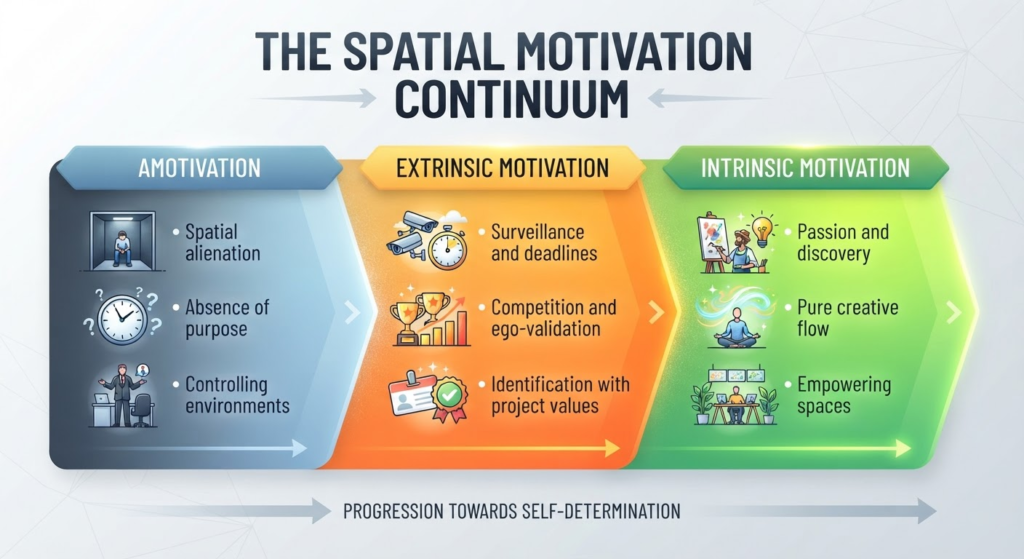
The Motivation Continuum: From Controlled Regulation to Architectural Creative Flow
Self-Determination Theory rejects treating motivation as a unitary concept measured solely by quantity. Instead, it posits that the quality of motivation serves as the true predictor of creative problem-solving and complex execution—the core of architectural practice. Motivation flows across a continuum starting at amotivation, where an individual loses all sense of purpose and competence due to oppressive spatial or organizational environments, and extending to intrinsic motivation, where an action is performed for its own sake out of passion for spatial exploration and experimentation.
Between these two poles lies extrinsic motivation, categorized into four forms that vary by degree of internalization. External regulation relies on strict deadline pressure and direct surveillance systems. Introjected regulation operates on internalized guilt, anxiety, and fear of judgment during architectural design juries. The more self-determined forms comprise identified regulation and integrated regulation, wherein the architect or space user consciously endorses the project’s values and goals, transforming architectural action into an authentic expression of personal identity.
In a structural review, researcher Jonathan L. Howard and colleagues demonstrated that motivation follows a semi-radex structure. This indicates that behavioral regulations are not isolated categories, but qualitative levels that interlock along a continuum to shape an individual’s response to their environment. Within design practice, this structural reality reveals that spatial and professional environments can systematically guide a designer from forced compliance with blueprints toward creative engagement when supportive environmental conditions exist.
The Spatial Psychological Triad: Autonomy, Competence, and Relatedness
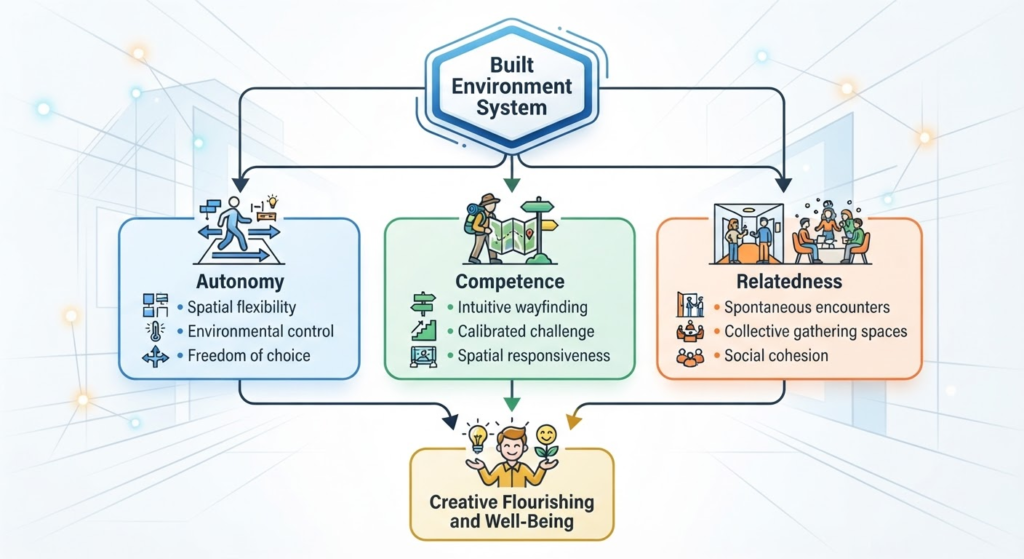
Self-Determination Theory proposes that human psychological functioning requires three essential, non-negotiable nutriments to flourish, with the built environment serving as the primary arena where these needs are either fulfilled or thwarted:
Spatial autonomy does not signify isolation, but rather the experience of volition and self-direction. Architecturally, this need translates into flexible workplaces and adaptable layouts that allow users to reconfigure space, rearrange furniture, and control environmental factors like daylight and ventilation, rather than rigid, static environments that impose monolithic patterns of movement and seating.
The sense of competence reflects the need to interact effectively with one’s surroundings and master challenges. Successful architecture addresses this requirement through spatial legibility, intuitive wayfinding, and studio environments that present calibrated design challenges paired with constructive guidance rather than destructive criticism.
Spatial relatedness expresses the human desire for belonging and mutual connection. Urbanistically, this manifests through spatial syntax that encourages spontaneous encounters, the inclusion of spatial hearths in residential and office buildings, and the design of public spaces that accommodate social diversity and foster community cohesion.
Research by Edward L. Deci and Richard M. Ryan confirms that satisfying these three basic needs predicts psychological well-being and optimal performance across diverse cultural settings, from individualistic Western contexts to collectivist societies in Russia, Japan, China, Nigeria, and India. Consequently, built environments that ignore this psychological triad function as hostile spaces that trigger defensive mechanisms and spatial alienation.
The Mini-Theories: Dissecting Studio and Workplace Dynamics
Self-Determination Theory comprises six interconnected mini-theories whose application to architectural practice casts new light on studio management and environment design.
Cognitive Evaluation Theory explains how environmental factors—such as contingent monetary rewards, strict surveillance, and pressing deadlines—affect intrinsic motivation. While supportive feedback and choice enhance feelings of autonomy and competence, environments characterized by excessive oversight suppress exploratory drive. Organismic Integration Theory complements this framework by outlining how young architects transition from executing orders out of external compliance to fully assimilating the architectural values of an organization or studio.
Causality Orientations Theory addresses individual differences in adapting to spatial settings, showing that individuals with an autonomous orientation actively seek creative opportunities within a space, whereas those with a controlled orientation respond primarily to directive constraints. Goal Content Theory differentiates between intrinsic aspirations—such as personal growth, community contribution, and environmental stewardship—and extrinsic aspirations like fame, pure commercial expansion, and superficial awards. Empirical data indicates that design oriented toward intrinsic goals yields deeper, more sustainable architecture.
At the scale of design teams and client-architect relationships, Relationships Motivation Theory demonstrates that effective creative partnerships require mutual autonomy support rather than mere empathy. Architectural projects flourish when both client and designer retain the freedom to express ideas without coercive pressure from either side.
The Reward and Control Dilemma: Why Controlled Environments Fail to Produce Innovative Architecture
Meta-analyses synthesized by Marylène Gagné and Edward L. Deci reveal a critical reality: tangible extrinsic rewards and strict surveillance undermine intrinsic motivation, particularly during complex activities that demand innovative thinking and non-traditional solutions.
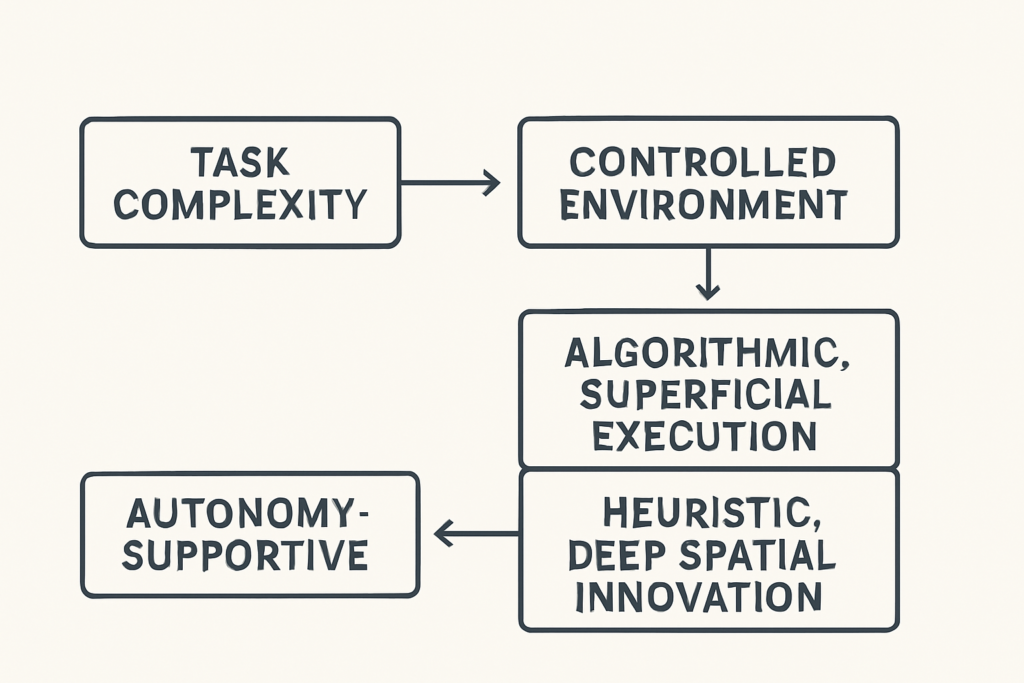
While pressure and directive control may accelerate simple, repetitive algorithmic tasks, they fail entirely when applied to complex, heuristic design challenges like spatial orientation and concept development. Subjecting design offices to arbitrary performance metrics and micromanagement restricts creative capacity and results in superficial, repetitive architectural solutions. Conversely, studio leadership that supports autonomy—by understanding designers’ perspectives, encouraging initiative, and providing clear rationales for decisions—elevates architectural quality and strengthens organizational commitment.
Field Applications: From Educational and Healthcare Facilities to Urban Space
The applications of Self-Determination Theory extend beyond design offices to inform architectural strategy across various functional sectors:
In educational architecture, research led by Richard M. Ryan and Edward L. Deci shows that autonomy-supportive classrooms and academic studios foster an exploratory environment that enhances students’ conceptual learning. Architectural layouts that offer flexible spatial configurations and minimize the dominance of the teacher’s podium translate this autonomy support into physical form.
In healthcare design, studies by Heather Patrick and Geoffrey C. Williams demonstrate that healing environments respecting patient autonomy—by offering environmental control over natural light, access to healing gardens, and mobility—accelerate recovery rates and improve patient engagement with treatment plans.
In sports facilities and public realms, research by Martin Hagger and Nikos Chatzisarantis proves that designing urban parks and exercise trails to encourage self-directed participation, rather than rigidly controlled movement, promotes sustained physical activity and public health.
Toward a Copernican Shift in Built Environment Design
Self-Determination Theory represents what Richard M. Ryan and colleagues describe as a “Copernican turn” in motivational science. It shifts the perception of human beings from passive subjects driven by external forces to active organisms with an inherent propensity for growth, integration, and flourishing when supplied with necessary psychological nutriments.
The responsibility facing architects and urban planners today extends beyond generating geometric forms and managing project budgets; it requires crafting spatial ecosystems that respect human psychological needs. Architectural space is not a passive concrete container, but an active driver of human motivation—functioning either as a mechanism of control that suppresses creative potential, or as an empowering environment that fosters autonomy, builds competence, and deepens social connection.
✦ ArchUp Editorial Insight
Modern corporate offices and design studios are shaped primarily by institutional risk mitigation, billable-hour accounting, and financialized metrics of real estate efficiency. To secure predictable productivity and operational oversight, corporate governance models deploy standardized spatial allocation, centralized environmental control, and rigid floorplate layouts. The prevailing architectural typologies—inflexible desk grids, panoptic open-plan layouts, and static spatial hierarchies—are not design oversights, but physical mechanisms engineered to enforce behavioral compliance and transactional throughput. By stripping occupants of spatial autonomy, environmental control, and intuitive social syntax, these built environments predictably generate cognitive fatigue, creative stagnation, and workplace burnout. What manifests as a crisis of employee motivation or declining design innovation is the logical spatial symptom of economic frameworks that prioritize immediate operational surveillance over the fundamental psychological requirements of human agency.
References
Deci, Edward L., and Richard M. Ryan. “Self-Determination Theory: A Macrotheory of Human Motivation, Development, and Health.” Canadian Psychology / Psychologie canadienne, 2008.
Deci, Edward L., and Richard M. Ryan. “The ‘What’ and ‘Why’ of Goal Pursuits: Human Needs and the Self-Determination of Behavior.” Psychological Inquiry, 2000.
Howard, Jonathan L., Marylène Gagné, and Alexandre J. S. Morin. “Putting the Pieces Together: Reviewing the Structural Conceptualization of Motivation Within SDT.” Motivation and Emotion, 2020.
Ryan, Richard M., and Edward L. Deci. “Intrinsic and Extrinsic Motivation from a Self-Determination Theory Perspective: Definitions, Theory, Practices, and Future Directions.” Contemporary Educational Psychology, 2020.
Patrick, Heather, and Geoffrey C. Williams. “Self-Determination Theory: Its Application to Health Behavior and Complementarity with Motivational Interviewing.” International Journal of Behavioral Nutrition and Physical Activity, 2012.
Gagné, Marylène, and Edward L. Deci. “Self-Determination Theory and Work Motivation.” Journal of Organizational Behavior, 2005.
Hagger, Martin, and Nikos Chatzisarantis. “Self-Determination Theory and the Psychology of Exercise.” International Review of Sport and Exercise Psychology, 2008.
Ryan, Richard M., Edward L. Deci, Maarten Vansteenkiste, and Bart Soenens. “Building a Science of Motivated Persons: Self-Determination Theory’s Empirical Approach to Human Experience and the Regulation of Behavior.” Motivation Science, 2021.