Site-State Memory: What Slime Mould Can Teach Construction Handover

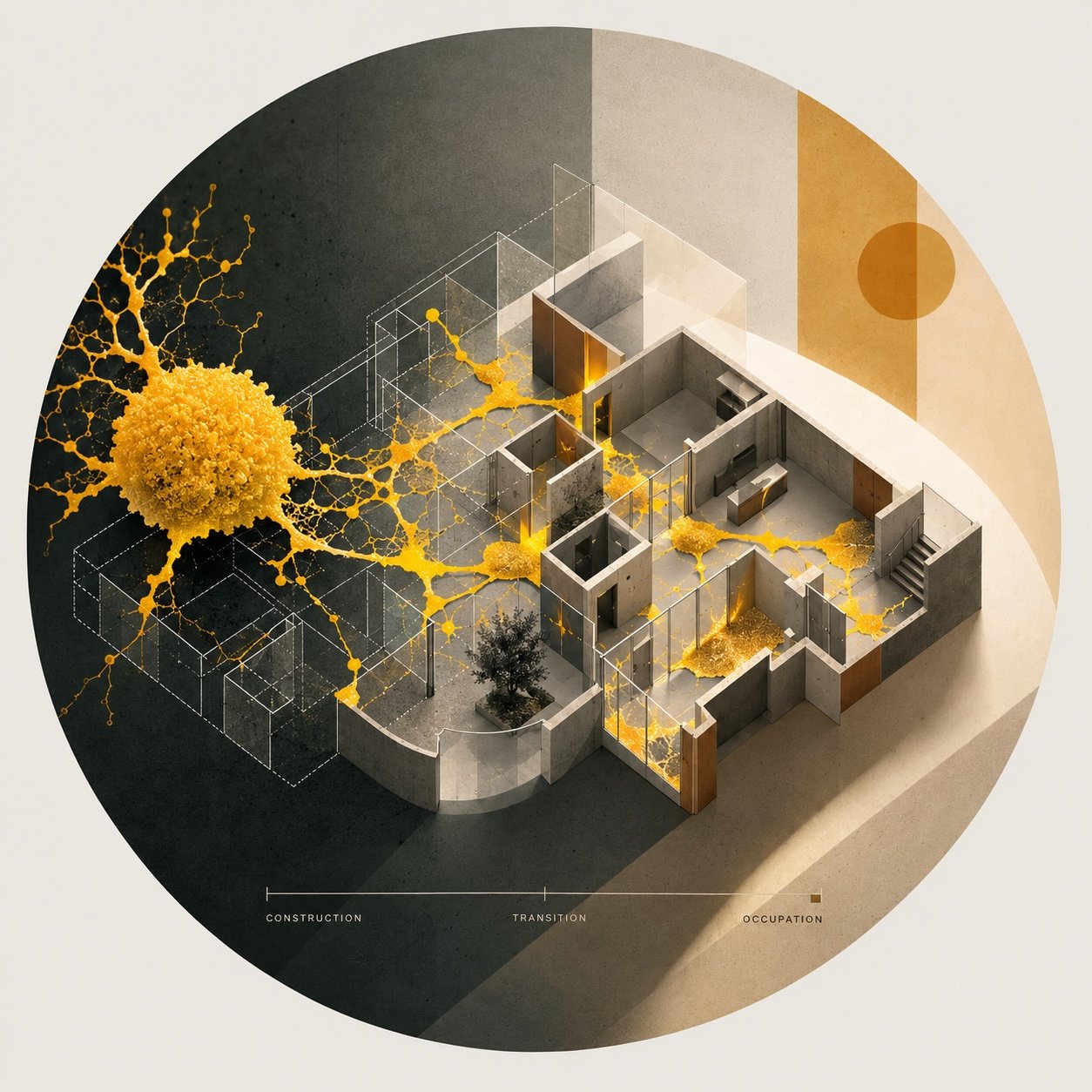
A ceiling panel is opened, inspected and closed. The next trade arrives with a different question and opens it again. This hypothetical handover problem suggests a research question: could a building site retain a readable, temporary record of what has happened at each location, so that useful information travels with the work?
This research commentary develops a proposed construction-management experiment from a biological study. It reports no field trial and makes no claim that the proposed system improves productivity.
The biological evidence
In a 2012 PNAS study, Chris R. Reid and colleagues investigated the slime mould Physarum polycephalum. It preferentially avoided surfaces carrying extracellular slime. In a U-shaped obstacle experiment, 96% of 24 specimens reached a food target within 120 hours on blank agar, compared with 33% of 24 on slime-coated agar. The coating obscured the distinction between previously visited and unvisited ground. The authors interpreted this as externalized spatial memory.
From a trail to a record of work
The proposed architectural translation concerns information placement. Consider a service zone above a corridor ceiling. A drawing identifies the intended installation; a local record could identify the latest verified condition of that installation. These are different questions. A worker needs to know both what should exist and what has actually been checked.
For this proposal, Site-State Memory means a temporary, location-linked record containing the work item, its current verification status, the date and the responsible team. This is an editorial working term, not a claim of a newly discovered scientific field. It would complement existing inspection records and project information systems.
A removable label at an agreed access point could display a short text status and an identifier linking to the relevant record. A scan should be optional for understanding the essential status. Colour could reinforce the message, but text and symbols would carry its meaning. No biological material would be introduced into the building.
A trace must be able to expire
A mark reading “checked” is too ambiguous for this experiment. Checked for what, by whom, and before or after which alteration? The proposed record would name the specific inspection, its scope and its date. It would distinguish “not inspected,” “inspection recorded,” and “review required after change.” None of these labels would replace formal acceptance or authorize another trade to proceed.
The important design decision is the invalidation rule. If work within a zone changes, the earlier record must remain traceable while its current status becomes pending review. Without that rule, a durable marker could preserve an obsolete conclusion. The useful memory is therefore a sequence of accountable states, not a permanent green sticker.
A testable construction experiment
A pilot could compare similar service zones under three arrangements: the project’s normal documentation process; the same process with location identifiers; and the same process with identifiers plus visible, time-stamped status records. Mandatory inspections and responsibilities would remain identical in all three groups.
Before work begins, the study team would define which reopenings are necessary and which count as avoidable repetition. It would record retrieval time, duplicate inspection requests, discrepancies between labels and approved records, and missed required checks. Recording and correcting the labels would count as labour, rather than disappear from the cost calculation.
Assignment should account for trade sequence, installation complexity and team experience. A small pilot would first estimate variability; a later study would use that information to determine sample size. An independent reviewer could audit a sample of records against actual conditions. Any time saving accompanied by more missed checks would fail the proposed acceptance criterion.
Limits and governance
The biological result does not establish an effect on human teams or construction quality. This proposal also does not claim that location labels, inspection tags or digital handovers are new. Its specific research question is whether explicit expiry and verification states add measurable value beyond location identification alone.
Labels could become clutter, detach or contradict a newer record. The pilot therefore needs a named owner for each update, a defined authoritative record and a removal procedure at handover. It should track work states rather than individual movement. Emergency signs and access instructions must remain visually distinct.
✦ ArchUp Editorial Insight
The design opportunity is modest but concrete: make the status of work legible where decisions about that work occur. A useful architectural application of biology should produce a testable operational question. Here, the question is whether a carefully maintained local record can reduce repeated information searches without weakening verification. If the pilot cannot demonstrate that distinction, the additional marking layer has not justified itself.
Reference
Reid, C. R.; Latty, T.; Dussutour, A.; Beekman, M. (2012). Slime mold uses an externalized spatial “memory” to navigate in complex environments. PNAS, 109(43), 17490–17494.