Refining the Social Fabric Through Urban Density and Form

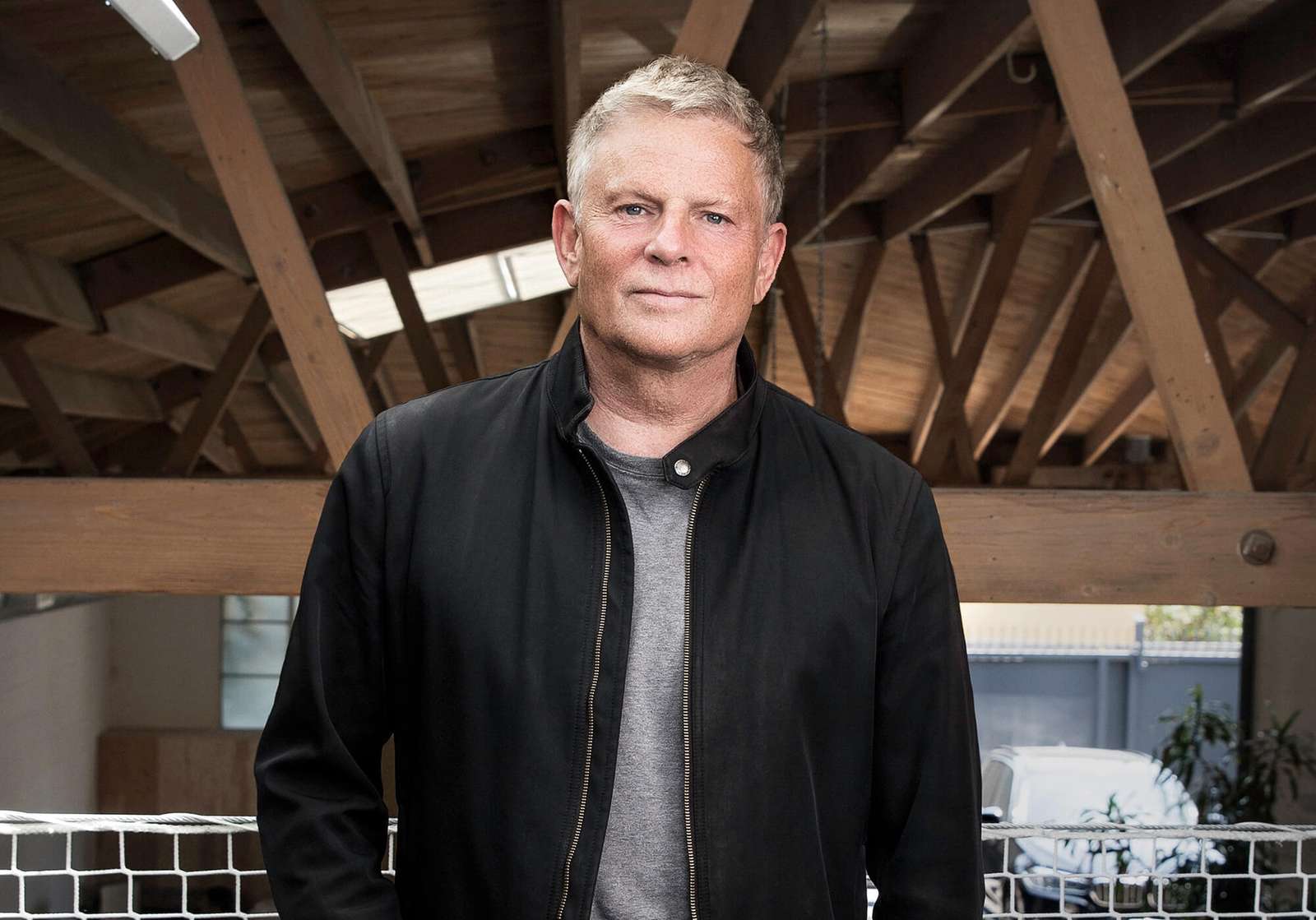
The global architectural community reflects on a career defined by the rigorous pursuit of social housing innovation and the aesthetic transformation of urban density. This body of work challenged the traditional boundaries of residential typologies, particularly within the fragmented landscapes of Southern California and the industrial Midwest. The approach positioned architecture as a social act, prioritizing the public realm and the spatial sequence of collective living over isolated objects.
The design philosophy emerged from a diverse professional background, drawing technical and critical logic from experiences at several significant American practices. Since establishing a studio in Los Angeles in 1994, the team progressively expanded its scope from bespoke residential buildings to complex multi-unit developments and cultural facilities. This evolution demonstrated a consistent interest in how private architecture can contribute to the vitality of the street through porosity and shared space.
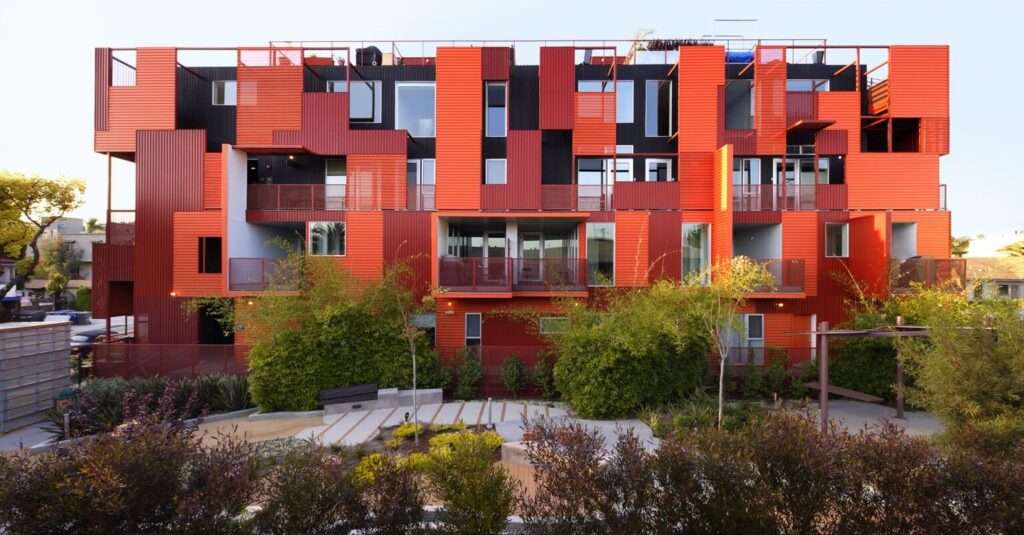
In West Hollywood, the team developed housing strategies that responded directly to historic contexts. One notable project situated 19 residential units adjacent to a significant 1920s modernist landmark, utilizing white, black, and lime-green volumes to navigate the site’s density. Another nearby intervention utilized a vivid red envelope and a dedicated pocket park to integrate private development with the local neighborhood, treating the building mass as a painterly composition.
Advancing Social Equity Through Supportive Housing
The team’s commitment to urban welfare manifested through significant work in supportive and affordable housing. In 2011, a construction project repurposed a storage facility into administrative offices for a housing trust, signaling a long-term engagement with social infrastructure. Subsequent developments, such as a 26-unit supportive housing complex, utilized upper-level patios and crystalline pavilions to foster community interaction among residents.
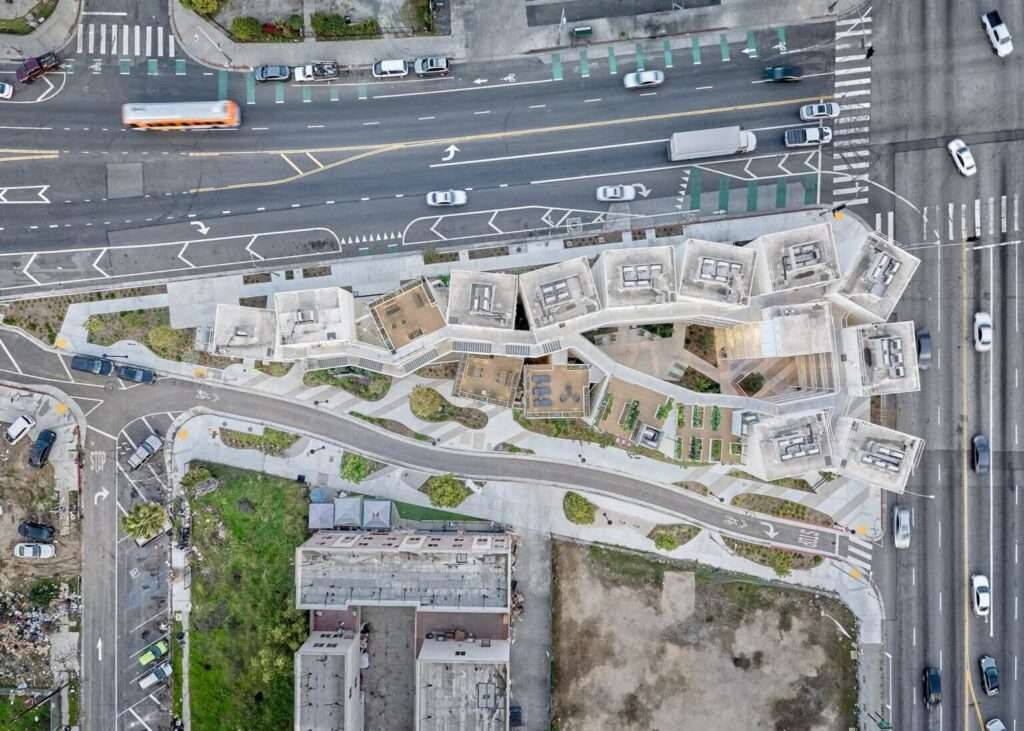
Technical innovation accompanied these social goals, particularly in the use of non-traditional sites. On an attenuated parcel near a major highway interchange, the team delivered a 54-unit project that addressed the challenges of noise and air quality through strategic orientation. These projects shifted the focus from luxury commodities to functional, dignified environments for vulnerable populations, reinforcing the idea that high-quality design serves as a tool for equity.
Intervening in the Industrial Fabric of Detroit
Later expansions took the studio’s logic to Detroit, where the team confronted the challenges of urban decay and historic Victorian fabrics. In the Brush Park district, the design strategy reinforced corner lots with stepped monoliths, using singular building materials like brick, wood, and metal to establish a contemporary presence. This work emphasized the importance of the street wall and the re-establishment of pedestrian-scale density in a city historically dominated by the automobile.
At the Milwaukee Junction site, a 138-unit development featured an undulating metal exterior inspired by automotive bodywork. A central, chasm-like courtyard provided a protected internal environment while maintaining a sharp, industrial character on the exterior. This project reflected the team’s ability to translate local industrial heritage into modern residential forms, ensuring that new developments resonated with the city’s material history.
Spatial Sequence and Programmatic Intelligence
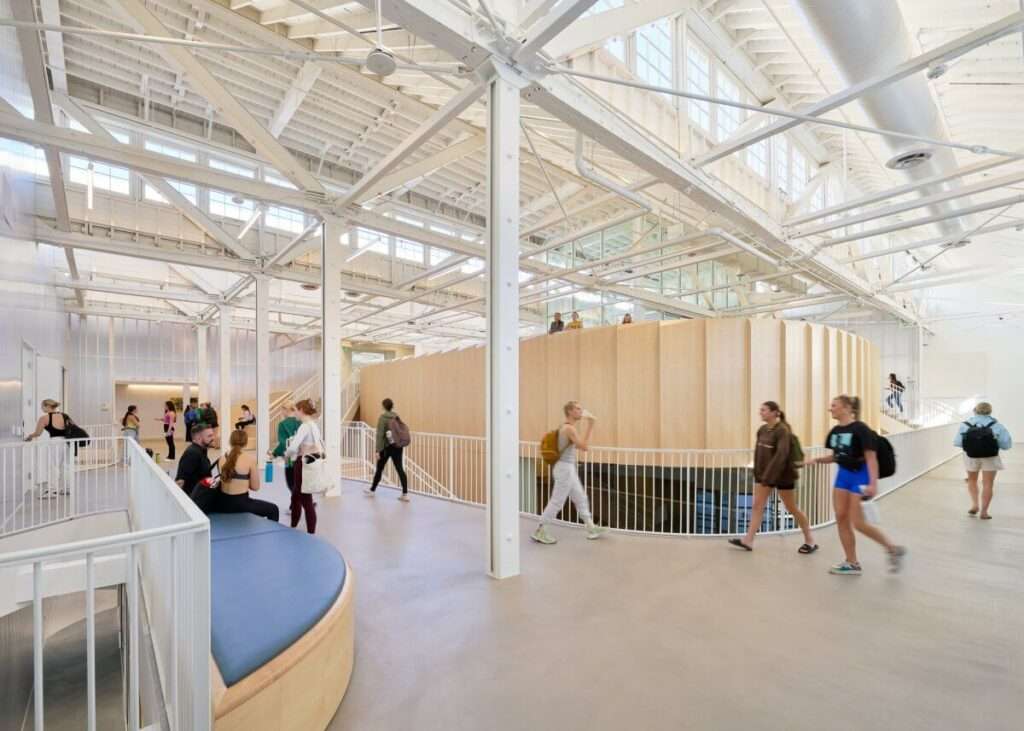
The architectural strategy consistently prioritized the “void” as much as the “solid.” By carving courtyards, cascading stairs, and upper-level terraces out of dense urban blocks, the team created a sophisticated circulation hierarchy that encouraged accidental social encounters. This approach rejected the typical corridor-heavy apartment layout in favor of light-filled transitional spaces that connect the private dwelling to the cities beyond. The use of color and texture did not serve as mere decoration; rather, these elements clarified the massing and defined different programmatic zones within a single development. This rigorous control of form ensured that even at higher densities, the buildings maintained a human scale and a legible relationship to their surrounding neighborhoods.
✦ ArchUp Editorial Insight
This retrospective frames a career dedicated to reclaiming the social potential of urban density by treating housing as a collective civic stage rather than a private commodity. By prioritizing the “void” through porous courtyards and sculptural massing, the work successfully navigates the friction between architecture and fragmented urbanism. This approach proves that sophisticated form can serve as a tool for equity, transforming marginalized sites into dignified nodes of connectivity within evolving cities.
However, one must question if this aestheticization of social infrastructure risks masking the brutal economic realities of displacement and gentrification. While vibrant envelopes and staggered monoliths offer a poetic response to urban decay, they remain tethered to developer-driven frameworks that often prioritize visual branding over long-term affordability. The tension persists: can radical geometry truly solve systemic housing shortages, or does it merely provide a polished facade for deep-seated socio-economic instability?
Project Team: Lorcan O’Herlihy, Lorcan O’Herlihy Architects (LOHA), Richard Loring, John Chase, Skid Row Housing Trust, Clifford Beers Housing, Bedrock. Location: Los Angeles, West Hollywood, Santa Monica, Detroit, Dublin.
Project Notes: The practice continues operations following a radical restructuring in March 2026. The late principal earned over 200 design awards and held teaching positions at USC. Projects such as Formosa1140 reside in the collection of the Heinz Architectural Center.