Nine Architects Reveals Open Book Design for New Taipei City Library

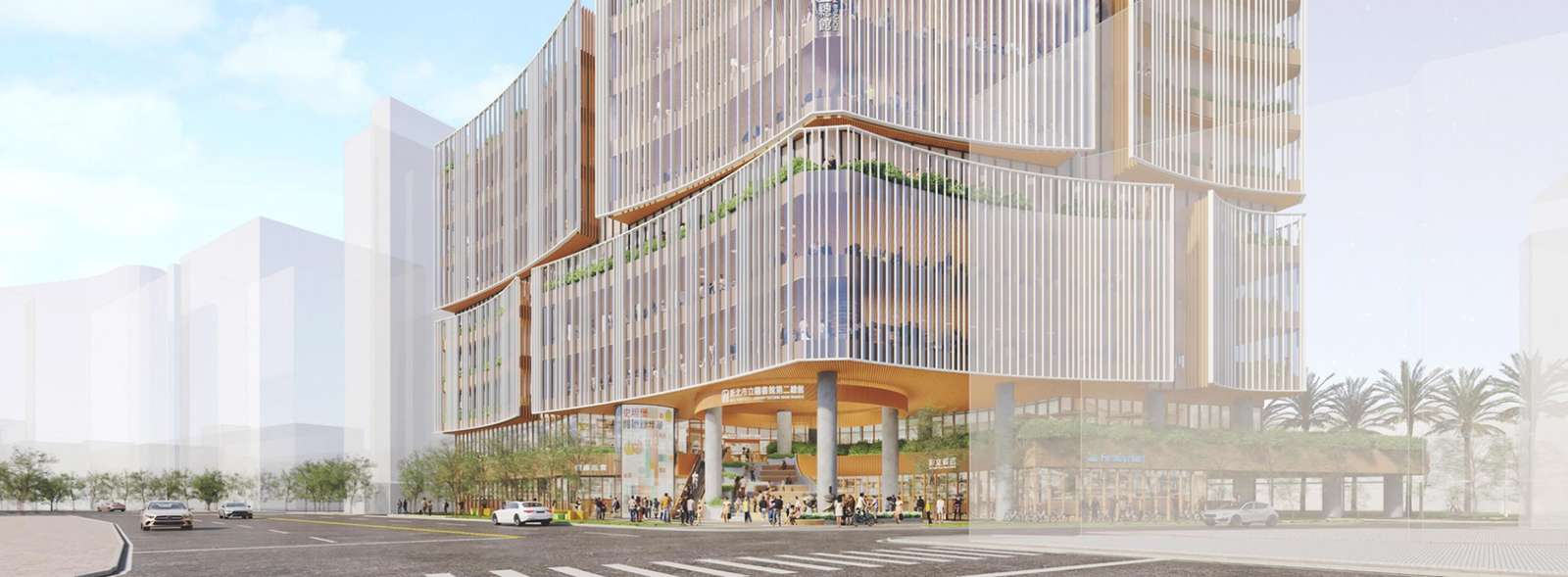
Nine Architects recently revealed the design for the New Taipei City Library Second Main Branch, an eight-story cultural facility planned for the original site of the Sanchong Branch. The project reconfigures the traditional reading environment into an “urban living room” characterized by fluid curves and a tiered massing strategy. The team expects to begin construction in 2027 with a projected completion date in 2031.
The design team adopts the “open book” concept to drive the formal logic of the building. Instead of stacking floor plates vertically in a traditional block, the architecture unfolds as a series of cascading layers. These fluid curves soften the visual impact of the large public volume at the street corner. The building effectively acts as an extension of the public realm, opening its facade to create a dialogue with the surrounding urban fabric.
Volumetric response to urban context
The site conditions directly influenced the massing of the library. One side of the plot faces a major thoroughfare, while the other adjoins a residential area and a campus. Nine Architects intentionally reduced the building volume on the campus side to harmonize with the lower-scale surroundings. This strategic reduction preserves natural light and sightlines for the neighborhood, ensuring the library functions as an accessible, porous structure rather than a closed institution.
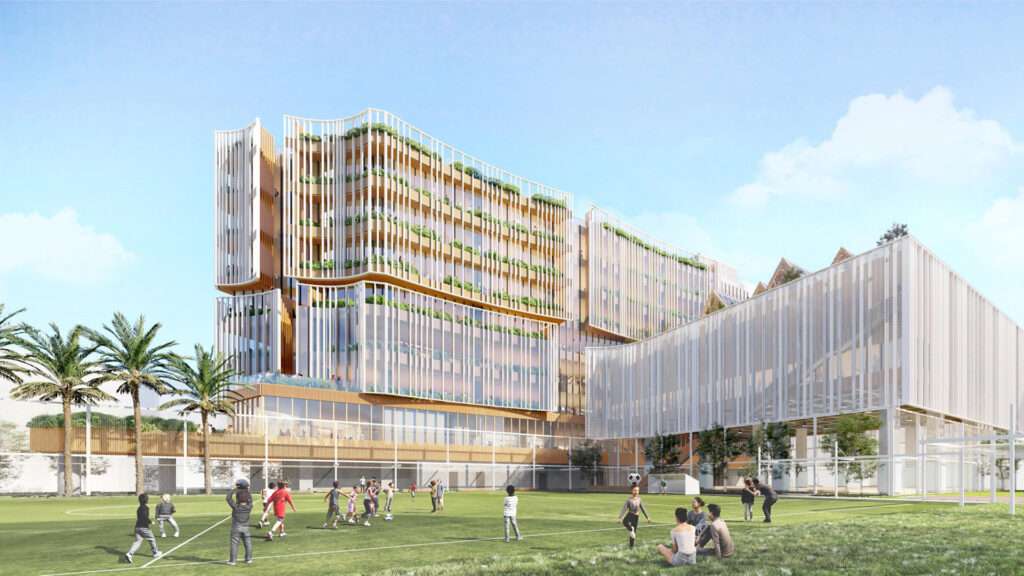
The program includes eight floors above ground and a three-story underground parking facility. The layout provides multiple open spaces for residents and students to utilize throughout the day. By integrating these flexible zones, the library accommodates community activities and social interaction alongside its primary function as a center for architecture and learning. The design prioritizes the rhythm of daily life over static book storage.
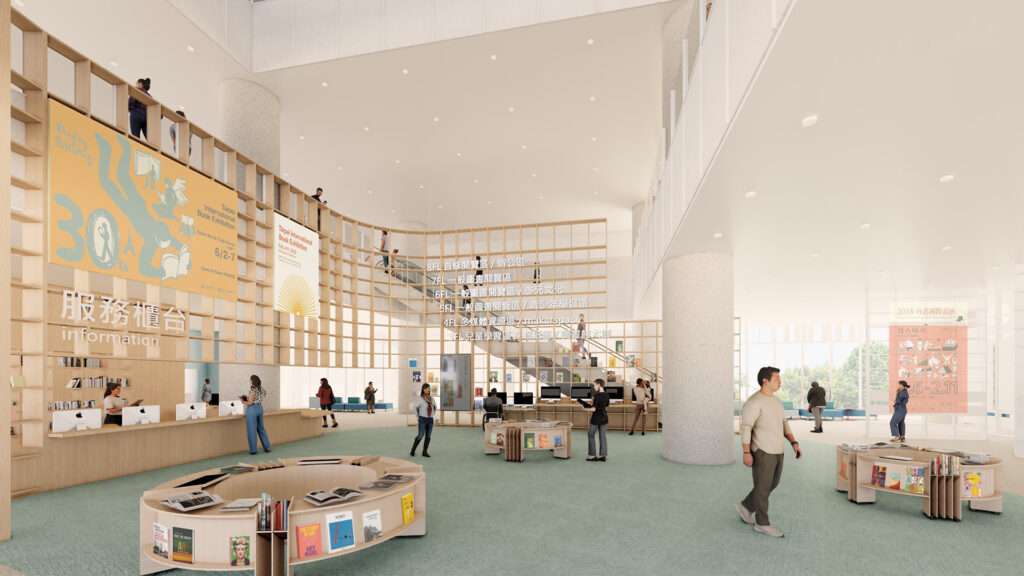
A semi-open terraced platform marks the entrance at the street corner, physically connecting the sidewalk to the building interior. This transition zone allows pedestrians to engage with the facility naturally without a formal threshold. Inside, a high-ceiling atrium maintains an open atmosphere. The main reading areas occupy the second floor, while the ground level serves as a barrier-free public lobby that encourages relaxation and informal use.
Tiered circulation and multi-generational programming
Tiered spatial language defines the internal circulation and visitor sequence. Large staircases serve as both movement corridors and stationary reading zones. These elements also function as flexible auditoriums for lectures, performances, or workshops. This versatility allows the library to adapt its spatial configuration based on immediate operational needs rather than relying on fixed-use rooms.
The hierarchical design extends to specific user zones, such as the children’s reading area. Here, the floor plan divides into age-appropriate sections with varying spatial scales. Meanwhile, the senior reading area sits adjacent to these zones, promoting natural intergenerational interaction within the shared facility. This layout reflects the shift of the library from a traditional archive into a citizen-centered platform for technology and social life.
The existing Sanchong Branch will close in June to prepare for demolition and site clearing in July. This process marks the beginning of the transition toward the new cultural landmark. The project signifies a broader effort by the New Taipei City Library system to redefine public space as a dynamic urban infrastructure that balances quiet study with civic engagement.
✦ ArchUp Editorial Insight
The New Taipei City Library Second Main Branch represents a significant departure from the introverted typology of traditional archives. By utilizing an “open book” formal logic, Nine Architects creates a porous interface between the library program and the streetscape. The project prioritizes the “urban living room” as its core operational identity, using tiered platforms and semi-open circulation to dissolve the boundary between public sidewalk and private study. Architecturally, the tiered massing responds effectively to the varying scales of the site’s edges. This strategy transforms the library from a static storage facility into a flexible piece of civic infrastructure that accommodates diverse social behaviors across different generations.
Project Team: Nine Architects (Lead Design). Location: Sanchong District, New Taipei City, Taiwan.
Project Notes: Construction begins in 2027; completion expected in 2031. Sanchong Branch closure and demolition starts July 2024.