
The Energy Model Is Not the Building

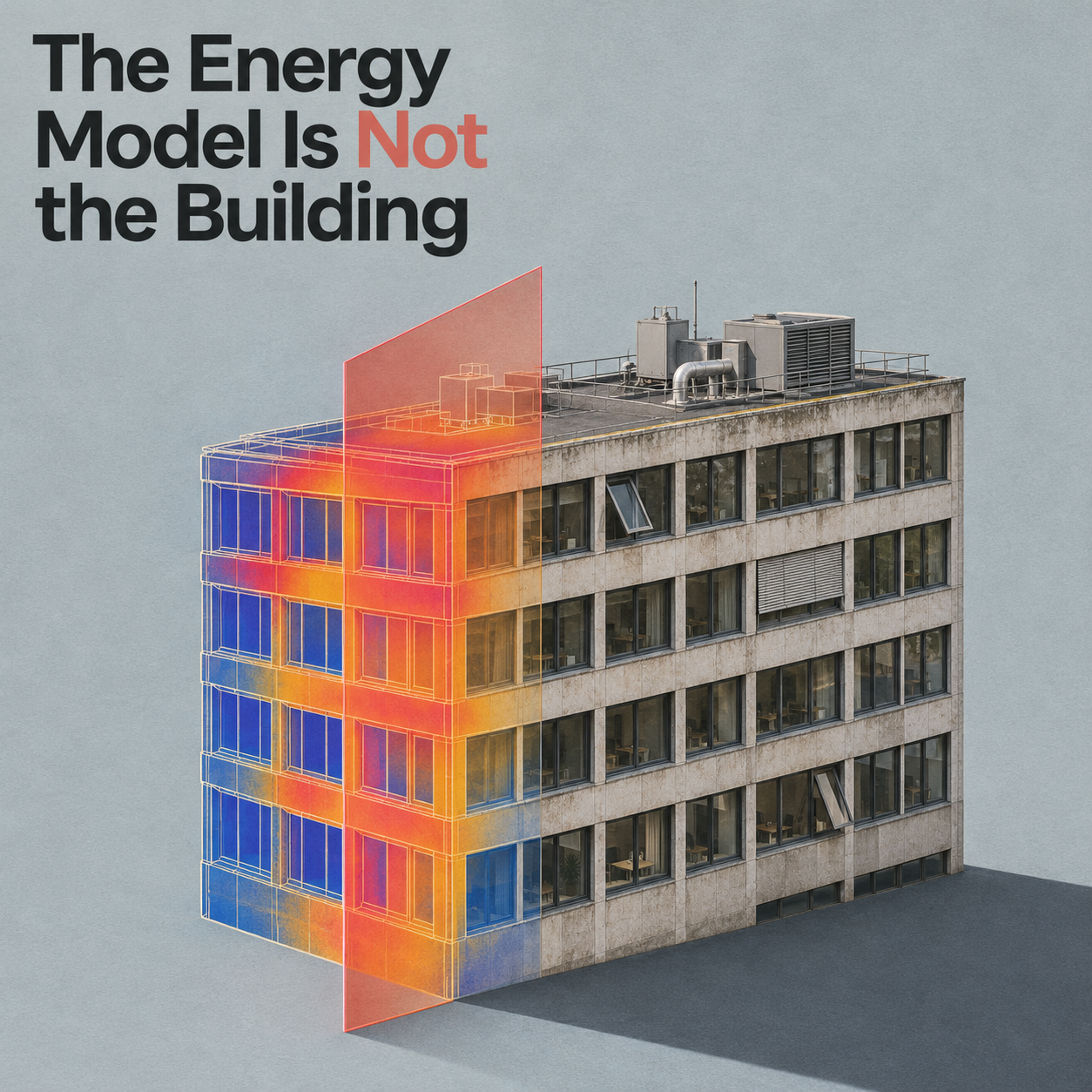
Simulated performance keeps missing measured reality. The gap is not a modelling failure, it is a signal about what the model structurally cannot see — and the most actionable feedback a designer has.
A building that is modelled to consume 100 kWh/m² a year routinely consumes 150, 180, occasionally twice as much once it is occupied. This is not a rumour that circulates between consultants. It has been measured, in large samples, across building types, for more than two decades. The question for designers is no longer whether a performance gap exists. It is what to do when the central instrument of low-carbon design keeps predicting the wrong number.
The evidence has been consistent for a long time
Pieter de Wilde’s 2014 framework paper in Automation in Construction synthesised the earlier literature and proposed a vocabulary for the different kinds of gap: modelling error, operational divergence, and the slippery category of unknown unknowns. Menezes and co-authors, in a study of non-domestic buildings published in Applied Energy, found predicted-to-actual ratios that varied so widely that any single mean figure flattens the real diversity beneath. A later review by van Dronkelaar and colleagues in Frontiers in Mechanical Engineering catalogued more than thirty causes grouped into design, construction, and operation stages. Earlier still, the PROBE studies and the Bordass–Cohen–Field “credibility gap” work in the early 2000s established the problem for commercial buildings in the United Kingdom before the regulatory frameworks that depend on simulation were put in place.
The literature is clear on one point. The gap is not one problem. It is a bundle of problems that end up in the same place.
What the gap reveals
Read carefully, the gap is a mismatch between what simulation models and what buildings do. Models assume occupancy that follows a weekday schedule. People open doors and prop them open, override thermostats, close blinds in the wrong direction. Models specify construction quality that site conditions rarely reproduce. Thermal bridges at junctions, membrane continuity at penetrations, airtightness at the fourth floor of a tower: each one is a line in a drawing and a judgement at ten in the morning by whoever is on the scaffold. Models treat control systems as if they will be commissioned, maintained, and respected. In most buildings they are set once, drift, and then persist, running on defaults no one authored.
Zou and co-authors, writing in Energy and Buildings, grouped the strategies for narrowing the gap into three categories that track this diagnosis: better modelling inputs, better delivery and handover, and better operational feedback. None of the three is new. What is new is the growing willingness in procurement to pay for the second and third.
Three consequences for practice
The first is epistemological. A single-point prediction treats a building as if it has one performance value. A building has a distribution. Scenario-based modelling, where occupancy, weather, and control assumptions are varied, produces a cloud of outcomes that reflects what a building might actually do once handed over. This changes the conversation with clients. Instead of defending a single number, the designer explains a range and the conditions under which the building will land toward its better edge.
The second is contractual. If the gap is driven by handover, commissioning, and operation, then a procurement model that ends the architect’s engagement at practical completion is structurally unable to close it. Outcome-based contracts, soft-landings processes, and post-occupancy evaluation written into the brief are not optional additions to a sustainability section. They are the mechanism by which prediction becomes information rather than marketing.
The third is material. Specifications written for performance values without being written for operability produce buildings that work on paper. A façade that depends on a motorised shading system assumes a maintenance regime. A heat-recovery unit assumes filter changes. A green roof assumes irrigation and inspection. When the specification does not name the maintenance obligation, the building degrades toward its worst-case prediction within a few years of occupation. The material choice and the operational contract are the same decision.
The limits of what the research can carry
Much of the published evidence comes from buildings where post-occupancy evaluation was done at all, which is a self-selecting sample. Residential and non-domestic gaps have different signatures and should not be averaged. Hot and arid climates, which dominate much of the construction activity along the Gulf coast, are under-represented in the datasets that shaped the first wave of the literature. The reported gap figures should not be imported without re-examination for climates where cooling, not heating, is the dominant load and where solar gains and envelope thermal mass behave differently from the UK and European cases that supplied the early data.
What is transferable is the method: compare predicted and measured, disaggregate the causes, feed the findings back to the next project. The method survives the climate; the numbers do not.
A reminder about the instrument
The energy model is a useful object. It is not the building. The distinction is not a criticism of simulation. It is a reminder of what a model is: a representation of assumptions, some of them held firmly, most held weakly. The gap is the space where those weakly held assumptions meet the world. Treated as a failure of the model, the gap is discouraging. Treated as a signal, it is the most actionable feedback a designer has — more useful than a certification plaque on the entrance wall and more honest than a brochure figure printed before anyone turned the building on.
✦ ArchUp Editorial Insight
The performance gap is not a reputational problem for architects to manage, and it is not a technical problem for the energy consultant to own alone. It is a governance problem embedded in how buildings are procured. As long as the economic incentive on designers and contractors ends at practical completion, no refinement of simulation inputs will close a gap whose causes are rooted in what happens after the ribbon is cut. A regulation that mandates simulation without mandating measurement treats prediction as compliance and leaves operation unregulated. ArchUp’s position is that measurement, not modelling, is the honest discipline — and that the briefs and contracts commissioned in this region over the next decade should carry that inversion on their first page.
References
- Bordass, B., Cohen, R., & Field, J. (2004). Energy performance of non-domestic buildings: closing the credibility gap. Proceedings, Improving Energy Efficiency in Commercial Buildings Conference, Frankfurt.
- de Wilde, P. (2014). The gap between predicted and measured energy performance of buildings: A framework for investigation. Automation in Construction, 41, 40–49. doi:10.1016/j.autcon.2014.02.009
- Menezes, A. C., Cripps, A., Bouchlaghem, D., & Buswell, R. (2012). Predicted vs. actual energy performance of non-domestic buildings: Using post-occupancy evaluation data to reduce the performance gap. Applied Energy, 97, 355–364. doi:10.1016/j.apenergy.2011.11.075
- van Dronkelaar, C., Dowson, M., Burman, E., Spataru, C., & Mumovic, D. (2016). A review of the energy performance gap and its underlying causes in non-domestic buildings. Frontiers in Mechanical Engineering, 1, Article 17. doi:10.3389/fmech.2015.00017
- Zou, P. X. W., Wagle, D., & Alam, M. (2019). Strategies for minimising building energy performance gaps between the design intent and the reality. Energy and Buildings, 191, 31–41. doi:10.1016/j.enbuild.2019.03.013
