The Architecture of Not Enough

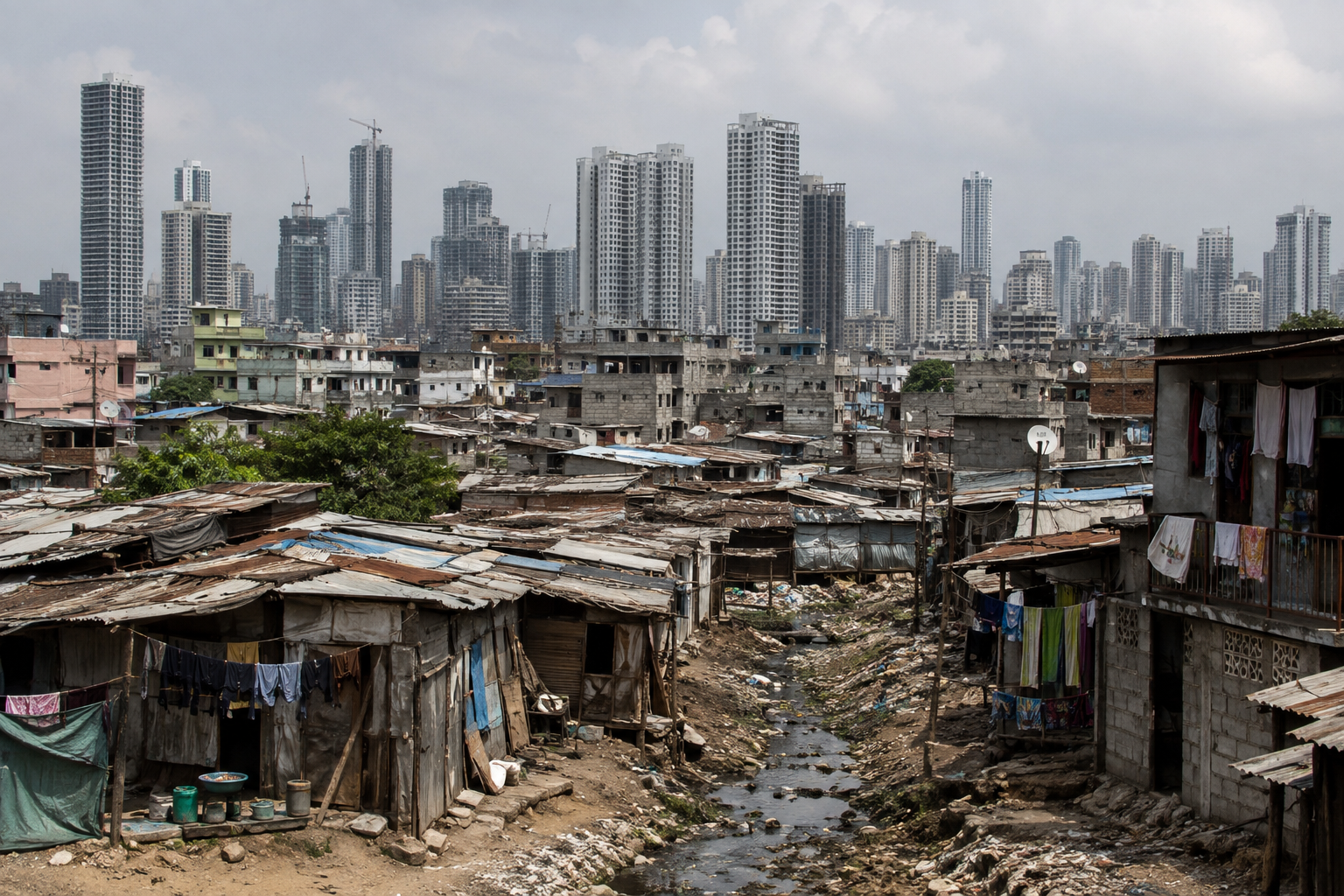
Architecture serves as an economic ledger for low-income families, reflecting and reinforcing their financial status. Land costs and tenure security dictate construction quality more than technical skill. Poverty shapes the built environment through incremental building, while design choices directly influence household health, developmental outcomes, and long-term financial stability.
Overcrowding, thermal inefficiency, and poor maintenance exacerbate poverty by impacting health and increasing energy costs. Effective policy requires minimum design standards and strategic location. Sustainable housing for the poor prioritizes structural integrity and flexible growth over immediate cost minimization to provide a foundation for future social and economic mobility.
There is a photograph I cannot forget, though I no longer remember where I first saw it. A house on a slope at the edge of a growing city, built in stages you could read like tree rings. A foundation of concrete block at the bottom, laid by someone who believed they would stay. Above it a course of fired brick, from a better year. Above that a wall of corrugated iron, from a worse one. And at the very top, weighted down with old tires against the wind, a roof of plastic sheeting, from the year the money ran out entirely. The house was a financial statement. Every material was a sentence about what the family could afford the season it was added, and the whole structure, read from bottom to top, was an autobiography of a household’s fortunes written in the only ink available, which was building material. That is the subject of this piece. Not architecture as art, and not architecture as luxury, but architecture as the most honest ledger a poor family ever keeps.
We usually discuss the relationship between wealth and building in one direction. The rich commission fine architecture, the poor make do. But the evidence describes something more unsettling and more circular. Poverty shapes the built environment, deciding where people live, what they build, how much space they occupy, and how their neighborhoods evolve. And then the built environment shapes poverty back, feeding its own conditions into household budgets, children’s health, educational outcomes, and the odds of ever escaping. Architecture is not a passive record of economic status. It is an active participant in whether that status improves or hardens, which means design is not downstream of poverty. It is one of the currents that keeps poverty in place, or lets it move.
What Poverty Builds
Begin with the force that shapes low income housing more than any other, and it is not a design decision at all. It is the price of land. Serviced land in central cities is scarce and expensive, so the urban poor are pushed either to hazardous ground, the marshland, the steep slope, the riverbank, the railway margin, the edge of the dump, or into informal tenure on land the formal market cannot price. The urban economics literature is careful to note that this is rarely a true physical shortage of land. It is a failure of the institutions that deliver land, restrictive regulation, unclear property rights, high transaction costs, that together make legal land unaffordable while informal markets supply it at prices the poor can actually pay, minus any security. This is the first and most consequential lesson, that the affordability of a home is set by the cost of land far more than by the cost of construction, which is why the clever cheap building technologies that engineers love have so rarely solved the problem. You cannot detail your way out of a land market.
From that constraint grows an entire architecture, and it is worth seeing it clearly rather than pitying it. More than seventy percent of housing investment in most developing countries is made by households themselves, and in many cities more than half the population lives in housing it built or informally produced. Poverty writes itself directly into how this housing rises. Families build incrementally, starting with whatever is cheap and to hand, cardboard, plastic, mud, reclaimed timber, and upgrade as savings allow, so the building grows the way income arrives, in fits and pauses. And the single variable that governs whether a family invests in something durable is not income. It is the perception of security. Where households believe they will not be evicted, they invest, adding brick facades, then upper floors, then rooms to rent. Where they expect the bulldozer, they rationally build nothing permanent, because permanence is a bet on a future the state has not promised them. In one squatter settlement in Kathmandu, more than eighty percent of houses had been consolidated into permanent brick and concrete. In a comparable settlement in Khulna, half remained temporary constructions of thatch and mud. The difference was not wealth. It was the confidence to believe tomorrow would arrive at the same address.
This produces something the vocabulary of the profession struggles to name, a resource constrained vernacular that is neither simply deprivation nor simply ingenuity but both at once. The same informal builders who use materials that offer little protection against storm, flood, and fire also develop genuinely intelligent low cost adaptations, raised plinths against flooding, overhead storage for when the water comes, perforated walls and large openings for ventilation in the heat, lanes and drains maintained by the community because no municipality will. Poverty does not only degrade design. It generates a distinctive design intelligence whose quality rises and falls with tenure, income stability, and any access to technical help. The tragedy is not that the poor build badly. It is that they build brilliantly under conditions that waste their skill.
The Ledger Turns Against Its Keeper
Now watch the relationship reverse, because this is where the architecture of poverty stops being a passive record and becomes an active cause. The clearest mechanism is overcrowding, which is not merely uncomfortable but developmentally corrosive. In Los Angeles County, more than half of children lived in crowded homes, four times the national rate, and rigorous panel research found that crowding independently lowered children’s reading and math scores, worsened their behavior, and damaged their physical health, even after controlling for the family’s socioeconomic status. Read that carefully. The crowding did harm beyond what poverty alone explained. The room itself, the simple fact of too many people in too little space, reached into a child’s cognition and future earnings. This is how a housing market condition becomes a hereditary one, transmitted through the plan of a dwelling into the life chances of the next generation. The cities that tolerate overcrowding are not merely housing the poor badly. They are manufacturing tomorrow’s poverty in the bedrooms of today’s.
The second mechanism is thermal, and it carries some of the sharpest numbers in the entire literature. Poor households occupy older, uninsulated, single glazed building stock, the least efficient shells available, and so they pay the most per square meter to stay warm or cool. Low income families in the United States carry an energy burden roughly three times that of other households, a quarter of them spending more than fifteen percent of their income simply on energy, against a national median near three percent, and in some European contexts the winter burden climbs far higher still. This produces the choice the literature bluntly calls heat or eat, and it is not rhetorical, since around thirty four million American households have reported cutting food or medicine, or sitting in unsafe temperatures, to pay an energy bill. The building is the cause. An inefficient envelope converts low income into cold, and cold into illness, and illness into medical cost and lost work, and the household that spends a tenth or more of its income on energy is measurably more likely to fall into poverty or stay trapped in it. The wall that was cheap to build becomes expensive to inhabit, forever, and the family pays the difference every month for the life of the building.
The third mechanism is the quiet violence of the unmaintained rental. Rental housing is systematically worse maintained than owner occupied housing, and poor tenants are structurally unable to force repairs. The research frames this through a subtle anatomy of power. There is visible power, the landlord who simply wins the dispute. There is hidden power, the grievance the tenant never voices for fear of retaliatory eviction or in the belief that complaint is futile. And there is invisible power, the most corrosive of the three, where the tenant no longer even experiences the damp, the mold, the cold, the unsafe wiring as a grievance at all, because their expectations have been lowered until substandard has become normal. This is how maintenance deficits persist in open defiance of legal standards. The poorest tenants, with the fewest alternatives, absorb conditions the law forbids, and they absorb them silently, because the machinery of complaint assumes a power they do not have. A housing code that depends on the victim to enforce it is a code written for someone else.
Whether Design Can Push Back
So can architecture actually reduce poverty rather than merely record it? The evidence supports a disciplined yes, provided we are honest about the conditions. A quasi experimental study in Ahmedabad compared women moved into new public housing with comparable women still waiting in the slums, and found large measured gains in structural quality, crowding, and services, and significantly better physical and mental health, with the physical quality of the housing statistically mediating the health improvement. The upgrade itself, not merely the selection of who received it, produced the benefit. Durability, ventilation, daylight, thermal comfort, all of these are modifiable building attributes with documented returns, and cheap proven measures, insulation, draught proofing, reflective roofs, passive cooling, deliver comfort while cutting the operating costs that trap poor households. In one case, passive standard social housing was built below the cost of comparable conventional low energy housing. Designing for low running cost is not a luxury layered onto welfare. It is welfare, delivered through the building envelope.
But the same evidence is unsparing about how design fails the poor, and the failures cluster around a few repeated mistakes. The most consistent is location. Public housing, sites and services schemes, and rental estates built on cheap peripheral land isolate residents from work and services and load them with transport costs that erase the savings on rent, which is precisely why the centrally located informal settlement so often outperforms the well meaning project on the edge of town. The second failure is standardization. Units designed to one size ignore the large family and recreate the crowding they were meant to cure. The third is the amputation of the social fabric. The Ahmedabad women who gained health in better buildings also lost the neighborhood networks that had sustained them, and in some cases the new housing reproduced the very hazards, poor ventilation, concealed wiring, that the upgrade was supposed to remove. Better material with worse community and identical hazards is not unambiguous progress. It is one deprivation traded for another.
The most hopeful finding, and the one most relevant to policy, is that minimum design standards function as a form of social protection. Where a jurisdiction imposed a comprehensive apartment design standard, quality rose even in the most disadvantaged neighborhoods, while where standards were absent, design quality followed a socioeconomic gradient, good where residents could demand it and poor where they could not. The standard is a distributive instrument. It protects the renter who cannot exit a bad building by making bad buildings harder to build in the first place, and it matters most for the poor precisely because they have the least power to negotiate quality for themselves. This is where serious architectural research earns its keep, not in the celebration of exceptional buildings but in the quiet proof that a floor under quality lifts the people standing lowest. The projects that reduce poverty are rarely the ones that win the awards or make the news, and almost never the ones a design competition would flag as innovative. They are serviced plots dimensioned for future growth, cores built with foundations strong enough to carry the floors a family will add over twenty years, standards that guarantee ventilation and space, and infrastructure financed for maintenance rather than only for the ribbon cutting.
There is a deeper point beneath all of this, and it reframes what sustainability should mean for the majority of the world’s builders. For the incremental self builder, the most sustainable act is a foundation and a staircase provision strong enough to carry a future the family cannot yet afford, because those are the costs that cannot be retrofitted, the leaps that a poor household can never make later. Designing for the poor is therefore mostly designing for time, building the expensive, invisible, structural generosity now so that the cheap, visible additions become possible later. It is the opposite of the developer instinct to minimize today’s cost, and it is the only design logic that treats a poor family’s future as real.
So the conclusion is harder and plainer than the usual sympathy. The architecture of poverty is not a lesser architecture practiced by people without taste. It is a rational, skilled, and often ingenious response to conditions the rest of us set, land markets we regulate, tenure we withhold, standards we decline to enforce, peripheries we exile people to. The poor do not build badly. They build exactly as well as we allow them to, and the wall of block and brick and iron and plastic is not a portrait of their failure. It is a portrait of ours, legible from the bottom up, to anyone willing to read a house as the ledger it has always been.
✦ ArchUp Editorial Insight
The wall of concrete block and fired brick and corrugated iron is not a design statement — it is a financial timeline, and the article’s most structurally precise contribution is its identification of tenure security as the primary variable governing whether a poor family invests in permanence, because that finding dissolves the assumption that informal construction is the product of poverty alone and replaces it with the correct analytical unit: the rational calculus of a household that will not build what the state has not promised to allow it to keep. The energy burden data — low-income families paying three times the rate of other households simply to maintain thermal conditions in the least efficient building stock — is the mechanism through which the cheap construction decision made at the developer or landlord level is converted into a permanent monthly tax on the family least able to pay it, and the article’s identification of this as a poverty transmission system rather than a housing quality problem is the reframing that matters most: the inefficient envelope is not a symptom of poverty, it is one of its causes, compounding across the lifetime of the building while the party who specified it has long since exited the asset, a pattern this archive has traced from The Hidden Cost of Breathing through Residential Deterioration through Architecture for Rent — in every case the same structural logic: the decision that minimizes today’s construction cost maximizes the lifetime cost to the occupant with the least power to have prevented it, and the building that results is not a portrait of the poor family’s failure but of the land market, tenure framework, and minimum standards regime that the rest of us designed, regulated, and in most jurisdictions have so far declined to change.
Ibrahim Fawakherji — ArchUp
Sources
- Foster S, Hooper P, Kleeman A, Turrell G. Are all apartments equal? An investigation of contemporary apartment design quality by neighbourhood level socioeconomic disadvantage. Urban Policy and Research, 2024, 42(2), 124 to 138.
- Bredenoord J, van Lindert P. Pro poor housing policies: rethinking the potential of assisted self help housing. Habitat International, 2010, 34(3), 278 to 287.
- Adamkiewicz G, et al. Environmental conditions in low income urban housing: clustering and associations with self reported health. American Journal of Public Health, 2014, 104(9), 1650 to 1656.
- Kolokotsa D, Santamouris M. Review of the indoor environmental quality and energy consumption studies for low income households in Europe. Science of the Total Environment, 2015, 536, 316 to 330.
- Turley R, et al. Slum upgrading strategies involving physical environment and infrastructure interventions and their effects on health and socioeconomic outcomes. Cochrane Database of Systematic Reviews, 2013.
- Chisholm E, Howden-Chapman P, Fougere G. Tenants’ responses to substandard housing: hidden and invisible power and the failure of rental housing regulation. Housing, Theory and Society, 2018, 37(2), 139 to 161.
- Mooya MM. Making urban real estate markets work for the poor: theory, policy and practice. Cities, 2011, 28(3), 238 to 244.
- Gan X, et al. Are migrant workers satisfied with public rental housing? A study in Chongqing, China. Habitat International, 2016, 56, 96 to 102.
- Wekesa BW, Steyn GS, Otieno FAO. A review of physical and socioeconomic characteristics and intervention approaches of informal settlements. Habitat International, 2011, 35(2), 238 to 245.
- Solari CD, Mare RD. Housing crowding effects on children’s wellbeing. Social Science Research, 2012, 41(2), 464 to 476.
- Parvin A, Mostafa A, Syangadan R. Disaster adaptive housing upgrading: insights from informal settlements in Bangladesh and Nepal. Journal of Housing and the Built Environment, 2023, 38(3), 2129 to 2149.
- Vaid U, Evans GW. Housing quality and health: an evaluation of slum rehabilitation in India. Environment and Behavior, 2016, 49(7), 771 to 790.
- Wang YP, Wang Y, Wu J. Housing migrant workers in rapidly urbanizing regions: a study of the Chinese model in Shenzhen. Housing Studies, 2010, 25(1), 83 to 100.
- Energy burden data: U.S. Department of Energy Low Income Energy Affordability Data (LEAD) Tool, and American Council for an Energy Efficient Economy (ACEEE) energy burden research.