Visible but Unreadable: Visual Crowding at Clinic Corridor Junctions

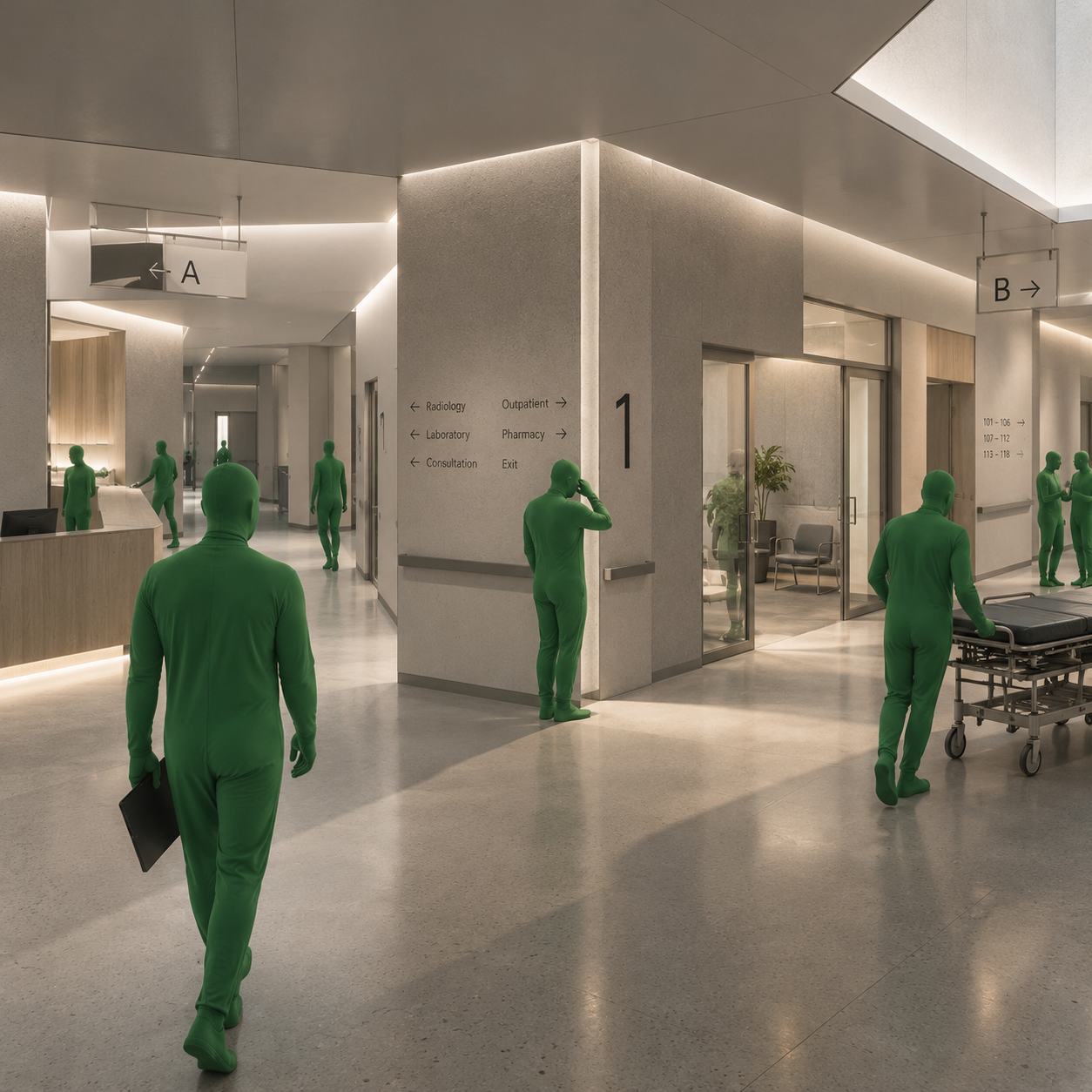
A visitor reaches a junction in an outpatient clinic. A directional panel shares the view with appointment notices, a promotional screen and several door labels. The project team has approved the panel’s typography, but an unresolved question remains: can a person approaching the junction identify the destination and choose the correct branch?
Visual crowding offers a way to investigate that question. ArchUp Research Lab proposes evaluating the directional panel together with its surroundings and the visitor’s approach. This is an architectural research proposal informed by vision science, with no field results yet and no claim that the proposed application is unprecedented.
What the original study established
Denis G. Pelli, Melanie Palomares and Najib J. Majaj published their study in Journal of Vision on 30 December 2004. Seven observers performed controlled visual tasks. Nearby letters disrupted peripheral identification more than simple detection; the affected spacing depended on distance from fixation. Many conditions used 200-millisecond presentations. These were laboratory measurements, not tests of people navigating buildings. Their proposed feature-integration explanation should be distinguished from the observed performance.
A consequential challenge: more elements can sometimes help
Mauro Manassi, Bilge Sayim and Michael H. Herzog reported a relevant challenge in Journal of Vision on 8 November 2013. Discriminating the offset of two short lines became harder inside a square, but improved when additional squares surrounded it. Changing the surrounding shapes changed performance. The authors argued for a role of perceptual grouping, challenging simple accounts in which additional neighbours necessarily worsen crowding. Their experiments did not establish a universal neural mechanism or a signage prescription.
The architectural hypothesis
Our proposed application is deliberately specific: the approach to a corridor junction in an outpatient clinic, before the visitor commits to a branch. The hypothesis is that reorganising nearby notices into a separate, coherent information area can improve destination identification while preserving the directional panel’s size, wording, contrast and position.
One test layout would leave the current notices in place. A second would redistribute the same notices across a clearly bounded bulletin area outside the immediate directional composition. A third would increase their separation from the panel without regrouping them. Keeping all messages available avoids confusing successful navigation with the simple removal of information.
These layouts test different interventions. If redistribution helps but separation alone does not, the result would justify investigating organisation more closely. It would still not demonstrate that a particular neural mechanism caused the improvement. If neither helps, the proposal has failed under those conditions and other explanations deserve attention.
A verification protocol before specification
- Define the decision. Select one junction, one approach and a set of destinations. Record where visitors first encounter the panel and where a wrong turn becomes possible. Include standing and seated viewing positions.
- Build comparable scenes. Use a full-scale mock-up or a controlled virtual model. Keep lighting, wording, sign dimensions and viewing distance consistent. Test moving screens separately rather than changing them alongside the notice layout.
- Separate recognition from navigation. First ask participants to identify a destination and its arrow from controlled views. Then run a separate walking task with free gaze. Eye tracking, when available, can establish whether a target was actually viewed peripherally. Without gaze measurements, describe the outcome as wayfinding performance, not proof of peripheral crowding.
- Control learning. Recruit people unfamiliar with the layout. Randomise or counterbalance conditions and vary destination tasks so repeated exposure does not hand participants the answer. Include older visitors and people with relevant visual or mobility needs; report their outcomes separately.
- Define success in advance. Use incorrect first turns as the main operational measure, with decision time, stopping and requests for help as secondary measures. Determine sample size from a pilot and a prespecified meaningful improvement; report uncertainty as well as averages.
A faster decision with more wrong turns would not count as a successful redesign. Nor would a result that improves the average while making navigation substantially worse for a subgroup. Report unsuccessful conditions alongside improvements.
Limits of the transfer
A visitor can move the eyes, turn the head, slow down or ask for help. The proposed field test must therefore evaluate those behaviours rather than importing a laboratory spacing ratio into a drawing. No clearance dimension in millimetres, guaranteed error reduction or universal layout rule follows from this proposal.
Arabic and English panels also need testing with their intended readers and actual wording. A result for one script, destination set or group of visitors cannot establish equivalence for another. Glare, poor translations, ambiguous arrows and physical obstruction remain competing explanations that the trial must record.
Any eventual design change should preserve required safety information and accessible routes. This proposal concerns routine clinic navigation; it has not been validated for emergency evacuation.
✦ ArchUp Editorial Insight
Fragmented responsibility can make institutional communication compete with the access it is meant to support. If signage, appointment notices and promotional screens are commissioned and approved separately, each component may satisfy its brief while their combined effect remains untested. The research raises a governance question: who controls the information surrounding a directional sign after handover, and what triggers renewed review? Where approval ends at installation, subsequent changes can transfer the work of resolving ambiguity to visitors and the staff they interrupt. Any resulting delays would have to be measured; the laboratory studies establish neither their scale nor this institutional explanation. The same dependence on changing conditions underpins ArchUp’s proposal that inspection records lose their current validity when the work they describe changes: an approval cannot establish performance under conditions it never assessed. For clinic management, this suggests assigning responsibility for the whole decision scene and retesting it after relevant changes, rather than treating every additional notice as an isolated communication task. The proposed comparison matters because it could test whether reorganising unchanged information improves navigation. Corridor layout and signage placement then become the spatial expression of a prior institutional choice: whether responsibility follows individual objects or the visitor’s complete route.
References
- Denis G. Pelli, Melanie Palomares and Najib J. Majaj. Crowding is unlike ordinary masking: Distinguishing feature integration from detection. Journal of Vision, 2004.
- Mauro Manassi, Bilge Sayim and Michael H. Herzog. When crowding of crowding leads to uncrowding. Journal of Vision, 2013.