The Meal Arrives. Who Designed Its Last Mile?

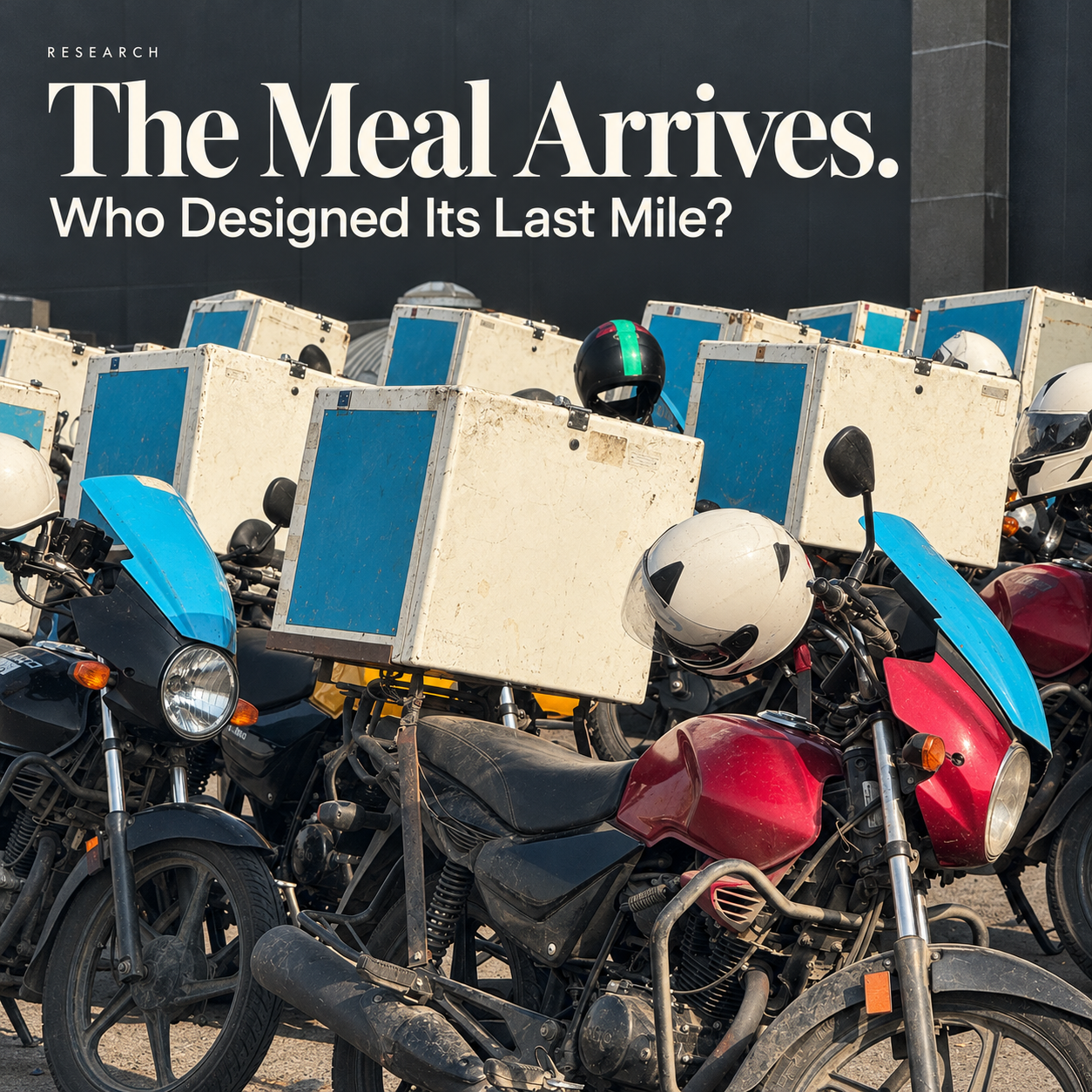
App-based food delivery relies on urban spaces beyond roads, creating planning challenges across collection, transit, and building access points. Rather than just speeding up transit, effective interventions require spatial and operational changes at pickup counters, waiting areas, and residential entrances to reduce delays while protecting rider safety and food hygiene.
Urban design proposals must account for dark kitchen activity, environmental heat exposure, and reusable container return routes. A comprehensive evaluation framework tests these interventions through localized pilots, assessing rider working conditions, public space usage, and waste generation alongside delivery efficiency.
A meal is ready, but the rider cannot stop outside the restaurant. The rider arrives, but the order is still being packed. The journey ends at an apartment tower, but the meal waits again while security contacts the resident. On a screen, these events collapse into a moving dot and an estimated arrival time. On the ground, they occupy counters, pavements, kerbs, shaded corners and building entrances.
Food delivery makes a demanding claim on the city: a prepared meal must move through several independently managed spaces while remaining suitable to eat. The final journey is therefore a planning problem as well as a dispatch problem. The relevant question is not simply how to make the motorcycle faster. It is how to remove avoidable waiting without transferring its cost to the rider, the pedestrian or the meal.
This research review focuses on app-based delivery of prepared food. It connects published evidence on hygiene, delivery-only kitchens, rider heat exposure and packaging with Ibrahim Joharji’s Last Meal article on ArchUp and the INJ Architects research of the same name. It develops a proposed framework for evaluating the journey from restaurant handover to residential receipt.
From Last Meal to an operational planning question
Joharji’s article places the delivery window within an architectural sequence: collection, movement and entry into buildings. Its accompanying ArchUp editorial commentary draws attention to the dignity of workers using spaces routinely treated as secondary. This provides a useful starting point for treating couriers as recurring building users rather than unexpected visitors. [1]
The INJ Architects project proposes pickup interfaces, designated waiting areas, parking and support facilities. These are design proposals, not an adopted statutory code or independently demonstrated performance standard. This review extends that spatial proposition by asking how each intervention would change measurable food-delivery conditions. [2]
The distinction matters. A new hatch may shorten the exchange but leave the rider waiting in full sun. A generous waiting bay may improve pedestrian clearance while masking chronic kitchen delays. A receiving lobby may reduce elevator trips but leave meals unattended. Each intervention needs an operating rule and a performance question.
The meal has a clock before the vehicle moves
For planning purposes, the interval between a meal becoming ready and its receipt can be divided into four parts:
Ready-to-receipt time = pre-collection holding + handover + travel + destination access.
This is a proposed accounting framework, not a food-safety model. Time alone cannot establish whether a meal is safe; food type, temperature history, packaging and handling also matter. Its purpose is to reveal where delay occurs. A short drive can sit inside a long overall journey.
Consider a hypothetical order: eight minutes on a collection shelf, four at handover, twelve on the road and six entering the destination. The total is thirty minutes. Reducing road travel by 20% saves 2.4 minutes. Reducing shelf holding to four minutes and destination access to two saves eight minutes without asking the rider to travel faster. These invented values illustrate a design comparison, not measured industry averages or a promised result.
The implication is practical: record when the meal is ready, when custody changes and when the recipient receives it. Arrival at the map pin should not be mistaken for completion of delivery. In a tower, the last few metres may contain doors, reception procedures, lifts and an uncertain handover.
The pickup counter is part of the food-handling chain
Byrd and Wang’s 2025 study explicitly examines delivery workers through a food-safety knowledge, attitudes and practices model. It brings the courier into the food-handling discussion rather than treating restaurant exit as the end of responsibility. Limon’s pandemic-period Philippine study surveyed 751 home-based online food handlers and reported inadequate practices, including shortcomings in observed behaviour. That context should not be generalized to all restaurants or countries. [3,4]
For architectural design, the useful question is whether the layout makes the intended procedure feasible. Can staff verify an order without placing it on a dirty surface? Can insulated bags be handled without blocking the customer entrance? Can hot and cold components follow their appropriate handling arrangements? Is there an accessible hygiene facility, and who maintains it?
A proposed pickup zone should distinguish packing, controlled holding and transfer. It should have cleanable surfaces, legible order identification and a defined cleaning responsibility. Returned containers should follow a separate dirty route. These spatial provisions support a food-safety procedure; they do not replace training, operational controls or validation by competent food-safety personnel.
A sealed bag can indicate interference, but it cannot reveal an unsuitable temperature history. Equally, an insulated carrier cannot compensate for indefinite waiting. A delivery radius should therefore be tested against the complete journey and the actual menu, rather than selected only as a circle on a map. This article proposes no universal distance or temperature threshold.
A restaurant without seats still produces street demand
Hakim and colleagues screened 22,520 app-listed establishments in three Brazilian cities. A manually examined sample, after exclusions, contained 2,682 food-service establishments; 727, or 27.1%, were classified as dark kitchens. The percentage belongs to that evaluated sample, not the entire initial list. Nor does classification as a dark kitchen establish a failure of inspection or food safety. [5]
The planning lesson is that customer seating is an incomplete proxy for activity at a food premises. A kitchen with no dining room can still generate repeated collections, waste movements, loading and staff trips. Conversely, several online brands may use one production address. Counting storefronts or app names alone can misrepresent the physical demand.
A food-delivery assessment should identify the actual kitchen, its peak collection rate, dispatch arrangements and relationship to neighbouring entrances. The operational unit is the place where meals and riders meet. That remains true whether the app presents one brand or ten.
Size the waiting space from waiting, not from a leftover corner
A simple queueing relation offers an initial estimate under reasonably stable operating conditions: average riders present equal the arrival rate multiplied by average time spent at the location. It describes an average, not the capacity needed during a surge.
For illustration, sixty rider arrivals per hour with a six-minute average stay imply six riders present on average. Reducing that stay to three minutes implies three. The example assumes a steady flow; simultaneous restaurant peaks, batched orders and uneven arrival patterns require observation and additional capacity. It is not a parking standard.
This suggests two complementary design tasks. Provide safe, accessible space for the expected collection activity, and reduce avoidable dwell time through kitchen readiness and clear handover. Expanding a bay without improving dispatch can simply accommodate a larger queue. Improving dispatch without protecting a pedestrian through-route can still leave dangerous conflicts.
The boundary between private restaurant operations and public pavement deserves explicit agreement. Who funds the waiting provision? Who keeps it clear? Can a neighbouring business still receive customers? A delivery window should not function by quietly borrowing the entire footway.
Shade belongs in the delivery network
Jiang and colleagues used thermal modelling and rider GPS trajectories in Nanjing to examine heat exposure. Their evaluated mitigation measures produced reductions of 15.5% in transient and 13.2% in cumulative heat stress. These are case-specific model results, not guaranteed reductions for another city. Mean radiant temperature, used in this research, should also not be confused with ordinary air temperature. [6]
The planning response is to map where riders actually spend time, including collection queues. A shaded route offers limited relief if the next pickup requires a long exposed wait. Shelter should be evaluated at the hours of operation and paired with usable rest arrangements. A roof on a drawing is not evidence that the occupied area is shaded at lunchtime.
For a pilot in Jeddah or Riyadh, the appropriate next step would be local measurements and observation across representative hot periods. The Nanjing percentages should not be imported as local forecasts. Rider rest also needs platform support: infrastructure has little value if a worker is penalized for using it.
Delivery speed cannot be separated from working conditions
Useche and colleagues’ review includes 32 studies covering 38,682 last-mile workers. Its scope is broader than food delivery alone, so those totals cannot be presented as a food-courier sample. It nonetheless provides a relevant occupational context for examining time pressure, workload and safety. [7]
In a food-delivery pilot, measure restaurant delay and building-access delay separately from travel. Otherwise a late kitchen can become a rider’s apparent failure. A planning intervention should not be declared successful merely because the displayed arrival time improves while rest opportunities decline or dangerous stopping increases.
A fair evaluation would ask whether the same service can be delivered with fewer conflicts, shorter unmanaged waits and less pressure to compensate on the road. Responsibility must follow the controllable part of the process: kitchen readiness belongs to the restaurant, dispatch incentives to the platform, and access arrangements to the building operator.
The last metre inside the building
Food differs from an ordinary parcel in how it should be received and held. A generic locker or unattended reception shelf is not automatically suitable for a hot meal, chilled dish or mixed order. A receiving facility needs an agreed operating procedure appropriate to the food and the duration of storage.
Three arrangements can be tested: direct handover to the resident at an accessible entrance; managed receipt with suitable controlled holding; or authorized access to the apartment door. Each distributes waiting differently. The choice should consider residents who cannot come downstairs, building security, staffing and the route taken by the courier.
Designing a receiving point therefore means designing a service, including notification, identification and responsibility for uncollected orders. A decorative shelf without a responsible operator simply relocates the uncertainty.
The return journey of the container
Jang and colleagues estimated 72.93 thousand tonnes of plastic packaging consumed by Korean online food delivery in 2020. Their life-cycle comparison favoured multi-use containers overall among the assessed alternatives, while identifying a substantially higher terrestrial ecotoxicity burden. The result argues for evaluating the whole system rather than choosing a material by its appearance. [8]
Zhou and colleagues modelled Chinese takeaway packaging scenarios in which shared tableware could reduce waste by up to 92%. That is scenario potential, not an observed saving guaranteed wherever reusable containers are introduced. Collection, washing, losses and repeated use determine whether a local system can approach its intended benefit. [9]
Our planning proposal is to treat container return as a distinct route: return point, dirty storage, collection, washing, clean storage and redistribution. Dirty returns must not cross the clean meal-handover surface. A shared return point serving several food outlets may be worth testing, but only if responsibility, cleaning capacity and transport are specified. A reusable container with no convenient return network can become a heavier disposable one.
Food demand does not end at the doorstep
Rahman and colleagues used cross-sectional data from 1,042 Indonesian university students to examine delivery-platform use and food waste. They reported higher waste with more frequent use, discussing over-ordering, portion mismatch and promotions. The design and population limit causal and geographical generalization. [10]
Halloran and colleagues also frame meal-delivery apps as part of the digital food environment, raising questions about health and the choices offered to consumers. This is a reason to assess the meals made accessible, not to assume that every delivered meal is nutritionally poor. [11]
For a neighbourhood pilot, delivery count is therefore an insufficient measure of benefit. Record unwanted food separately from packaging, and consider whether portions, minimum-order incentives and access costs affect use. The objective is a reliable meal service, not maximum movement of bags.
A pilot that can test the spatial argument
The following framework is proposed by ArchUp Research Lab. It is an extension for evaluation, not a validated Last Meal index or an adopted code.
| Location | Proposed intervention | Measure | Operating responsibility |
|---|---|---|---|
| Restaurant handover | Separate packing, holding and transfer | Ready-to-collection time; handling deviations | Restaurant |
| Waiting area | Shelter and a clear pedestrian route | Exposed waiting minutes; obstruction events | Property operator and street authority |
| Delivery route | Assess safer stopping and heat exposure | Journey duration; conflicts; thermal exposure | Street authority and platform |
| Residential entrance | Defined, accessible receipt procedure | Arrival-to-receipt time; failed handovers | Building operator and resident |
| Container return | Separate dirty return and clean distribution | Return rate; completed reuse cycles; washing inputs | Container-system operator |
Begin with a small group of restaurants and their receiving buildings. Observe a baseline, introduce one coordinated package of changes, and compare similar operating periods while recording demand, weather and staffing. Include rider interviews and pedestrian observations. Track median and upper-percentile delays so a good average does not hide repeated severe waits.
Do not compress these measures into a single impressive score before testing their reliability. A faster journey cannot cancel an unresolved food-handling problem, and a high return rate cannot erase unsafe rider access. Keep the outcomes visible separately.
ArchUp Research Lab analysis
Last Meal’s architectural proposition becomes most useful when it changes what a project brief asks for. The delivery interface needs a place, a responsible operator and a way to judge its performance. The same principle continues along the route: waiting space, residential access and container return are parts of the service rather than incidental gaps between transactions.
The city should not measure food delivery only from the consumer’s saved minutes. It should also examine the time spent by the worker, the public space occupied and the resources consumed after the meal is eaten. A well-designed last mile removes avoidable friction while keeping those costs visible. Its achievement is a meal received reliably, a rider able to work with dignity and a street that continues to serve everyone else.
Method and limits: This is a focused narrative review and planning synthesis based on the supplied research material, checked publication records and accessible primary-source documentation. It is not a systematic review, local field survey or food-safety certification. The numerical examples and pilot framework are editorial proposals. Last Meal is attributed to Ibrahim Joharji and INJ Architects; it is discussed here as a design research contribution. General parcel-delivery systems are outside this article’s scope.
References
- Joharji, Ibrahim. Last Meal: Unveiling the Delivery Window Architects, Why Have We Been Silent? ArchUp, 2025. Architectural commentary.
- INJ Architects. Last Meal. Architectural research and proposed design guidelines, 2025; project documentation consulted October 2026.
- Byrd, K.; Wang, L. (2025). Are Food Delivery Workers a Food Safety Risk? An Evaluation Using the Integrated Food Safety Knowledge, Attitudes, and Practices Model. International Journal of Hospitality Management, 131, 104305.
- Limon, M. R. (2021). Food Safety Practices of Food Handlers at Home Engaged in Online Food Businesses during COVID-19 Pandemic in the Philippines. Current Research in Food Science, 4, 63–73.
- Hakim, M. P., et al. (2023). Exploring Dark Kitchens in Brazilian Urban Centres: A Study of Delivery-Only Restaurants with Food Delivery Apps. Food Research International, 170, 112969.
- Jiang, L.; Wang, J.; Castaño-Rosa, R.; Zhong, C.; Cao, S.-J. (2024). Heat Exposure and Coping Strategies for Food Delivery Riders under Urban Heat Extremes. Energy and Buildings, 322, 114693.
- Useche, S. A., et al. (2025). The Human Cost of Fast Deliveries: A Systematic Literature Review of Occupational Risks and Safety Outcomes in Last-Mile Delivery Workers. Journal of Transport & Health, 44, 102133.
- Jang, Y.; Kim, K. N.; Woo, J. R. (2023). Post-Consumer Plastic Packaging Waste from Online Food Delivery Services in South Korea. Waste Management, 156, 177–186.
- Zhou, Y., et al. (2020). Sharing Tableware Reduces Waste Generation, Emissions and Water Consumption in China’s Takeaway Packaging Waste Dilemma. Nature Food, 1, 552–561.
- Rahman, M. S., et al. (2025). Do Online Food Delivery Platforms Contribute to Food Waste? Evidence from Indonesian University Students. Food and Humanity, 5, 100886.
- Halloran, A., et al. (2022). The Cost of Convenience: Potential Linkages between Noncommunicable Diseases and Meal Delivery Apps. The Lancet Regional Health – Europe, 12, 100293.