Architectural Design for Twenty Dollars

Ibrahim Fawakherji — ArchUp
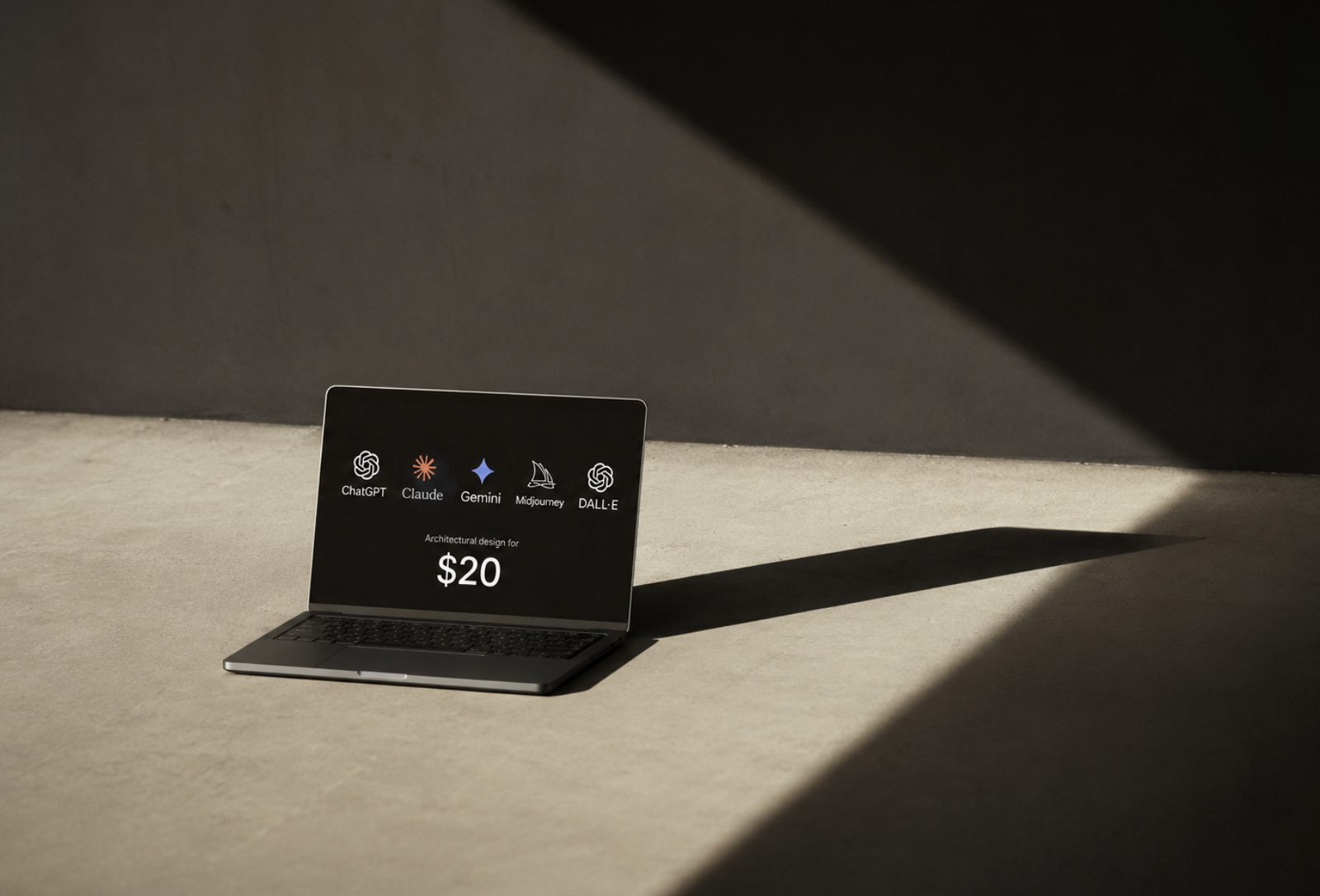
A few days ago I was watching one of the Arab economic channels. An analyst was speaking with considerable confidence about the coming end of cheap AI subscriptions. His exact words were close to: prepare yourselves, the twenty-dollar monthly plan will not last much longer.
I will be honest with you. I do not build my professional opinions on television commentary, particularly when it touches technology markets or equities. Analysis in that space mixes easily with personal interest, with the desire to move a stock price, with the mechanics of creating a media cycle around a particular investment thesis. So I turned off the program and started researching the question myself.
What I found was more interesting than the original claim.
The numbers that have been circulating in the technology press deserve to be looked at directly, without drama and without dismissal.
Uber consumed its entire 2026 AI budget within four months. By March of this year, 84 percent of its engineers were using Claude Code in their daily work, and approximately 70 percent of the company’s code was being written with AI assistance. The company’s own leadership acknowledged that the dramatic increase in token consumption had not produced a proportional increase in the value of the final product. More spending, not obviously more output.
At NVIDIA, the vice president of deep learning stated publicly that compute costs for his team had exceeded the cost of the employees themselves. This is worth pausing on. The company that sells the infrastructure for AI acknowledged that the infrastructure now costs more than the people using it.
One company, which has been discussed in technical circles without being formally named, accumulated a Claude usage bill of 500 million dollars in a single month because no consumption limits had been set. Token management, which sounds like a technical detail, became an executive financial crisis.
Gartner projects that global spending on AI agent software will reach 207 billion dollars in 2026, within a total technology spending environment of 6.31 trillion dollars, representing a 13.5 percent increase over the previous year. AI is the primary driver of that growth.
Against this, a study from MIT found that AI automation is economically viable in approximately 23 percent of jobs dependent on computer vision. In 77 percent of cases, the human being remains the cheaper option.
These numbers do not tell a single story. They tell a complicated one, which is why they are worth knowing.
I have been practicing architecture for more than twenty years. I wrote recently about missing the render, about the V-Ray era and the hours of waiting for a single image. Today I can generate dozens of visual concepts in minutes. I will say clearly that AI has raised my productivity in ways I did not anticipate and would not want to reverse.
But there is a question I have started asking myself that is separate from whether the tools are useful.
What happens to the economics of architectural practice if the cost of these tools increases by a factor of ten?
If the twenty-dollar subscription becomes two hundred dollars, and the professional-grade access that large firms require reaches a thousand dollars per seat per month, what changes? The tools do not change. The outputs do not change. What changes is the cost structure of every practice that has built its workflow around these tools. And that cost will eventually appear somewhere. In project fees. In staffing decisions. In the viability of small practices relative to large ones.
We are not Uber. We are not NVIDIA. But we are practitioners who now run significant portions of our daily work through cloud infrastructure we do not own, at prices set by companies whose primary obligation is not to the architectural profession.
There is a second issue that I find genuinely disorienting, even though I understand why it exists.
The tools keep changing.
When I worked with AutoCAD I knew AutoCAD. When I moved to SketchUp for modeling I knew SketchUp. When V-Ray became my rendering environment I invested time in understanding it deeply, and that investment returned value over years. The relationship between the practitioner and the tool had a kind of stability that made expertise possible.
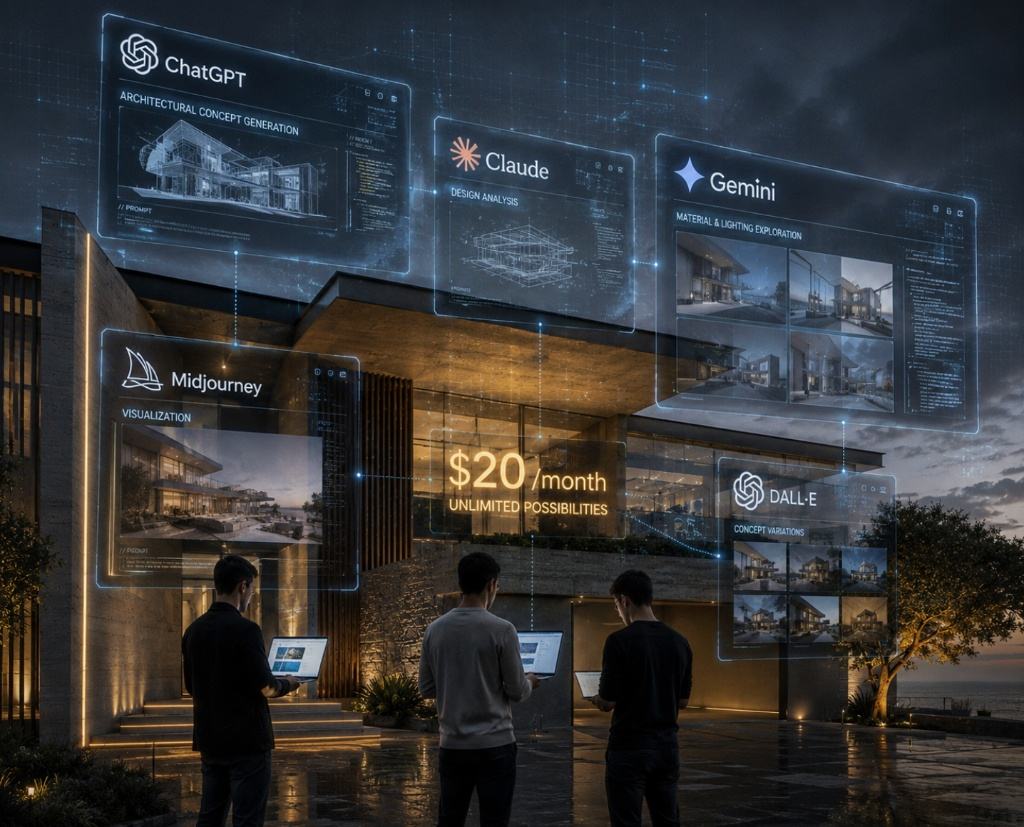
Now: GPT, then DeepSeek, then Gemini, then back to GPT, then Claude, then a new model, then a new version, then a new interface, then an announcement that the previous workflow is deprecated.
The innovation is real. The competition between platforms is genuinely producing better tools. I am not arguing against any of it.
But there is a legitimate professional need for stability that the current environment does not address. A practitioner needs to build expertise on a platform, not spend a meaningful portion of every month deciding which platform to be on this week. The architect who is constantly migrating between tools is not deepening their capability. They are spending cognitive resources on logistics that should be going into design.
The old software ecosystem, for all its cost and complexity, gave you something the current one does not: a workflow you could trust to be there in the same form next quarter.
There is a question underneath all of this that I have been reluctant to state directly, but which I think deserves to be said.
For years, architectural practices, publications, research institutions, and individual practitioners have been producing written knowledge and making it accessible. ArchUp alone has published thousands of articles, analyses, and documented projects. Across the industry, the accumulated textual and visual record of architectural thought represents an enormous body of human knowledge.
The AI systems that are now embedded in professional practice were trained on this material. Not on a small sample of it. On the full scope of what human beings wrote and published and shared across decades of internet-accessible content. The 500,000 bots that visit ArchUp websites in one day are not browsing for entertainment. They are feeding training pipelines.
This is not a conspiracy. It is how the technology works and it has been largely understood as such.
But the economic question that follows is legitimate. Human practitioners contributed to building the knowledge base that these systems learned from. Those practitioners are now being asked to pay monthly subscriptions to access systems built on their collective output. If those subscription prices increase significantly, the people who contributed most to the training data, the active practitioners who document their work and publish their thinking, will face the largest relative cost increase.
I am not claiming this is wrong. I am saying it is a structural condition of the current moment that deserves to be named clearly, because it affects how the profession should think about its relationship to these platforms going forward.
The architectural profession has absorbed many tool transitions. The drafting table gave way to CAD. CAD gave way to BIM. BIM is now being supplemented by AI. Each transition changed the economics of practice, redistributed competitive advantage, and required practitioners to rebuild portions of their workflow.
What makes the current transition different is not the magnitude of the change. It is the ownership structure.
When you bought AutoCAD, you owned a license. The tool was yours, within the terms of the agreement, for the period you paid for. When you subscribe to a cloud AI service, you own nothing. The capability exists as long as the subscription continues, at the price the platform sets, under the terms the platform determines, with the limitations the platform chooses to impose.
This is a different relationship between the practitioner and the tool than anything the profession has previously navigated. It is worth understanding clearly before building a practice model that depends entirely on its continuation.
My position has not changed on the fundamental question. AI is not a threat to the architectural profession. It is a tool, and like every tool that preceded it, its value is determined by the quality of judgment directing it.
The practitioner who uses AI to accelerate the mechanical aspects of work, the documentation, the visualization, the information retrieval, while retaining their own capacity for spatial judgment, site reading, client understanding, and design decision-making, is using the tool correctly. The practitioner who has allowed AI to replace those capacities rather than support them has created a dependency that will be difficult to sustain if the economics shift.
The twenty-dollar subscription may last for years. Or it may change next quarter.
The architectural eye, the ability to read a site and understand what it needs, the capacity to hold a complex spatial problem in the mind and move through it systematically, the judgment about what a building owes to the people who will inhabit it: these are not available on any subscription model.
They are built over years, through practice, through error, through the accumulation of real decisions made under real conditions.
That is what survives when the platform changes its pricing.
✦ ArchUp Editorial Insight
The twenty-dollar subscription is not a pricing anomaly that the market will eventually correct upward — it is a deliberate land-acquisition strategy, the digital equivalent of a developer offering below-market rents during the period required to achieve tenant lock-in, after which the exit cost of relocating exceeds the cost of absorbing the price increase. The architectural profession is currently in the lock-in phase: workflows have been rebuilt, muscle memory has been retrained, and the cognitive cost of platform migration now functions as the same invisible barrier that keeps tenants in buildings whose rents have quietly exceeded the market rate they originally accepted. The article’s most structurally significant observation — that practitioners contributed the knowledge base on which these systems were trained and are now being asked to pay subscription fees to access the derivative of their own collective output — is not a grievance but a precise description of an extraction model, one that mirrors what The Dematerialization of the Studio identified as the foundational shift: the conversion of professional tool ownership into permanent operational dependency, where the platform retains the asset and the practitioner retains only the license to use it, at terms that will be renegotiated at the moment the switching cost makes renegotiation unnecessary.