The Internalized Jury: Overcoming Academic Trauma and Creative Paralysis in Architecture Practice

Staring at a blank CAD screen or an empty roll of tracing paper without being able to draw a single line is a terrifying experience known to almost every architect and interior designer. In our professional culture, we call it “blank page syndrome” or a design block. However, contemporary psychological research reveals that this creative paralysis is rarely a mere “lack of inspiration.” Rather, it is often the culmination of maladaptive perfectionism, harsh self-criticism, and a specific form of trauma that typically begins in the jury rooms of architecture schools and persists into highly competitive professional studios.
The Root of the Paralysis: The Trauma of the Architectural Jury
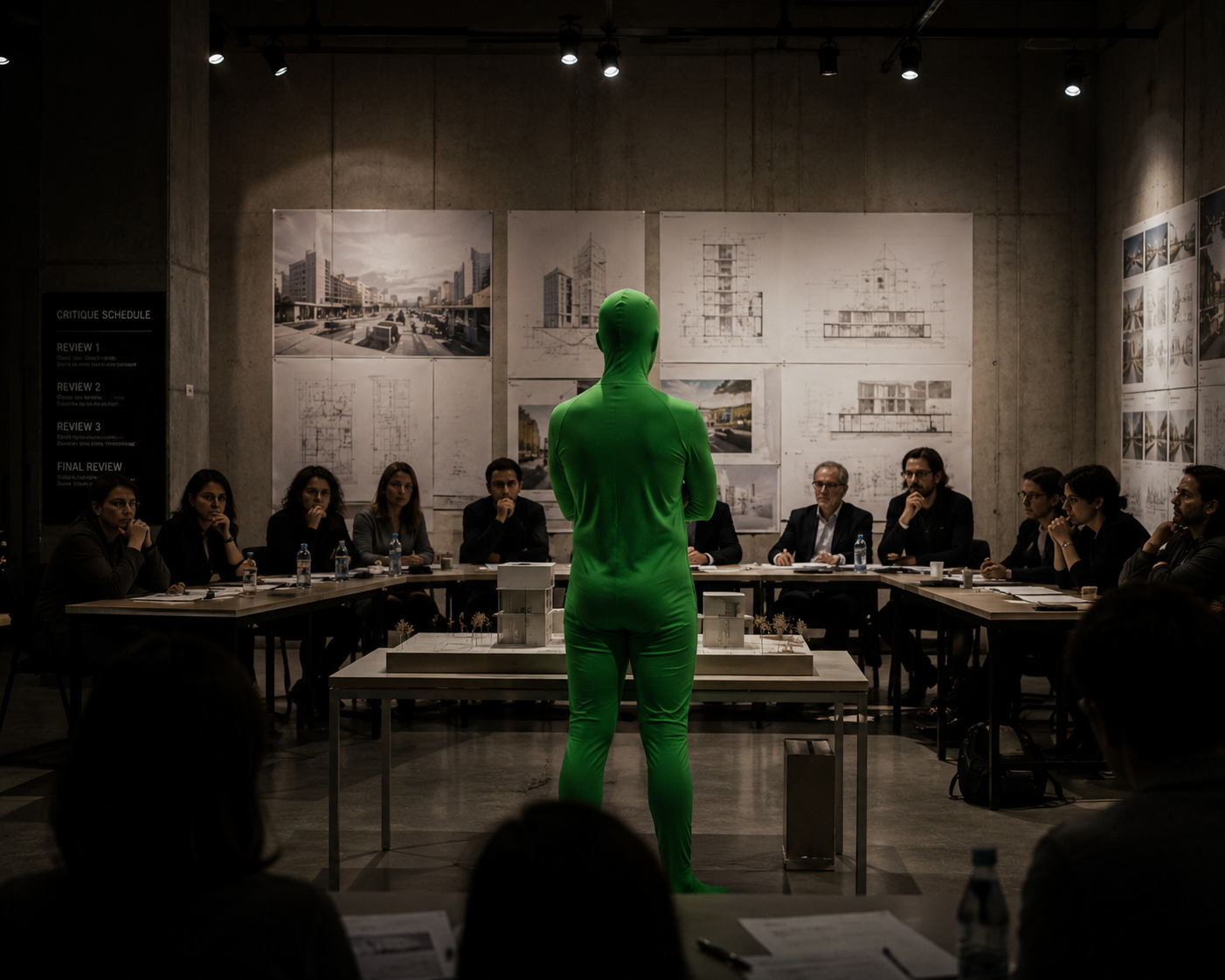
Public juries and pin-ups are obligatory rites of passage in design education, theoretically intended to train students to defend their ideas and receive constructive criticism. In practice, however, these sessions frequently devolve into harsh trials where a critic’s success is measured by their ability to dismantle a student’s confidence alongside their project.
Psychologically, this environment fosters what researchers identify as the roots of narcissistic trauma. In a toxic jury setting, a student’s identity is rarely separated from the quality of their design. Critique directed at a building massing is internalized as a judgment on the student’s intellect or human worth. Compounded by the glorification of sleep deprivation (charette culture), the student arrives at the jury in a state of extreme physical and emotional fragility. Public humiliation in this vulnerable state teaches the developing designer a dangerous lesson: exposing one’s creative inner world guarantees rejection and shame.
Professional Consequences: The “Safe Design” Syndrome
The psychological scarring that begins in academia actively reshapes an architect’s creative capacity and communication style in professional practice. This trauma manifests in several destructive ways:
- The Internalized Critic: The harsh academic juror becomes an internalized voice. Perfectionism morphs into a maladaptive concern where the architect believes, “If this conceptual draft isn’t flawless immediately, it is worthless.” This fear preemptively paralyzes the mind to avoid potential shame.
- Aversion to Creative Risk: A designer who has endured repeated academic trauma often defaults to “safe and boring” design choices. The fear of brutal rejection kills the spirit of experimentation. Instead of exploring innovative spatial solutions, the architect produces exactly what they know will appease the client or the design director, desperately avoiding any risk that might place them on the defensive.
- Extreme Defensiveness: Toxic critiques teach students that design is a battle to be won, not a collaborative problem-solving process. In a professional setting, this translates into architects who are highly defensive when receiving feedback from structural engineers or clients. Every requested revision is perceived as a personal attack, effectively sabotaging cross-disciplinary BIM workflows.
- The Cycle of Abuse: Graduates who survived ruthless juries often adopt the same behavior when they become Project Managers or Art Directors, subconsciously believing that cruelty is what forged their success. This perpetuates a toxic workplace culture, leading to high burnout and turnover rates.
The Three Emotional Systems of the Studio
To decode this paralysis, we can map Hammond’s model of emotional regulation onto the architectural studio:
- The Drive System: “I must win this competition or dazzle the client to prove my competence.”
- The Threat System: “This spatial layout is terrible; I will be exposed as an amateur and rejected.”
- The Soothe System: “I enjoy the process of massing and exploring spatial relationships, regardless of the final product.”
In creative paralysis, the Threat system completely hijacks the architect’s mind. The evidence-based solution is the deliberate activation of the Soothe system by reframing design as an act of problem-solving and expression, rather than an arena for self-validation.

Evidence-Based Practices to Restore Creative Flow
To break free from this paralysis, psychological literature recommends several practices that can be integrated into daily studio life:
- Reclaiming “Play” Over “Product”: Research shows that creativity crushed by rigid standards can be restored by abandoning end-goals. In architecture, this means temporarily stepping away from 3D rendering software and returning to physical massing models (clay or cardboard) or charcoal sketching with zero intention of showing the results to a client or director. Separating the act of “making” from the pressure of “evaluation” reconnects the designer with the foundational joy of composition.
- Self-Compassion as an Engineering Tool: Studies demonstrate that speaking to oneself kindly during a creative block completely eliminates originality deficits in highly self-critical individuals. When a complex floor plan fails to resolve, instead of accusing oneself of incompetence, the architect must acknowledge that design is inherently an iterative process and that stumbling is a natural phase of the profession.
- Designing Safe Studio Communities: Isolation magnifies creative paralysis. Sharing “unfinished work” in safe environments mitigates performance pressure. In architectural firms, this requires cultivating a collaborative pin-up culture focused on inquiry (“What if we tried this path?”) rather than aggressive interrogation (“Why did you do this?”).
The Core Principle of Change: Feedback must be formulated around “how the building behaves” rather than “how the designer thinks.” Replacing the statement “Your design is illogical” with “How will this corridor handle peak user circulation?” entirely shifts the dynamic from a personal attack to an objective spatial challenge.
Perspective Producing humane architecture requires, first and foremost, psychologically healthy architects. The architectural studio should be the safest space to commit intellectual errors and discuss them, not an arena for settling scores or flexing a critic’s ego. Today’s engineering and design firms desperately need professionals with mental agility, effective communication skills, and collaborative spirits—qualities that are entirely dismantled if educational institutions continue to graduate architects permanently haunted by the “blank page” and the fear of others’ judgments. It is time to shift our industry paradigm from a “trial by jury” to a “collaborative laboratory.”
✦ ArchUp Editorial Insight
The architectural jury is not a pedagogical instrument that occasionally malfunctions — it is a labor formation mechanism that functions precisely as designed, producing a specific psychological profile in graduates: high tolerance for sleep deprivation, practiced defensiveness under public scrutiny, and an internalized authority figure whose approval governs creative decisions long after the academic institution has been left behind. The charette culture the article correctly identifies as a contributing condition is not an accidental byproduct of demanding standards; it is the outcome of a professional socialization model that deliberately conflates physical endurance with intellectual seriousness, borrowing from military and surgical training environments the assumption that stress inoculation produces resilience rather than, as the psychological literature now confirms, maladaptive perfectionism and creative constriction. What the profession reproduces through this system is not excellence but compliance — an architect conditioned to preemptively self-censor in the direction of the imagined juror, which is structurally identical to what Who Really Builds Our Cities identified as the public planner’s false deference to the mega-developer: in both cases, an actor with genuine agency performs powerlessness before an authority whose dominance is partly institutional and partly internalized, and the built environment that results — cautious, defensive, optimized for approval rather than inhabitation — is the spatial consequence of that psychological formation, produced before a single brick is laid or a single site is zoned.
Credits / References
- Ringel, S. (2016). The Role of the Creative Process in Holding and Facilitating Traumatic Experience. Contemporary Psychoanalysis.
- Frantz, G. (2016). Creativity and Healing. Psychological Perspectives.
- Feldmann, T. B. (1989). Creativity and narcissism. The Arts in Psychotherapy.
- Vecchione, M., et al. (2023). The associations between grandiose narcissism and perfectionism. Personality and Individual Differences.
- Elise, D. (2002). Blocked Creativity and Inhibited Erotic Transference. Studies in Gender and Sexuality.
- Zabelina, D. L., & Robinson, M. D. (2010). Don’t Be So Hard on Yourself: Self-Compassion Facilitates Creative Originality. Creativity Research Journal.
- Benjamin, E. (2018). The creative artists support group. Person-Centered & Experiential Psychotherapies.
- Hammond, K. (2020). Threat, drive, and soothe. Higher Education Research & Development.
- Merrell, R. S., et al. (2011). Emergent themes in the writing of perfectionists. Psychotherapy Research.