The Architecture of the Afterlife
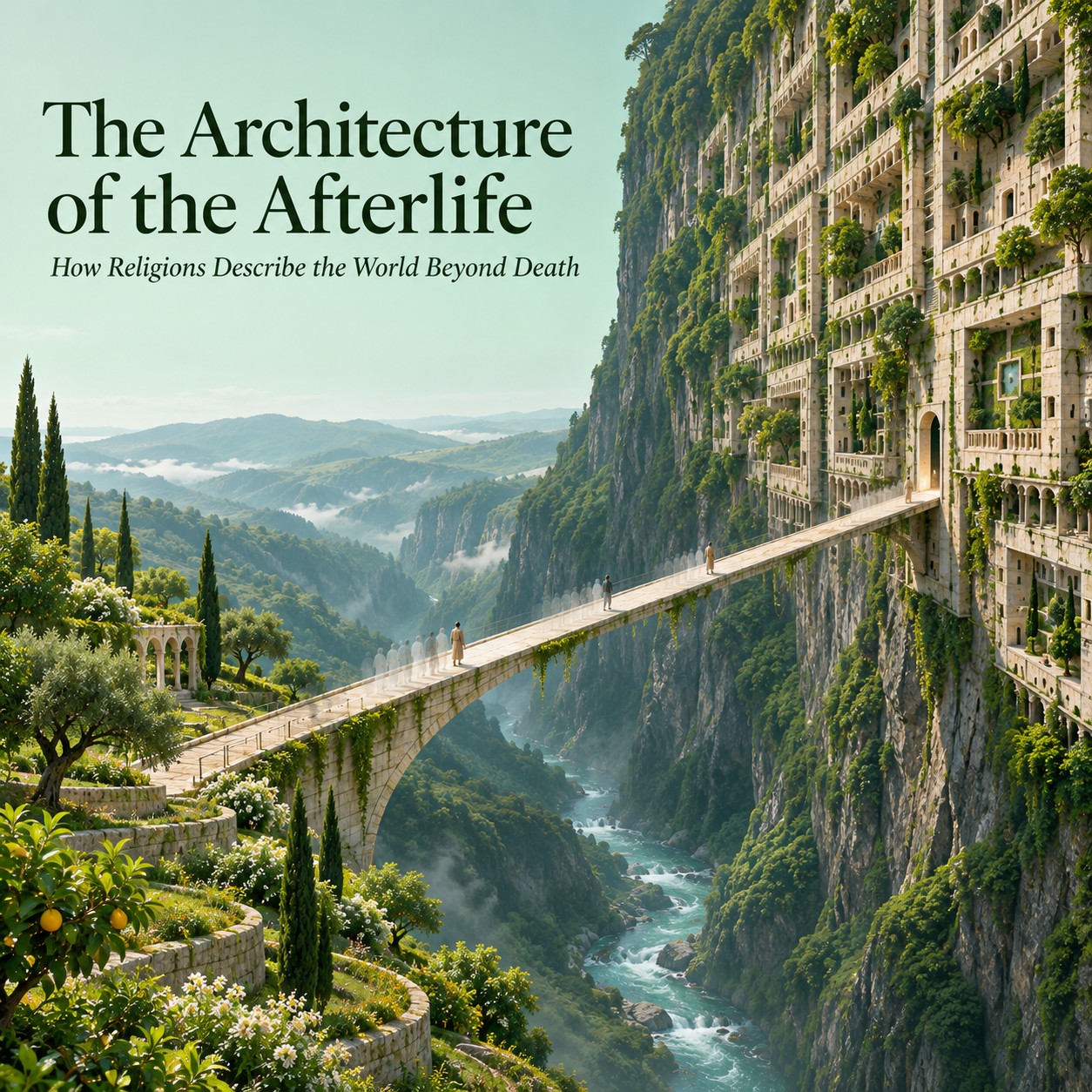
Religious traditions describe the afterlife through varied motifs, such as gardens, measured cities, mountains, and bridges. Rather than literal blueprints, these descriptions function as theological poetics, visions, and allegories that convey divine order, moral accountability, and cultural values.
Across traditions, shared elements include structural thresholds, vertical realms, symbolic materials, and moral judgment. Despite these commonalities, traditions disagree on the nature of the soul and eternity. Ultimately, these spiritual concepts inspired earthly sacred architecture to express meaning and human hope.
Begin with a warning, because it is the first finding and it governs everything after it. There is no single architecture of the afterlife. The descriptions the world’s religions have left are not building specifications, and to read them as blueprints is to misread every one of them. They are revelation, liturgy, vision, poetry and law, and their genre decides how literally their walls and gates and rivers should be taken. What follows is therefore not a set of plans but a careful walk through a shared repertoire, gates, rivers, gardens, cities, mountains, jewels, fire and darkness, used by different traditions to say profoundly different things. The aim is description and quotation, so that the picture assembles itself in the reader’s eye, and the aim is also precision, because in matters of belief a careless word is a kind of damage. This is a study for anyone who cares about architecture as a carrier of meaning, for the afterlife is the place where building and belief have always met most intensely.
Islam: the Garden described in glimpses, amplified in tradition
The Qur’an names two realms, al janna, the Garden, and al nar, the Fire, and it describes the Garden in swift glimpses rather than in plans. It is “gardens beneath which rivers flow,” and the rivers are of water, of milk whose taste does not change, of wine delicious to the drinkers, and of purified honey. There are fountains, among them Salsabil and al Kawthar, there is shade and there are date palms and pomegranates and vines, and at the boundary near the throne stands the Sidrat al Muntaha, the Lote Tree of the farthest limit. The materials are precious, gold and silver and pearl, and the dwellers wear silk and fine brocade and recline upon raised couches. What the Qur’an gives is abundance, coolness, purity and nearness to God. What it does not give is a dimension, a street plan, or a sequence of construction, and this restraint is itself significant and must be respected.
The precision the subject demands requires a clear line here. The famous architectural detail comes not from the Qur’an but from the hadith and the later tradition, which amplify the scriptural landscape. One well known tradition describes the Garden as built of “a brick of gold and a brick of silver, its mortar is fragrant musk, its pebbles are pearls and rubies, and its soil is saffron.” The Lote Tree grows so vast that a rider might travel a hundred years in its shade. It is in the eschatological manuals of later centuries that Paradise receives its most building like form, eight gates and eight ascending levels each assigned to a category of the saved, the sixth and highest being al Firdaws, and the Tuba tree given roots of pearl and a trunk of ruby. The scholars of Islam debated at length whether these rewards are to be understood literally or as the created imagery of a bliss beyond description, and the responsible position reports that debate rather than silencing it. The sound reading is that the Qur’anic text is allusive, that the manuals’ architecture is reverent amplification and not a revealed building code, and that the imagery is at once a promise of real reward and a language of divine favor, purity and abundance. Any treatment that flattens this into a literal set of measurements distorts the tradition it claims to describe.
Christianity: the city measured with a golden rod
Where Islam gives a garden in glimpses, the Christian imagination gives a city, measured and foursquare. The vision belongs to Revelation, where John sees “the holy city, the new Jerusalem, coming down out of heaven from God.” Its wall is jasper, its twelve foundations are adorned with every kind of jewel, its twelve gates are each a single pearl, and “the street of the city was pure gold, like transparent glass.” An angel measures it with a golden rod, and it is a perfect cube, twelve thousand stadia in length and breadth and height, its gates named for the twelve tribes and its foundations for the twelve apostles. There is no temple in it, “for the Lord God Almighty and the Lamb are its temple,” and it needs no sun or moon, “for the glory of God gives it light.” Through its center runs “the river of the water of life, bright as crystal,” and the tree of life grows on either bank, bearing twelve kinds of fruit, “and the leaves of the tree were for the healing of the nations.”
The numbers here are theology, not surveying, twelve upon twelve upon twelve, the cube as the ancient sign of perfection, and the early commentators were uneasy with readers who wanted the gold and pearls too literally. Recent scholarship has shown something subtler, that the city deliberately mirrors and democratizes the luxury construction of the Roman elite, the gold leaf and jeweled walls and glassy floors and indoor gardens of the imperial palace, so that the wealth once hoarded by the few is given to all the faithful. The reception of this image shaped the church building itself as a figure of heaven on earth, the dome as the vault of the sky, the apse as the heavenly court, the mosaic program as the ordered cosmos, and the jeweled chapel walls read as the New Jerusalem made visible in stone and glass.
Judaism: reticence, and a vision of five chambers
The Hebrew Bible is strikingly reticent. Sheol is a shadowed place of dust and silence, not a city, and the rabbinic tradition speaks of Gan Eden for the righteous and Gehenna for the wicked within the larger idea of the world to come, but it offers no single authoritative plan. The most architectural Jewish vision is medieval and explicitly visionary, the Vision of Rabbi Joshua ben Levi, in which Paradise is divided into five chambers each with a custodian, the first of glass and cedar, the second of cedar and silver, the third of silver and gold for the patriarchs and the righteous kings, the fourth of olive wood for those whose lives were embittered, and the fifth of precious gems and gold and silver and onyx, where the Messiah reclines. Hell in the same text is seven houses overseen by historic sinners. This is ethical and communal allegory in the material language of precious substances, graded nearness to God rendered as rooms, and it is honest to label it so, a twelfth century composition and not a Talmudic blueprint, because Jewish views of the hereafter were always plural and changing.
Hinduism and Buddhism: the measured cosmos and the mind made prison
The Indian traditions give the most vast and most precisely numbered otherworlds, and they place them on a cosmic vertical centered on Mount Meru, the world mountain broader at its summit than its base, crowned by the cities of the gods and undercut by the regions of the infernal. The Purana literature enumerates and measures the hells with astonishing specificity, twenty one in one text, twenty eight in another, eighty four in a third, with Raurava two thousand leagues wide and strewn with blazing coals, the next twice its size and filled with molten copper, the sword leaf forest of Asipatravana vast beyond it, and the river Vaitarani of blood surpassing all in horror. The epic descent describes “a dark path covered with hair and moss, with flesh and blood, with worms and insects,” a plain of iron rocks, a river of boiling water, iron jars of boiling oil. Yet these hells are temporary, karmic stations measured in enormous spans of years from which the soul is at last released and reborn, which is a theology of justice utterly unlike an eternal sentence.
Buddhism inherits this cosmos and gives it iron architecture, eight great hot hells beneath the southern continent, Avici itself twenty thousand units deep and wide, each hell set behind an imposing gate so that hell becomes, in the words the scholarship uses, a punitive city with impregnable walls and demonic guards. The palace of the judge Enma has four iron gates, and within it a Pristine Crystal Mirror reflects every deed. And yet the same tradition insists that this topography is also mind made, comparing the heart to “a skilled painter” whose own dark karma paints the iron walls, and in the esoteric reading hell is revealed to be the Pure Land itself once insight tears it open. This double register, concrete place and ontological illusion at once, is the heart of Buddhist afterlife design, and it produced in turn the Pure Land of Amitabha in the west, with its jeweled trees and lotus ponds, a soteriological refuge rather than a city to be copied. The architectural inheritance is immense, for the temple is built as Meru and the stupa as the world axis, its dome the vault of heaven, its tiers the heavens above, so that Borobudur is at once a mountain and a mandala.
Zoroastrianism: the bridge that narrows
The Zoroastrian afterlife is organized around a threshold, the Chinvat Bridge that spans the abyss. For the righteous it broadens into an easy crossing and a beautiful maiden, the personification of their own good deeds, leads them across into Infinite Light. For the wicked it narrows until it is “thinner than a hair and sharper than a razor,” and they fall headlong into a hell that the Pahlavi books describe as “below, deep, underground, most dark, most fetid and most terrible, narrow, a pit.” The most detailed infernal tour in the tradition devotes the great majority of its chapters to hell. And yet, decisively, this hell is temporary. At the end of time a river of molten metal will flow over the earth, the righteous passing through it as through warm milk and the wicked as through molten metal, until all are purified and “everybody will eventually reach paradise.” The parallels this tradition shares with later Islamic imagery, the razor bridge and the Sirat, the scales and the mizan, the intermediate station and the A’raf, are noted by scholars as selective borrowing and modification rather than simple identity, and the careful word is parallel, not origin.
Egypt, Greece and Mesopotamia: journey, meadow, and house of dust
The older civilizations complete the repertoire. Egypt gives not a map but a journey, the Duat through which the sun travels at night, a landscape of gates and doors and paths and mounds and caverns, and the funerary texts repeat that these doors are “open” for the deceased. The tomb itself is built as a microcosm of this journey, arranged on levels corresponding to earth and sky and underworld, so that the architecture is not a picture of the otherworld but a working model of it, a passage. Greece gives Hades as a house with gates that the dead must cross, its shades recognizable yet untouchable, Odysseus reaching three times for his mother who slips away “like a shadow or a dream,” its space structured by the rivers Styx and Acheron and Pyriphlegethon. But Greece also gives Elysium, not a city at all but a blessed meadow, where Pindar sings that “the force of the sun shines below during the night here, and in meadows of red roses their suburb is shaded, laden with golden fruit,” fragrant and musical. Mesopotamia gives the bleakest vision of all, the house “where those who enter are deprived of light, where dust is their food and clay their bread, where they see no light and dwell in darkness, and are clothed like birds with feathers.” There is no jeweled palace here and no celestial city, only the Land of No Return, though the grave goods buried across its history, the tools and games and furniture, quietly suggest a people who hoped for more than the poems allowed.
What recurs, and what divides
Across this range certain patterns recur with remarkable consistency, and they are worth naming because they are the deep grammar of the subject. The threshold is nearly universal, for almost every tradition sorts its dead at a gate, a bridge, a river or a wall, the Egyptian doors, the Greek gates of Hades, the Zoroastrian Chinvat, the Islamic Sirat and eight gates, the Christian twelve gates, the Hindu southern gate of Yama. Verticality is nearly universal, heavens above and hells below with graded levels of nearness to the divine. Water and vegetation stand for life, the rivers and gardens of the blessed, inverted in hell into boiling rivers and rivers of blood or no water at all. Precious materials function as theology rather than luxury, gold and pearl and gem as a grammar of incorruptibility and radiance, answered in hell by iron and fire and filth. Measurement itself is a theological act, the cube and the league and the gate expressing that the other world is ordered and not chaotic. And almost everywhere the afterlife is a moral audit, the Egyptian weighing of the heart, the Zoroastrian scales, the Islamic mizan, the mirror of Enma, the Christian book of life. The temples and tombs that followed are built in this grammar, the church as the city, the temple as the mountain, the tomb as the journey.
But the differences are not decorative, and honesty forbids dissolving them into a single interfaith heaven. The traditions disagree on the person who survives, bodily resurrection and continued identity in Islam and Christianity and Judaism and Zoroastrianism, rebirth without a permanent self in the Indian traditions, a shadow in Homer, and in Egypt a complex of faculties that does not map onto the modern word soul at all. They disagree on time, the eternal destinies of the dominant Islamic and Christian readings against the temporary and purgative hells of Hinduism and Buddhism and Zoroastrianism. They disagree on whether the imagery is literal or symbolic, and they disagree on whether there is a city at all, the strong celestial cities of Islam and Christianity against the Greek meadow, the Egyptian journey and the Mesopotamian house of dust. These are different theologies of divine justice and human destiny, and to treat them as one is to describe none of them faithfully.
The lasting lesson, the one that matters most for the built world, is that genre matters more than motif. A Qur’anic verse, a prophetic tradition, a medieval vision, a Purana’s hell list, a Japanese scroll, a Pahlavi treatise, a tomb inscription, a philosopher’s myth and a Sumerian epic are not the same kind of evidence, and each describes the afterlife in order to shape this life, to console, to warn, to purify, to teach. The gardens and cities and mountains that the living then built, the chahar bagh and the Alhambra and the Taj Mahal, the domed church and the jeweled chapel, Borobudur and Angkor and the pyramids, were never attempts to reproduce the other world. The garden is a promise, the temple a vehicle, the tomb a passage, the church an image. The cities that carry these forms still carry their meanings, and the most serious architectural research into sacred space now reads them as theological poetics rather than as failed engineering. The architecture news will keep treating the great religious monuments as feats of construction and the design competitions will keep admiring their forms, while the deeper truth waits underneath, that the projects which have outlasted every empire were attempts to say, in stone and water and light, what the world ought to be and what a human being ought to become. The architecture of the afterlife is in the end a language of ultimate order, and the genuine sustainability of the monuments it inspired lies not in their materials but in the fact that each generation still reads its own hope into their gates. Description can assemble the picture, and quotation can preserve the words, but the final meaning of these gardens and cities belongs to the belief that raised them, and must be approached with the care that belief deserves.
✦ ArchUp Editorial Insight
This piece touches sacred belief across many living traditions, and its own governing discipline is the correct editorial posture for that material: it opens by refusing to read revelation as blueprint, insists that genre decides how literally a wall or gate or river should be taken, and holds the line throughout between scripture and later amplification — the Qur’anic Garden given in allusive glimpses while the brick of gold and the eight ascending gates belong to the hadith and the medieval manuals, the Christian city’s twelve-upon-twelve numbering named as theology rather than surveying, the Jewish five chambers labeled honestly as a twelfth-century vision and not a Talmudic plan. That scrupulous separation is not incidental, because the essay’s central architectural claim depends on it: these descriptions were never attempts to reproduce the other world but theological poetics, and the chahar bagh, the domed church, Borobudur and the pyramids were built in their grammar without ever being their reproduction — the garden a promise, the temple a vehicle, the tomb a passage, the church an image. The most structurally useful observation is the deep repertoire the comparison exposes, that the threshold is nearly universal — almost every tradition sorts its dead at a gate, a bridge, a river or a wall — and that measurement itself functions as a theological act, the cube and the league asserting that the other world is ordered rather than chaotic, which is the same recognition this archive reached in Masjid al-Haram, that sacred geometry is a carrier of meaning before it is a solution to a problem. Where the essay earns its authority is its refusal to dissolve difference into a single interfaith heaven, naming plainly that the traditions disagree on who survives, on whether the sentence is eternal or purgative, on whether there is a city at all — a careful even-handedness that treats each theology as itself rather than flattening all into none. The durable lesson, and the one that belongs to this archive’s long argument, is that genre matters more than motif and that the monuments which outlasted every empire were attempts to say in stone and water and light what a human being ought to become, their real sustainability lying not in their materials but in the fact that each generation still reads its own hope into their gates — the final meaning, as the piece rightly concedes, belonging to the belief that raised them and approached with the care that belief deserves.
ArchUp Research Lab — ArchUp
Sources
- Rustomji N. Early Views of Paradise in Islam. Religion Compass, 2010.
- Moss CR, Feldman LM. The New Jerusalem: Wealth, Ancient Building Projects and Revelation 21 to 22. New Testament Studies, 2020.
- Perry MJ. Jewish heaven, Christian hell: Rabbi Joshua ben Levi’s vision of the afterlife. Journal of Medieval History, 2017.
- Gardiner E, editor. Hindu Hell, 2013.
- Hirasawa C. The Inflatable, Collapsible Kingdom of Retribution: A Primer on Japanese Hell Imagery and Imagination. Monumenta Nipponica, 2008.
- Ossa-Richardson A. Yearning for immortality: The European invention of the ancient Egyptian afterlife. Intellectual History Review, 2025.
- Gazis GA, Hooper A, editors. Aspects of Death and the Afterlife in Greek Literature, 2021.
- Yazdani N, Lozanovska M. The design philosophy of Edenic gardens: tracing the Paradise Myth in landscape architecture. Landscape History, 2016.
- Mąkosa PM. Between Faith and Art: Representations of Heaven in the Italian Iconography of the Final Judgement. Medieval Mystical Theology, 2022.
- Mabbett IW. The Symbolism of Mount Meru. History of Religions, 1983.
- Sompura PO, Dhaky M, Chanchani N, Patel D. A Temple for Ascending to Heaven. Art in Translation, 2010.
- Marchman KR. The changing Buddhist landscape: Anxiety and the development of Pure Land Buddhism in medieval China. The Australian Journal of Anthropology, 2025.
- Stausberg M. Hell in Zoroastrian History. Numen, 2009.
- Akbar A. The Zoroastrian Provenance of Some Islamic Eschatological Doctrines. Studies in Religion, 2019.
- Zago S. The Otherworld within This World: Imhet as a Natural Conduit between Dimensions in Egyptian Sources. Journal of Near Eastern Studies, 2022.
- Barrett C. Was Dust Their Food and Clay Their Bread? Grave Goods, the Mesopotamian Afterlife, and the Liminal Role of Inana and Ishtar. Journal of Ancient Near Eastern Religions, 2007.