ATRIUM Car Garage Inspired by Möbius Strip Design

Reframing the Function of the Garage
This project addresses the concept of the Architecture of the garage beyond its traditional function of merely storing cars, presenting automobiles as display elements closer to museum exhibits. Instead of focusing on pure utilitarian performance, the relationship between space and its contents is redefined from a perspective of exhibition and visual organization.
Integration with the Architectural Context of the Estate
The Buildings is located within a private estate on the outskirts of Moscow, originally developed in the early 2000s by the ATRIUM studio and comprising a country mansion and a guest house. Within this context, the garage does not appear as an isolated project but as an architectural extension of an existing system, maintaining the same language of integration with the surrounding forest environment.
Functional Multiplicity and Interior Spatial Organization
The building is not limited to storage functionality; rather, it combines several uses within a single architectural volume, including a car exhibition space, a home gym, a meeting area, as well as a relaxation zone and auxiliary rooms such as a changing room and ski equipment storage. This multiplicity reflects a tendency toward integrating diverse programs into a single flexible spatial organization, a concept often explored in Interior Design.


Engineering Concept: Möbius Strip
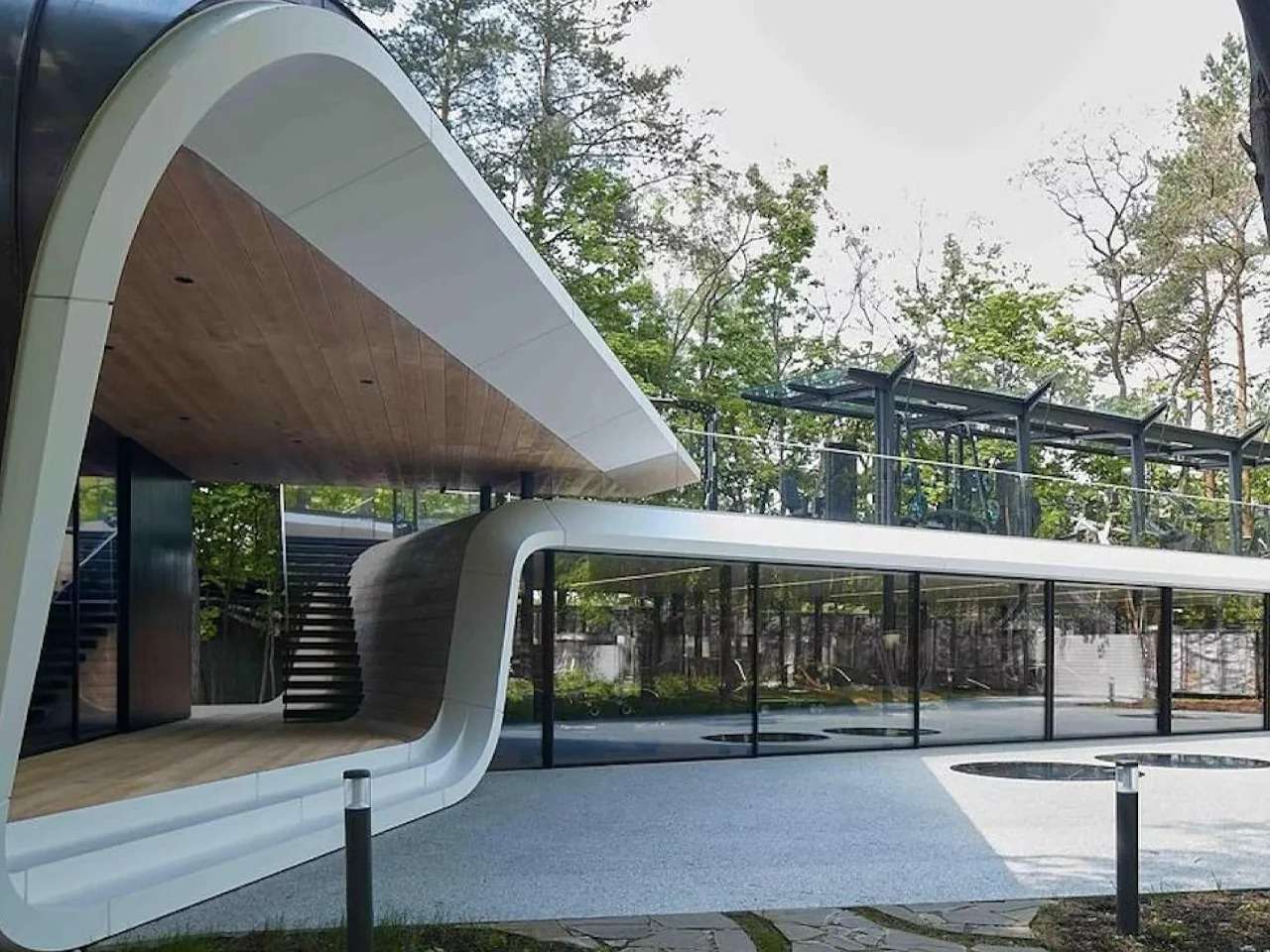
The architectural composition of the building is based on the concept of the Möbius strip, where space is formed as a continuous path resembling a flowing ribbon wrapping around the site. This approach does not produce a traditional mass but instead creates a continuous Construction read as a single motion organizing the distribution of functions across multiple levels.
Program Distribution Across Three Levels
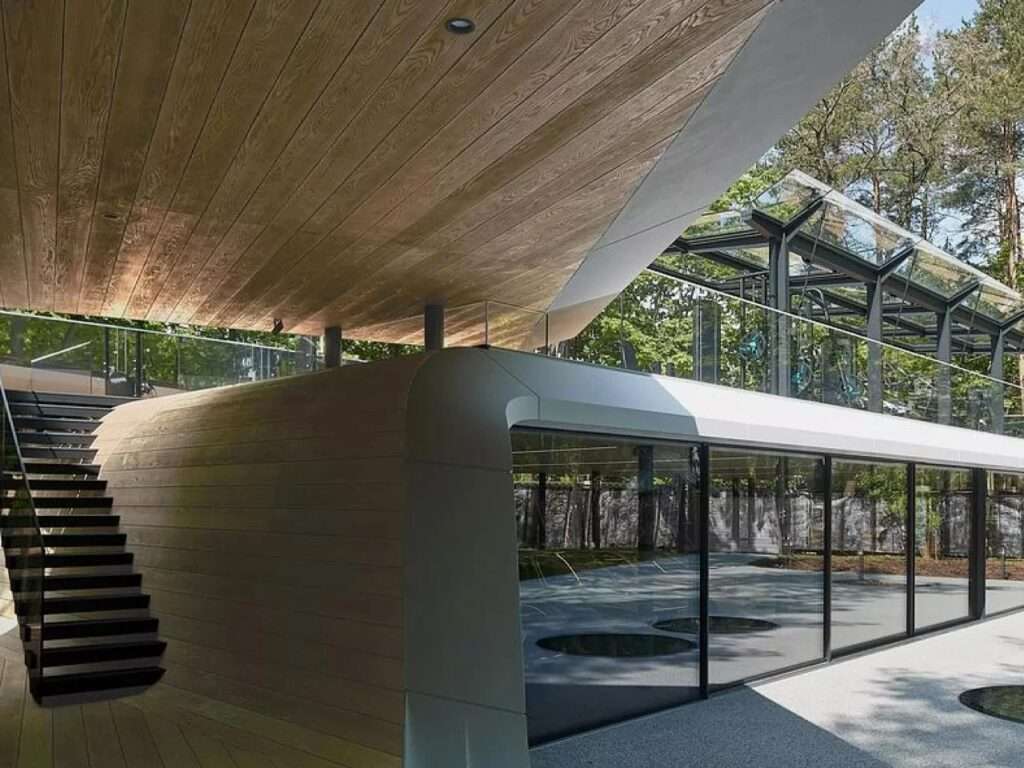
The architectural program is distributed across three levels within this continuous path. On the ground level, there is a glazed exhibition space opening onto wide façades with slender sections on the northern and southern sides, allowing direct display of the cars. The strip then rises diagonally to reach an outdoor sports terrace on the roof, while on the opposite side it descends below ground level to accommodate a gym and an office. Hidden floor openings allow natural light penetration without compromising the simple external reading of the building. For more on such innovative approaches, see related Projects.
Materials and Visual Identity
The precision of the composition is reflected in the choice of Building Materials. The exterior is clad in a smooth white Corian surface, giving the building a clear technical and engineered character. In contrast, wood and copper are used within the interior spaces to introduce warmth and a more tactile human dimension. This contrast creates a dual reading of the building: externally it appears as an organized mechanical object, while internally it adopts a calmer, more domestically oriented atmosphere, reflecting the nature of its functions. Detailed Material Datasheets can provide further insight into such choices.


Integration with the Natural Cover
The project demonstrates an approach based on minimal intervention in the site, preserving all existing trees within the forested plot without removing any of them. Instead of imposing an independent architectural mass, the building is shaped to adapt to the surrounding tree cover, a strategy often discussed in the context of green Cities. In this sense, the natural environment is treated as an active component of the Design rather than a constraint. Additionally, the underground expansion reduces the building’s visual impact, making its presence in the landscape limited and allowing it to appear as if it gradually emerges from the forest floor rather than being imposed upon it.
Timeline and Architectural Recognition
The project was completed in 2024, after its design was developed in 2020 by a team led by Anton Nadtochy and Vera Butko. It was later shortlisted for the 2025 World Architecture Festival in two categories: Completed Buildings – Transport, and Small Project Awards, a notable achievement in Architecture Competitions. This classification reflects a redefinition of the “garage” as an architectural type, treating it as a multi-layered program that extends beyond its traditional function without departing from its fundamental use. The final Competition Results are highly anticipated.


✦ ArchUp Editorial Insight
The car collection garage within a private estate on the outskirts of Moscow emerges as a spatial outcome of long-term capital accumulation that reclassifies automobiles as display assets within private ownership. The primary driver is the continuous expansion of the estate and the reorganization of land use under a private ownership framework, while constraints related to forest preservation, structural footprint limits, and underground excavation costs enforce a redistribution of the program. This complex scenario is frequently analyzed in Research.
This results in a spatial solution based on a continuous circulation system inspired by the Möbius strip, distributing functions between ground-level exhibition areas, upper terraces, and lower-level spaces, while separating uses into independent occupancy flows. The unified external material strategy functions as a mechanism to reduce maintenance and enhance environmental insulation. Ultimately, the structure emerges as a negotiated solution between environmental preservation and intensified private use, where authorship recedes in favor of structural constraint logic.