
If Kant Were an Architect

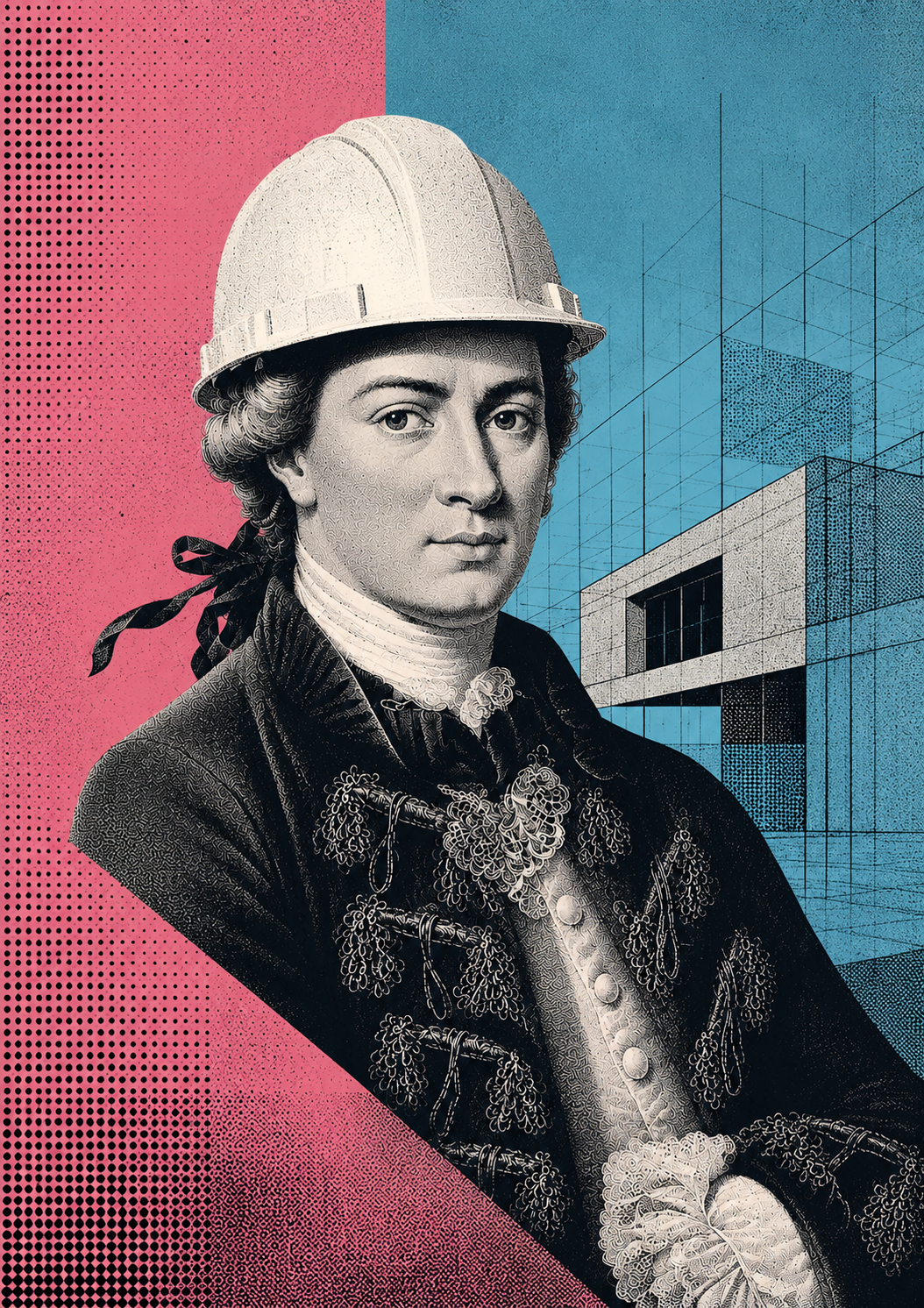
Kant’s philosophical framework, particularly his concepts of the a priori, the Categorical Imperative, and purposive aesthetic judgment, is examined as a foundation for understanding how spatial experience operates on both conscious and pre-conscious levels. Research in cognitive neuroscience supports the view that occupants begin evaluating a space before conscious attention engages.
The ethical implications extend to contemporary practice, framing design decisions as a fiduciary responsibility toward occupants rather than instruments of financial optimization or self-expression. The piece also addresses how economic pressures in 2026 development culture suppress spatial ambition, arguing that architecture remains the most accurate record of a society’s actual values.
On Design Intent, the Unconscious Room, and the Ethics of Space
There is a building in your memory that you cannot fully describe, but you remember exactly how it made you feel. Perhaps it was a corridor that compressed you without warning, or a ceiling that released something in your chest the moment you entered. You did not analyze it. You simply lived inside it, and it lived inside you. That involuntary transaction, the one that happens before any conscious judgment forms, is precisely where the philosophy of Immanuel Kant and the practice of architecture meet in quiet, unannounced collision.
Kant spent his entire life in Königsberg, a city he famously never left. He mapped the universe from a single room. He was not an architect in any professional sense, yet his three Critiques, published between 1781 and 1790, constitute one of the most rigorous frameworks ever constructed for understanding how human beings perceive, judge, and inhabit reality. To read Kant through the lens of contemporary architectural research is to discover that his central obsession, the relationship between the structures of the mind and the structures of the world, is the same obsession that drives every serious design decision, whether the designer knows it or not.
The entry point is his concept of the “a priori.” Kant argued that human understanding does not passively receive the world; it actively constructs it. Space and time, in his framework, are not properties of the external world waiting to be discovered. They are the conditions the mind imposes on experience before experience begins. A building, in this reading, does not simply occupy space. It negotiates with the spatial grammar already hardwired into human cognition. The successful room is one that honors those pre-existing conditions, that speaks the language the mind was already prepared to hear. The failed room is one that ignores this internal architecture entirely, treating the user as a blank receptor rather than a being who arrives with an entire cognitive inheritance already loaded.
This is not a metaphor. Architectural research in cognitive neuroscience has spent the last two decades producing evidence that validates what Kant described in purely philosophical terms. The work of Hayn-Leichsenring and Chatterjee on aesthetic judgment and neural response, and the structural analyses of Kitcher on Kantian epistemology, together suggest that spatial experience operates on at least two simultaneous registers: the conscious and the pre-conscious. A user begins evaluating a space before their attention has formally engaged with it. Light ratios, acoustic texture, the thermal quality of a surface, the proportional relationship between a window and the wall that contains it, all of these enter the nervous system as what Kant called “obscure representations,” sensory data that the mind processes without illuminating. The productive imagination, to use his term, synthesizes these fragments into an overall affective state. Comfort or unease. Expansion or constriction. Belonging or alienation.
The implications for design are not small. If a significant portion of spatial experience is pre-conscious, then the architect who concentrates exclusively on the visible, on the rendered image, the material finish, the decorative resolution, is addressing only the surface layer of a much deeper transaction. The Kantian designer would direct equal attention to what Minazzi describes as the “infrastructural conditions of perception,” the decisions that shape experience before experience becomes legible. The angle of natural light at three in the afternoon. The degree to which sound travels between volumes. The way a threshold prepares the body for what comes next. These are the decisions that determine whether a space functions as architecture or merely as enclosure.
The ethical dimension of Kant’s thought introduces a more uncomfortable set of questions. His Categorical Imperative, and specifically the Formula of Humanity, holds that rational beings must always be treated as ends in themselves, never merely as means. Transposed into professional practice, this principle becomes a direct critique of two of the most persistent pathologies in contemporary development. The first is the subordination of human comfort to financial optimization, the production of spatial units calibrated to yield rather than to inhabit. The second, more subtle and perhaps more damaging, is the use of a client’s project as a medium for the architect’s self-expression, the conversion of someone else’s need into a vehicle for professional vanity. Denis and Auxter, in their respective analyses of Kantian ethics and purposiveness, both locate the moral core of this principle in the obligation to preserve the dignity of the other as the primary condition of any legitimate act. A building that diminishes its occupants, regardless of how it photographs, is a building that has failed its most fundamental test.
This connects directly to what Kant called “purposiveness without purpose,” his account of aesthetic judgment in the Critique of Judgment. A beautiful object appears organized toward a goal without our being able to specify what that goal is. It coheres. It feels necessary. Applied to architecture, this describes the quality that separates a building with integrity from one that is merely competent. Cohen and Calichman both examine how this aesthetic category operates within spatial experience, noting that the judgment of architectural beauty is neither purely subjective nor reducible to technical criteria. It emerges from what Kant called “common sense,” a shared human capacity for aesthetic response that transcends individual preference while remaining grounded in sensory experience. The building that achieves this quality does not require explanation. It simply persuades.
There is one final territory where Kant’s thought bears directly on architectural practice, and it is perhaps the most consequential in 2026. His distinction between the “mathematical sublime,” the overwhelming experience of vast scale, and the “dynamical sublime,” the encounter with forms of immense power, describes a psychological register that contemporary urbanism has largely abandoned in favor of density metrics and return timelines. The great pre-modern structures, the pyramids at Giza, the vaulted interior of the Pantheon, the compressed approach sequence of Hagia Sophia, all operate in this register. They produce in the body something that exceeds comfort and function, a momentary suspension of self in the face of something larger. Choi documents how contemporary spatial research has begun recovering this category, not as nostalgia for monumental excess, but as a serious inquiry into what human beings require from the built environment beyond shelter and efficiency.
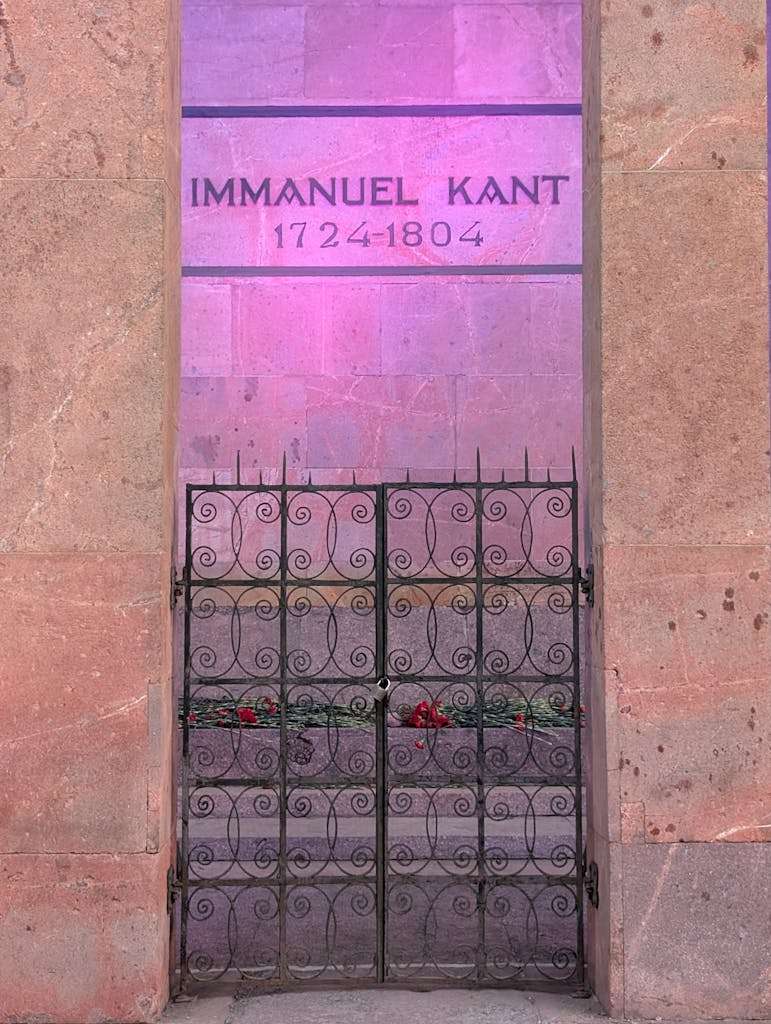
The global debt burden, currently estimated at 348 trillion dollars, has produced a development culture that is structurally hostile to this kind of ambition. When capital is expensive and timelines are compressed, the sublime is the first casualty. What remains is the adequate, the deliverable, the photographable. Kant would not have been surprised. He understood that the conditions of production shape the conditions of perception, and that a civilization which cannot afford to pause will eventually lose the capacity to experience depth.
Architecture has always been the most honest register of what a society actually values, as distinct from what it claims to value. The cities we are building in 2026, their proportions, their materials, their relationship to light and to the human body, are a more accurate document of our priorities than any policy statement or cultural manifesto. Kant’s final contribution to design is not a technique or a formal vocabulary. It is a demand for seriousness, for the recognition that every spatial decision carries a weight that exceeds its immediate function. A room is not neutral. A threshold is not incidental. A ceiling height is not arbitrary. Each is a claim about the human being who will live inside it, and each will be answered, in the only register that does not lie, by the body that inhabits the space long after the architect has moved on.
✦ ArchUp Editorial Insight
The conceptualization of the “Unconscious Room” is a clinical symptom of architecture operating as an involuntary psychological transaction before conscious judgment is even formed. Data layering reveals that applying Immanuel Kant’s philosophical rigor to spatial design translates the Categorical Imperative into a tangible mandate: the built environment must respect human autonomy rather than manipulate it. This systemic pressure generates an institutional decision framework where spatial ethics prioritize the occupant as an end in themselves, rather than a mere means for directed consumption or forced circulation.
Consequently, the architectural outcome is the rejection of coercive geometries in favor of an “ethical massing” that honors cognitive freedom. In 2026 cities, this paradigm redefines design not merely as an aesthetic or functional organization, but as a profound fiduciary responsibility to the human psyche. The architect’s role evolves from a creator of functional shells into an orchestrator of moral thresholds, finalizing the transition of architecture from a passive physical container into a sovereign infrastructure of spatial ethics.
Credits and Source Material
Hayn-Leichsenring, G. U., and Chatterjee, A. (2018). Minazzi, F. (2022). Choi, S. (2005). Kitcher, P. (2012). Denis, L. (1997). Auxter, T. (1986). Cohen, A. (2018). Calichman, R. (2019).
Editorial: ArchUp Global News Desk


