Mod-u: A Modular Lamp Made from Recycled Eggshells

Material Transformation: From Café Kitchen Waste to a Structural Composite
The Mod-u lamp begins from a non-architectural point of production in the conventional sense, sourcing its raw material from everyday waste generated in café kitchens. Eggshells are treated here as a material capable of reformation rather than as expired waste. After collection, they undergo cleaning, sanitization, and drying processes before being crushed into a fine powder using a simple household appliance. This powder is then combined with a biodegradable biopolymer to form a moist composite material that behaves like a granular, sand-like mass before being cast into molds and transformed into a solid object through a natural drying period lasting approximately one week. The absence of firing or heavy industrial processing places the material within a slow-hardening logic that depends more on time than energy, producing a surface that retains its original texture and natural coloration without decorative intervention. This approach to Building Materials challenges conventional manufacturing paradigms.
The Modular System as a Spatial Organization Between Light and Mass
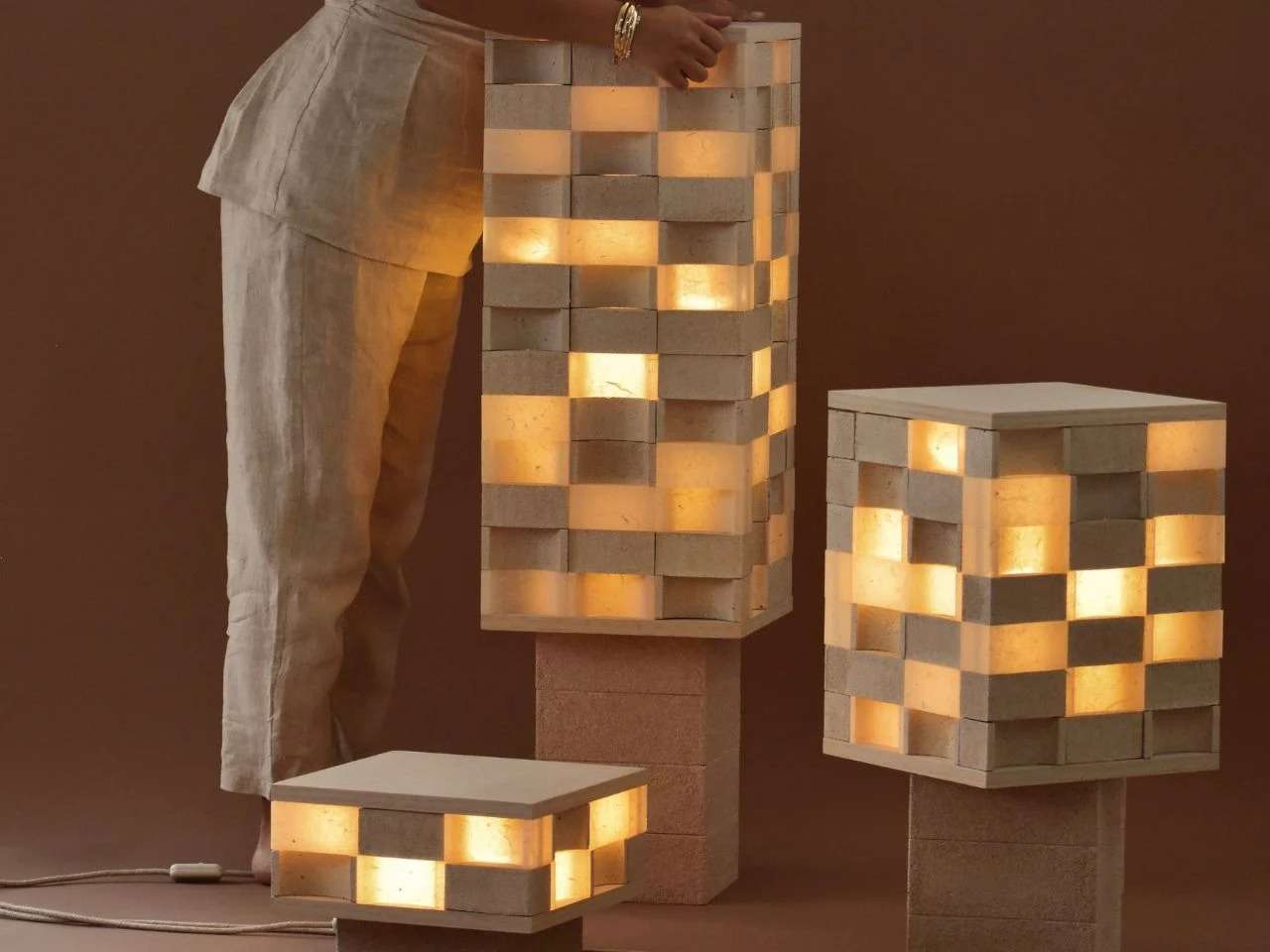
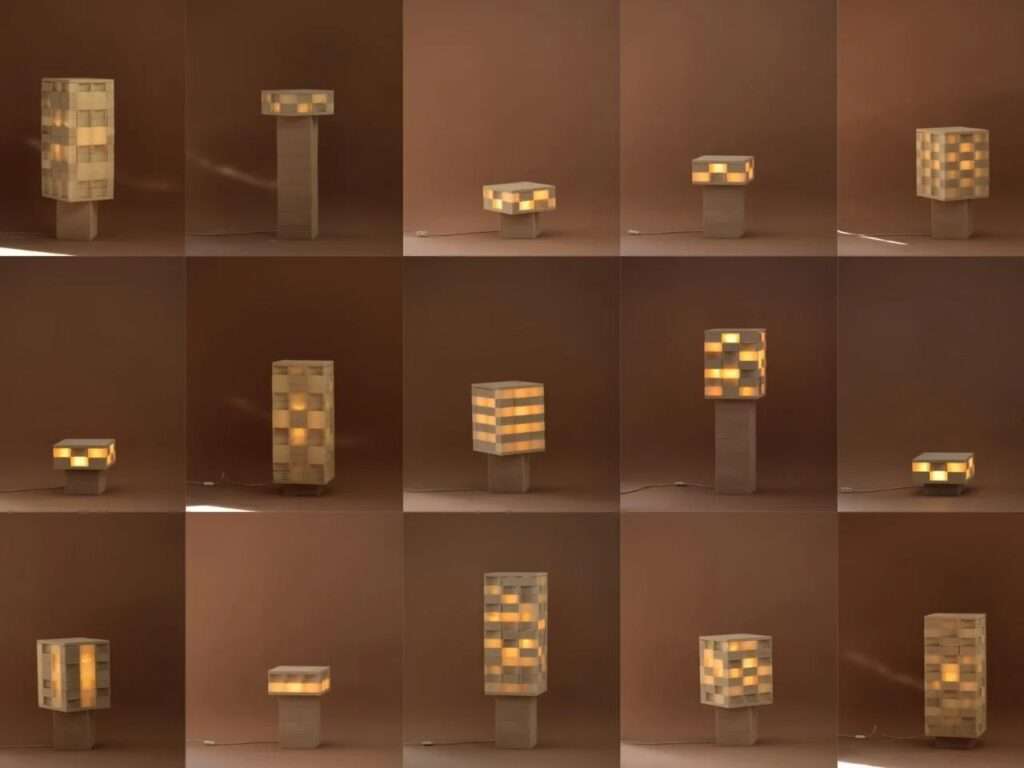
The lamp consists of repeated modular units stacked according to a logic reminiscent of construction toys, positioning it somewhere between a functional object and a sculptural mass. This configuration does not produce a conventional lighting fixture as much as it creates a system that can be dismantled and rearranged, where illumination becomes a direct consequence of structure rather than an applied function. The relationship between void and mass is managed through stacking and adjacency rather than through an enclosed frame or finished shell, allowing the overall form to emerge as a transformable assembly rather than a fixed product. This systemic thinking connects to broader themes in Architecture and modular Design.
Academic Experimentation as the Starting Point for Deconstructing the Idea of “Material”
The origins of Mod-u trace back to an academic context within furniture design studies at RMIT University in 2022, where Odisho was tasked with transforming food waste into a design product. This educational framework was not merely a technical exercise but a testing ground for redefining the relationship between waste and usable materials. Early experiments with spent coffee grounds encountered issues of rapid decomposition and mold growth, exposing the limitations of certain organic materials when removed from their immediate environmental context. Eggshells, by contrast, offered greater material stability, evolving from a secondary option into a primary experimental focus. This shift was further informed by Materiom’s Research into bio-based materials derived from natural resources. Within this process, the eggshell ceased to be a household waste product and became a reconfigurable element within a new material system subject to continuous testing and refinement.
The Modular System as a Response to Shifting Use and Space
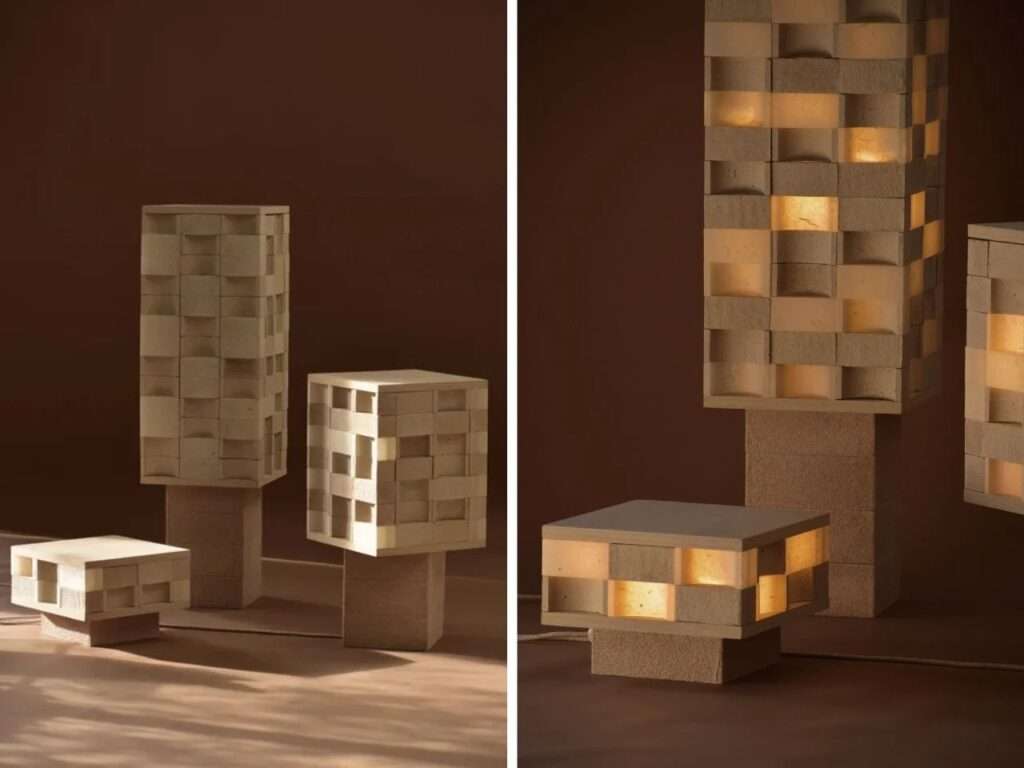
The project later crystallized into Mod-u as a lighting system built from repeated eggshell-based blocks, where the lamp is understood not as a static object but as a structure capable of ongoing reorganization. Each unit can be rotated or restacked, enabling functional transformations between a table lamp, a floor lamp, and an independent sculptural object. This modular logic provides more than formal flexibility; it directly responds to the realities of compact living environments, where multifunctionality becomes a structural necessity rather than an added feature. The relationship between user and object is established through continuous reconfiguration, meaning the design is only completed through human intervention in arranging the blocks and redefining their position within space. Similar strategies can be found in adaptable Buildings and Construction systems.
The Award as a Framework for Redirecting the Design Concept
The lamp’s recognition through the Australian Furniture Design Award emerged within a competitive context centered on the theme of “living well in small spaces,” a framework that requires projects to reconsider the relationship between function and spatial density. Within this setting, Mod-u is not presented as a final solution but as an experimental response to the increasing pressure placed on residential environments as a contemporary design condition. Its value stems not only from its material composition but also from the way it redistributes functionality within an adaptable structure, testing the boundaries between a daily-use object and a continuously reconfigurable system. This recognition places it among notable Architecture Competitions and award-winning projects.
Interaction as a Mechanism for Redefining Spatial Stability
One of the most compelling aspects of the lamp is its structural openness to change. Rather than presenting a fixed form, it enables a sequence of transformations generated through direct user involvement. Processes of assembly, disassembly, and rearrangement create an intentionally unstable relationship between object and space, making illumination a variable outcome determined by the positioning of the blocks rather than a fixed characteristic embedded within them. This type of interaction shifts the design from a logic of “use” to one of “participation in formation,” where the user becomes part of redefining the object rather than merely engaging with a finished product. Such participatory approaches are frequently discussed in Discussion forums on contemporary design.
Material Presence as an Unpolished Visual Layer
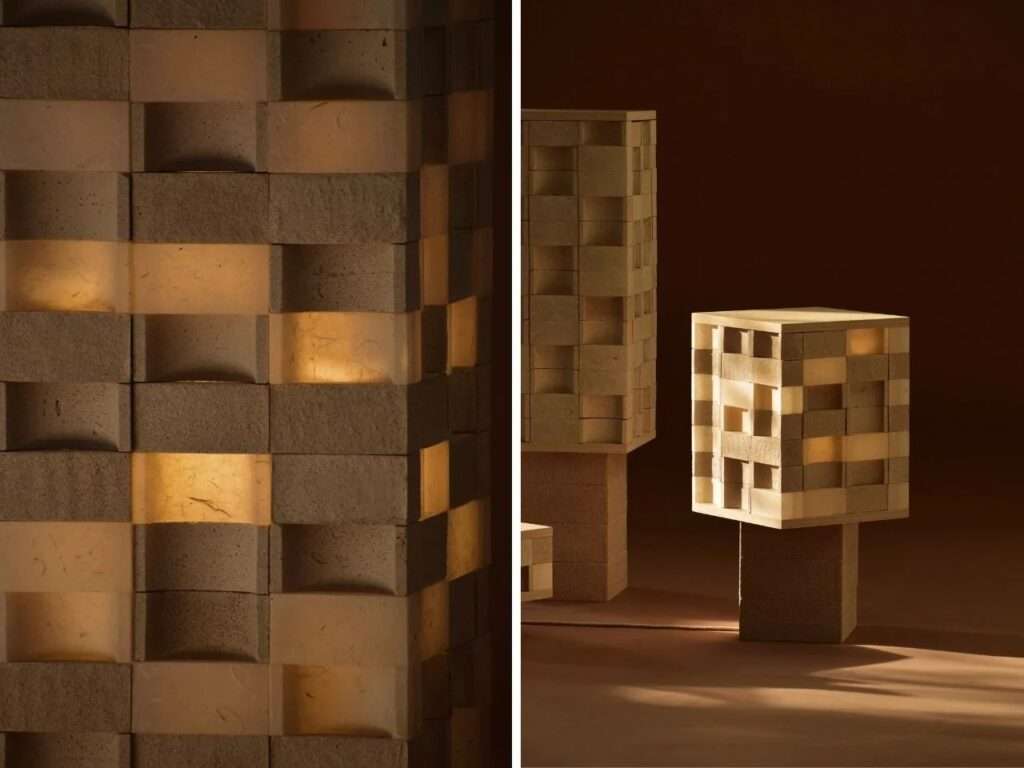
At the material level, the design refuses to conceal the origin of its raw ingredients. The eggshells remain visible through their natural coloration without artificial coatings or polishing. This decision functions not only as an aesthetic choice but also as a direct revelation of the material’s structure and environmental origins, giving the surface a distinctly non-industrial character despite the precision of its fabrication process. The result is a visual object that oscillates between carefully engineered production and the appearance of slow natural formation, with the surface acting as a material record of transformation rather than a finalized finish. Detailed properties of such bio-based compositions can be found in Material Datasheets.
Sustainability as a Shift from Moral Messaging to Quiet Materiality
Mod-u approaches sustainability outside the conventional discourse of direct awareness campaigns or the moral narratives often associated with recycling. Instead, the concept is reconstructed at a material and experimental level, where the material itself becomes the sole medium of the design argument. There is no reliance on heavy technical language or excessive theoretical justification; the idea is communicated through a direct sensory experience that links everyday waste with its structural potential. This shift transforms sustainability from a “message” into a material condition that can be tested within space, where value is measured through performance and transformation rather than explanation or instruction. This perspective aligns with contemporary Research on material circularity in Architecture.
Redefining Fragility as a Transformable Structural Logic
Within this framework, eggshells are transformed from symbols of fragility into structural elements capable of cohesion and reconfiguration. The contradiction between the material’s origin and apparent weakness, and its behavior after transformation, creates a dual layer of perception within the designed object. Distinctions between “strong” and “fragile” become less clear than they are in conventional materials. This tension is not resolved within the design but remains deliberately open as part of its experience, allowing the furniture to be read as an object in a constant state of transition between potential breakage and temporary stability. At this level, engaging with everyday waste is no longer a matter of reuse but of redefining the limits of material itself within architectural and spatial practice. Such experimental approaches are featured in many Projects exploring new Building Materials.
✦ ArchUp Editorial Insight
The Mod-u lamp can be interpreted as a clinical manifestation of a broader transformation occurring within contemporary design systems and material production. The project’s real value does not lie in the product itself but in the layered convergence of food-waste streams, local consumption patterns, biomaterial research, and the growing pressure generated by shrinking residential spaces. When these non-architectural variables are analyzed collectively, a gradual transition becomes visible, from linear manufacturing models toward circular material systems in which waste is reclassified as a productive resource. This systemic pressure extends beyond environmental sustainability into economic, logistical, and cultural dimensions, establishing a new institutional framework for decision-making that prioritizes adaptability, material circularity, and extended product lifecycles. Within this context, the eggshell is no longer categorized as waste but as a measurable material component within a reconfigured value chain. For further reference, Material Datasheets provide detailed insights into bio-based composites.
The architectural outcome of this framework is a product that behaves more like a spatial system than a fixed object. Its modular assembly represents a logical response to the increasing demand for flexibility within the dense urban environments and shrinking residential footprints of 2026. Rather than arriving at a closed and final form, the lamp’s compositional mass remains open to continuous transformation, allowing it to be reshaped according to changing spatial and functional needs. This reflects a broader shift within contemporary architecture, where adaptability is gradually replacing permanence as a central design value. This trend is evident in innovative Design strategies for Cities and compact living. Simultaneously, the direct exposure of the raw material transforms its origin and production history into a visible component of the design experience rather than concealing it behind finishing treatments. As a result, the designer’s strategic responsibility expands beyond form-making toward resource-cycle management, material accountability, and the development of systems capable of long-term adaptation. The project’s ultimate revelation lies in the transition from designing completed objects to organizing material systems that possess the capacity to continually reconfigure themselves over time. This approach is frequently discussed in Discussion forums on sustainable Construction.