UNFOLD Pavilion: Circular Temporary Architecture

In most exhibitions, temporary architecture ends as soon as the event is over; the blocks that hosted visitors are dismantled and disappear from the scene as if they had never existed. While sustainability-related discourse continues to grow, this rapid fate of temporary pavilions remains one of the most visible contradictions in contemporary architectural practice, where many structures are designed for immediate visual impact rather than for an extended life cycle.
Architecture that transcends the moment of display
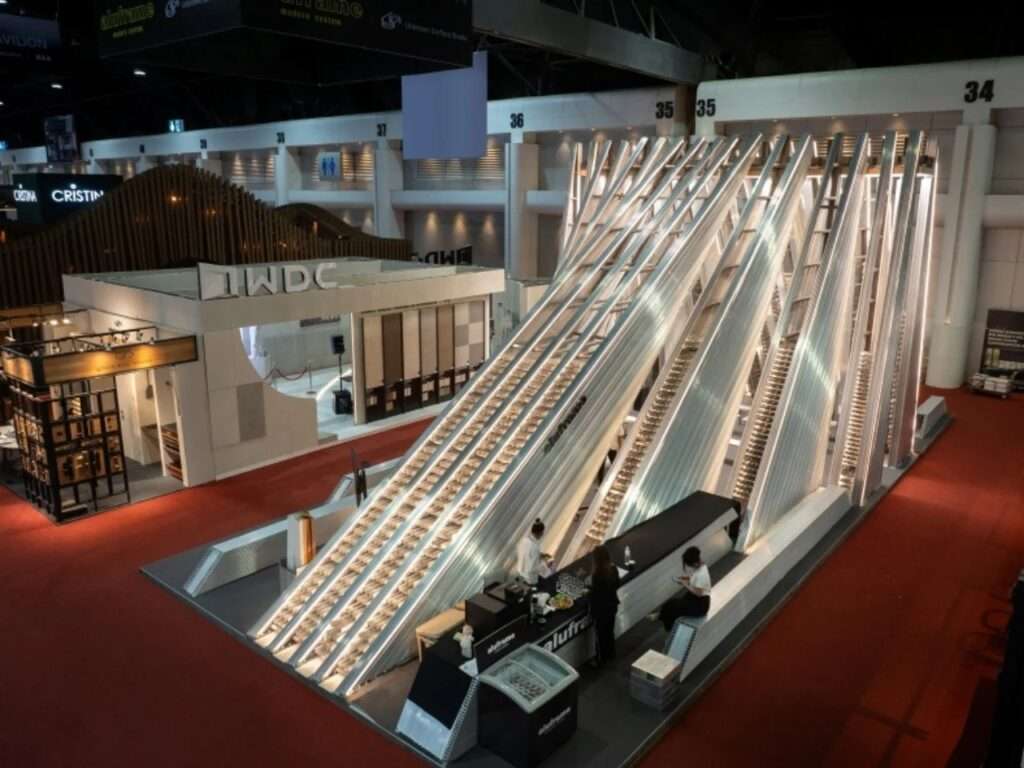
The UNFOLD pavilion approaches this issue from a different perspective, not through theoretical discourse but through the nature of its material composition. From the very first moment, the pavilion is not read as a closed object tied to a specific exhibition timeframe, but as a system capable of transformation and reconfiguration. As one moves around it, the mass appears to be in a continuous state of unfolding, creating a shifting visual relationship between interior space and the external environment.
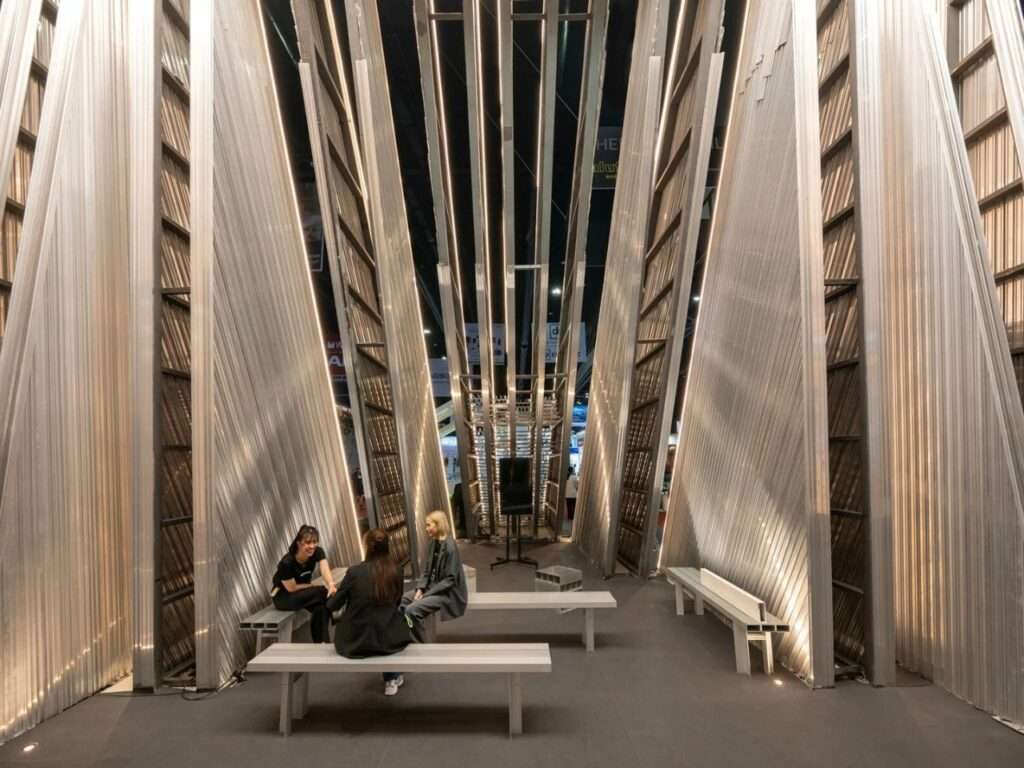
At the same time, the experience of movement within the pavilion is linked more to the idea of continuity than to temporary existence; the user does not feel they are passing through a structure designed for rapid consumption, but rather through a framework capable of moving from one context to another without losing its function or material value. Here, sustainability shifts from a theoretical concept into a tangible spatial experience that redefines the meaning of the temporary and the permanent in contemporary architecture.
The logic of the warehouse as an architectural language
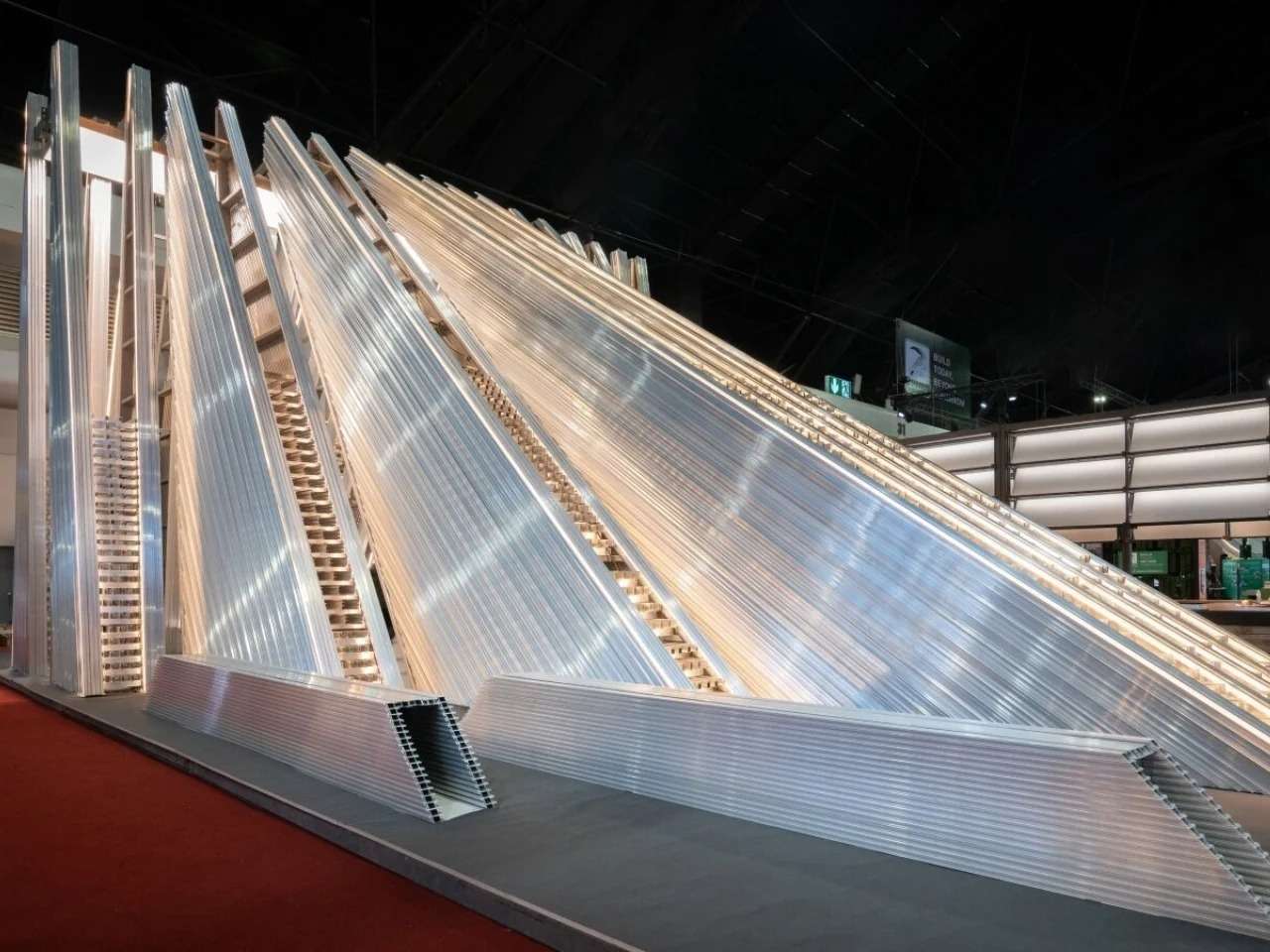
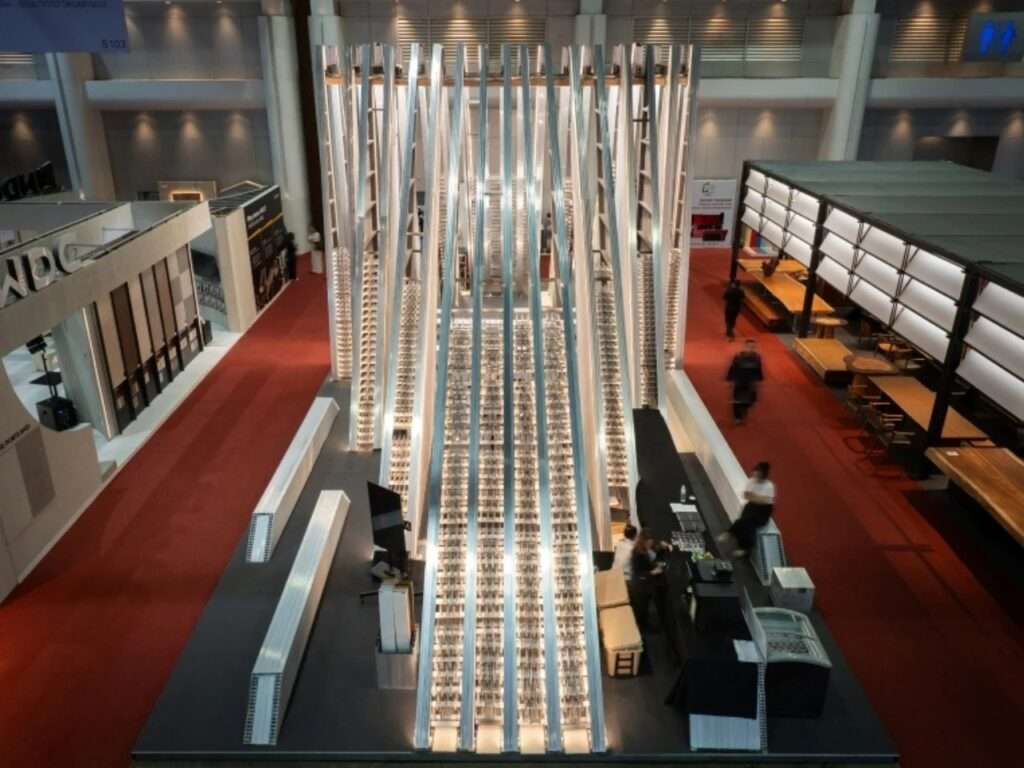
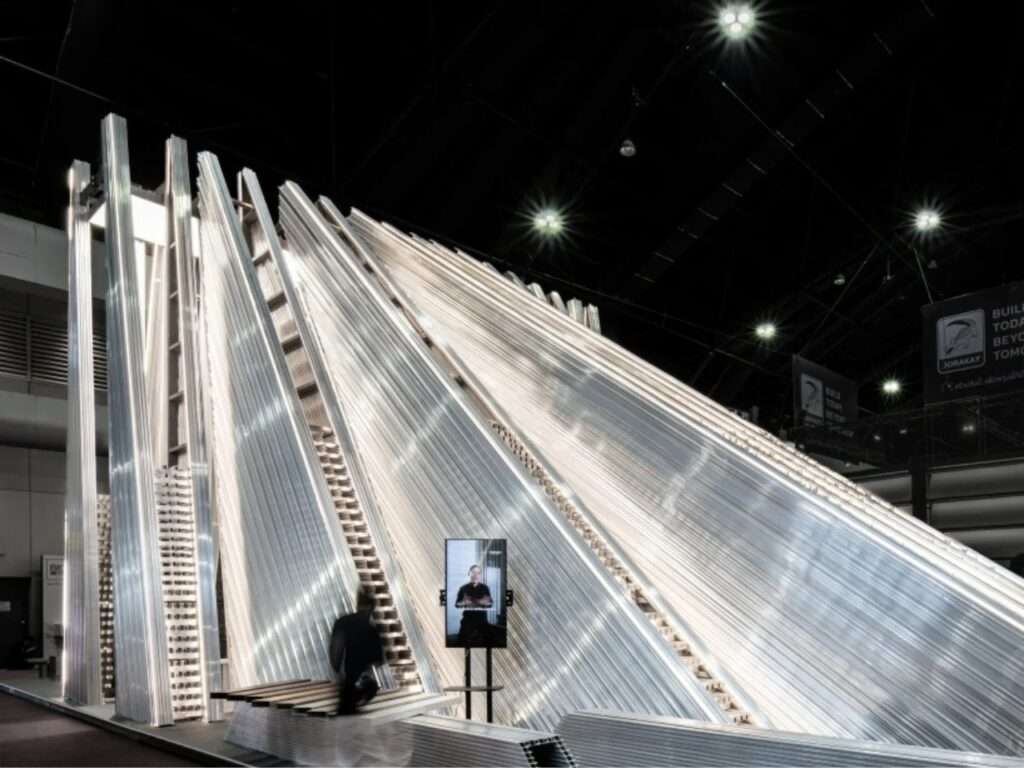
The pavilion is based on industrial aluminum sections as a raw building material that retains its original identity without attempts to conceal or beautify it. However, the importance of the project does not lie in the material itself as much as in the reference system from which the design is derived. Rather than deriving form from the final product, the pavilion borrows its logic from the storage and organizational environments in which these sections are typically found. Thus, stacking patterns, repetition, and rhythm are transformed into architectural elements that shape space and define its visual presence.
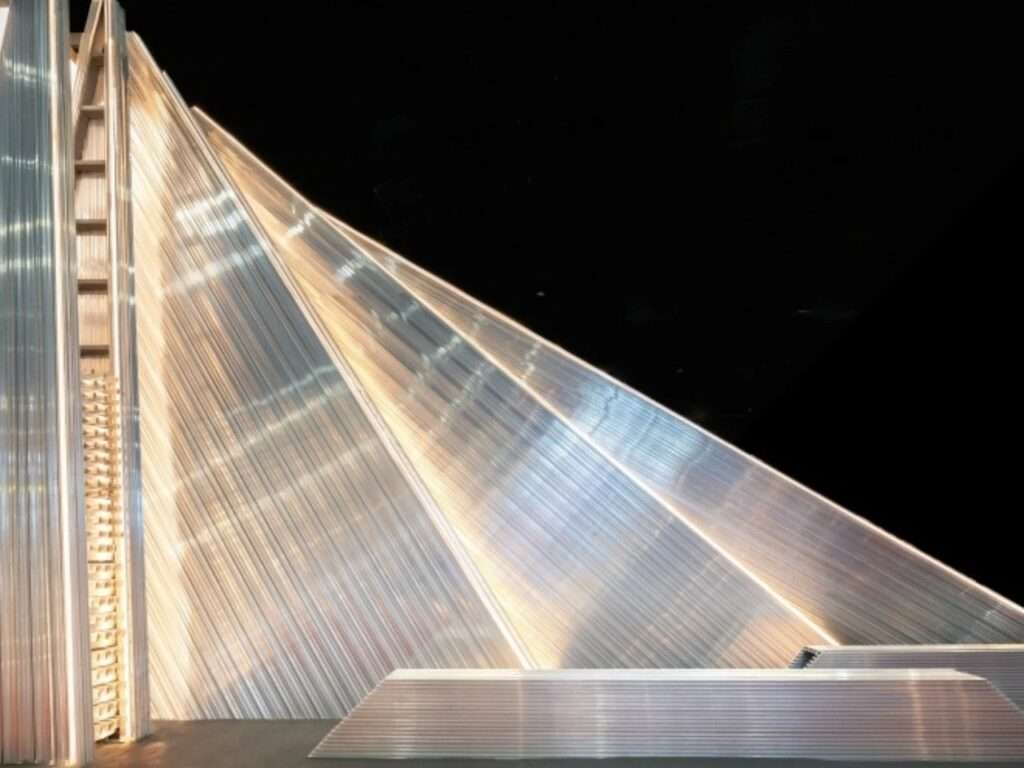
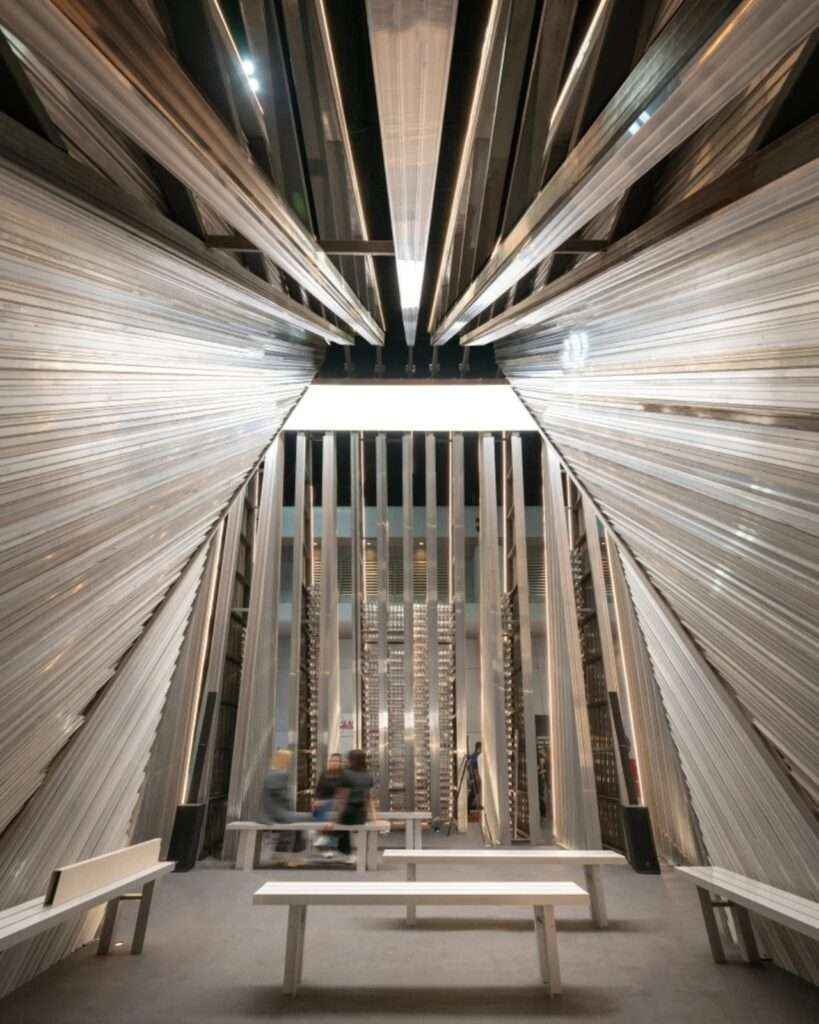
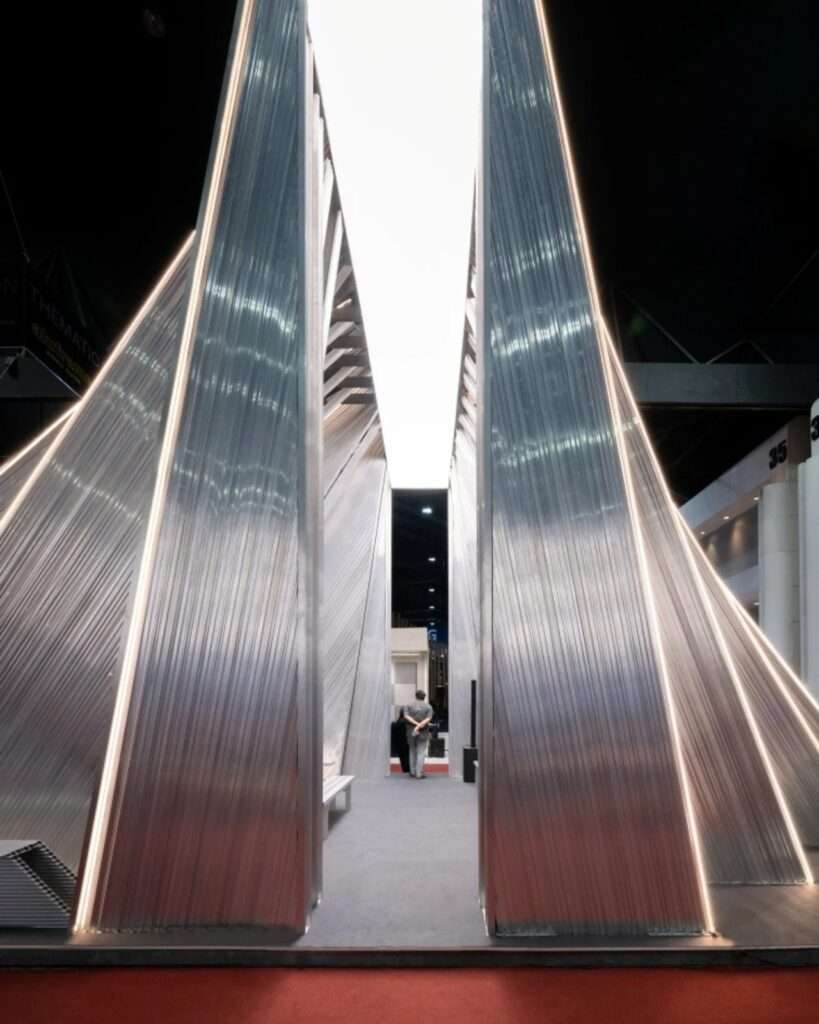
When approaching the pavilion, the sections are not read as isolated structural components, but as successive layers that generate a sense of depth and movement. The relationship between light and mass shifts with the observer’s position, as linear shadows intertwine with interstitial voids to form a constantly changing visual field that reflects the industrial nature of the material while granting it a spatial dimension that goes beyond its original function.
An open space between shadow and perception
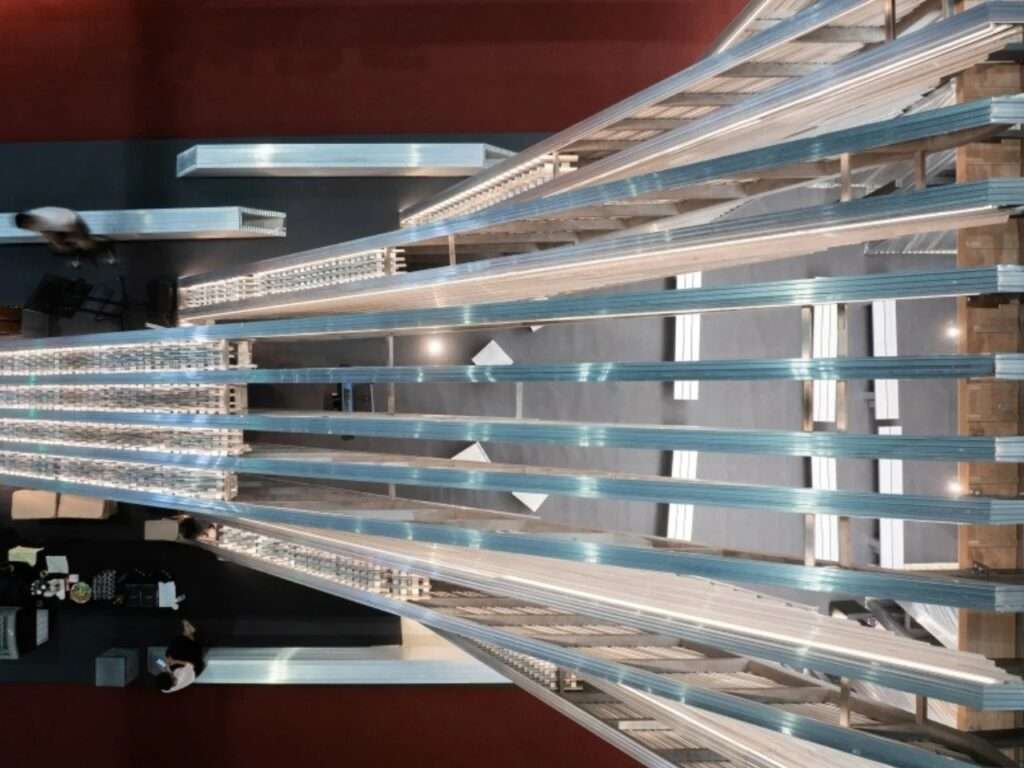
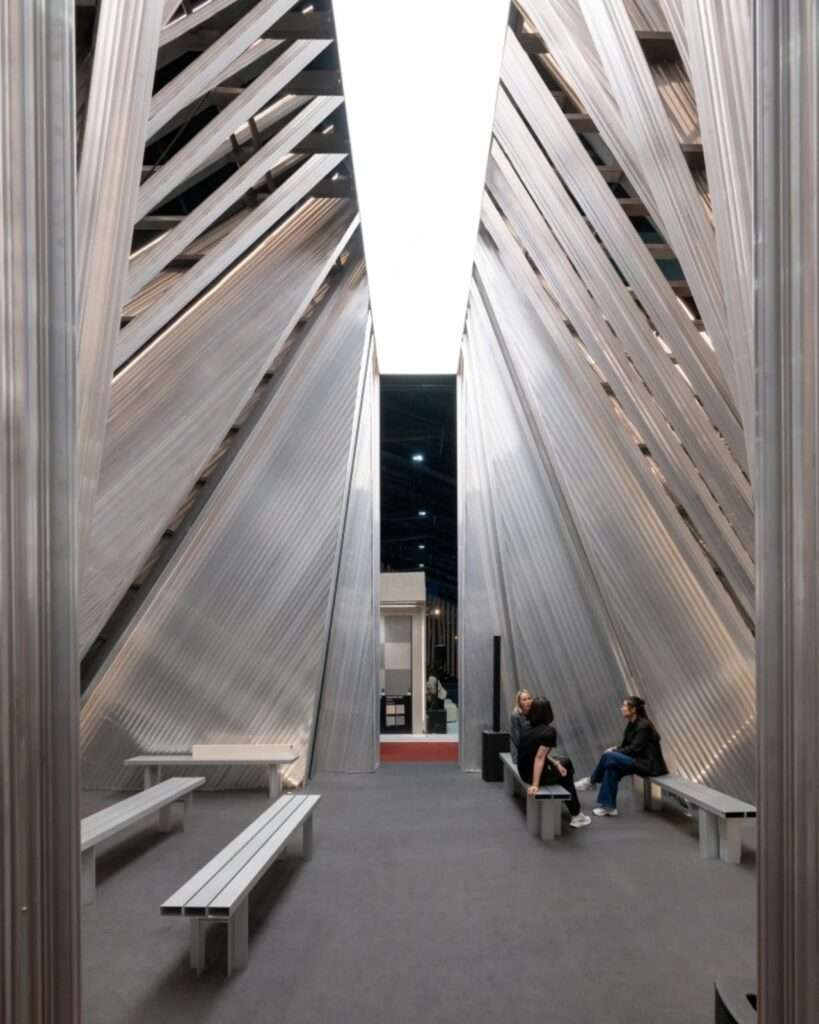
The structure adopts a fan-like configuration that allows the sections to extend outward in successive layers, drawing flexible spatial boundaries. Inside the pavilion, the visitor does not encounter a rigid wall separating inside from outside, but rather a graded visual threshold that allows air, light, and movement to pass through in varying degrees. As a result, boundaries become less rigid and more tied to the sensory experience of space.
The density of the sections also plays a fundamental role in shaping perception and composing the interior scene. In some areas, elements converge to create more shaded and focused zones, while in others they open up to allow broader visual extensions. As one moves around the pavilion, the perception of the mass continuously shifts; at times it appears dense and cohesive, and at others lighter and more transparent. These transformations do not rely on additional elements or complex visual effects, but emerge directly from the organization of the material itself and its distribution within space.
The warehouse as an architectural façade, not a hidden backstage
The concept of the “living material library” is based on reversing the traditional relationship between what is displayed and what is concealed. Instead of treating the warehouse as a service space outside the field of perception, the pavilion reintroduces it as a direct spatial experience. Here, technical details are not hidden behind neutral finishing layers; instead, they are exposed as they are: visible sections, expressed joints, and explicit assembly logic all become compositional elements that define the identity of the space. This approach aligns with construction strategies that prioritize material honesty over superficial finishes.
This exposure does not function as an aesthetic display of industrial material, but as a translation of “functionality” into a readable visual language. Every structural element is left in its natural position without reinterpretation or decoration, making the experience closer to reading an architectural structure in its raw state rather than encountering it as a polished final image. Thus, the pavilion becomes a space that redefines beauty as a direct outcome of structural logic, rather than as a separate surface.
A closed loop instead of a temporary structure
However, the most decisive dimension of this project is not only how the material is displayed, but how it continues after the exhibition ends. When the pavilion is dismantled, its components do not end their life; instead, they are reintegrated into a circular system that reintroduces them into the usage chain. Whether the structure is reassembled in a new location or the sections are returned to production inventory, they remain within a continuous operational cycle without becoming waste. This process reflects principles found in architectural research focused on material life cycles and circular economy models.
In this sense, UNFOLD is not constructed as an isolated object with a fixed lifespan, but as a node within a broader system of reuse. The dismantling process itself does not produce an “end,” but a transition phase. Through this shift, the temporary pavilion is redefined not as a transient event, but as a repeatable and adaptable structure, placing the conventional model of exhibition architecture under direct questioning regarding the material loss generated by its termination. Similar experiments can be explored through various architectural projects that prioritize adaptability and disassembly.
Circular design as an operational logic, not a slogan
The concept of “circular design” is reintroduced here outside its usual marketing context, as a material operating system rather than a theoretical claim. UNFOLD does not treat circularity as a conceptual addition attached after completion, but as a structure embedded in its very formation. The sections used are not custom-designed elements for a single condition, but standardized industrial units capable of entering and exiting multiple usage systems without losing value. This approach aligns with contemporary design strategies that prioritize adaptability over fixed form.
From the earliest design stage, the logic of disassembly was not separated from the logic of construction. The structure is not understood as a completed mass that is later dismantled, but as a temporary assembly pre-programmed for deconstruction and reassembly. In this way, the act of ending becomes part of the beginning, and the project’s architectural time becomes non-linear, essentially circular, where there is no final point, only continuous transitions between states of use.
Temporary architecture as a cultural paradox
Temporary architecture occupies a contradictory position in contemporary culture; it is expected to be visually striking enough to generate immediate presence, while simultaneously being economically light enough to be removed without material regret. Within this framework, UNFOLD proposes an approach that moves beyond this contradiction by redefining the value of temporality itself, not as a short-lived solution, but as a structure capable of persistence through transformation.
The project does not rely on spectacle or formal complexity, but on reconfiguring the relationship between material, function, and time. Value is not derived from the stability of form, but from the system’s capacity for repetition, adaptation, and reintegration into new contexts. In this sense, a structure does not need to be permanent to be understood as a complete architectural work; it is sufficient that it is internally consistent, aware of its own cycle, and capable of continuing beyond its initial moment of display. Similar principles can be observed in other architectural projects that embrace disassembly and material reuse.

✦ ArchUp Editorial Insight
The UNFOLD pavilion operates as a clinical display of systemic symptoms within the broader exhibition-related architectural apparatus, where temporary constructions are gradually absorbed into circular material economies and post-event logistical infrastructures. The layering of non-architectural data, such as the standardization of industrial aluminum sections, logistical recyclability, and lifecycle calculations, reveals a condition in which the production of space is no longer governed by formal representation, but by the efficiency of material flow through systems. This generates a structural pressure that reshapes institutional decision-making frameworks behind pavilion design, prioritizing disassembly, reuse, and reintegration into inventory systems over singular spatial permanence. Within this context, the architect’s role shifts from formal innovation to the orchestration of an embedded operational protocol within the design process.
As a result, an architectural formation emerges that is essentially a direct logical outcome of this operational framework: a semi-permeable radial mass composed of standardized aluminum sections, where spatial boundaries are produced through gradients of density rather than rigid enclosure. The spatial organization of the pavilion functions as a reversible system, calibrated for disassembly operations and reintegration into supply chains, aligning with 2026 cities’ increasing reliance on flexible and reconfigurable infrastructures. Within this context, the architect’s role transforms into a fiduciary responsibility toward the “afterlife of matter,” where authorship does not end at spatial formation but extends into lifecycle management, signaling a definitive shift in architectural practice from producing “objects” to managing “systems.”
This operational logic can be further explored through architectural research focused on circular economies and material life cycles, as well as through architecture competitions that challenge conventional approaches to temporality and reuse. The top news in contemporary architectural discourse increasingly highlights such innovative models, while architects’ lobbies advocate for policy changes that support circular construction practices. Ultimately, the UNFOLD pavilion demonstrates how material datasheets and standardized components can become the foundation of a truly sustainable and repeatable architectural language.