Islamic Ornament Is Not the Final Layer
Research and analysis: ArchUp Research Lab.
How Geometry, Calligraphy and Materials Shape Architectural Space
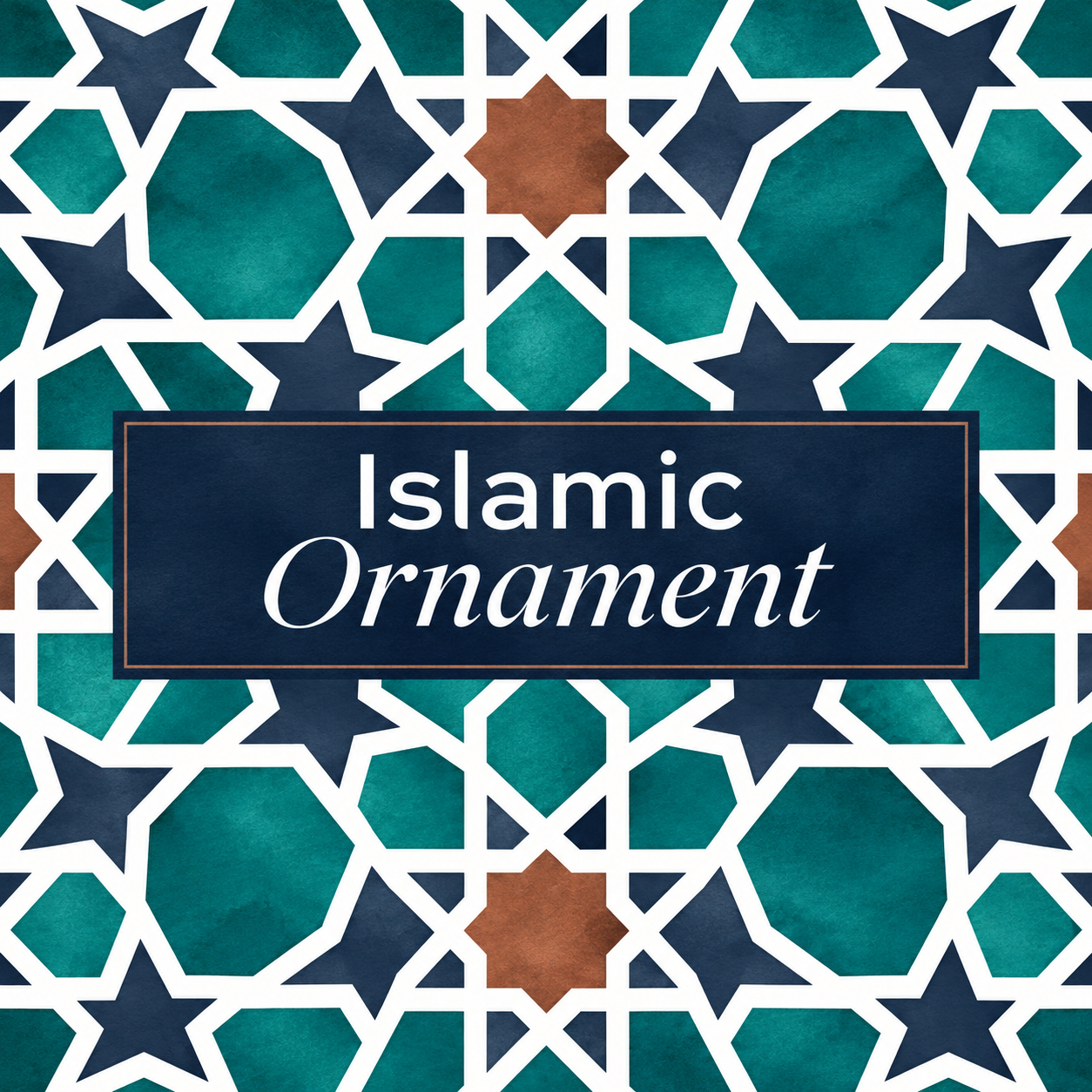
The cover begins with a familiar recognition: stars, interlacing bands and coloured polygons announce Islamic ornament before a building appears. Yet the image leaves the most consequential architectural questions unanswered. Is this pattern printed on a wall, cut through stone, assembled from ceramic pieces or suspended in front of a window? Does it carry a readable text? Does someone see it from across a courtyard or touch it while opening a door? The same graphic outline can become several fundamentally different architectural experiences.
That is the central argument of this research. Islamic ornament is not merely a final layer applied after architecture has been resolved. It can organise attention, establish a threshold, frame a text, mediate light or express the way a material is worked. Equally, it can remain a largely visual surface treatment. Neither condition should be disguised. The task is to identify what the ornament is doing in a particular place and to design that relationship deliberately.
This article combines checked museum records and curatorial essays with selected research on geometric construction. It then develops an original design framework for contemporary architecture and interiors. Historical descriptions, mathematical interpretations and proposed design tests are kept distinct. We do not claim a comprehensive survey of all Islamic cultures, a universal symbolic dictionary or measured environmental benefits for every patterned surface.
A shared vocabulary with many histories
The term Islamic art includes more than objects made for worship. The Metropolitan Museum’s account encompasses religious and secular production across societies, patrons and makers connected to the Islamic world. Its classification also includes figural representation alongside calligraphy, vegetal ornament and geometry. Describing the whole tradition as an art without figures therefore erases part of its history. [1]
This distinction matters when a contemporary client requests an “Islamic interior.” A mosque, hotel, museum, home and clothing collection are not interchangeable contexts. The suitability of imagery, inscriptions and materials must be considered for the particular commission. A historical category cannot replace a design brief, and a visual association cannot settle a religious question.
Nor did geometric and vegetal ornament emerge without predecessors. The museum’s essays describe the adaptation and development of earlier regional traditions rather than an isolated invention from nothing. [2,3] A useful understanding of continuity therefore includes transformation. It allows us to ask how makers selected, reorganised and combined forms, instead of treating history as a sealed collection of motifs that can only be copied.
For the architect, specificity is more valuable than a vague claim of authenticity. Which object, building, region or craft process informs the proposal? Which features have been retained, and which have been changed? A contemporary design may legitimately combine influences, but it should identify that combination as a contemporary decision rather than attribute it to an imaginary uniform historical style.
Three visual languages that do different work
Geometry, vegetal ornament and calligraphy often coexist, but they should not be treated as interchangeable fills. Geometry can organise relations between parts. A vegetal composition can develop through branching, turning and changes of density. Calligraphy carries language as well as shape. Their combination is a design decision about hierarchy and reading, not simply an opportunity to make the surface busier.
The Met’s geometric essay explains how comparatively simple shapes can be combined into elaborate patterns. [2] The transferable lesson is to understand the generating arrangement before enlarging a small fragment. Copying a star without its surrounding relationships may produce a recognisable symbol while losing the coherence of the original field.
The vegetal essay describes considerable historical variation in plant ornament. [3] It does not justify assigning a fixed spiritual meaning to every leaf or flower. In a contemporary project, a designer may propose an association with growth, a garden or local vegetation, but should identify that as an interpretation unless evidence establishes the historical meaning in the particular case.
Calligraphy requires a different level of responsibility because it transmits text. The museum’s discussion emphasises this linguistic role even where the writing is highly ornamental. [4] Before adjusting letterforms to fit a panel, the team needs an approved text, competent linguistic and calligraphic review, and an understanding of where and how it will be encountered.
| Ornamental language | A useful architectural question | A common mistake |
|---|---|---|
| Geometric pattern | What relationships organise the field, its edges and its openings? | Copying an isolated star and stretching it to fit |
| Vegetal composition | How do branching, density and direction relate to the surface? | Assigning an invented universal meaning to each motif |
| Calligraphy | What does the text say, and how is it read and respected? | Treating letters as interchangeable decorative strokes |
| A combined composition | Which element leads and which supports it? | Giving every layer equal visual emphasis |
Repetition is a rule, not an instruction to cover everything
A pattern is more than a motif repeated many times. It includes the relationship between units, the way lines meet, the treatment of corners and the decision about where the field stops. These decisions become especially visible when ornament moves from an illustration to a room with doors, sockets, structural joints and changing dimensions.
The middle of a panel is often the easiest part to design. The difficult work occurs at the edge. Does the pattern finish against a border, turn a corner, meet another material or appear to continue beyond the visible surface? Does a door interrupt the logic, or has the opening been included from the beginning? A strong design can use interruption intentionally. An unresolved design merely crops whatever happens to reach the boundary.
Scale is equally important. A fine pattern suitable for an object held in the hand may become visually weak on a distant facade. Enlarging it may solve recognition while creating awkward joints or overly heavy bands at close range. The proposal here is to test at least the intended distant view, the normal occupied view and the close material encounter. These are different design conditions, not three versions of the same rendering.
There is also a difference between visual continuity and literal infinity. A finite wall can suggest continuation through its organisation. That does not prove that its maker intended a particular metaphysical proposition. A spiritual reading may be meaningful, but it should be described as a reading, not automatically as a documented historical instruction.
Geometry without the mythology of effortless perfection
Lu and Steinhardt’s 2007 study argues that selected historical girih patterns can be analysed through a system of decorated tiles and subdivision, including a remarkable example at Darb-i Imam in Isfahan. Their paper also acknowledges imperfections and limits to what can be inferred about the makers’ understanding. [5] This is a more interesting account than the headline that every Islamic pattern secretly contains the same advanced mathematics.
The existence of a mathematically persuasive reconstruction and the existence of a surviving workshop instruction are different kinds of evidence. A pattern can be generated in more than one way. Identifying a possible construction does not automatically establish the exact sequence used by every craftsperson who made a similar surface. The authors’ subsequent response to commentary further demonstrates that the interpretation was part of a scholarly discussion. [6]
For contemporary practice, the productive lesson is neither to romanticise the past nor to dismiss its sophistication. It is to make the proposed construction explicit. The designer should be able to explain the units, joining rules, tolerances and exceptions well enough for another person to manufacture, install and repair the work.
A digital file that generates a beautiful field is only the beginning of that explanation. The construction information must also address material thickness, supports, fixings, joints and the relationship between the pattern and the actual building. Mathematical coherence and construction readiness are connected tasks, but they are not the same task.
Two objects, two architectural operations
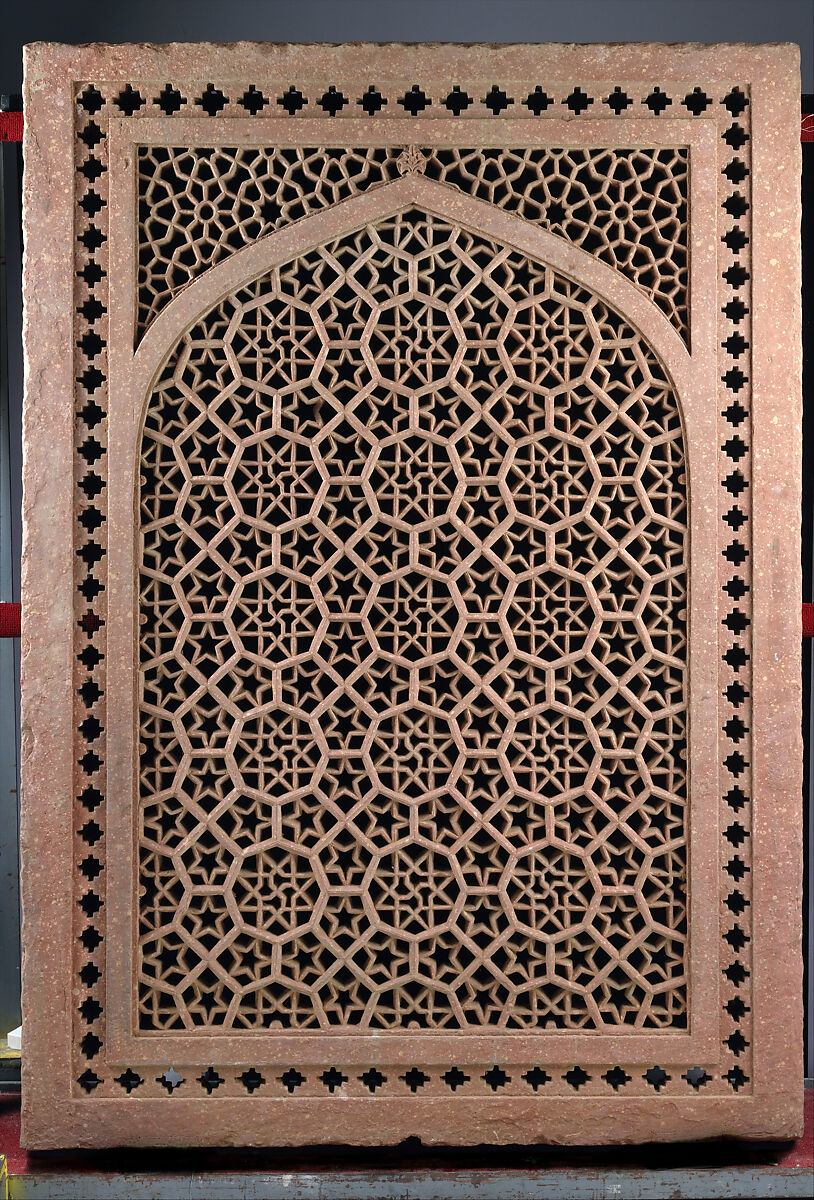
The Met’s pierced sandstone screen, object 1993.67.2, is dated to the second half of the sixteenth century and made in India. Its record identifies it as a jali and discusses its probable use in an exterior window sequence. The related educational account explains how such screens mediated light, views and air. [7] These are documented descriptions of an architectural type, not a measured performance certificate for a new facade.
The useful design distinction is between the material that remains and the opening that is removed. In a screen, both are active. The visible pattern is also an arrangement of apertures with depth and edges. A printed imitation may reproduce its image while having none of those spatial effects. Conversely, a contemporary screen can develop a related spatial role without reproducing the historic motif exactly.
The second example is the mihrab from the Madrasa Imami in Isfahan, dated 755 AH, or 1354–55 CE, and held by the Met as object 39.20. Its record describes cut glazed tiles assembled into patterns and inscriptions. [8] Here the emphasis is not a perforated boundary but a composed architectural focus in which material, writing and geometry work together.
Our comparative reading is that the two examples ask different questions of the viewer. The screen mediates a relationship through its openings. The mihrab gathers attention through an articulated surface and niche. Reducing both to a downloadable pattern library would preserve some visual information while discarding much of their architectural purpose.
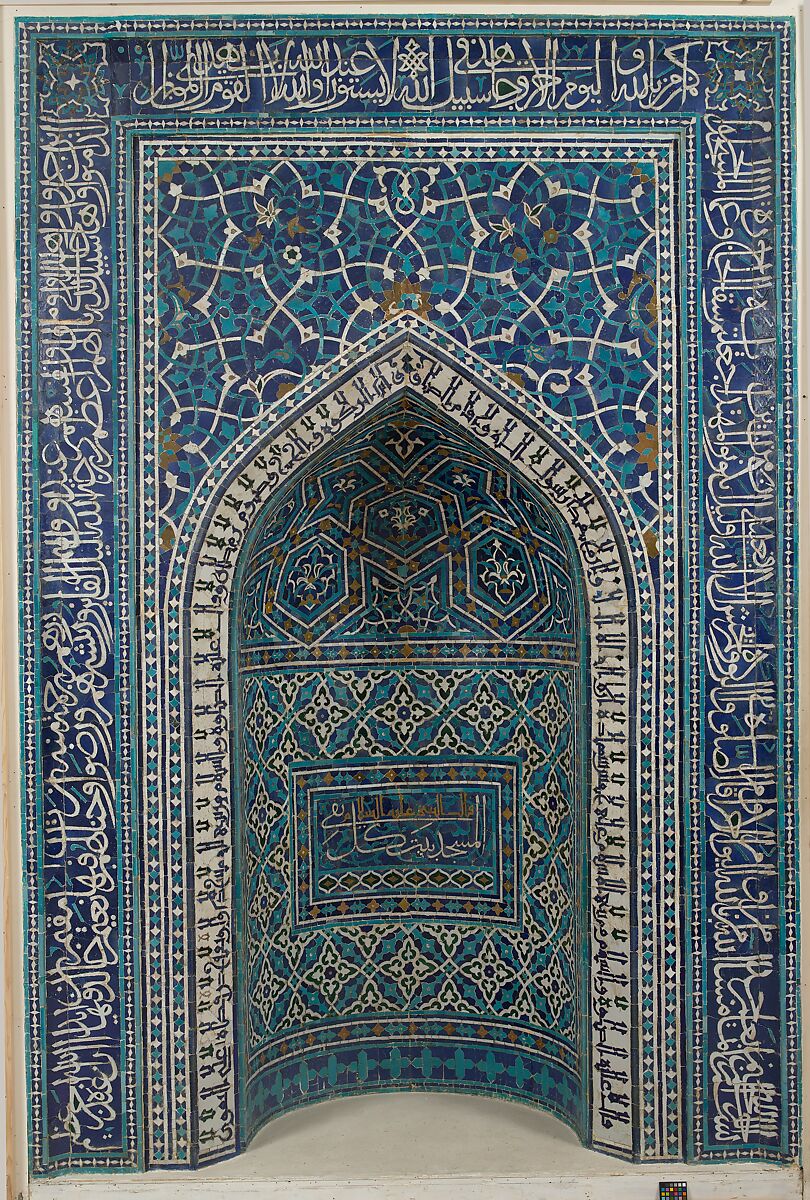
The comparison also has a limit. Museum images isolate objects from their original rooms, changing light, approach and surrounding surfaces. They are valuable records, but they cannot reproduce the complete original experience. This research uses them to examine identifiable material and compositional features, not to claim a reconstructed sensory history.
When ornament becomes an environmental element
A perforated screen may participate in shading, privacy or airflow, but its visual complexity is not evidence of effective performance. The relevant questions include orientation, opening size, depth, spacing, distance from glazing, adjacent obstructions and the way the room is used. The design team must define the intended function before choosing a pattern to represent it.
Consider an original hypothetical comparison. Two screens have the same outline when viewed straight on. One is thin and mounted close to glass; the other has deeper openings and a different separation from the facade. They may look similar in an elevation while producing different views and solar exposure. This is a design hypothesis to test, not a claim of a particular percentage improvement.
Privacy also depends on direction and lighting conditions. A screen that limits views inward in one situation should not be assumed to do so under every nighttime arrangement. The proper test includes the relevant viewing positions and actual internal and external lighting. A marketing label such as “privacy pattern” is not an adequate specification.
The same caution applies to acoustics. A carved wall is not automatically an acoustic treatment, and a perforated panel is not automatically an absorber. Its complete construction and the relevant performance evidence matter. Ornament can be integrated into a tested system, but it should not borrow technical claims merely because the surface appears complex.
Materials change the meaning of the same line
A line cut in stone, assembled from tile, carved in wood or printed on fabric has a different relationship to thickness, touch, joints and repair. Selecting material after the pattern is fixed can force the design into avoidable compromises. The more useful sequence is to develop pattern and material together.
For a tiled surface, the module and joint are part of the composition. For a perforated metal panel, the supports and edges cannot disappear from the construction drawing simply because they were hidden in the rendering. For carved plaster, fragility, cleaning and the treatment of vulnerable edges need attention. For textiles, seams, folding and the direction of the body or furniture change how the pattern is seen.
These are proposed design considerations, not blanket rankings of materials. No material is automatically more authentic, more sustainable or more appropriate because it resembles a familiar historic finish. A contemporary material can be used honestly; an imitation becomes misleading when its presentation conceals how it actually works or claims a history it does not have.
Repairability deserves a place in the initial brief. Can a damaged unit be removed without dismantling a large field? Are replacement patterns and colours recorded? Will a future repair be identifiable and compatible? Is access to the fixing available? An ornament that cannot survive ordinary maintenance has been designed for its opening photograph rather than its full life.
Calligraphy must survive translation into construction
The translation from writing to a building can introduce errors at several stages. A designer may distort proportions to fit a panel, a fabrication file may reverse a component, or a site joint may interrupt a word. These are reasons to preserve responsibility for the text from concept through installation, rather than consider approval complete when the first illustration is accepted.
The proposed process separates approval of wording, approval of calligraphic composition and approval of the installed result. The same reviewer does not necessarily cover every task. A readable directional sign and an ornamental inscription also have different purposes. The presence of one should not be used as an excuse to omit the other.
The location of sacred text requires particular care and appropriate advice. The architect should not make an independent religious ruling from a visual reference. Questions of position, handling, maintenance and possible misuse belong in the early brief, before a pattern is repeated across floors, furniture, packaging or clothing.
This discipline extends to automated image generation. A convincing image of script is not proof that the words are correct. Any generated proposal containing text needs independent verification and a controlled production file. Visual plausibility cannot replace linguistic accuracy.
The contemporary interior needs hierarchy, not saturation
An interior can communicate identity without assigning a pattern to every surface. A dense wall, patterned floor, intricate ceiling and richly printed furniture may each be attractive in isolation while competing when combined. The question is where the visitor should look, what should remain quiet and how the composition changes through movement.
One approach is to establish a primary ornamental element and allow other surfaces to support it through colour, proportion or material. Another is to use a repeated vocabulary at different scales, provided the relationships remain deliberate. Neither is a universal style rule. They are strategies to test against the intended use and the visual demands already present in the room.
In a hotel lobby, ornament might organise an arrival point or a screened waiting area. In a home, it might contribute to a threshold or a piece of joinery. In a museum, it must coexist with the objects and interpretation. In a mosque, it needs to be considered alongside worship, reading and orientation. The same motif may be appropriate in several places, but its density and role need not be identical.
Furniture and clothing make the issue especially clear. A pattern moves differently across a rigid panel and a folded fabric. Seams, handles, cushions and bodily movement alter its continuity. This is not a reason to avoid transferring motifs between media. It is a reason to redesign the relationships rather than treat transfer as a simple change of scale.
Digital tools can extend a tradition without explaining it away
Lin and Kaplan’s research presents a computational method for generating freeform geometric compositions using circle packing and related polygonal arrangements. [9] The consulted record establishes a method for pattern generation. It does not demonstrate reduced building energy use, improved wellbeing or the historical intentions of earlier makers.
The opportunity for practice lies in using computation to explore alternatives while keeping the design criteria explicit. A team can compare patterns against fabrication constraints, local dimensions and the need for openings. It can also preserve a clear record of how the design was generated, making future changes more manageable.
The danger is to treat the number of variations as a substitute for judgment. Hundreds of generated panels do not resolve which one belongs in a particular building. Nor does a complex algorithm confer cultural authority. The designer still needs to explain the sources, the changes, the material logic and the intended experience.
Craft knowledge should enter that process early. A maker can identify where a fragile connection, awkward joint or impractical sequence is hidden inside an elegant drawing. Digital production and skilled manual work need not be presented as opposing camps. Their relationship should be assessed through the quality, maintainability and honesty of the resulting work.
A practical brief for Islamic ornament
The following framework is an original proposal for commissioning and reviewing ornament. It is intended to make decisions inspectable rather than prescribe a particular historical style.
| Stage | Question to resolve | Evidence or deliverable |
|---|---|---|
| Purpose | What should this ornament contribute here? | A clear statement separating visual, cultural and technical aims |
| Reference | Which traditions or objects inform it? | Identified sources and an account of deliberate changes |
| Composition | How do units, borders, openings and corners work? | Drawings showing the complete field and its interruptions |
| Text | Are wording, script and placement appropriate? | Relevant linguistic, calligraphic and contextual approval |
| Material | Can the pattern be made and maintained as drawn? | Fabrication details and consultation with the maker |
| Performance | Which benefits are being claimed? | Appropriate simulation, testing or measured evidence for those claims |
| Prototype | Does it work at the intended scale? | A sample or mockup under relevant viewing and lighting conditions |
| Handover | Can another team repair or reproduce it? | Material records, production files and a maintenance strategy |
A prototype should include a difficult condition, such as a corner, opening or joint. Testing only a perfect central fragment leaves the most consequential coordination unresolved. Where light or privacy is part of the purpose, the mockup should be assessed in the relevant configuration rather than photographed under a favourable studio light.
Evaluation after installation is equally useful. The team can examine whether the text remains legible, whether cleaning is practical, whether components have been damaged and whether the intended spatial role is apparent to users. These observations should inform correction and future projects. They should not be converted into universal psychological conclusions without an appropriate study.
Ornament is a relationship that must be built
Islamic ornament becomes architecturally significant when its visible order is connected to a place, a material and an activity. Its history offers more than a library of stars and leaves. It offers evidence of makers negotiating pattern, writing, craft and architectural purpose across different contexts.
Contemporary practice can continue that work without copying every inherited form or claiming that every new pattern is an innovation. It can identify what it has learned, what it has changed and what remains to be tested. It can allow beauty to be a legitimate aim while refusing to attach unsupported technical benefits to it.
The strongest question is therefore not simply whether a building has Islamic ornament. It is whether the ornament belongs to the way that building is encountered, understood, used and cared for. A final decorative layer can change an image. A designed relationship can change the experience of a space.
Sources and reading limits
- Department of Islamic Art, The Metropolitan Museum of Art. The Nature of Islamic Art. 2001. Curatorial essay consulted for the scope and diversity of the category.
- Department of Islamic Art, The Metropolitan Museum of Art. Geometric Patterns in Islamic Art. 2001. Curatorial essay consulted; no claim to a complete history of mathematical practice.
- Department of Islamic Art, The Metropolitan Museum of Art. Vegetal Patterns in Islamic Art. 2001. Curatorial essay consulted for variation and development of vegetal ornament.
- Department of Islamic Art, The Metropolitan Museum of Art. Calligraphy in Islamic Art. 2001. Curatorial essay consulted for the relationship between writing and ornament.
- Lu, Peter J., and Paul J. Steinhardt. Decagonal and Quasi-Crystalline Tilings in Medieval Islamic Architecture. Science, 2007, 315(5815), pp. 1106–1110. DOI: 10.1126/science.1135491. Accessible paper sections on construction, subdivision and limits consulted. Its historical interpretation is attributed to the authors.
- Lu, Peter J., and Paul J. Steinhardt. Response to Comment on Decagonal and Quasi-Crystalline Tilings in Medieval Islamic Architecture. Science, 2007, 318(5855), p. 1383b. DOI: 10.1126/science.1146352. Princeton institutional abstract and bibliographic record consulted, not the complete debate.
- The Metropolitan Museum of Art. Pierced Window Screen (Jali), object 1993.67.2; related educational resource, Image 15. Object record and educational discussion consulted. No new environmental measurements were made.
- The Metropolitan Museum of Art. Mihrab (Prayer Niche), object 39.20, dated 755 AH/1354–55 CE. Object record consulted for origin, material, date and inscriptions.
- Lin, Rebecca, and Craig S. Kaplan. Freeform Islamic Geometric Patterns. arXiv:2301.01471, submitted 2023. DOI: 10.48550/arXiv.2301.01471. Repository abstract consulted; cited as a computational research record, without asserting a publication status not verified here.
Image note: the cover artwork was supplied for this publication. The two internal object images are identified by The Metropolitan Museum of Art as Public Domain. Captions identify their collection records. The cover is illustrative and is not documentation of a historical object.