When Water Changes the Surface: Pitcher Plants and Entrance Floor Testing

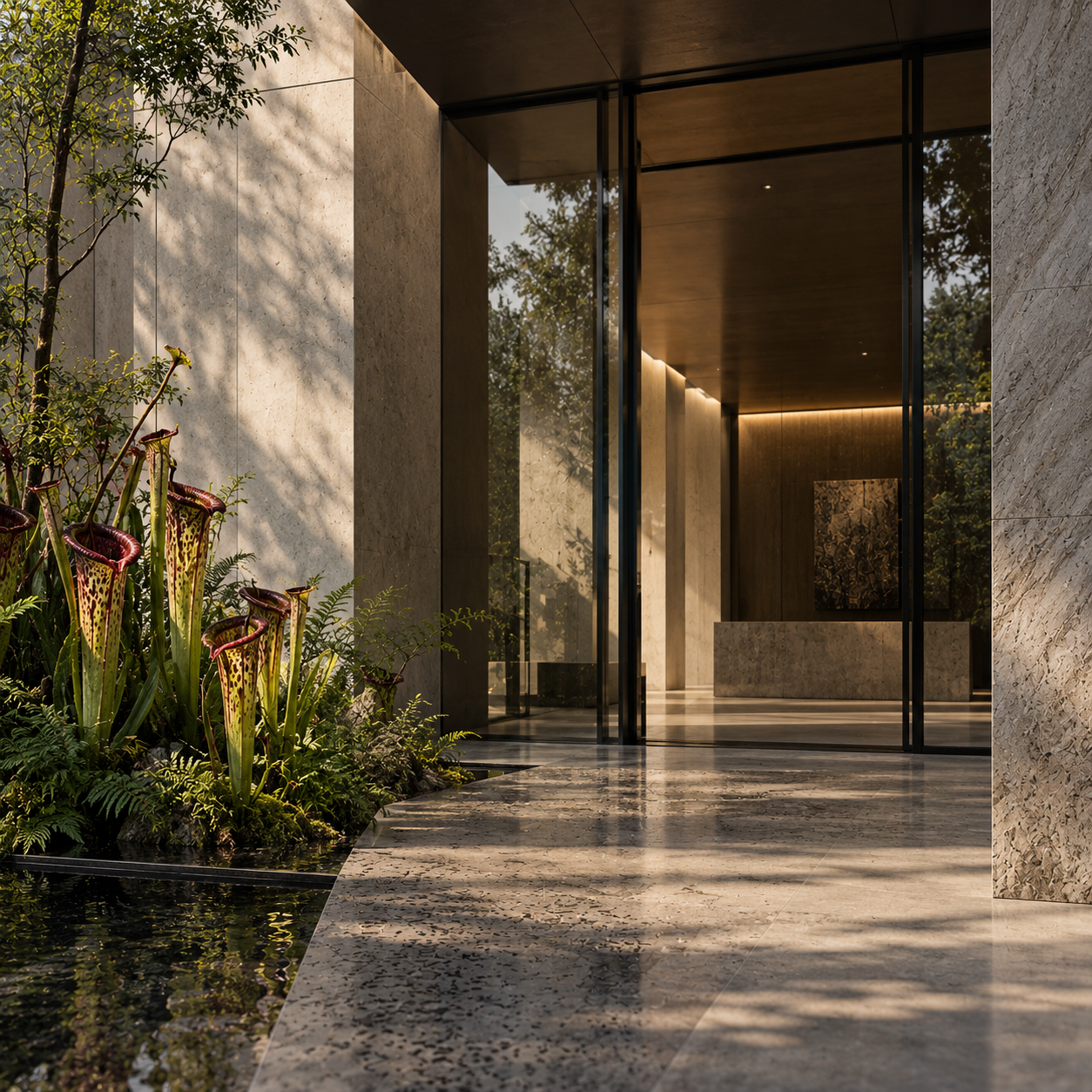
An entrance floor is selected as a material but used as a changing surface. A visitor encounters the finish together with whatever has accumulated on it, and at a particular moment after rain or cleaning. For architects and contractors, this raises a practical research question: what should an entrance mock-up demonstrate before its finish and maintenance routine are accepted?
Research on Nepenthes pitcher plants provides an unusual starting point. This ArchUp investigation develops an architectural testing proposal from two biological studies. It reports no new experiment, and the proposed application remains unvalidated.
The biological finding: wetness changes attachment
Holger F. Bohn and Walter Federle’s 2004 study compared ant attachment on dry and wetted pitcher rims. Water disrupted the adhesive pads, while directional surface geometry affected claws differently. Drying and rewetting reversed the trapping effect. The force measurements involved 62 repeated cycles on 13 ants, not 62 independent animals.
A subsequent study by Ulrike Bauer, Holger F. Bohn and Walter Federle, published online in November 2007 and in a 2008 journal issue, connected changing capture performance with rain, condensation and nectar. Nectar’s contribution was mainly indirect: its moisture-attracting properties helped sustain wetness. Electrical conductance tracked wetting changes but could not establish the absolute amount of liquid.
What the evidence does and does not establish
The first study appeared online on 21 September 2004, with an issue date of 28 September. The follow-up’s online date was 29 November 2007 and its issue date 7 February 2008. Neither investigated shoes or architectural floors. Their limited biological samples and species-specific mechanisms do not establish a human slip threshold or justify copying the plant’s texture.
That boundary is central to the architectural interpretation. The transferable question concerns how performance is assessed across changing conditions. A plant rim, a shoe sole and an installed tile have different geometries, materials, loads and contact times. Even a convincing resemblance would leave the building application to be tested independently.
ArchUp’s proposal: commission an entrance through its operating states
Consider a proposed entrance linking an exposed forecourt to an interior lobby. The mock-up would include the selected finish, joints, threshold and intended water-management details. The design team would also specify the actual cleaning product, its prescribed dilution and the planned cleaning sequence. These are proposed test inputs, not findings from the plant studies.
The hypothesis is that evaluating this assembled entrance at several points during a wetting and cleaning cycle will reveal weaknesses that a single dry inspection cannot capture. It may also help distinguish a finish problem from a drainage, detailing or maintenance problem. ArchUp has not demonstrated either outcome.
The contractor would prepare comparable assemblies using the proposed finish and a reference finish. Keeping geometry constant would allow a first comparison of materials. A separate comparison, with material held constant, could investigate a drainage or joint-detail change. Changing both at once would make any improvement harder to explain.
A verification protocol, before any claim of improvement
- Define the scope. Record the intended users, likely footwear, exposure and cleaning routine. Appoint a competent testing specialist to select the relevant recognised method and project acceptance criteria before testing.
- Define repeatable conditions. Examine a clean dry baseline, controlled water exposure, the specified cleaning sequence and the subsequent drying period. Measure liquid application and elapsed time rather than describing the floor simply as “wet”.
- Record contact performance and recovery separately. Use the selected floor-testing method, document surface condition and track how long the assembly takes to regain its agreed usable condition. A moisture reading alone must not stand in for a friction assessment.
- Repeat and control. Use multiple specimens and randomise the comparison order where practicable. Include a documented wear or maintenance-conditioning sequence if long-term performance is part of the claim. Report variability, not only the best result.
- Set a decision rule. If the proposed assembly performs no better than the reference, reject the improvement claim. If performance depends on a cleaning routine the operator cannot maintain, revise the design or its operating assumptions before acceptance.
This is a proposed investigation framework, not a completed floor specification or a substitute for applicable requirements. Initial testing should use controlled apparatus, not ask people to walk across deliberately hazardous samples. Any later human study would require its own justified design and safeguards.
✦ ArchUp Editorial Insight
The architectural opportunity lies in expanding what is handed over. Alongside a finish sample, the project could deliver evidence describing how the installed entrance behaves after water exposure and cleaning, which conditions were tested, and which remain uncertain.
That would give the architect, contractor and facilities team a shared record of the assumptions behind acceptance. The same appearance would no longer be treated as evidence of the same performance throughout the day. The proposition is modest and testable: assess a surface through its operating states, then let building-specific evidence determine whether the design works.
References
Holger F. Bohn and Walter Federle. Insect aquaplaning: Nepenthes pitcher plants capture prey with the peristome, a fully wettable water-lubricated anisotropic surface. Proceedings of the National Academy of Sciences, 2004.
Ulrike Bauer, Holger F. Bohn and Walter Federle. Harmless nectar source or deadly trap: Nepenthes pitchers are activated by rain, condensation and nectar. Proceedings of the Royal Society B, 2008.