The Surface Feels Wet. Is It? Rethinking Bathroom Touch and Drying Tests

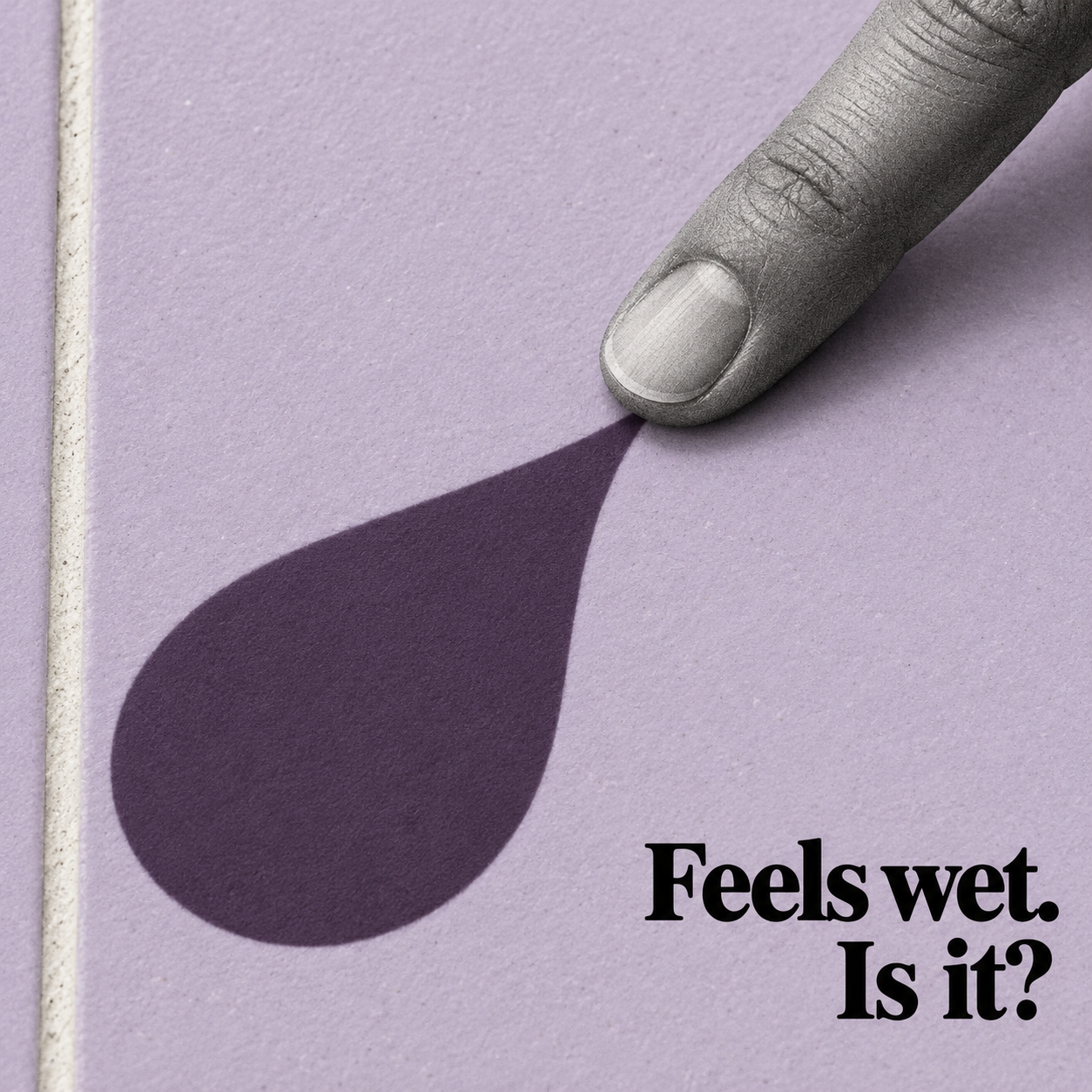
A bathroom surface can feel damp without that judgement establishing how much water remains on it. For architects and operators, the distinction matters at the moment a cleaned shower room returns to use: a hand check, a drying record and a slip-resistance assessment answer different questions.
This research-led analysis connects the science of touch with a specific architectural proposition: testing bathroom contact surfaces under their intended cleaning and temperature conditions. The proposed procedure is an ArchUp hypothesis, not an experiment performed by the cited researchers or a validated acceptance standard.
What the original experiment established
Davide Filingeri, Damien Fournet, Simon Hodder and George Havenith published their study in the Journal of Neurophysiology in 2014, first online on 18 June. Thirteen healthy young men encountered equally wetted stimuli at 25, 30 and 35°C on the forearm and index finger. Colder contact produced stronger wetness sensations; movement supplied additional tactile information. Reducing A-fibre activity also reduced perceived wetness. The findings support a multisensory account of wetness perception.
Why “feels wet” needs its own category
Oliver Typolt and Davide Filingeri extended this question in 2020. Dry cooling elicited wetness sensations across tested body regions, and menthol stimulation also elicited wetness sensations. Their results implicate cold-sensitive TRPM8 channels. They do not establish a dedicated water detector or show that all dampness complaints have a sensory rather than a physical cause.
For an architectural investigation, three records should therefore remain distinct. The first describes the physical state of the surface, including detectable water. The second records how a person experiences contact. The third establishes performance for the intended activity. A user’s report belongs in the second record and may prompt investigation of the others; it cannot settle them.
Consider a proposed comparison between two shower seats or grab-rail finishes. If people describe one as damper, the project team should not immediately conclude that it retains more water or that it is inadequately cleaned. Conversely, a comfortable, apparently dry sensation cannot certify hygiene, drainage or safe grip. Those are separate claims requiring suitable evidence.
Limits that prevent a shortcut from laboratory to bathroom
The 2014 study’s small, male sample and arm-and-finger protocol limit generalisation to diverse building users and barefoot movement. Neither cited experiment tested bathroom reopening or slip resistance. Their sensory mechanisms motivate a question; they do not validate a building specification.
The key methodological objection to an architectural extrapolation is a mismatch of outcomes. A rating of perceived wetness is not a measurement of friction, residual detergent or the time required for a room to become usable. A successful demonstration of perceptual differences would still leave all those questions open. In a real bathroom, visual information, expectations, contact duration and cleaning residues would also need to be controlled or recorded rather than assigned to temperature by assumption.
A bounded architectural application
ArchUp proposes beginning with a shower seat, bench edge or grab rail in a full-size bathroom mock-up. These are contact surfaces that can be assessed without asking participants to walk on an intentionally slippery floor. The question would be whether the selected finish and operating condition produce a repeatable mismatch between recorded surface moisture and reported dampness.
The project should define which decision the result could change before testing. Possibilities include a material substitution, an altered drying procedure, or clearer criteria for investigating user complaints. A perceptual result alone would not justify reducing cleaning, accelerating reopening or removing a safety measure.
How to test the proposition
- Keep the specimen realistic. Use the proposed finish, substrate, joints and cleaning products. Record surface and room temperatures, humidity, cleaning sequence and elapsed time.
- Establish the physical baseline. Have the testing team select and calibrate a surface-water method suitable for the material. Distinguish surface water from moisture within a porous substrate; document detection limits and measurement uncertainty.
- Separate the experimental factors. Compare dry and controlled-wet conditions across realistic, comfortable surface temperatures. Keep contact area, duration and pressure consistent. Randomise order and conceal condition labels; run a later comparison with normal visual information.
- Record experience separately. Ask participants for dampness, thermal comfort and confidence in contact as separate ratings. Recruit for the intended user population, justify sample size and obtain appropriate ethics review for human research.
- Verify functional requirements independently. Use competent testing for grip, slip resistance, hygiene and drainage where relevant. Do not substitute the sensory exercise for applicable project requirements.
- Repeat the cleaning cycle. Compare results after repeated use and cleaning, then give the operator the conditions and limits of the test with the material schedule.
The hypothesis would gain support if perceived dampness changes reproducibly while measured surface water is held constant. A null result would also matter: it would argue against using this mechanism to justify that project’s finish change. No accident-reduction or labour-saving claim follows unless a separate evaluation measures it.
✦ ArchUp Editorial Insight
Pressure to return rooms to service can turn a quick sensory judgement into an informal acceptance rule. Where a cleaning contract measures completed rooms while a material specification records finish and durability, neither document necessarily defines what “dry enough to reopen” means. The worker then has to translate an ambiguous tactile impression into an operational decision, although the choice of surface and its thermal conditions may have been settled elsewhere. This is a proposed institutional risk, not a documented finding of the sensory experiments. It resembles the division of responsibility examined in ArchUp’s analysis of who owns the bedroom’s night operating condition: installation approval can leave an important state of use outside the evidence required at handover. For bathroom surfaces, a useful contract provision would distinguish verified physical conditions, mandatory performance checks and reports of discomfort, and assign a response to each. The material schedule could then carry the tested cleaning and drying conditions into operations. That would make a dampness complaint investigable without automatically blaming the cleaner or dismissing the user. The architectural consequence would be a surface selected together with its maintainable operating conditions, rather than an appearance whose practical interpretation is delegated after procurement.
References
- Davide Filingeri, Damien Fournet, Simon Hodder and George Havenith. Why wet feels wet? A neurophysiological model of human cutaneous wetness sensitivity. Journal of Neurophysiology, 2014.
- Oliver Typolt and Davide Filingeri. Evidence for the involvement of peripheral cold-sensitive TRPM8 channels in human cutaneous hygrosensation. American Journal of Physiology-Regulatory, Integrative and Comparative Physiology, 2020.