
The City Decides Whether It Rains

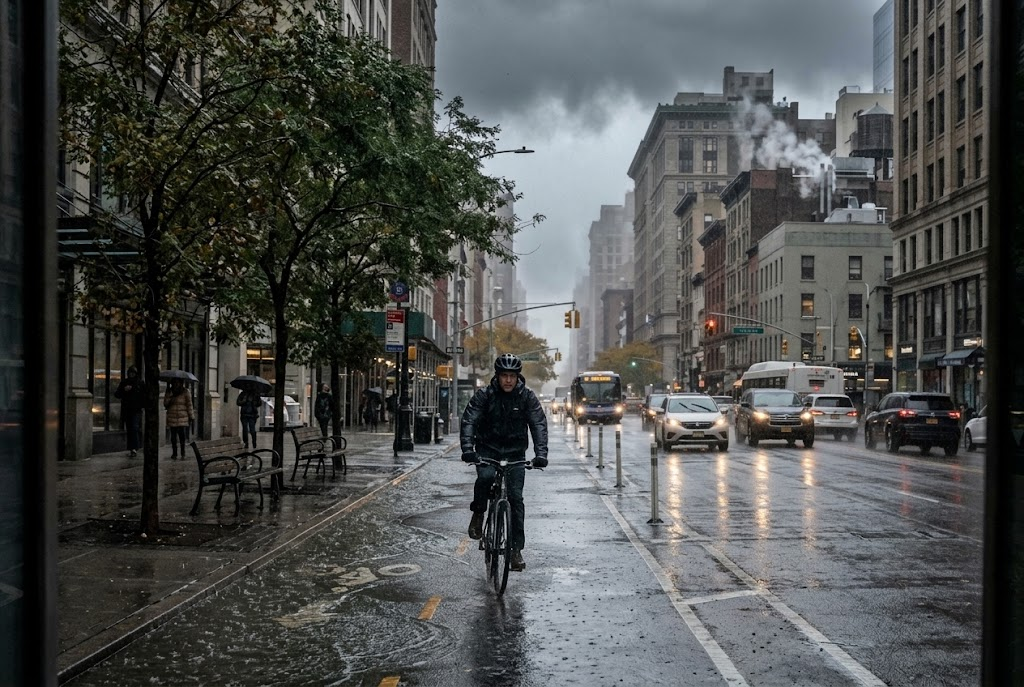
Weather and calendar variations strongly influence daily cycling levels, with extreme temperatures, rain, and wind acting as deterrents. However, the extent to which severe weather reduces cycling varies significantly between cities, driven by differences in established bicycle culture, infrastructure, and local urban design.
Urban planners can mute weather impacts by designing street microclimates through shade, tree canopies, wind protection, and winter maintenance. Treating microclimate as core infrastructure ensures cycle networks remain functional year-round, supporting reliable mobility and equity for populations with limited transportation alternatives.
There is a number in the research on cycling that should stop any urban planner cold. In a study of Polish data, roughly seventy one percent of the day to day variation in how many people cycled was explained by weather and the calendar alone, before land use or infrastructure or anything a city designs was even considered. Weather, in other words, is not a nuisance to be filtered out of the data. It is the single most powerful force acting on whether a person gets on a bicycle on any given morning, and cycling is the most weather exposed of all the ways people move, far more elastic than walking and vastly more than the sealed, climate controlled car. This is usually read as bad news for anyone trying to build a cycling city, a reminder that the sky holds a veto over the best bike lane. Read more carefully, the same body of evidence says something far more interesting and far more useful, which is that the degree of that veto is itself a design decision, and that the mature cycling city is precisely the one that has quietly stripped the weather of its power.
That reframing is the whole argument, and it matters because it moves the weather from the category of fate into the category of design. A city cannot change the temperature or stop the rain. But the research shows, repeatedly and across continents, that two cities facing identical weather can experience completely different cycling responses to it, and that the difference is made by infrastructure, by culture, and by the microclimate of the street, all of which are things that planners and architects actually control. The question for urban planning is therefore not whether weather suppresses cycling, because it always does to some degree, but how much a city chooses to let it.
The Shape of the Weather Effect
Before the planning lesson, the mechanism has to be understood accurately, because its details are where the design opportunities hide. Temperature is normally the most important single variable, but its effect is not a straight line. It is a curve that rises to an optimum somewhere between roughly twenty and twenty eight degrees and then flattens or reverses, so that beyond a certain warmth additional heat begins to suppress cycling rather than encourage it. The optimum sits around twenty four or twenty five degrees in one European city, near twenty eight in New York bike share data, lower still on some marine climate trails. And the curve is asymmetric in a way that matters enormously for cold cities, because cold deters far more forcefully than moderate warmth attracts. Cycling in one Canadian study began losing riders below about fifteen degrees while walking held up until far colder, and cycling proved about twice as sensitive to cold as walking. The implication is immediate. A city that wants winter cycling is fighting a steeper slope than a city managing a warm summer, and it must design accordingly.
Rain reduces cycling in essentially every study ever conducted, but again the detail is instructive. The reduction scales with intensity and duration, and it carries lagged and anticipatory effects that reveal cycling as a planned rather than impulsive act. Rain in the previous few hours suppresses current cycling almost as much as rain falling now, morning rain cuts afternoon commuting because the commuter already decided at breakfast to take another mode, and riders who merely see rain in the forecast for their evening return are measurably less likely to take the bicycle in the morning. People are not reacting to weather. They are planning around their expectation of it, which means the information environment, the forecast, the perceived reliability of conditions, is itself part of what shapes behaviour. Snow and ice are stronger deterrents than rain, consistently the largest single negative weather effect in the data, and wind suppresses cycling about twice as much as it suppresses walking. Darkness, humidity, and the full thermal comfort of a street, the combination of sun, wind, and radiation rather than air temperature alone, all press in the same direction.
The Finding That Changes Everything for Planners
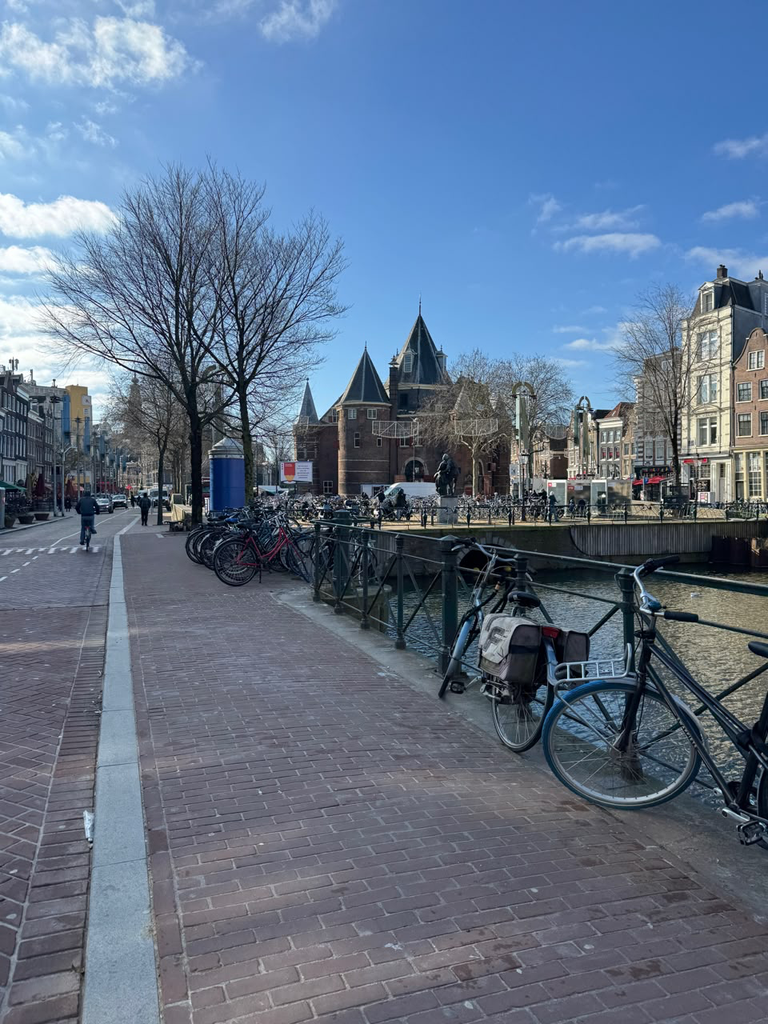
If the story ended there it would be a counsel of despair, a long list of atmospheric forces beyond anyone’s control. It does not end there, and the turn is the most important thing in the entire literature for anyone who shapes cities. When researchers compared thirty German cities using automated counters, they found that the weather elasticity of utilitarian cycling differed significantly from city to city, and that several cities, Münster and Oldenburg and Göttingen among them, showed almost no statistically detectable weather response at all. People in those cities cycled through conditions that would have emptied the bike lanes elsewhere. The researchers interpreted this low weather sensitivity as a revealed indicator of an established bicycle culture, a signature in the data of a place where cycling has become simply what one does, rain or shine, because the alternative has been made inconvenient and the cycling itself has been made easy and normal.
A cross comparison of four northern city regions sharpened the same point. Temperature raised cycling in Utrecht and Oslo and Stockholm but not in car dominated Stavanger, and rain and wind significantly depressed cycling only in Utrecht, where cycling’s share of all trips is very high. This looks paradoxical until it is read correctly. The city with the most cyclists showed weather effects precisely because it has so many discretionary, weather sensitive riders at the margin, while the car dominated city was weather insensitive for the bleak reason that almost nobody was cycling in any weather. Snow shortened trips in some cities but not in Oslo or Stockholm, because those places and their residents are adapted to snow through systematic clearing and long experience. The lesson that the researchers draw explicitly, and that every planner should internalise, is that weather elasticities cannot be transferred from one city to another. The same rain is a minor inconvenience in one place and a trip ending event in another, and the difference is manufactured by the city.
Microclimate Is Infrastructure
This is where the discipline of the built environment enters, because if culture and infrastructure can mute the weather, then the physical design of the street, and the architecture that lines it, is a climate instrument. The research has begun to say this directly. A recent review of urban nature and cycling found that the positive association between greenery and cycling becomes less stable under harsher climatic conditions, and it argues for a decisive shift in how we classify street trees and blue and green infrastructure. These are not amenities, not aesthetic nice to haves to be cut from the budget when money is tight. They are climate resilient infrastructure that provides the shading and the thermal comfort which, in a warming world, determine whether a route is usable at all. A row of trees along a cycle route is not landscaping. It is a microclimate machine, lowering the effective temperature of the corridor, breaking the wind, and shifting the street back down the temperature curve toward the optimum at which people actually ride.
Once microclimate is understood as infrastructure, the design program for a cycling city becomes concrete and climate specific. In hot cities the enemy is the upper half of the temperature curve, so the work is shade, tree canopy, misting, orientation that keeps the path out of the worst sun, the deliberate construction of a cool corridor through a hot city. In cold cities the enemy is the steep deterrent of cold and the dominating effect of snow and ice, so the work is systematic snow clearing of cycle paths, protection from wind, and in some cities even sheltered or heated routes. The construction of a bike lane, in this reading, is only the skeleton of the intervention. The microclimate wrapped around that lane, the canopy above it and the clearing regime applied to it, is what actually decides whether the lane carries riders in July and January or stands empty. This is a far more demanding brief than painting a line on asphalt, and it is the brief the evidence actually supports.
Who the Weather Punishes
There is an equity dimension running through all of this that urban planning cannot ethically ignore, because the weather does not fall on everyone equally once the city is involved. Sensitivity to weather is heterogeneous in ways that track vulnerability. Commuter cycling is less weather elastic than recreational cycling, weekend discretionary trips bend to the weather far more than weekday necessity, and crucially the research in hot climates finds that rising heat suppresses the intention to use low carbon transport and to be physically active most strongly among older and lower income groups, with the absence of shading and cooling named as a major barrier. This means that a failure to design the microclimate of the street is not a neutral omission. It falls hardest on exactly the people with the fewest alternatives, the person who cannot simply retreat into an air conditioned car, and it quietly converts a transport question into a question of justice.
The same equity logic appears on the cold side and in the infrastructure data. The German comparison found that cities with a larger share of residents under eighteen, people without access to a car, and with a denser cycle network showed smaller weather elasticities, which is to say that where people have no alternative and the network is good, they ride regardless of the sky. Weather sensitivity, read this way, is partly a measure of how many of a city’s cyclists are riding by genuine choice at the fragile margin and how many are locked into cycling by necessity. A humane cycling policy does not simply celebrate high ridership. It asks who is being left off the bicycle on the bad days, and it designs the shade and the shelter and the clearing for them first.
The Limits of Technology, and the Honesty the Data Demands
It is tempting to hope that technology dissolves the whole problem, and the electric bicycle genuinely helps, but the research insists on an honesty here that planners should keep. Electric pedal assistance attenuates weather sensitivity without removing it. In a Dutch programme, electric bike commuting stayed high across conditions but was still reduced by snow and ice, by heavy precipitation, and by strong wind, in that order, with wind mattering less than for a conventional bicycle because the motor offsets part of the physical effort. The assistance flattens the hills and shortens the felt distance, but it does not make rain dry or ice safe. Shared electric scooters appear somewhat less weather sensitive again, mostly because the trips are shorter and demand less effort, but every pedal and wheeled mode in the open air remains exposed to the sky in a way the car is not. Technology shifts the curve. It does not abolish it, and a planning strategy that leans entirely on the electric bicycle to solve a climate exposure problem is leaning on a partial fix.
The deepest methodological warning in the research is also the one with the most direct consequence for practice, and it is the warning against transferring numbers between places. Because elasticities are so strongly moderated by climate and culture and infrastructure, a figure measured in one city is not a reliable guide to another, and a short counting campaign conducted in fair weather will systematically overstate a city’s true cycling levels unless it is weather corrected. The serious architectural research and urban analysis that a cycling strategy should rest on therefore has to be local, measured in the actual city under its actual weather across a full year, rather than borrowed from a famous cycling capital whose conditions and culture do not apply. A plan built on Utrecht’s numbers in a hot or a car dominated city is a plan built on a mirage.
What the City Should Take From the Sky
So the conclusion that the evidence actually supports is not the fatalistic one that weather limits cycling and little can be done. It is the far more demanding and more hopeful proposition that the weather’s power over a city’s cycling is itself a variable the city sets. The atmospheric forces are fixed, the temperature curve and the rain penalty and the bite of cold and wind are real and universal, but the degree to which a given city surrenders its cyclists to those forces is made by culture, by the density and safety of the network, and above all by the microclimate that design wraps around the route. The mature cycling city is legible in the data precisely as the city whose cycling barely responds to the weather any more, and it reached that state not by waiting for a better climate but by building one at street level, corridor by corridor.
This reframes a great deal of what passes for cycling policy. The news will keep reporting the ribbon cuttings of new bike lanes as though the painted line were the achievement, and the design competitions will keep rewarding the elegant rendering of a sunny cycle path full of smiling riders, but the real test arrives in the rain and the heat and the dark, on the days the rendering never shows. A cycle network without canopy, without wind protection, without a snow clearing regime, without the shaded cool corridor in the hot city and the sheltered cleared one in the cold, is a fair weather network, and its ridership will rise and collapse with the sky because the city never took the sky’s power away from it. The genuine sustainability of active mobility, its capacity to carry real numbers of people out of cars and keep carrying them through a warming and more volatile climate, depends on treating microclimate as the core infrastructure it is, and on designing the street so that fewer and fewer people, especially the oldest and the poorest and those with no other way to move, are turned back by the weather. The city cannot decide whether it rains. It can decide, to a remarkable and measurable degree, whether the rain still empties the bike lane, and that decision is one of the quieter but more consequential projects a planner will ever undertake.
✦ ArchUp Editorial Insight
The essay’s governing move is to take a finding that reads as fatalism — that roughly seventy-one percent of daily variation in cycling is explained by weather and the calendar before any designed variable enters — and invert it into a design mandate, because the decisive evidence is that two cities facing identical weather experience completely different cycling responses to it, which relocates the weather from the category of fate into the category of a variable the city sets. The most structurally consequential observation is that weather elasticity itself is a revealed signature in the data: the mature cycling city is legible precisely as the one whose ridership barely responds to the sky any more, having stripped the weather of its power corridor by corridor rather than waiting for a better climate. This reframes microclimate — the tree canopy, the wind protection, the snow-clearing regime — not as amenity but as core infrastructure, the same reclassification this archive traced in The Economics of Indoor Air Quality, where the environmental systems that determine whether a space is usable are funded last and cut first precisely because they are misfiled as discretionary. The essay’s sharpest contribution is its equity reading, which names the liability transfer directly: the failure to design the street’s microclimate falls hardest on the oldest, the poorest, and those with no air-conditioned car to retreat into, converting a transport question into a question of justice and echoing the distributional logic this archive documented in The Rent You Pay After the Rent, where the absent design consideration always lands on the party with the fewest alternatives. The closing verdict is the correct one: the ribbon-cutting rewards the painted line and the competitions reward the sunny rendering full of smiling riders, but the real test arrives in the rain and the heat and the dark on the days the rendering never shows, and a network without canopy or shelter or clearing is a fair-weather network whose ridership will collapse with the sky because the city, having photographed the lane on its opening day, never took the sky’s power away from it.
Sources
- Dovbischuk T. Cycling with nature in cities: a scoping review considering weather and climate. Transport Reviews, 2025.
- Ermagun A, Lindsey G, Loh TH. Urban trails and demand response to weather variations. Transportation Research Part D, 2018.
- Böcker L, Priya Uteng T, Liu C, Dijst M. Weather and daily mobility in international perspective: a cross comparison of Dutch, Norwegian and Swedish city regions. Transportation Research Part D, 2019.
- Pazdan S, Kiec M, D’Agostino C. Impact of environment on bicycle travel demand, assessment using bikeshare system data. Sustainable Cities and Society, 2021.
- Nosal T, Miranda-Moreno LF. The effect of weather on the use of North American bicycle facilities: a multi city analysis using automatic counts. Transportation Research Part A, 2014.
- An R, Zahnow R, Pojani D, Corcoran J. Weather and cycling in New York: the case of Citibike. Journal of Transport Geography, 2019.
- Saneinejad S, Roorda MJ, Kennedy C. Modelling the impact of weather conditions on active transportation travel behaviour. Transportation Research Part D, 2012.
- de Kruijf J, van der Waerden P, Feng T, Böcker L, van Lierop D, Ettema D, Dijst M. Integrated weather effects on e-cycling in daily commuting. Transportation Research Part A, 2021.
- Goldmann K, Wessel J. Some people feel the rain, others just get wet: an analysis of regional differences in the effects of weather on cycling. Research in Transportation Business and Management, 2021.
- Noland RB. Scootin’ in the rain: does weather affect micromobility? Transportation Research Part A, 2021.
- Liu YY, Chiu YH, Liu ST. Effects of high urban temperatures on use of low carbon transportation and participation in outdoor physical activities. City and Environment Interactions, 2026.