
The Discipline That Optimizes the Given

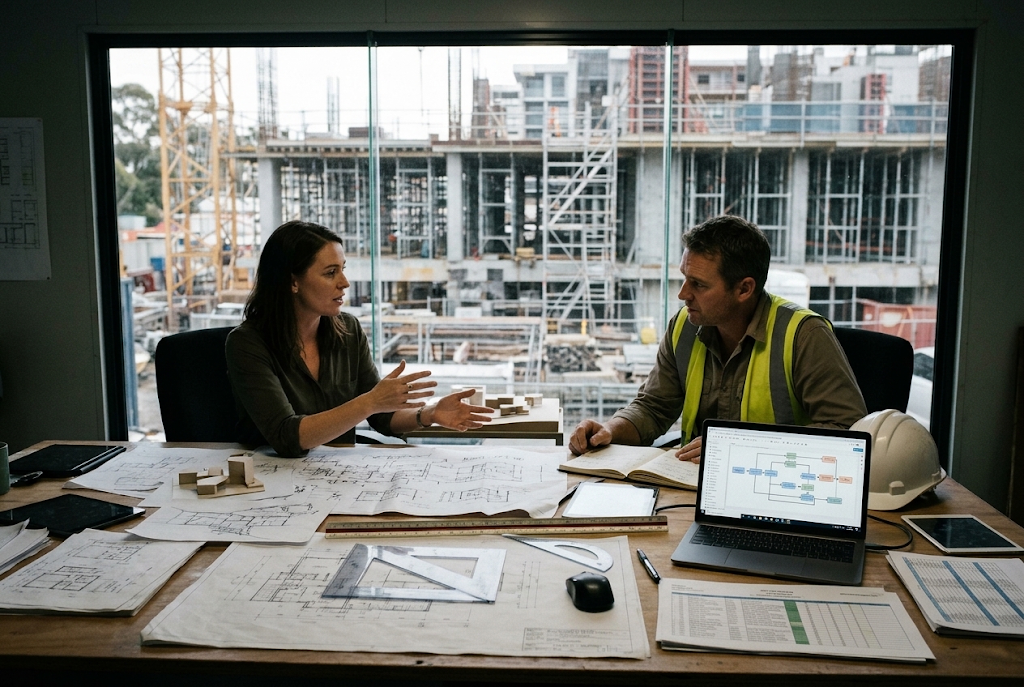
Industrial engineering applies methods like process optimization to reduce waste, cost, and time in construction. However, its core focus is optimizing within given constraints rather than questioning them. Architecture focuses on defining the underlying purpose, design requirements, and human value of a project before execution begins.
Problems arise when optimization logic determines project design, turning unmeasurable architectural qualities into perceived waste. To maintain project quality, architects must determine what to build and why, while industrial engineers optimize how to build it. When kept in proper sequence, projects achieve both meaningful design and efficient delivery.
There is a moment that recurs on large projects, and anyone who has sat at enough meetings will recognize it the instant it arrives. A new figure enters the room, not the architect, not the structural engineer, not the contractor, but someone whose vocabulary is different, who speaks of throughput and cycle time and waste, of input and output and the ratio between them, of the one better way to perform a repeated task. This is the industrial engineer, and the moment carries a particular charge because this person has come, in the most literal professional sense, to optimize. On the projects where that logic arrives, it changes everything downstream of it, usually for the better in ways that are easy to measure and occasionally for the worse in ways that are almost impossible to measure, and the difference between those two outcomes is the subject worth examining, because it is not really about industrial engineering at all. It is about what happens to the architectural question when a discipline built to optimize the given is allowed to decide what the given should be.
The discipline deserves fairness from the start, because the critique only means something if the respect is real. Industrial engineering is one of the great five branches of engineering, and its intellectual core is genuinely powerful. It is the field concerned, in its own classical self definition, with the design, improvement, and installation of integrated systems of people, materials, equipment, and energy, drawing on the mathematical, physical, and social sciences to specify, predict, and evaluate what those systems will produce. Its founding act was Frederick Taylor standing over a task with a stopwatch, insisting that every operation be timed and that a defined task, a definite time, and a definite method could replace the chaos of custom with the order of measurement. The Gilbreths reduced human motion to seventeen fundamental elements. The whole apparatus of method study grew from this, and its value to the making of buildings is not in doubt. When it enters a project it brings a rigor that construction has always needed and rarely supplied on its own, the systematic hunt for wasted effort, wasted time, wasted material, wasted money, the relentless question of whether this sequence of operations could be made faster, cheaper, safer, and more certain.
The Method That Works, and What It Quietly Assumes
To understand both the gift and the danger, you have to understand how the industrial engineer actually thinks, because the method is explicit and it is taught as a sequence. The core technique, method study, follows a procedure captured in an acronym, select the job, record the facts, examine them critically, develop a better method, define it, install it, and maintain it. It is disciplined, iterative, and genuinely creative at its best, and it is governed by a formula so simple it is almost innocent, productivity as the ratio of output to input. The entire art is the raising of that ratio, usually by stripping out the excess work content and the ineffective time that creep in through imperfect design and inefficient method, and often without any additional capital at all, simply by seeing the work clearly and reorganizing it. Applied to the repetitive operations of a building site, to the pouring and the cladding and the fit out, this is close to miraculous, and any honest architect should want it in the room.
But look carefully at where that method begins, because the first step is the tell. It begins with select the job. It does not begin with ask whether this job should exist. The industrial engineer, by training and by the deep logic of the discipline, optimizes within given constraints. The constraints are handed to him, the goal is handed to him, and his brilliance is deployed entirely on the question of how to reach that goal with the least waste. The philosophers of engineering have named this with precision, observing that the engineer pursues not the optimal solution but the satisfactory one, satisficing rather than optimizing in the pure sense, because real problems are ill structured and information is incomplete. And they have named something sharper still, that engineering has been described as a profession without a system of self reflection, trained to solve well constrained technical problems but rarely taught to step back and ask whether the constraints themselves are the right ones, so that the engineering way of thinking, optimize within the given, has been exported uncritically into economics and politics and social life. That last phrase is the one that should make every architect sit up, because a building is one of the places that export lands.
The Boundary Dispute Hiding Inside Every Project
Here is where the tension becomes structural rather than personal, and the literature on industrial engineering admits it with unusual candor. The discipline’s own classical definition, the design and improvement of integrated systems, was recognized decades ago as dangerously broad, because the moment you define a profession as the one concerned with integrated systems of people and materials and equipment, you have described something that the civil engineer working on a transport network can claim, that the hospital administrator can claim, and that, most pointedly for us, the architect and the urban planner can claim with equal right. The field has what one of its own major critics called a chronic identity problem, and the same critic noticed a revealing pattern, that when a great cross cutting innovation appears, the industrial engineer often acts as midwife to a new discipline and then fails to retain a central place in it. The boundary between industrial engineering and the design projects it enters is therefore genuinely contested, not because anyone is behaving badly, but because two professions are reaching for the same object, the whole integrated system, from opposite directions.
And the directions truly are opposite, which is the heart of the matter. The clearest idea in the philosophy of engineering is that design, not analysis, is what separates engineering from science, that where science seeks to explain how things are, engineering concerns itself with how things ought to be, with synthesis rather than analysis. But within that shared territory of design there is a further and crucial split, the one between the engineer who synthesizes a solution to a defined functional requirement and the architect whose design must first decide what the functional requirements even are, must transform a vague human wish into the precise specification that the engineer will then optimize. The research is explicit that this transformation, the extraction of well defined requirements from ill defined ones, is itself the crucial and socially negotiated part of design, and that it cannot be done mechanistically or algorithmically. This is the architect’s native ground, the ill structured front of the problem, the deciding of what ought to be built and why and for whom, before anyone can sensibly ask how to build it with the least waste.
What the Intervention Gives, and What It Can Take
So when industrial engineering intervenes in a project, two very different things can happen, and they are easy to confuse because they wear the same vocabulary. In the first, the industrial engineer takes the architectural decision as given, the what and the why already settled, and brings the full power of method study to bear on the how, and the result is a project delivered faster, cheaper, safer, with less waste and more certainty, the architecture fully intact and simply realized better. This is the discipline functioning as it should, as a magnificent servant of a decision made elsewhere. It rescues schedules and budgets that were drowning, and an architect who resents it is a romantic fool. The models of how projects actually run that the research describes, the shift from the old sequential process where each department threw its work over the wall, toward concurrent and dynamic models where design and production planning overlap inside integrated teams, are largely gifts of this engineering mindset, and they have made the building of complex things possible at all.
In the second, something subtler and more dangerous occurs. The optimizing logic, finding no one to stop it, drifts upstream from the how into the what. Because the measurable crowds out the unmeasurable, the question quietly changes from how do we build this well to what can we build most efficiently, and the two are not the same question at all. The ratio of output to input is a magnificent compass for execution and a catastrophic one for meaning, because the things that make a building worth building, the civic generosity of a space, the memory a facade carries in the longer life of architecture, the dignity of a threshold, the quality the research itself admits cannot be reduced to calculation, all register as input with no measurable output and are therefore, to a pure optimization, waste. A column that exists for proportion rather than load is waste. A ceiling higher than function requires is waste. A material chosen for how it ages rather than how it costs is waste. When the industrial engineer is confined to the how, none of this is threatened. When the optimizing logic is allowed to redefine the what, all of it is on the chopping block, defended by no number.
Optimizing the Given Is Not the Same as Questioning It
This is why the deepest warning in the engineering literature matters so much to the built environment, the observation that engineering lacks a tradition of self reflection and needs what one philosopher called a duty to look further, a duty plus respicere, beyond the given constraints to their wider consequences. An industrial engineer optimizing a factory line operates in a world where the goal is clean and agreed, more units, less waste, and the duty to look further is a refinement. An industrial engineer, or an owner wielding industrial engineering logic, optimizing a building operates in a world where the goal is contested and human, and the refusal to look past the given constraints becomes an active danger, because the constraints handed to the optimizer, the budget, the schedule, the leasable area, the unit count, are precisely the things that a good architect is supposed to push back against on behalf of the people who will live inside the result. To optimize the given brilliantly while never questioning whether the given is right is to build the wrong thing with superb efficiency, and the cities are full of exactly that, developments optimized to the last square meter of return and impoverished in every dimension that no spreadsheet tracked.
None of this is an argument against the discipline. It is an argument about sequence and authority, about who decides the what before the how is optimized. The scope of industrial engineering is expanding at tremendous speed, out of the factory and into healthcare and services and now into the digital frontier of the Internet of Production, the cyber physical systems and the data driven models and the digital shadows that promise to integrate development and production and use in real time. That expansion will reach architecture fully, and it should, because the building site is one of the last great unoptimized industrial processes on earth and it bleeds waste at every joint. The serious architectural research of the coming decade will have to absorb this logic rather than resist it, to learn the method study and the productivity ratio and the lean discipline, because a profession that refuses to measure what can be measured surrenders the project to those who will. The danger is not that industrial engineering enters architecture. The danger is that it enters without architecture retaining the authority over the question it alone can answer.
The Settlement
So here is the position the evidence actually supports, and it is neither the architect’s reflexive fear of the stopwatch nor the optimizer’s quiet imperialism over the whole project. The two disciplines answer different questions and must be kept in their proper order. Industrial engineering answers the how with a rigor architecture has never matched and badly needs, and within that domain its authority should be close to total, because the hunt for waste in the execution of a building is pure gain, taking nothing from the architecture and giving the project speed and certainty and safety. Architecture answers the what and the why, the ill structured human front of the problem that no algorithm can resolve, the transformation of a wish into a brief, and within that domain its authority must be protected absolutely, because it is the only place in the entire apparatus where the question of whether the given is even worth building gets asked at all. The failure mode, the one that hollows out real projects, is always the same, the migration of the optimizing logic upstream past the boundary it should respect, the moment the ratio of output to input is allowed to answer a question it was never built to answer.
The news will keep celebrating the project delivered under budget and ahead of schedule as though efficiency were the achievement, and the industry competitions will keep split between those that reward the beautiful and those that reward the lean as if they were opposed, and the quiet truth that an experienced project actually teaches is that they are not opposed at all when the sequence is right. Decide the what with the full weight of architectural judgment, defend it against the constraints rather than merely accepting them, and then unleash the industrial engineer on the how without reservation, and you get the rare thing, a building that is both meaningful and efficiently made. Reverse the order, let the optimizer define the what because his numbers are the only ones anyone can argue with, and you get the common thing, a building optimized into mediocrity, its every waste eliminated including the ones that were not waste at all but were the whole reason to build. The durable sustainability of the profession depends on holding that line, because industrial engineering is, in the end, a magnificent servant and a catastrophic master, and the architect’s hardest and least glamorous job is to make sure it is never handed the question that was his to answer. Optimizing the given is a gift. Deciding the given is a responsibility, and it is the one thing the discipline of the stopwatch was never designed to do.
✦ ArchUp Editorial Insight
The essay’s governing distinction is precise and structurally consequential: industrial engineering optimizes within given constraints while architecture decides what the constraints should be, and the danger is never the discipline itself but the migration of its optimizing logic upstream, past the boundary where the how ends and the what begins. Its sharpest analytical move is to locate the tell inside the method’s own first step — select the job, not ask whether this job should exist — which exposes that the entire apparatus of method study is built to raise the ratio of output to input without ever interrogating whether the output is worth producing, a compass the essay correctly calls magnificent for execution and catastrophic for meaning. The real mechanism it names is that the measurable crowds out the unmeasurable, so that under a pure optimization the column that exists for proportion rather than load, the ceiling higher than function requires, the material chosen for how it ages rather than how it costs, all register as input with no measurable output and are therefore reclassified as waste — the same liability this archive traced in Saving on the Back of a Donkey and Marble Is Manufactured by Geology, where the decision optimized for the figure that fits the spreadsheet silently discards the value that no spreadsheet tracks. What distinguishes this piece from a reflexive defense of architectural judgment is its honesty about sequence and authority rather than territory: it concedes that the building site is one of the last great unoptimized industrial processes and bleeds waste at every joint, and that a profession refusing to measure what can be measured surrenders the project to those who will — the same argument this archive made in Who Really Builds Our Cities about the institution that concedes decisive authority by default. The structural verdict is therefore exact: the failure mode is always the optimizer being handed the question that was the architect’s to answer, because the constraints passed to the optimizer — the budget, the schedule, the leasable area, the unit count — are precisely the things a good architect is supposed to push back against on behalf of the people who will inhabit the result, and to optimize the given brilliantly while never questioning whether the given is right is to build the wrong thing with superb efficiency, which the cities already demonstrate at scale.
Sources
- Kiran DR. Work Organization and Methods Engineering for Productivity. Elsevier, 2020.
- Brecher C, Schuh G, van der Aalst W, Jarke M, Piller FT, Padberg M, editors. Internet of Production. Springer, 2024.
- Elsayed EA. Industrial Engineering Education: A Prospective. European Journal of Engineering Education, 1999.
- Pleasants J, Olson JK. What is engineering? Elaborating the nature of engineering for K to 12 education. Science Education, 2018.
- Keith A. Twenty Stages toward a Philosophy of Engineering. Techné: Research in Philosophy and Technology, 2021.
- Buzacott JA. The Future of Industrial Engineering As An Academic Discipline. IIE Transactions, 1984.
- Patange G, Jobaliya J. Scope for problem solving in industrial engineering and management subject curriculum reform. Materials Today: Proceedings, 2023.
- Eskandari H, Sala Diakanda S, Furterer S, Rabelo L, Crumpton Young L, Williams K. Enhancing the undergraduate industrial engineering curriculum. Education and Training, 2007.
- Braha D, Maimon O. The design process: properties, paradigms, and structure. IEEE Transactions on Systems, Man, and Cybernetics, 1997.
- Yazdani B. Four Models of Design Definition: Sequential, Design Centered, Concurrent and Dynamic. Journal of Engineering Design, 1999.