The Landing at Evermore: Water-Driven Spatial Reconfiguration

Spatial Dynamics and Scene Reorientation
The spatial structure of the project shifts from the traditional enclosed model oriented toward golf courses to an open spatial framework in Architecture that adopts the freshwater lake as a new visual and orienting focal point. The massing abandons structural excess in favor of horizontal circulation axes that establish a reciprocal relationship between the aquatic environment and its surrounding shores. The compositional orientation is based on maximizing visual openness, where the built environment on the northern, eastern, and western edges forms an urban frame embracing the water void within Cities. This creates a balance between residential volumes and shared communal areas, transforming the void from a mere passage space into a stable environment that directs users’ daily movement.
Scenographic Experience and Spatial Connectivity in “The Landing” Mass
The experience of transition and arrival is shaped through the “The Landing” building, conceived as a kinetic gateway and spatial filter linking two contrasting environments: the expansive golf courses and the open beach. The user undergoes a scenographic experience that begins at the reception moment, where internal pathways flow fluidly to guide movement toward diverse social and recreational activities. The Design language plays a fundamental role in shaping psychological and physical perception through the orchestration of light openings and layered shadows that interact with the architectural masses. This allows visitors to perceive a vivid sensory awareness of the place while moving through the market, restaurants, and fitness areas, while maintaining airflow and visual comfort that enhance human connectivity within the shared space through Interior Design supported by deeper Research.
Material Expression and Deconstruction of Contemporary Masses
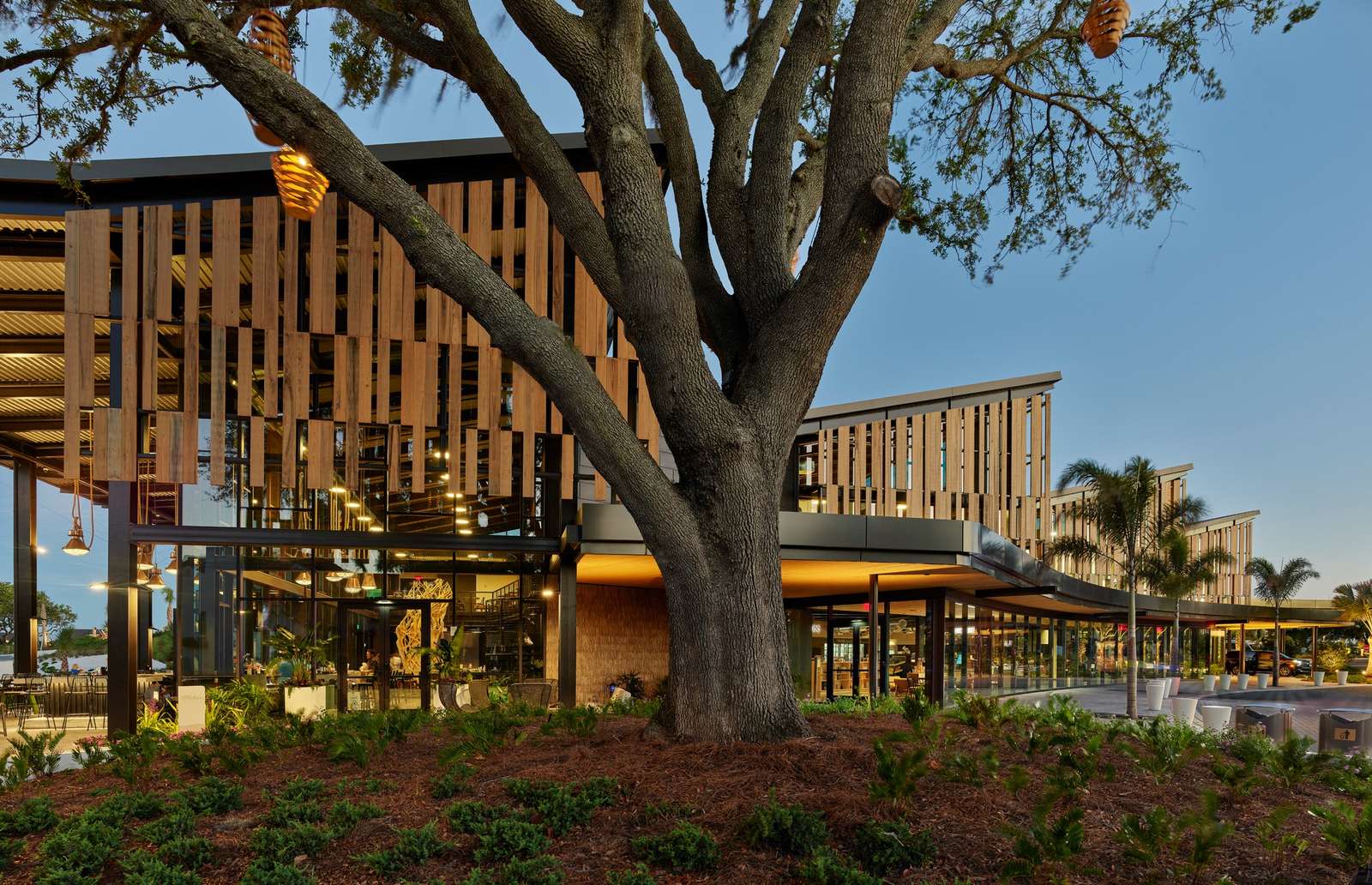
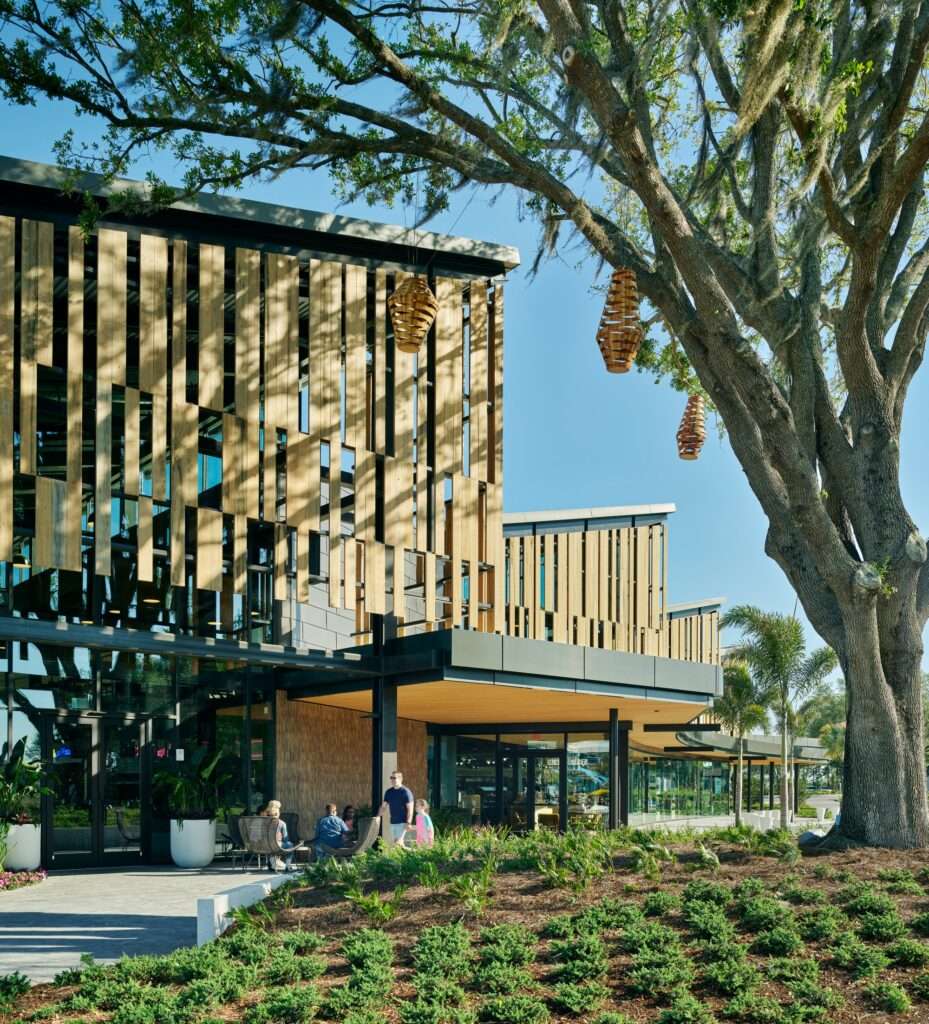
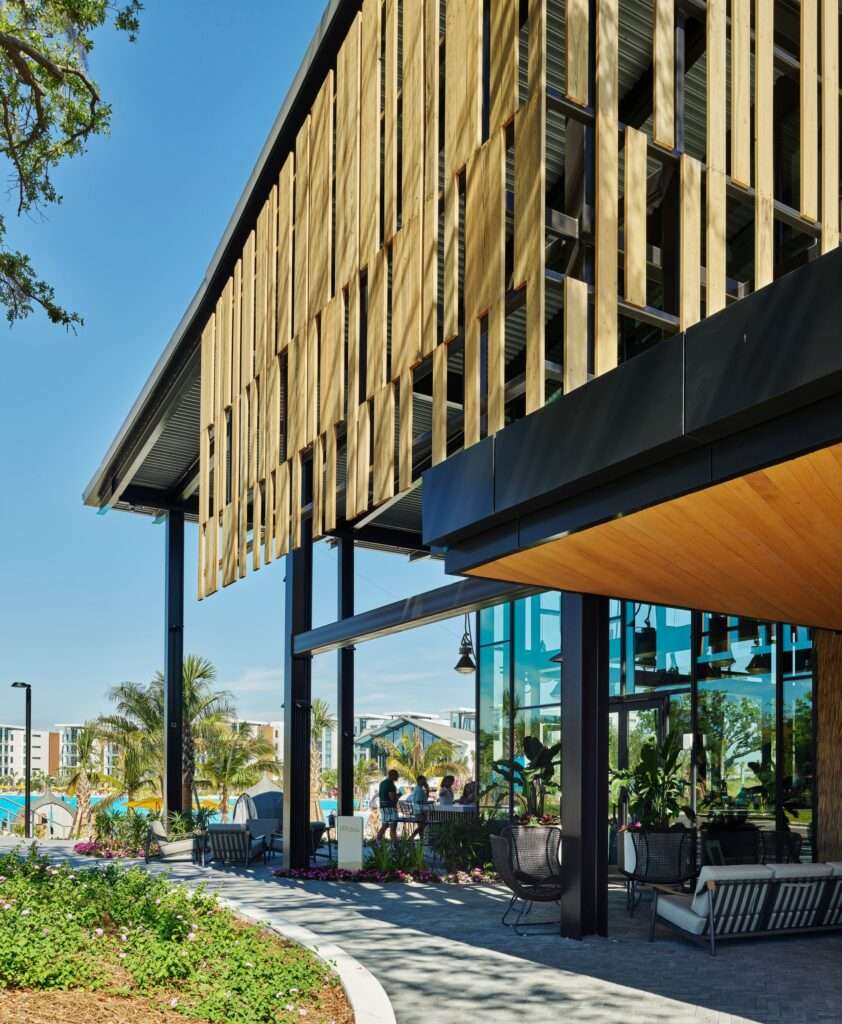
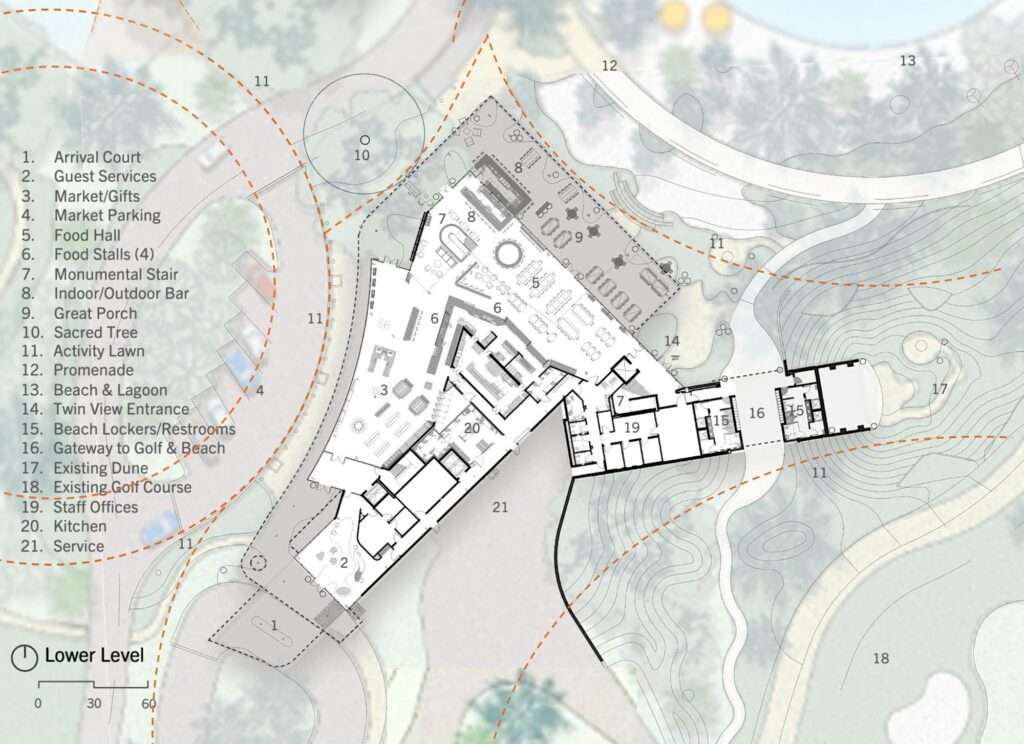
The design challenge lies in formulating a modern tropical architectural language that transcends superficial “representational” imitation, instead relying on an honest expression of materials and authentic construction techniques inspired by coastal architecture and maritime piers in Building Materials. The “The Landing” building is conceived as a flexible structure that intelligently responds to site constraints and the existing natural landscape. The initial concept evolves from a simple beach pavilion into a complex operational and culinary hub that organizes logistical services without compromising spatial visual quality through advanced Construction. Mass deconstruction here is based on a strategy of containment and camouflage, where public functions, such as guest services, the market, and dining hall, wrap around a two-level back-of-house operational grid, fully concealing it within integrated Projects.
Vital Experience and Scenographic Lighting Rhythm
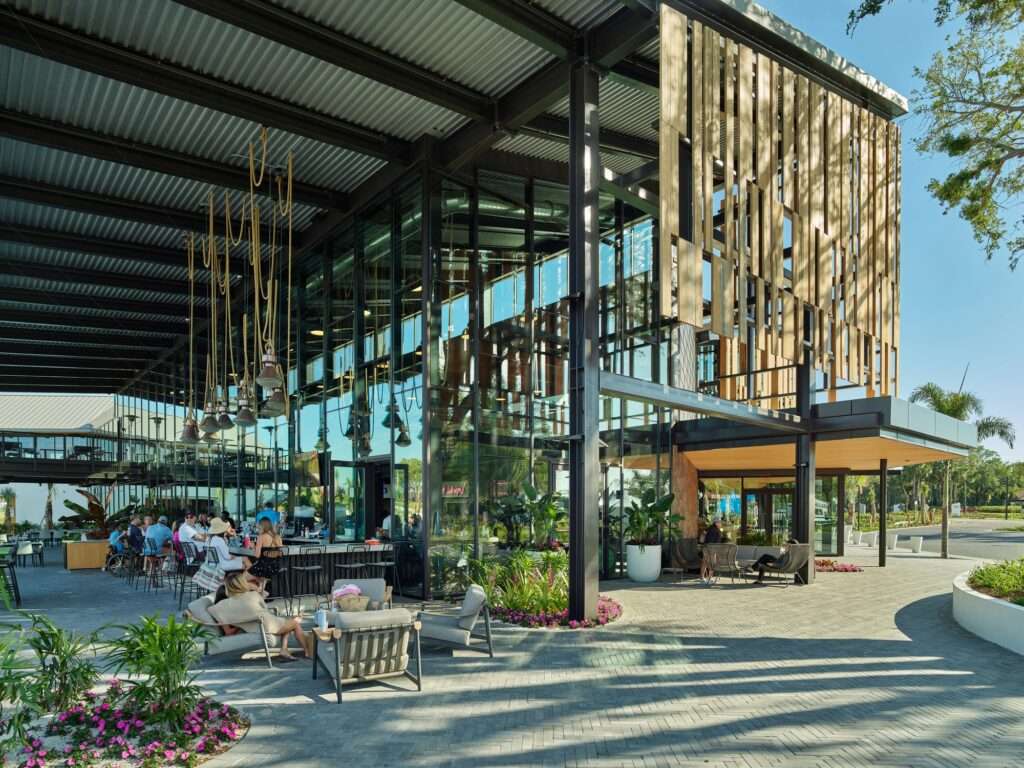
The building’s exterior envelope orchestrates a human experience based on dissolving boundaries between interior and exterior spaces. This dynamic interaction is expressed through the rhythm of wooden screens and repetitive clerestory openings along the curved glazed façade, functioning as a visual and climatic filter that softens the intense western light entering the dining hall and the upper-level fitness center. This creates a dynamic interplay of shadows and solid masses throughout the day, reinforcing the material logic of Buildings while referencing evolving spatial ideas preserved in Archive.
Spatial Sequence and Light-Oriented Human Connectivity
Natural light acts as the central axis governing the spatial circulation sequence, where guest services, the market, the dining hall, and the beach are connected in a continuous uninterrupted flow. The design is based on the principle of “reciprocal visibility” through open staircases and upper-level lofts that render visitor movement visible and facilitate spontaneous social encounters. To achieve scenographic balance, intimate gathering spaces alternate with larger communal dining zones activated by four food stations. Meanwhile, subtle elements such as marine-inspired lighting, signage, and driftwood sculptures deepen the sense of place (Genius Loci), reinforcing spatial thinking in Architecture.
Sculptural Junctions and Visual Perception Guidance
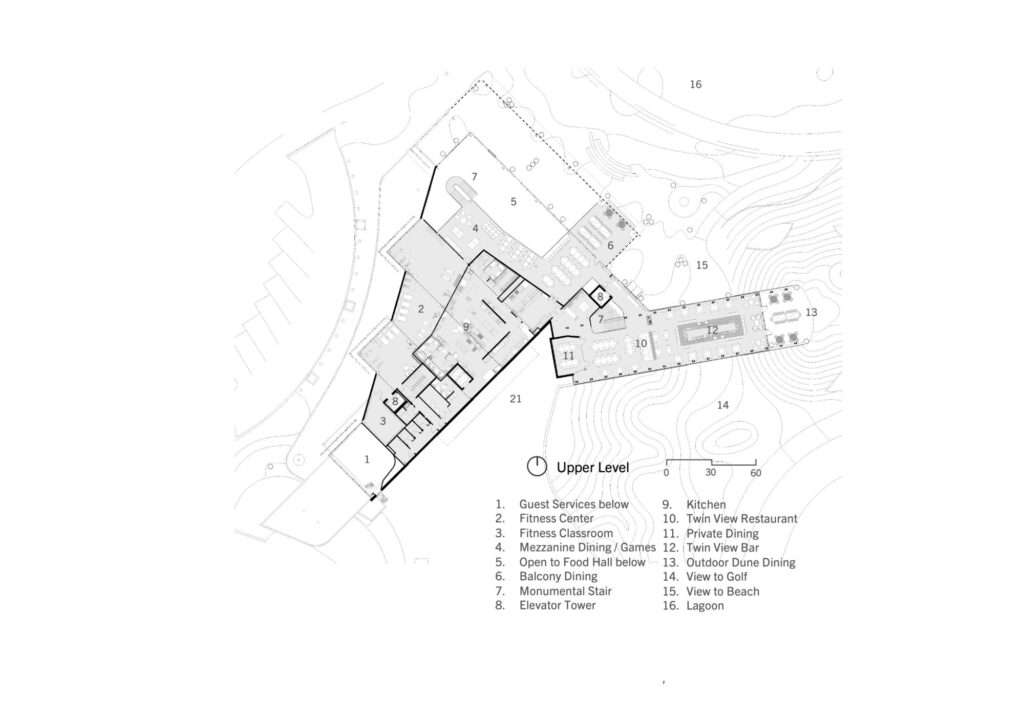
The zinc-clad elevator tower operates as both a sculptural element and a structural junction linking two distinct masses, transforming into a landmark that asserts its presence across the lake and guides spatial perception and movement. Adjacent to it, the Twin View restaurant and bar rises to offer a dual panoramic experience combining the restored sand dune and the golf courses within a broader field of Cities influenced planning logic. Below it, a subterranean passage houses lockers and day-use bathrooms, acting as a physical gateway connecting beach and golf users. The wedge-shaped void between the two primary structures accommodates a grand staircase that frames glimpses of the project’s dynamic structure, generating visual momentum and an ascending spatial experience that encourages exploration of upper levels.
Architectural Bridge and Liberation of Panoramic Views
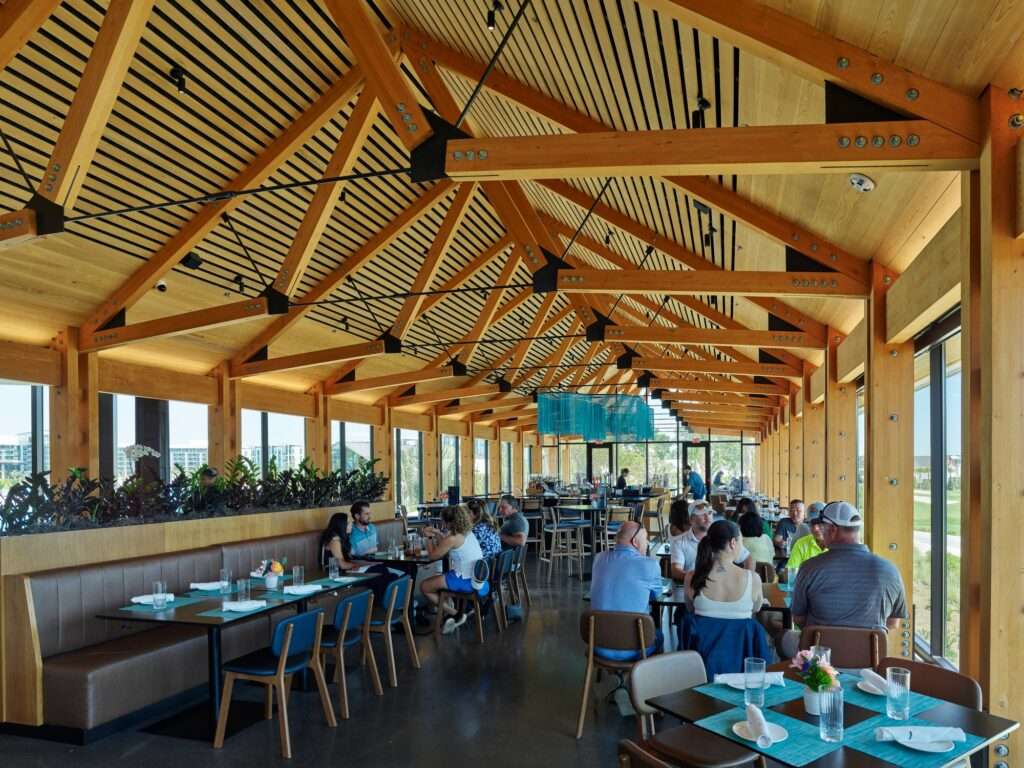
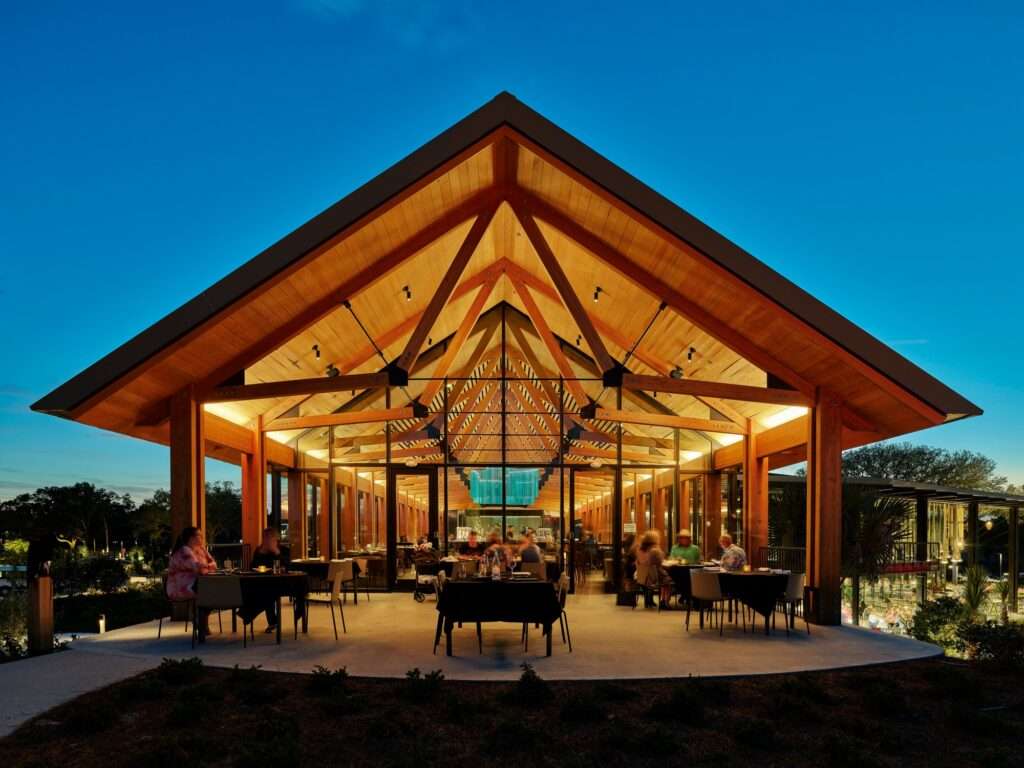
The “Twin View” mass transforms from a conventional golf-course bar into a pivotal architectural element and destination restaurant, forming a material and conceptual bridge between the tranquility of the golf courses and the vibrancy of the open beach. The mass deconstruction strategy separates the kitchen and relocates it within the main building, freeing the entire dining volume within this glazed bridge to achieve near 360-degree panoramic views. The structural aesthetics of this space are reinforced through a repeated series of inverted timber trusses with a balanced dual configuration, establishing the bridge as a dominant visual and structural element that governs the contemporary design language.
Light Scenography and the Relationship Between Mass and Topography
The visual composition merges with the movement of light and natural elements, allowing users to experience a spatial transition between two distinct environments. Above the bar area, a custom dynamic lighting element is installed to mimic the organic contours of the lake, precisely positioned at a key intersection point, appearing as a luminous mass floating above the convergence of golf and beach worlds, drawing visual attention from across the resort. Simultaneously, the dining space extends over a rehabilitated sand dune that has been strategically reshaped topographically to visually shield nearby beach activity while revealing calm, directed views toward the 18th hole. This achieves a final balance between operational efficiency and experiential depth in an authentic architecture that forms the living core of the Evermore resort.
✦ ArchUp Editorial Insight
The text articulates a structural shift from exclusive sports isolation toward family-oriented, program-driven hospitality through the use of contemporary tropical architectural vocabulary. Through structural clarity and material honesty, the project activates a linear architectural sequence guided by natural light, intelligently concealing complex back-of-house operations to dissolve physical boundaries and engineer genuine shared human encounters along the waterfront.
Conversely, this precisely orchestrated experimental design contains a romantic blind spot in its assumption that material authenticity alone can transcend the representational artificiality of neighboring resorts. The transformation of primitive regional pavilion typologies into large-scale infrastructure serving thousands of daily users strips these models of their local lightness. Ultimately, this dense spatial machine becomes a financed and privatized simulation of community.